
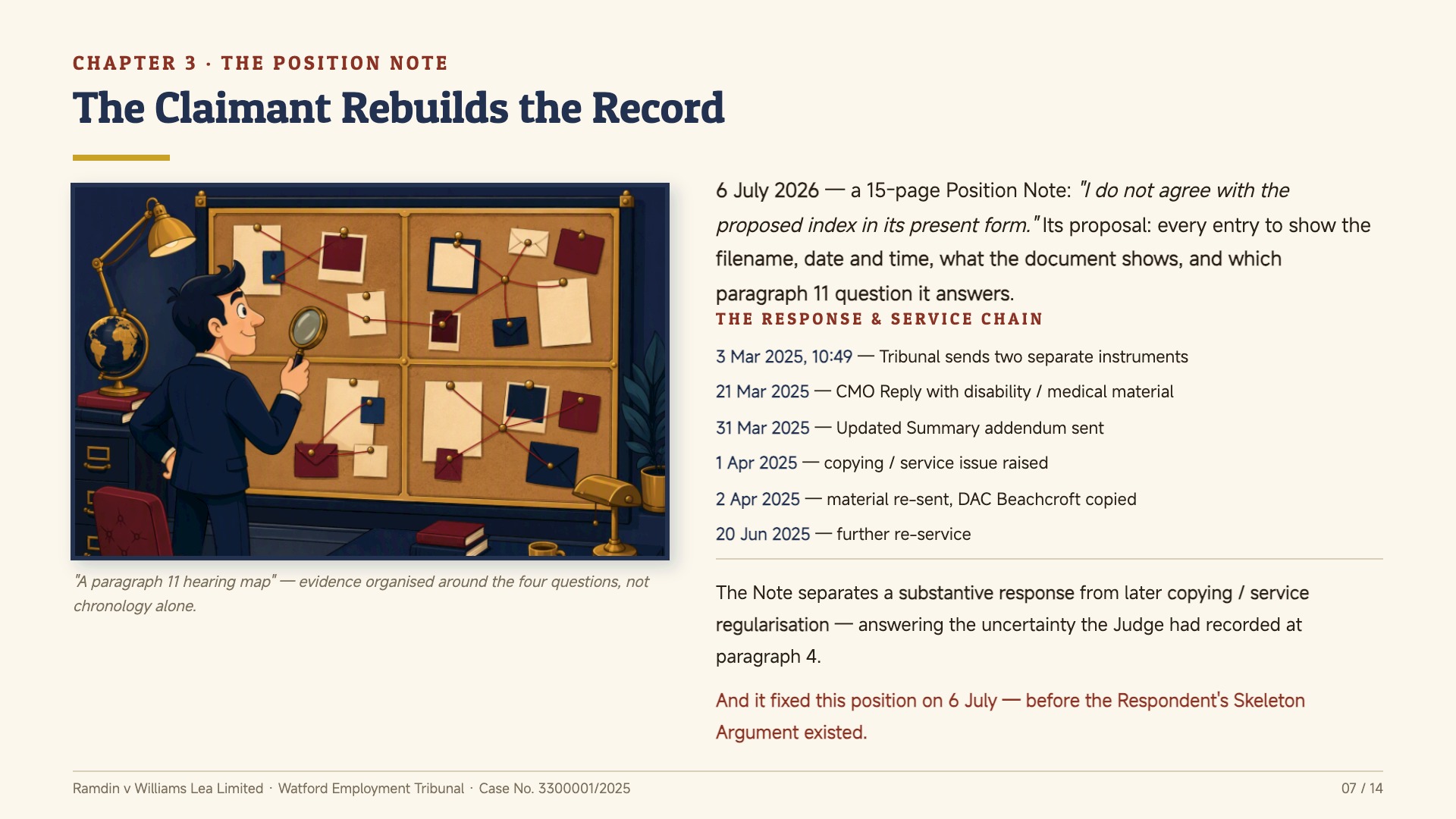
The Claimant’s Position Note of 6 July 2026 reconstructs the documentary record around paragraph 11(a)–(d), distinguishing the substantive response from later copying and service regularisation before the Respondent’s Skeleton Argument was produced.
Employment Tribunal (Watford) — Reconstruction of the Procedural Record, Paragraph 11 Clarification, Respondent’s Strike-Out Application, and Postponement of the Public Preliminary Hearing
Introduction
This Public Interest Disclosure records the procedural sequence immediately preceding the public preliminary hearing in:
Ramdin v Williams Lea Limited
Employment Tribunal Case No. 3300001/2025
Watford Employment Tribunal
The hearing had been listed as a one-day public preliminary hearing by video (CVP) for 8 July 2026 at 10:00. Its scope originated in an Order approved by Employment Judge Anstis on 29 August 2025 and sent to the parties on 12 September 2025. Paragraphs 1–10 of that Order recorded the Tribunal’s procedural account. Paragraph 11 then identified four matters for determination at the public preliminary hearing.
The significance of that Order is not confined to the fact that it listed a hearing. Employment Judge Anstis expressly recorded uncertainty concerning the completeness of the Tribunal’s own documentary record. He stated that correspondence may have been missed, that he could not be confident that he had seen all correspondence sent by the Claimant, and that some correspondence appeared not to be on the Tribunal file or available from the Tribunal’s email records. The Order then used expressly qualified language when reconstructing the Claimant’s April 2025 response and service pathway.
That acknowledged uncertainty became directly relevant to the matters listed at paragraph 11, because the hearing was required to determine:
whether the Claimant had complied with the Notice and Order dated 21 February 2025;
if so, whether the identified Rule 28 elements should proceed under Rule 28(3);
whether, on the basis of any reply or lack of reply to the overtime order, the overtime claim should be struck out; and
any consequential further case management.
The Tribunal subsequently issued a Notice of Preliminary Hearing by Video dated 17 November 2025. Although the heading contains an apparent reference to “8 July 2025”, paragraph 1 expressly states that the public preliminary hearing would take place on 8 July 2026 at 10:00, by video, for approximately one day.
The immediate documentary sequence before that hearing then compressed into a period of only a few days.
| Date / Time | Documentary Event |
| 3 July 2026, 09:28 | Ashleigh Green of DAC Beachcroft LLP served the Respondent’s proposed 320-page Preliminary Hearing Bundle and stated that it had been limited to the paragraph 11 issues. |
| 6 July 2026 | The Claimant served his Position Note reconstructing that record around paragraph 11(a)–(d). |
| 7 July 2026 | Robert Dunn of Parklane Plowden Chambers produced the Respondent’s Skeleton Argument seeking dismissal and/or strike-out. |
| 7 July 2026 | The Claimant served a written Response to the Respondent’s overtime strike-out and Clause 12 case. |
| 7 July 2026 | Regional Employment Judge Foxwell postponed the hearing listed for the following morning. |
| 8 July 2026, 10:00 | The public preliminary hearing did not proceed on the original date. |
| July 2026 | The parties entered the Tribunal-directed re-listing process. |
The disclosure therefore examines a single continuous documentary sequence:
Tribunal record uncertainty
→ paragraph 11 public-hearing framework
→ Respondent’s proposed hearing bundle
→ Claimant’s reconstruction of that record
→ Respondent’s strike-out Skeleton Argument
→ Claimant’s contemporaneous Response
→ Tribunal postponement
→ re-listing
The purpose is not to substitute publication for judicial determination.
It is to preserve the documentary record necessary to understand what the Tribunal had directed should be determined, what material existed before the hearing, how the Respondent and Claimant respectively characterised that material, what strike-out application was advanced, how it was answered, and what remained unresolved when the hearing was postponed.
This disclosure continues an existing Williams Lea disclosure sequence. It should therefore be read alongside, rather than as a wholesale repetition of:
Employment Tribunal Rule 28(1) Initial Consideration
https://truthfarian.co.uk/public-disclosures-PIDA-whistleblowing/employment-tribunal-rule-281-initial-consideration
Employment Tribunal Five-Month Delay – Medical Accommodation
https://truthfarian.co.uk/public-disclosures-PIDA-whistleblowing/employment-tribunal-five-month-delay-medical-accommodation
Williams Lea – Unpaid Overtime, Time Equivalent Served (TES) and Health & Safety Threshold Breach
https://truthfarian.co.uk/public-disclosures-PIDA-whistleblowing/williams-lea-unpaid-overtime-time-equivalent-served-tes-and-health-safety-threshold-breach
Williams Lea – Video Hearing Direction, Overtime Evidence and Scope
https://truthfarian.co.uk/public-disclosures-PIDA-whistleblowing/williams-lea-video-hearing-direction-overtime-evidence-scope
Tribunal Knowledge, Medical Vulnerability and Subsequent Procedural Detriment
https://truthfarian.co.uk/public-disclosures-PIDA-whistleblowing/tribunal-knowledge-medical-vulnerability-and-subsequent
The earlier disclosures already contain the underlying Rule 28 history, medical-accommodation record, overtime/TES evidence, JIRA working-time evidence, TOIL evidence, medical-vulnerability chronology and associated legal frameworks.
Those matters are therefore cross-referenced here where necessary rather than re-proved chapter after chapter.
The present disclosure is narrower.
Its evidential focus is the integrity and interpretation of the procedural record immediately before the scheduled public hearing.
The methodology remains documentary and chronological:
- exact dates;
- exact times where recorded;
- named individuals;
- named organisations;
- original filenames;
- original document titles;
- service and receipt pathways;
- Tribunal orders;
- party submissions;
- and direct comparison between propositions made within the documentary record.
Where a document states a party’s allegation, that allegation remains attributed to that party.
Where the Tribunal gives an express reason, that reason is preserved rather than replaced with speculation.
Where two documents conflict or sit in tension, the disclosure places them side by side rather than inventing a motive to explain the difference.
Where a matter remained unresolved because the public hearing was postponed, it is described as unresolved.
For this disclosure, the evidential architecture is fixed to the existing EX01–EX08 master exhibit set. No additional exhibit-number sequence is created within the chapters.
Chapter 1 — Tribunal Hearing Order and Procedural Framework
1.1 The Controlling Order
The controlling procedural instrument is the Order approved by Employment Judge Anstis on 29 August 2025 and sent to the parties on 12 September 2025.
The Order begins:
“The claim will be listed for a one-day public preliminary hearing by video (CVP) to address the matters referred to in para 11 below.”
The structure is important.
Paragraphs 1–10 record the Tribunal’s account of the procedural history.
Paragraph 11 defines the matters that the Tribunal intended to determine at the public preliminary hearing.
Those functions should not be conflated.
The first ten paragraphs explain how the Tribunal understood the case had reached that point. Paragraph 11 is the operative hearing framework.
1.2 Paragraph 1 — Separate Procedural Pathways
Paragraph 1 records that on 21 February 2025 Employment Judge Anstis prepared:
- a Notice and Order under Rule 28(1); and
- an order concerning the Claimant’s overtime claim.
The Judge understood those documents to have been sent on 3 March 2025.
Paragraph 1 separately records that another order had been made concerning the Claimant’s alleged disability or disabilities, but expressly states that the Judge did not need to address that order, or the Claimant’s response to it, in the 29 August 2025 Order.
This establishes an important documentary distinction.
The 3 March 2025 procedural package contained separate pathways:
| Instrument | Function |
| Rule 28 Notice and Order | Initial consideration of identified claim elements. |
| Overtime order | Required an explanation concerning the contractual wording and asserted entitlement to overtime payment. |
| Separate disability CMO | Required disability/medical information through a separate case-management route. |
The underlying Notice and Order itself confirms that distinction. Part 1 identifies unfair dismissal, reasonable adjustments and GDPR/HR/workload matters. Part 2 separately directs the Claimant to address the contractual overtime wording. It then states that further orders were being made separately concerning disability.
1.3 Paragraphs 2–4 — Correspondence Volume and Tribunal Record Uncertainty
Paragraph 2 states:
“Much correspondence – too much correspondence – has ensued from the claimant.”
That observation is immediately followed by paragraph 3, which is materially different in character.
Employment Judge Anstis states:
“There is a danger with so much correspondence some points will have been missed.”
He then records:
“I cannot be confident that I have seen all the correspondence sent by the claimant”
and further states that some correspondence appeared not to be:
“on the file nor available from the tribunal’s email records.”
This is an express judicial acknowledgement of uncertainty within the Tribunal’s own documentary record.
Paragraph 4 then attempts to reconstruct the response chronology using qualified language.
The Judge states:
“As far as I can tell”
the Claimant replied to the Notice and Order and overtime order on 1 April 2025, but records that the response was not on the Tribunal file.
The paragraph then states that:
- it appeared the Claimant had not copied the Respondent;
- the Tribunal may have sent the response to the Respondent on 1 April 2025; and
- possibly the Claimant himself sent it on 2 April 2025.
The paragraph then refers to a Respondent letter dated 7 April 2025 criticising the response and alleging non-compliance.
The language matters.
Paragraph 4 does not record an unqualified finding that no substantive response existed.
It records a reconstruction of an incomplete record.
That distinction later becomes central when the Claimant produces the July 2026 Position Note reconstructing the underlying email chain.
1.4 Paragraphs 5–9 — Subsequent Procedural History
Paragraph 5 records that on 23 April 2025 the Claimant sent a document described as a “without prejudice settlement offer”.
Paragraph 6 records the Claimant’s 18 June 2025 request “to formally request procedural direction” and the Judge’s refusal of items 2–5 of that request insofar as they fell within the Tribunal’s jurisdiction.
Paragraph 7 records that on 7 August 2025 the Claimant was notified that the Tribunal could not consider without-prejudice correspondence from him.
Paragraph 8 records further material sent on 18 August 2025, including material headed “without prejudice” and “updated consolidated particulars of claim”.
Paragraph 9 addresses amendment procedure. Employment Judge Anstis states that, insofar as amendment was sought, the Claimant had to apply in accordance with Guidance Note 1 to the Presidential Guidance on General Case Management, and that filing updated particulars alone had no procedural significance unless made as an application to amend.
These paragraphs form part of the history from which the hearing emerged. They do not themselves replace the four matters subsequently identified at paragraph 11.
1.5 Paragraph 10 — Prospective Rule 38 / Rule 74 Warning
Paragraph 10 records Employment Judge Anstis’ concern regarding extensive correspondence, repeated without-prejudice material and concepts regarded as outside Employment Tribunal litigation or jurisdiction.
The Order states that repetition:
“may amount to unreasonable conduct of his claim, potentially giving rise to the consequences outlined in rule 38 and/or 74.”
The language is prospective.
It records a warning about possible future consequences.
It does not itself:
- strike out the proceedings;
- impose costs;
- determine that Rule 38 had been satisfied;
- or determine that Rule 74 consequences were payable.
That distinction matters because the Respondent subsequently relied upon the warning when advancing its broader strike-out case on 7 July 2026.
1.6 Paragraph 11 — Operative Public-Hearing Map
Paragraph 11 states that the case would be listed for a one-day public preliminary hearing by CVP and that both parties should attend.
The hearing was required to consider:
Paragraph 11(a)
Whether the Claimant complied with the Notice and Order of 21 February 2025.
Paragraph 11(b)
If he complied, whether the elements described in that Order should proceed under Rule 28(3).
Paragraph 11(c)
Whether, on the basis of any reply or lack of reply to the overtime order, the overtime claim should be struck out.
Paragraph 11(d)
Any further case-management matters arising from those determinations.
The operative distinction is therefore:
| Order Section | Function |
| Paragraphs 1–10 | Procedural history, judicial observations, record uncertainty and warning. |
| 11(a) | Compliance. |
| 11(b) | Rule 28 progression. |
| 11(c) | Overtime strike-out. |
| 11(d) | Consequential case management. |
This four-part structure becomes the reference point for the remainder of the disclosure.
1.7 Listing of the Public Preliminary Hearing
On 17 November 2025, the Tribunal issued its Notice of Preliminary Hearing by Video.
Paragraph 1 states:
“There will be a preliminary hearing in public by video on 8 July 2026. The hearing will start at 10:00.”
The Notice states that the hearing would last approximately one day and required the parties to have the claim form, response and relevant documents available.
Accordingly:
29 August 2025 Order
→ defined what would be determined.
17 November 2025 Notice
→ defined when and how that determination was scheduled to occur.
1.8 Discussion
The central procedural fact established by Chapter 1 is that the Tribunal itself recognised uncertainty in the documentary record before directing a public hearing to determine compliance and strike-out questions.
The sequence is:
record uncertainty acknowledged
→ response chronology reconstructed conditionally
→ compliance remains unresolved
→ overtime response remains unresolved
→ four questions listed for public determination
The later July 2026 documentary reconstruction was therefore not addressing an issue invented by the Claimant after the event.
It addressed uncertainty already expressly recorded in the Tribunal’s own controlling Order.
1.9 Legal Frameworks Engaged
I. Employment Tribunals Act 1996
II. Employment Tribunal Procedure Rules 2024 — Overriding Objective
III. Employment Tribunal Procedure Rules 2024 — Rule 28
IV. Employment Tribunal Procedure Rules 2024 — Case Management Powers
V. Employment Tribunal Procedure Rules 2024 — Rule 38
VI. Employment Tribunal Procedure Rules 2024 — Rule 74
VII. Employment Tribunal Procedure Rules 2024 — Preliminary Hearings
VIII. Employment Tribunal Procedure Rules 2024 — Public Preliminary Hearings
IX. Employment Tribunal Procedure Rules 2024 — Electronic / Video Hearings
X. Employment Tribunal correspondence-copying requirements
XI. Presidential Guidance on General Case Management — Guidance Note 1
XII. Employment Rights Act 1996 — unfair-dismissal jurisdictional framework
XIII. Equality Act 2010 — reasonable-adjustment framework
XIV. Human Rights Act 1998 — Article 6 ECHR
XV. Common Law Natural Justice
XVI. Common Law Procedural Fairness
XVII. Open Justice Principle
1.10 Exhibits Engaged
EX01 — Employment Judge Anstis Order, 29 August 2025
EX02 — Notice of Preliminary Hearing by Video, 17 November 2025
1.11 Chapter Position
| Issue | Position |
| Tribunal documentary record | Expressly acknowledged by the Judge as potentially incomplete. |
| April 2025 response pathway | Reconstructed in qualified, not definitive, language. |
| Disability pathway | Expressly separate from the Rule 28/overtime pathway. |
| Rule 28 compliance | Remained for public determination. |
| Rule 28 progression | Remained for public determination. |
| Overtime strike-out | Remained for public determination. |
| Hearing | Listed publicly by CVP for 8 July 2026 at 10:00. |
Chapter 2 — Respondent’s Proposed Preliminary Hearing Bundle
2.1 Introduction
The immediate pre-hearing documentary sequence began on 3 July 2026 at 09:28, when Ashleigh Green, Associate — Employment and Pensions Group at DAC Beachcroft LLP, acting for Williams Lea Limited, served the Respondent’s proposed:
Ramdin - PH Bundle.pdf
The covering communication stated that the public preliminary hearing had been listed to deal with paragraph 11 of the Tribunal’s Order and described the proposed bundle as limited to those issues and “not an evidence bundle.”
The communication gave the Claimant until 12 noon Monday 6 July 2026 to identify any additional documents before proposed filing with the Tribunal. This disclosure records those terms and timing.
The importance of Chapter 2 is narrow.
It concerns the documentary record selected by the Respondent for the hearing, not yet the Claimant’s subsequent objection to its organisation.
2.2 Composition of the Respondent’s Bundle
The proposed bundle comprised 320 pages.
Its index included:
| Item | Document |
| 1.1 | ET1 |
| 1.2 | ET3 |
| 1.3 | Grounds of Resistance |
| 1.4 | Notice and Order |
| 1.5 | Case Management Orders |
| 1.6 | Updated Summary of Legal Breaches |
| 1.7 / 1.7.1 | April response correspondence / Respondent response |
| 1.8 | June 2025 procedural correspondence |
| 1.9–1.9.5 | August 2025 correspondence and associated documentation |
| 1.10 | 29 August 2025 Preliminary Hearing Order |
| 1.11 | Updated Appendices D and E |
| 1.12 / 1.12.1 | Medical-accommodation material |
| 1.13 | Notice of Preliminary Hearing by Video |
| 1.14 | Claimant procedural clarification |
| 1.15 | DAC Beachcroft response |
| 2.1 | Contract of Employment |
The underlying bundle confirms that the Notice and Order appears at pages 33–34, the separate disability CMO at pages 35–37, and the Updated Summary at pages 38–43.
2.3 Provenance of the Documentary Record
Although the bundle was selected, assembled, indexed and served by DAC Beachcroft on behalf of Williams Lea Limited, much of the substantive documentary material had originated from the Claimant.
That included:
- the ET1;
- the Updated Summary;
- Claimant correspondence;
- the August 2025 consolidated material;
- Appendices D and E;
- medical-accommodation correspondence;
- and subsequent Claimant procedural communications.
The remainder included Tribunal-generated orders and notices, the Respondent’s pleadings and correspondence, and the Contract of Employment.
The distinction is important.
The proposed bundle was the Respondent’s hearing compilation.
It was not a documentary record generated exclusively by the Respondent.
Accordingly, the later dispute did not principally concern whether relevant documents existed. Many already appeared within the Respondent’s own compilation.
The question became how those documents related to the four paragraph 11 issues.
2.4 Structure of the Proposed Index
The bundle was organised principally through:
- item number;
- document description;
- date;
- and page range.
It was not separately divided under:
11(a)
11(b)
11(c)
11(d).
That difference is observable from the index itself.
DAC Beachcroft had expressly connected the bundle to paragraph 11, but the index did not itself operate as a four-part paragraph 11 decision map.
This distinction later formed the basis of the Claimant’s 6 July 2026 Position Note.
2.5 Timing
The sequence was compressed:
| Event | Date / Time |
| Respondent’s proposed bundle served | 3 July 2026, 09:28 |
| Claimant response deadline specified | 6 July 2026, 12:00 |
| Public preliminary hearing | 8 July 2026, 10:00 |
The bundle was therefore served immediately before the scheduled public hearing.
That timing is recorded as a factual feature of the chronology.
The significance of what happened within that period is addressed in Chapters 3–5.
2.6 Discussion
Chapter 2 establishes four limited facts.
First, DAC Beachcroft selected and served a 320-page proposed hearing record.
Second, the covering communication expressly connected that record to paragraph 11.
Third, the underlying bundle contained much of the documentary material subsequently relied upon by the Claimant in reconstructing the response and overtime pathways.
Fourth, the bundle was not organised directly under the four questions that the Tribunal had itself identified for determination.
Those facts generated the next procedural event.
2.7 Legal Frameworks Engaged
I. Employment Tribunal Procedure Rules 2024 — Overriding Objective
II. Employment Tribunal Procedure Rules 2024 — Case Management Powers
III. Employment Tribunal Procedure Rules 2024 — Preliminary Hearings
IV. Employment Tribunal Procedure Rules 2024 — Public Preliminary Hearings
V. Employment Tribunal correspondence and party-copying requirements
VI. Common Law Procedural Fairness
VII. Equality of Arms
VIII. Open Justice Principle
2.8 Exhibits Engaged
EX01 — Employment Judge Anstis Order
EX02 — Notice of Public Preliminary Hearing
EX03 — Respondent’s Proposed Preliminary Hearing Bundle and covering service communication
2.9 Chapter Position
| Issue | Position |
| Bundle | 320-page Respondent compilation. |
| Purpose | Expressly connected by DAC Beachcroft to paragraph 11. |
| Documentary origin | Substantial material had previously originated from the Claimant. |
| Structure | Primarily documentary/chronological rather than organised directly under 11(a)–(d). |
| Immediate consequence | Claimant prepared a paragraph 11 hearing-map response. |
Chapter 3 — Claimant’s Position Note and Reconstruction of the Paragraph 11 Record
3.1 Introduction
On 6 July 2026, the Claimant served:
Claimant’s Position Note On The Respondent’s Proposed Preliminary Hearing Bundle Index
The Position Note comprised 15 pages and expressly stated:
“I do not agree with the proposed index in its present form.”
The document did not simply object to chronology.
It proposed:
“a paragraph 11 hearing map”
in which the evidence would be organised directly around the four matters identified by Employment Judge Anstis.
The Position Note stated that each entry should identify:
- the actual filename;
- date and time where available;
- what the document showed;
- and why it was relevant to the particular paragraph 11 question.
Its covering correspondence further confirmed that the Tribunal was copied because the issue concerned the hearing-bundle structure and the documents required for determination of paragraph 11.
3.2 Separate 3 March 2025 Instruments
The Position Note first reconstructed the Tribunal email sent on:
3 March 2025 at 10:49
under:
3300001_2025 CMO.eml
It identified two separate attachments:
| Attachment | Function |
|---|---|
| 3300001.2025 Notice and Order.pdf | Rule 28 and overtime issues |
| 3300001.2025 CMO.pdf | Separate disability / medical CMO |
The Position Note’s point was that the response record could not accurately be understood as though there had been one combined order requiring one undifferentiated response.
3.3 Paragraph 11(a) — Response and Service Chain
The Position Note reconstructed paragraph 11(a) through the following sequence:
| Step | Date | Documentary Event |
| 1 | 3 March 2025, 10:49 | Tribunal sends order package. |
| 2 | 21 March 2025 | Claimant sends CMO Reply and supporting disability/medical material. |
| 3 | 31 March 2025 | Claimant sends Updated Summary addendum. |
| 4 | 1 April 2025 | Tribunal raises copying/service issue. |
| 5 | 2 April 2025 | Claimant copies DAC Beachcroft and re-sends material. |
| 6 | 20 June 2025 | Claimant undertakes further re-service. |
The Position Note expressly described the 1 April event as a copying/service issue and the 2 April and 20 June events as later regularisation.
The distinction advanced was therefore between:
substantive response
and:
subsequent copying/service compliance.
That distinction directly addressed the uncertainty recorded in paragraph 4 of Employment Judge Anstis’ Order.
3.4 The Updated Summary
The Position Note identified:
UpdatedSummaryofLegalBreaches-Case 3300001:2025(MrERamdin-v-WilliamsLea).docx
dated 25 March 2025 and transmitted on 31 March 2025.
Importantly, DAC Beachcroft’s own proposed bundle already included that document at:
Item 1.6 — pages 38–43.
The Position Note stated that the Updated Summary was not merely background material.
For overtime, it identified:
- approximately 1,129.05 hours;
- the period October 2023 – June 2024;
- £43,979.55;
- JIRA log data;
- TOIL evidence;
- and section 13 of the Employment Rights Act 1996.
The Position Note therefore placed a defined overtime response into the paragraph 11(c) pathway before the Respondent’s Skeleton Argument was produced.
3.5 Paragraph 11(b) — Rule 28 Elements
The Position Note separately identified the Part 1 Rule 28 elements as:
unfair dismissal;
failure to make reasonable adjustments;
GDPR / HR record failures and exploitation of roles and workloads.
It mapped those matters through the original Notice and Order, Claimant’s response material, Updated Summary, ET1 and ET3/Grounds of Resistance.
The document expressly stated that paragraph 11(b) should not be confused with paragraph 11(c).
The distinction was:
11(b) — whether the Rule 28 Part 1 elements should proceed.
11(c) — whether the overtime claim should be struck out.
3.6 Paragraph 11(c) — Overtime Evidence Pathway
The Position Note’s overtime map reduced the issue to identifiable components:
| Component | Position Identified |
| Period | October 2023 – June 2024 |
| Claimed hours | 1,129.05 |
| Claimed value | £43,979.55 |
| Work records | JIRA |
| TOIL pathway | TOIL requests |
| Statutory wages basis | ERA 1996, s13 |
| Contractual issue | Respondent’s contractual wording / Clause 12 disputed |
The document stated that the contractual wording did not, in the Claimant’s case, automatically defeat the overtime claim and that the issue concerned the legal and evidential effect of the additional working, employer knowledge and contractual wording.
This did not prove the merits.
It established that the Claimant had articulated a specific case for determination.
3.7 Paragraph 11(d) — Further Case Management
For paragraph 11(d), the Position Note proposed that any remaining procedural issue could be approached through five questions:
What order was sent?
What response was given?
What supplementary material was supplied?
What copying/service issue arose?
How was it regularised?
It expressly proposed focused case-management directions or further particulars if necessary, rather than automatic strike-out or exclusion.
3.8 Documentary Position by 6 July 2026
By the close of the Position Note, the Claimant had placed the following into the hearing structure:
| Issue | Position |
| Separate orders | Identified |
| Substantive response | Identified |
| Updated Summary addendum | Identified |
| Copying/service issue | Separately identified |
| Re-service | Identified |
| Overtime period | Identified |
| Overtime hours | 1,129.05 |
| Claimed value | £43,979.55 |
| JIRA evidence | Identified |
| TOIL pathway | Identified |
| ERA s13 basis | Identified |
| Contractual dispute | Identified |
The significance of the date is important.
This position existed before the Respondent’s 7 July Skeleton Argument.
3.9 Discussion
The Position Note’s principal function was correlation.
It did not create an entirely new documentary case.
It took documents already existing within the proceedings — many already inside the Respondent’s own proposed bundle — and organised them around the questions the Tribunal had actually listed for determination.
3.10 Legal Frameworks Engaged
I. Employment Tribunal Procedure Rules 2024 — Overriding Objective
II. Employment Tribunal Procedure Rules 2024 — Rule 28
III. Employment Tribunal Procedure Rules 2024 — Procedural Irregularity / Non-Compliance
IV. Employment Tribunal Procedure Rules 2024 — Case Management Powers
V. Employment Tribunal Procedure Rules 2024 — Document Receipt and Service
VI. Employment Tribunal Procedure Rules 2024 — Correspondence Copying Requirements
VII. Employment Rights Act 1996 — Section 13
VIII. Employment Rights Act 1996 — Unfair Dismissal Framework
IX. Equality Act 2010 — Sections 20 and 21
X. UK GDPR / Data Protection jurisdictional framework insofar as included within paragraph 11(b)
XI. Contractual Construction — Clause 12
XII. Common Law Implied Contractual Terms
XIII. Common Law Natural Justice
XIV. Procedural Fairness
XV. Equality of Arms
3.11 Exhibits Engaged
EX01 — Employment Judge Anstis Order
EX03 — Respondent’s Proposed Preliminary Hearing Bundle
EX04 — Claimant’s Position Note
3.12 Chapter Position
The significance of the 6 July Position Note is that it fixed the Claimant’s documentary position before the Respondent’s Skeleton Argument.
The record was no longer simply:
Claimant says overtime exists.
It contained a stated:
period + hours + value + documentary pathway + statutory basis + contractual dispute.
Whether those propositions would ultimately succeed remained for the Tribunal.
Chapter 4 — Respondent’s Skeleton Argument, Rule 38 Strike-Out Application and Clause 12 Overtime Position
4.1 Introduction
On 7 July 2026, Robert Dunn of Parklane Plowden Chambers, acting for Williams Lea Limited, produced the Respondent’s:
Skeleton Argument for Public PH 8.7.26
The document expressly states that its page references relate to the 320-page Public Preliminary Hearing Bundle.
At paragraph 2, Robert Dunn states:
“As shown by the Order of EJ Anstis (below) the heads of claim are identifiable.”
At paragraph 3, the Respondent states that it would seek:
“dismissal and/or strike out of all of C’s claims”.
The document therefore moved beyond bundle preparation into a formal disposal application.
4.2 Claims Expressly Identified by the Respondent
The Skeleton identifies and addresses:
- ordinary unfair dismissal;
- reasonable adjustments;
- unlawful deduction from wages;
- holiday pay;
- overtime;
- GDPR / HR / exploitation matters.
For overtime, it states:
“C says he is owed £43,979.55 Overtime.”
The Skeleton also expressly identifies the figure:
1,129.05 hours.
The Respondent does not admit that those hours were worked. Its wording remains conditional.
What the Skeleton establishes is that the numerical overtime case was understood sufficiently to be expressly identified and answered.
4.3 Rule 28 Position
The Respondent maintained that the Claimant had failed to comply with the earlier Rule 28 Notice and Order.
Its description principally focused on:
21 March 2025
and
2 April 2025.
That differed from the broader chain mapped by the Claimant one day earlier, which additionally identified the 31 March Updated Summary and later service regularisation.
That difference was itself one of the matters awaiting determination.
4.4 Specific Overtime Strike-Out Application
At paragraph 28, the Respondent states:
“R invites the ET to Strike Out C’s claim for overtime, pursuant to Rule 38 ETR 2024.”
The reasons included:
- alleged failure to answer the contractual question;
- reliance upon the contractual clause at bundle page 315;
- the assertion that there was no contractual entitlement to overtime;
- and the statement that the Claimant had given “no basis, detail, or explanation” for the claim.
Paragraph 29 states that the contractual provision was fatal and that the claim should be struck out.
4.5 Documentary Comparison — Basis, Detail and Explanation
The Skeleton therefore contains the following within the same document:
| Respondent Proposition | Respondent’s Own Identification |
| Claim lacks basis/detail/explanation | Overtime claim expressly identified |
| Hours said to be “unspecified” | 1,129.05 expressly stated |
| Amount insufficiently explained | £43,979.55 expressly stated |
| Contractual issue | Clause 12 expressly identified |
| Respondent’s substantive defence | No contractual entitlement |
| Remedy sought | Rule 38 strike-out |
The Respondent’s earlier Grounds of Resistance had already identified the alleged overtime period as October 2023 – June 2024 and relied upon the contractual wording in denying liability.
The documentary question is therefore not whether the Respondent agreed that the claim was valid.
It plainly did not.
The question exposed by the documents is whether a claim that could be identified, quantified and answered by a substantive contractual defence was properly characterised as having no basis, detail or explanation.
That was the issue the Claimant answered the same day.
4.6 “Heads of Claim Are Identifiable” / “R Still Does Not Know What Claims They Must Meet”
A second internal comparison appears between paragraphs 2 and 38.
Paragraph 2:
“the heads of claim are identifiable.”
Paragraph 38(a):
“18 months after the ET1, R still does not know what claims they must meet.”
Between those two statements, the Skeleton itself identifies and argues against the individual causes of action.
No motive needs to be attributed.
The documentary tension is visible on the face of the Respondent’s own submission.
4.7 Treatment of the Claimant’s Position Note
At paragraph 36(i), the Skeleton characterises the Claimant’s “sole objection” to the bundle as being that the documents were in chronological order.
Yet the Skeleton itself reproduces the Claimant’s actual wording:
“The bundle index should therefore be organised around those four questions…”
The quoted text concerns the relationship between the evidence and paragraph 11, rather than a bare objection to chronological ordering.
The comparison is therefore documentary:
Claimant’s Position Note: paragraph 11 decision map.
Respondent’s characterisation: objection principally to chronology.
4.8 Wider Rule 38 Conduct Application
The Respondent separately advanced a wider application based on alleged unreasonable conduct.
The Skeleton described the Claimant’s conduct in strongly adverse terms and relied upon:
- earlier correspondence;
- monetary valuations;
- alleged failure to answer orders;
- August 2025 material;
- later correspondence;
- and the 6 July 2026 Position Note.
At paragraph 38 the Respondent states:
“R says a fair trial is no longer possible, and strike out is proportionate.”
At paragraph 39 it identifies Unless Orders or Deposit Orders as possible alternatives if strike-out were not granted.
The Skeleton therefore sought both:
claim-specific disposal
and:
wider disposal based upon the conduct of proceedings.
4.9 Discussion
By 7 July 2026, the Respondent’s position had been fixed in writing:
| Matter | Respondent Position |
| Claims | Identifiable at paragraph 2 |
| Overtime period | Already identified in Grounds of Resistance |
| Hours | 1,129.05 |
| Value | £43,979.55 |
| Contractual issue | Clause 12 |
| Defence | No contractual entitlement |
| Claim-specific remedy | Rule 38 strike-out |
| Wider remedy | Strike-out for alleged unreasonable conduct |
| Alternative | Unless / Deposit Orders |
The same document nevertheless relied upon alleged lack of basis/detail and alleged inability to know what claims had to be met.
Those propositions became the central target of the Claimant’s contemporaneous Response.
4.10 Legal Frameworks Engaged
I. Employment Tribunal Procedure Rules 2024 — Overriding Objective
II. Employment Tribunal Procedure Rules 2024 — Rule 28
III. Employment Tribunal Procedure Rules 2024 — Rule 38
IV. Unless Order Framework
V. Deposit Order Framework
VI. Written Representations
VII. Rule 74 / Costs and Conduct Framework
VIII. Employment Rights Act 1996 — Section 13
IX. Employment Rights Act 1996 — Unfair Dismissal Provisions
X. Equality Act 2010 — Sections 20 and 21
XI. Contractual Construction — Clause 12
XII. Procedural Fairness
XIII. Proportionality in Strike-Out
XIV. Fair-Trial Principle
XV. Ahir v British Airways plc
XVI. Cox v Adecco Group UK & Ireland
XVII. Chandhok v Tirkey
XVIII. Madarassy v Nomura International plc
XIX. Gestmin v Credit Suisse
XX. Bolch v Chipman
XXI. De Keyser Ltd v Wilson
XXII. Human Rights Act 1998 — Article 6 ECHR
4.11 Exhibits Engaged
EX03 — Respondent’s Preliminary Hearing Bundle
EX04 — Claimant’s Position Note
EX05 — Respondent’s Skeleton Argument
4.12 Chapter Position
The Skeleton Argument did not merely state that the overtime case was weak.
It identified the numerical claim, the contractual term and the Respondent’s defence, while simultaneously asking the Tribunal to remove the claim without substantive determination.
That is the position to which the Claimant responded on the same date.
Chapter 5 — Claimant’s Response to the Respondent’s Skeleton Argument and Overtime Strike-Out Position
5.1 Introduction
On 7 July 2026, the Claimant served:
Claimant’s Response to the Respondent’s Skeleton Argument — Overtime Strike-Out, Clause 12, and Legal Frameworks Engaged
The document comprises 16 pages and was specifically directed to the Respondent’s overtime strike-out case.
Its summary begins from the Respondent’s own Skeleton:
1,129.05 hours;
£43,979.55;
an overtime claim said to be defeated by Clause 12.
The Claimant states:
“That means the Respondent understands the overtime claim.”
and characterises Clause 12 as:
“a merits defence.”
5.2 Structural Position
The Claimant’s argument was not that the Respondent had admitted the hours were worked.
The Respondent expressly did not.
The Claimant’s narrower proposition was that the Respondent had identified:
- what the claim was;
- how many hours were alleged;
- what amount was sought;
- which contractual provision it relied upon;
- and why it said payment was not due.
The dispute was therefore identifiable.
The Claimant’s position was that an identifiable merits defence should not automatically be converted into proof that the claim itself lacked basis.
5.3 Existing Evidence Chain
The Response connected the Skeleton back to the evidence already mapped in the Position Note:
Tribunal order package;
CMO Reply;
Updated Summary addendum;
Updated Summary document;
JIRA evidence;
TOIL evidence;
2 April re-service;
20 June further regularisation.
The Response states:
“The Respondent’s skeleton does not displace that evidence chain.”
This is important because the Claimant’s case was not that the July Response supplied missing detail for the first time.
The case was that the detail already existed before Robert Dunn’s Skeleton was produced.
5.4 Employment Rights Act 1996 — Section 13
The Response treated the overtime dispute as engaging the statutory wages framework.
Its pathway was:
work alleged to have been performed
→ hours quantified
→ monetary value identified
→ payment not made
→ Clause 12 relied upon
The Claimant stated:
“The Respondent’s reliance on Clause 12 does not remove the section 13 issue. It is the Respondent’s defence to it.”
This did not establish that the claimed amount was legally payable.
It identified the legal dispute requiring determination.
5.5 Working-Time and Rest Protection
The Response separately identified the Working Time Regulations pathway.
It relied upon the alleged scale and nature of the additional work:
- substantial additional hours;
- late-night work;
- weekend work;
- TOIL;
- fatigue;
- and rest/recovery implications.
The Response expressly distinguished a contractual payment clause from the separate question of whether the working pattern was lawful, safe and compatible with statutory working-time protections.
5.6 Health, Safety and Risk Assessment
The Response then distinguished the health-and-safety consequences of the alleged working pattern.
It relied upon:
Health and Safety at Work etc. Act 1974 — section 2
and:
Management of Health and Safety at Work Regulations 1999.
The Claimant’s case was that Clause 12 could not itself answer separate questions concerning:
- workload;
- fatigue;
- health;
- welfare;
- risk assessment;
- and preventive measures.
The relevant pathway was therefore broader than payment alone.
5.7 Reasonable Adjustments
The Response also connected the alleged working pattern with the Claimant’s reasonable-adjustment case.
The document identified questions relating to:
- hours;
- workload;
- duties;
- deadlines;
- role burden;
- capacity;
- absence;
- and recovery.
Its position was that whether overtime was contractually remunerated and whether reasonable-adjustment duties were engaged were legally separate questions.
5.8 Mutual Trust and Confidence
The Response further relied upon the implied term of mutual trust and confidence.
The asserted pathway was:
additional work performed
→ work relied upon
→ illness/workload live
→ overtime unpaid
→ Clause 12 relied upon
→ strike-out sought.
The document states that Clause 12 may form a contractual defence but does not, in the Claimant’s case, dispose of the wider employment-relationship issues.
5.9 Rule 38 Procedural Fairness
The Response returned finally to the strike-out mechanism.
It stated:
“That sequence does not show an unintelligible claim. It shows a live dispute.”
and:
“The Respondent is attempting to convert a merits defence into a strike-out argument.”
The Claimant proposed that if clarification remained necessary, the proportionate course would be a focused direction for further particulars rather than dismissal of the overtime claim.
5.10 Structural Conclusion of the Response
The Claimant’s document ends by identifying:
1,129.05 hours;
£43,979.55;
Clause 12;
the Respondent’s defence that no payment was due.
It states:
“That confirms the claim is understood.”
and identifies the live dispute as engaging:
- unlawful deduction from wages;
- working-time protection;
- rest-break protection;
- health and safety;
- risk assessment;
- welfare at work;
- reasonable adjustments;
- mutual trust and confidence;
- and procedural fairness.
That was the Claimant’s written position immediately before the hearing was postponed.
5.11 Legal Frameworks Engaged
I. Employment Rights Act 1996 — Section 13
II. Employment Rights Act 1996 — Definition of Wages
III. Working Time Regulations 1998 — Maximum Weekly Working Time
IV. Working Time Regulations 1998 — Daily Rest
V. Working Time Regulations 1998 — Weekly Rest
VI. Working Time Regulations 1998 — Rest Breaks
VII. Health and Safety at Work etc. Act 1974 — Section 2
VIII. Management of Health and Safety at Work Regulations 1999 — Risk Assessment
IX. Equality Act 2010 — Sections 20 and 21
X. Common Law — Implied Term of Mutual Trust and Confidence
XI. Contractual Construction — Clause 12
XII. Employment Tribunal Procedure Rules 2024 — Rule 38
XIII. Employment Tribunal Case Management Powers
XIV. Proportionality
XV. Procedural Fairness
XVI. Natural Justice
XVII. Article 6 ECHR
5.12 Exhibits Engaged
EX04 — Claimant’s Position Note
EX05 — Respondent’s Skeleton Argument
EX06 — Claimant’s Response
5.13 Chapter Position
By the end of the written exchange on 7 July 2026, the parties’ disagreement had become express.
The Respondent said:
Clause 12 defeats entitlement and the claim should be struck out.
The Claimant said:
Clause 12 is a defence within a defined factual and legal dispute that should be determined rather than removed as unintelligible.
That dispute had not yet been judicially determined.
Chapter 6 — Tribunal Postponement Order and Procedural Effect
6.1 Introduction
Also on 7 July 2026, Regional Employment Judge Foxwell decided to postpone the public preliminary hearing listed for:
8 July 2026 at 10:00.
The Tribunal’s Postponement Order states:
“As it was extremely unlikely that the above case could have been heard on 08 July 2026, Regional Employment Judge Foxwell decided to postpone the hearing which will now be re-listed on an alternative mutually convenient date.”
The Order was addressed to the Claimant and to Ashleigh Green of DAC Beachcroft LLP, with ACAS copied.
6.2 Tribunal’s Stated Reason
The Tribunal expressly explained why it postponed the hearing.
Regional Employment Judge Foxwell considered postponement preferable to:
“leaving too many cases in the list and needing to send parties away unheard on the day their case was listed for hearing.”
That is the Tribunal’s stated reason.
This disclosure does not substitute a different causal explanation.
It therefore distinguishes between:
what the Tribunal expressly said caused the postponement
and:
what documents had been exchanged immediately before the postponement.
Both are part of the record, but they are not the same proposition.
6.3 Immediate Chronology
| Date | Event |
| 3 July 2026 | Respondent’s proposed bundle served. |
| 6 July 2026 | Claimant’s Position Note served. |
| 7 July 2026 | Respondent’s Skeleton Argument produced. |
| 7 July 2026 | Claimant’s Response served. |
| 7 July 2026 | Regional Employment Judge Foxwell postpones hearing. |
| 8 July 2026, 10:00 | Original hearing does not proceed. |
The temporal proximity is therefore a matter of documentary fact.
It does not, by itself, prove an undisclosed reason for postponement.
6.4 What the Order Did Not Determine
The Postponement Order does not determine:
- paragraph 11(a);
- paragraph 11(b);
- paragraph 11(c);
- paragraph 11(d);
- whether the Respondent’s Rule 38 application succeeds;
- whether Clause 12 defeats the overtime claim;
- whether the claimed 1,129.05 hours were proved;
- whether the £43,979.55 was legally payable;
- whether the Claimant’s substantive statutory arguments succeed;
- or whether the Respondent’s wider unreasonable-conduct strike-out application succeeds.
Instead, it states that the hearing:
“will now be re-listed on an alternative mutually convenient date.”
The operative result was therefore:
postponement
not:
determination.
6.5 Re-listing Direction
The Order required both parties to provide dates to avoid:
September 2026 – December 2026
by no later than:
14 July 2026.
The substantive hearing questions remained the same.
What changed was the date upon which they would be determined.
6.6 Effect on the Strike-Out Application
At the point of postponement, the documentary position already included:
- the Tribunal’s paragraph 11 framework;
- the Respondent’s bundle;
- the Claimant’s Position Note;
- Robert Dunn’s Rule 38 Skeleton Argument;
- and the Claimant’s written Response.
The Respondent’s strike-out application therefore remained live but unresolved.
The Claimant’s answer likewise remained before the Tribunal but unresolved.
Neither document became a judgment merely because the scheduled hearing did not proceed.
6.7 Discussion
The significance of the 7 July 2026 Postponement Order is procedural preservation.
The issues were not extinguished.
The public hearing was moved into a later listing period.
The documentary sequence had reached its most developed written state immediately before the public determination that had been scheduled for the following morning.
The resulting position was:
complete written dispute
→ no public determination on 8 July
→ hearing postponed
→ same live issues carried forward
6.8 Legal Frameworks Engaged
I. Employment Tribunal Procedure Rules 2024 — Overriding Objective
II. Employment Tribunal Procedure Rules 2024 — Case Management Powers
III. Employment Tribunal Procedure Rules 2024 — Postponement
IV. Employment Tribunal Procedure Rules 2024 — Preliminary Hearings
V. Employment Tribunal Procedure Rules 2024 — Public Preliminary Hearings
VI. Employment Tribunal Procedure Rules 2024 — Hearings by Electronic Communication
VII. Rule 38 — Unresolved Strike-Out Application
VIII. Human Rights Act 1998 — Article 6 ECHR
IX. Natural Justice
X. Procedural Fairness
XI. Reasonable-Time Principle
XII. Open Justice Principle
6.9 Exhibits Engaged
EX01 — Employment Judge Anstis Order
EX02 — Original Hearing Notice
EX05 — Respondent’s Skeleton Argument
EX06 — Claimant’s Response
EX07 — Postponement Order
6.10 Chapter Position
| Issue | Position Following Postponement |
| Original hearing date | No longer operative |
| Paragraph 11(a) | Undetermined |
| Paragraph 11(b) | Undetermined |
| Paragraph 11(c) | Undetermined |
| Paragraph 11(d) | Undetermined |
| Rule 38 application | Undetermined |
| Clause 12 effect | Undetermined |
| Public preliminary hearing | Preserved for re-listing |
Chapter 7 — Re-listing Correspondence and Confirmation of the Public Preliminary Hearing for 17 December 2026
7.1 Introduction
Following Regional Employment Judge Foxwell’s Postponement Order of 7 July 2026, the parties were directed to provide dates to avoid between September and December 2026, no later than 14 July 2026.
The postponement did not terminate the public preliminary hearing or alter the matters identified for determination under paragraph 11 of Employment Judge Anstis’ earlier Order. It moved those matters into a re-listing process.
The subsequent correspondence records the parties’ availability and culminated in the Tribunal re-listing the public preliminary hearing for 17 December 2026.
Accordingly, the procedural sequence is no longer accurately described merely as a hearing “awaiting re-listing”.
The hearing was re-listed.
7.2 Respondent Availability
Following the Tribunal’s direction, Ashleigh Green of DAC Beachcroft LLP, acting for Williams Lea Limited, provided dates upon which Respondent counsel was available.
Those dates included:
| Month | Respondent Counsel Availability |
| September 2026 | 29 September |
| October 2026 | 2, 6, 7, 16 and 29 October |
| November 2026 | 4, 5 and 6 November |
| December 2026 | 17 December |
The Respondent therefore expressly identified 17 December 2026 as an available hearing date.
7.3 Claimant Availability
The Claimant responded that December 2026 was suitable and that he had no dates to avoid during December.
The parties’ respective positions therefore produced a clear common date:
17 December 2026
The Claimant had made the entirety of December available.
The Respondent had identified 17 December as counsel availability.
7.4 Tribunal Confirmation
The subsequent Tribunal communication confirmed the outcome of the re-listing process.
The public preliminary hearing was re-listed for 17 December 2026.
The procedural sequence was therefore:
8 July 2026 public preliminary hearing listed
→ 7 July 2026 postponement
→ September–December availability requested
→ Respondent identifies 17 December as available
→ Claimant confirms December availability
→ Tribunal re-lists the hearing for 17 December 2026
This is significant because the postponement did not result in the paragraph 11 issues disappearing from the proceedings.
They remained live and were transferred to a specific replacement public-hearing date.
7.5 Matters Carried Forward to 17 December 2026
Nothing within the postponement or re-listing process determined the substantive matters identified for the public preliminary hearing.
The following therefore remained for judicial determination:
Paragraph 11(a)
Whether the Claimant complied with the Notice and Order of 21 February 2025.
Paragraph 11(b)
If so, whether the elements identified in the Rule 28 Order should be permitted to proceed.
Paragraph 11(c)
Whether, having regard to the Claimant’s reply or alleged lack of reply to the overtime order, the overtime claim should be struck out.
Paragraph 11(d)
What further case management should follow.
The Respondent’s later Rule 38 applications also remained undetermined.
The re-listing did not constitute acceptance of either party’s submissions.
It preserved the dispute for determination.
7.6 Procedural Continuity
The importance of the confirmed 17 December 2026 listing is therefore more than administrative.
The documentary sequence demonstrates continuity:
| Stage | Procedural Position |
| 29 August 2025 | Employment Judge Anstis defines paragraph 11 issues. |
| 17 November 2025 | Public PH listed for 8 July 2026. |
| 3–7 July 2026 | Final bundle, Position Note, Skeleton Argument and Claimant Response produced. |
| 7 July 2026 | Hearing postponed because of Tribunal listing pressure. |
| July 2026 | Parties provide replacement availability. |
| 17 December 2026 | Public preliminary hearing formally re-listed. |
There is therefore no procedural gap in which the Rule 28 or Rule 38 issues were determined without a hearing.
They were carried forward.
7.7 Public Character of the Hearing
Employment Judge Anstis had directed a public preliminary hearing.
Regional Employment Judge Foxwell postponed that hearing.
The later re-listing restored it to the Tribunal calendar for 17 December 2026.
The public character of the proceeding therefore remained part of the procedural structure.
The postponement was not a conversion to a private paper determination and was not disposal of the matters listed under paragraph 11.
7.8 Discussion
The re-listing evidence completes the procedural chain begun by the 29 August 2025 Order.
The relevant sequence is now definite:
public hearing directed
→ public hearing listed
→ parties prepare written cases
→ hearing postponed for the Tribunal’s stated listing reason
→ parties provide availability
→ 17 December 2026 identified as mutually workable
→ Tribunal confirms 17 December 2026 as the replacement hearing date
The documentary record therefore ends not with an unresolved administrative request for a hearing date, but with a confirmed continuation of the public preliminary hearing on 17 December 2026.
Legal Frameworks Engaged
I. Employment Tribunal Procedure Rules 2024 — Overriding Objective
II. Employment Tribunal Procedure Rules 2024 — Case Management Powers
III. Employment Tribunal Procedure Rules 2024 — Postponement and Re-listing
IV. Employment Tribunal Procedure Rules 2024 — Preliminary Hearings
V. Employment Tribunal Procedure Rules 2024 — Public Preliminary Hearings
VI. Employment Tribunal Procedure Rules 2024 — Hearings by Electronic Communication
VII. Human Rights Act 1998 — Article 6 ECHR
VIII. Common Law Procedural Fairness
IX. Reasonable-Time Principle
X. Open Justice Principle
Exhibits Engaged
EX07 — Postponement Order
EX08 — Re-listing correspondence and Tribunal confirmation of the 17 December 2026 public preliminary hearing
Chapter Position
| Issue | Final Position |
|---|---|
| Original public PH | 8 July 2026 |
| Postponement | 7 July 2026 |
| Re-listing period | September–December 2026 |
| Respondent December availability | 17 December 2026 |
| Claimant December availability | Entire December available |
| Replacement date | 17 December 2026 |
| Tribunal status | Formally re-listed |
| Paragraph 11 issues | Remain for determination |
| Rule 38 applications | Remain undetermined |
| Hearing character | Public preliminary hearing |
Chapter 8 — Integrated Final Position
The following entries complete the chronology:
| Date / Time | Named Individual / Organisation | Documentary Event | Procedural Significance |
|---|---|---|---|
| 7 July 2026 | Regional Employment Judge Foxwell | Postponement Order | Public preliminary hearing listed for 8 July postponed; parties directed to provide September–December availability. |
| 8 July 2026, 10:00 | Watford Employment Tribunal | Original public PH date | Hearing does not proceed because of the 7 July postponement. |
| July 2026 | Ashleigh Green / DAC Beachcroft | Respondent availability supplied | Respondent counsel identifies dates including 17 December 2026. |
| July 2026 | Endarr Carlton Ramdin | Claimant availability supplied | Claimant confirms December 2026 is suitable with no December dates to avoid. |
| Subsequent Tribunal confirmation | Watford Employment Tribunal | Replacement hearing confirmed | Public preliminary hearing re-listed for 17 December 2026. |
8.7 Effect of Postponement
The Postponement Order did not determine any of the paragraph 11 or Rule 38 questions. Those issues were preserved through the re-listing process and the public preliminary hearing was subsequently re-listed for 17 December 2026.
8.9 Final Disclosure Position
| Issue | Position at End of Disclosure Period |
|---|---|
| Paragraph 11(a) — Compliance | Remains for judicial determination at the re-listed public preliminary hearing. |
| Paragraph 11(b) — Rule 28 progression | Remains for judicial determination. |
| Paragraph 11(c) — Overtime strike-out | Live and undetermined. |
| Paragraph 11(d) — Further case management | Consequential upon the Tribunal’s earlier determinations. |
| 1,129.05 claimed overtime hours | Expressly identified in Claimant material and Respondent Skeleton; not admitted by the Respondent as hours actually worked. |
| £43,979.55 | Expressly identified as the claimed overtime value. |
| JIRA / TOIL pathway | Identified within the established underlying evidence and earlier disclosures. |
| Clause 12 | Expressly relied upon by the Respondent as its contractual defence. |
| Specific overtime Rule 38 application | Advanced; not determined by the postponement or re-listing. |
| Wider Rule 38 unreasonable-conduct application | Advanced; not determined by the postponement or re-listing. |
| Original public PH | Listed for 8 July 2026 and postponed on 7 July 2026. |
| Re-listing process | Completed following availability correspondence. |
| Replacement public PH | Formally re-listed for 17 December 2026. |
The final documentary position is therefore:
The documentary sequence does not end with a finding that the overtime claim lacked a basis, that Clause 12 defeated the claim, that Rule 38 was satisfied, or that the Claimant had failed to comply with the earlier Tribunal Order.
It ends with those matters remaining live for judicial determination and with the public preliminary hearing formally re-listed for 17 December 2026.
The procedural record is therefore continuous:
Tribunal record uncertainty → paragraph 11 public-hearing direction → Respondent’s proposed bundle → Claimant’s documentary reconstruction → Respondent’s Rule 38 Skeleton Argument → Claimant’s written Response → postponement → re-listing → confirmed public preliminary hearing on 17 December 2026.
Legal Frameworks
This single consolidated Legal Frameworks section uses the following structure: Roman-numbered framework → Verbatim → Analysis. It contains 112 distinct frameworks and authorities across the domestic, procedural, employment, equality, health-and-safety, evidential, human-rights and international layers raised by the record.
“Engaged” here means that the framework is materially connected to an issue disclosed in Chapters 1–8. It does not mean that a breach has already been judicially established. That distinction matters particularly for the Respondent's Rule 38 applications, Clause 12, the disputed overtime evidence, and the matters awaiting determination at the re-listed public preliminary hearing.
I. Constitutional Principle — Rule of Law and Access to Justice: R (UNISON) v Lord Chancellor [2017] UKSC 51
Verbatim
“the fundamental common law right of access to justice”
The Supreme Court treated access to Employment Tribunals as an aspect of the constitutional right of access to justice.
Analysis
This principle sits at the foundation of the disclosure because the procedural mechanisms under examination — Rule 28 dismissal, Rule 38 strike-out, Unless Orders and Deposit Orders — are capable of preventing a claim from reaching substantive adjudication. They must therefore operate consistently with effective access to the Tribunal rather than becoming ends in themselves.
That is particularly engaged where the Tribunal's own Order acknowledged uncertainty about whether all Claimant correspondence was on the Tribunal record, while later disposal applications depended upon what had or had not been supplied. The eventual issue is not whether procedural rules may be enforced; it is whether dispositive powers are applied to an accurately reconstructed record and in a way compatible with effective judicial access.
II. Common Law — Natural Justice: Audi Alteram Partem
Verbatim
“fairness … requires such a hearing”
The Supreme Court in Osborn v Parole Board emphasised the common-law requirement of a fair opportunity to participate where important matters are at stake.
Analysis
The principle that each party must have a meaningful opportunity to know and answer the case against it directly engages paragraph 11 and the subsequent Rule 38 applications.
The Claimant's Position Note reconstructed what had been sent and when; the Respondent then sought dismissal and strike-out; the Claimant answered that application in writing on 7 July 2026. The hearing designed to adjudicate those competing positions was postponed rather than determined.
III. Common Law — Procedural Fairness
Verbatim
“the importance of what is at stake”
That consideration forms part of the common-law fairness analysis identified in Osborn.
Analysis
Procedural fairness is independently engaged because the consequences sought by the Respondent included dismissal or strike-out of substantive claims.
Where the underlying controversy concerns whether documents were absent, late, copied incorrectly, or merely missing from the Tribunal's own record, fairness requires those distinct propositions to be separated before a dispositive consequence is attached to them.
IV. Constitutional Principle — Open Justice: Cape Intermediate Holdings Ltd v Dring [2019] UKSC 38
Verbatim
“The constitutional principle of open justice applies to all courts and tribunals exercising the judicial power of the state.”
Analysis
Employment Judge Anstis expressly directed a public preliminary hearing. The later postponement did not convert the determination into a private administrative disposal; the same public hearing was carried forward and has subsequently been re-listed for 17 December 2026.
Open justice is therefore not peripheral. Public examination of the paragraph 11 issues, the Rule 38 applications and the opposing documentary constructions forms part of the procedural architecture.
Employment Tribunal Statutory and Procedural Layer
V. Employment Tribunals Act 1996 — Section 1
Verbatim
Employment tribunals are established under the statutory scheme.
Section 1 provides the statutory foundation for Employment Tribunals.
Analysis
All of the procedural powers examined in the disclosure ultimately operate within this statutory jurisdiction. Neither a party nor a procedural rule can enlarge the substantive jurisdiction Parliament has conferred upon the Tribunal.
That is material because jurisdiction itself was one of the questions raised by the Rule 28 Notice and later relied upon by the Respondent.
VI. Employment Tribunals Act 1996 — Section 7
Verbatim
Procedure Rules govern the “practice and procedure” of Employment Tribunals.
Analysis
This provides the statutory foundation for the Employment Tribunal Procedure Rules 2024. It is therefore the bridge between the primary legislation and the individual procedural powers used throughout the disclosed chronology.
VII. Employment Tribunal Procedure Rules 2024 — Rule 3: Overriding Objective
Verbatim
“enable the Tribunal to deal with cases fairly and justly.”
Analysis
Rule 3 is engaged across the entire chronology: record reconstruction, bundle preparation, service, clarification, strike-out, postponement and re-listing.
It requires procedural choices to be assessed by their capacity to produce a fair and just determination rather than simply by whether a technical procedural defect can be identified.
VIII. Employment Tribunal Procedure Rules 2024 — Rule 5: Time
Verbatim
The Tribunal may exercise its procedural powers concerning time limits under the Rules.
Analysis
Timing is central to paragraph 11(a): what was required by 31 March 2025, what was transmitted before or around that date, and what later occurred by way of copying or re-service.
Rule 5 therefore forms part of the distinction between substantive compliance, lateness, extension and later procedural regularisation.
IX. Employment Tribunal Procedure Rules 2024 — Rule 6: Irregularities and Non-Compliance
Verbatim
Procedural non-compliance does not automatically invalidate the proceedings.
Analysis
This is one of the most important frameworks in the reconstructed record.
The documentary issue identified by the Claimant is that later communications concerned copying/service regularisation. Rule 6 prevents the analysis from collapsing every irregularity into automatic substantive extinction of the underlying response or claim.
X. Employment Tribunal Procedure Rules 2024 — Rule 8: Presidential Guidance
Verbatim
Tribunals must “have regard to” Presidential Guidance.
Analysis
Employment Judge Anstis expressly directed the Claimant to the Presidential Guidance on General Case Management in relation to amendment.
The Guidance therefore forms part of the actual Tribunal-directed procedural pathway rather than being an external framework introduced retrospectively.
XI. Employment Tribunal Procedure Rules 2024 — Rule 15: Protected Disclosure Claims
Verbatim
“If a claim alleges that the claimant has made a protected disclosure…”
Analysis
To the extent that the underlying proceedings retain protected-disclosure allegations, Rule 15 forms part of the Tribunal's specific procedural architecture for such claims.
Its relevance here is to the underlying claim structure, not to an assertion that publication of this Truthfarian page automatically constitutes a protected disclosure.
XII. Employment Tribunal Procedure Rules 2024 — Rule 28: Dismissal of Claim
Verbatim
The Rule provides a notice-and-representations procedure where jurisdiction or reasonable prospects are questioned.
Analysis
Rule 28 is structurally central.
Paragraph 11(a) asks whether the earlier Notice and Order was complied with; paragraph 11(b) asks whether identified elements should proceed. The later Position Note reconstructs the response record precisely because Rule 28 consequences depend upon what was actually provided.
XIII. Employment Tribunal Procedure Rules 2024 — Rule 30: Case Management Orders
Verbatim
“The Tribunal may … make a case management order.”
Analysis
Rule 30 provides the alternative procedural route repeatedly relevant in this disclosure: clarification, further particulars, focused directions, document organisation and hearing management.
That matters because a need for clarification does not necessarily require disposal. The Claimant's 7 July Response expressly advanced focused case management as an alternative to striking out an identifiable dispute.
XIV. Employment Tribunal Procedure Rules 2024 — Rule 31: Applications for Case Management Orders
Verbatim
A party may apply for a case management order “at a hearing or in writing”.
Analysis
The litigation contains repeated written requests for procedural direction and later focused written submissions concerning how paragraph 11 should be determined.
Rule 31 provides the procedural mechanism through which such case-management assistance can be requested.
XV. Employment Tribunal Procedure Rules 2024 — Rule 32: Postponements
Verbatim
An application by a party for a postponement must be received by the Tribunal as soon as possible after the need for a postponement becomes known.
Analysis
The 8 July 2026 hearing was postponed on 7 July by Regional Employment Judge Foxwell because the Tribunal considered it extremely unlikely that the case could be heard and considered postponement preferable to sending parties away unheard.
Rule 32 provides the general postponement framework. In this instance, however, the disclosed Order records a Tribunal-initiated postponement rather than a postponement granted upon a party’s application.
XVI. Employment Tribunal Procedure Rules 2024 — Rule 38(1)(a): No Reasonable Prospect of Success
Verbatim
“no reasonable prospect of success”
Analysis
The Respondent expressly invoked this ground against surviving claims.
Its application is particularly significant where the Respondent simultaneously identified the overtime amount, hours and contractual defence. The legal question is whether those materials permit the high Rule 38 threshold to be met, not merely whether the Respondent disputes liability.
XVII. Employment Tribunal Procedure Rules 2024 — Rule 38(1)(b): Conduct of Proceedings
Verbatim
“scandalous, unreasonable or vexatious”
Analysis
This is the separate conduct-based strike-out route expressly invoked in paragraphs 30–38 of Robert Dunn's Skeleton Argument.
The Respondent contends that the Claimant's conduct has rendered a fair trial impossible. The authorities discussed below make the possibility of a fair trial and proportionality central to what follows from such a finding.
XVIII. Employment Tribunal Procedure Rules 2024 — Rule 39: Unless Orders
Verbatim
An Unless Order may specify consequences for failure to comply.
Analysis
Robert Dunn expressly proposed an Unless Order as a possible alternative if the Tribunal declined to strike out the surviving proceedings.
It is therefore an expressly engaged framework rather than a hypothetical addition.
XIX. Employment Tribunal Procedure Rules 2024 — Rule 40: Deposit Orders
Verbatim
“little reasonable prospect of success”
Analysis
The Respondent expressly identified Deposit Orders as another alternative.
The distinction between no reasonable prospect under Rule 38 and little reasonable prospect under Rule 40 is important because the two thresholds must not be conflated.
XX. Employment Tribunal Procedure Rules 2024 — Rule 42: Written Representations
Verbatim
The Tribunal may consider written representations sent to it and the other parties.
Analysis
Immediately before the scheduled hearing, both sides placed detailed written positions before the Tribunal: the Respondent's Skeleton Argument and the Claimant's Response.
Those written representations remain part of the unresolved record notwithstanding the subsequent postponement.
XXI. Employment Tribunal Procedure Rules 2024 — Rule 46: Hearings by Electronic Communication
Verbatim
A hearing may be conducted, in whole or in part, by use of electronic communication (including by telephone) provided that the Tribunal considers that it would be just and equitable to do so and provided that those attending the hearing are able to hear what the Tribunal hears and, so far as practicable, see any witness as seen by the Tribunal.
Analysis
The public preliminary hearing was expressly directed to proceed by CVP.
Rule 46 governs hearings conducted by electronic communication and connects directly with the Tribunal’s CVP direction and the previously disclosed medical-accommodation and participation issues.
XXII. Employment Tribunal Procedure Rules 2024 — Rule 49: Privacy and Restrictions on Disclosure
Verbatim
The Tribunal may make an order “preventing or restricting the public disclosure” of information.
Analysis
The proceedings combine a public hearing with medical, disability and employment records.
Rule 49 provides the mechanism for reconciling open justice with genuinely necessary privacy protection. Its engagement does not convert the entire proceeding into a private process.
XXIII. Employment Tribunal Procedure Rules 2024 — Rule 52: Scope of Preliminary Hearings
Verbatim
Preliminary hearings may determine preliminary issues, consider strike-out and make case-management orders.
Analysis
That description closely matches paragraph 11: Rule 28 compliance, progression, overtime strike-out and consequential case management.
Rule 52 therefore defines the legal function of the hearing itself.
XXIV. Employment Tribunal Procedure Rules 2024 — Rule 53: Preliminary-Hearing Directions and Notice
Verbatim
The Rules require notice where a preliminary issue is to be determined.
Analysis
The Tribunal issued a formal hearing notice identifying the public preliminary hearing for 8 July 2026. Following postponement, the same unresolved matters were carried into a replacement listing.
The notice framework protects the parties' ability to prepare for potentially dispositive preliminary issues.
XXV. Employment Tribunal Procedure Rules 2024 — Rule 54: Public Preliminary Hearings
Verbatim
A preliminary hearing determining specified substantive matters is held “in public”.
Analysis
Employment Judge Anstis specifically directed a public preliminary hearing. That was not incidental drafting.
The public character of the paragraph 11 determination remained intact through the postponement and re-listing process.
XXVI. Employment Tribunal Procedure Rules 2024 — Rule 60: Reasons
Verbatim
“The Tribunal must give reasons for its decision on any disputed issue”
Analysis
The paragraph 11 and Rule 38 issues are disputed substantive and procedural questions.
When determined, the rule requires reasons identifying why the Tribunal has accepted one legal and documentary construction rather than another. This is especially important where record completeness, service, jurisdiction and strike-out are contested.
XXVII. Employment Tribunal Procedure Rules 2024 — Rule 74: When a Costs Order or Preparation-Time Order May or Must Be Made
Verbatim
The Tribunal may make “a costs order or a preparation time order”.
Analysis
Employment Judge Anstis expressly referred prospectively to possible Rule 74 consequences, and the Respondent later relied upon the earlier warning when advancing its conduct case.
The August 2025 wording was conditional; it did not itself constitute a costs determination.
XXVIII. Employment Tribunal Procedure Rules 2024 — Rule 88: Date of Receipt
Verbatim
Rule 88 governs when electronically sent documents are treated as received.
Analysis
This is directly relevant to the March–April 2025 communication chain.
Where compliance turns on dates, the legal concept of receipt must be distinguished from whether a document later appeared on the Tribunal's accessible file.
XXIX. Employment Tribunal Procedure Rules 2024 — Rule 89: Irregular Sending of Documents
Verbatim
A document may be treated as received where its “substance actually came” to the recipient's attention.
Analysis
This rule is especially important to the disclosure's distinction between substantive receipt and technical service irregularity.
It prevents an analysis that treats every defect in the method of transmission as proof that the underlying information did not exist or never reached the relevant recipient.
XXX. Employment Tribunal Procedure Rules 2024 — Rule 90: Copying Correspondence to Other Parties
Verbatim
A party communicating with the Tribunal must copy the communication to the other parties.
Analysis
This is the current copying rule.
The historical filename referring to “Rule 92” must remain unchanged as a contemporaneous filename, but the present disclosure should correctly describe Rule 90 as the current 2024 copying provision.
The 1 April, 2 April and 20 June pathway therefore needs to be analysed as a copying/service question separately from the existence of the underlying response.
XXXI. Presidential Guidance on General Case Management — Guidance Note 1
Verbatim
Tribunals must have regard to extant Presidential Guidance.
Analysis
Employment Judge Anstis expressly relied upon this Guidance when explaining the procedure required for any amendment.
It therefore governs that narrow procedural question and should not be expanded into a generic basis for treating every later document as an amendment application.
XXXII. Equal Treatment Bench Book — Participation and Remote Hearings
Verbatim
The Equal Treatment Bench Book provides equality considerations relevant to remote participation.
Analysis
The existing disclosure chain records medical vulnerability and requests concerning hearing participation.
The Bench Book therefore forms part of the practical judicial framework for ensuring that a CVP/public-hearing format does not itself create an avoidable barrier to effective participation.
Employment Rights Layer
XXXIII. Employment Rights Act 1996 — Section 1: Written Particulars
Verbatim
an employer “shall give … a written statement of particulars of employment.”
Analysis
The written contract is central because the Respondent relies on Clause 12 as its substantive overtime defence.
Section 1 is consequently engaged as part of the statutory framework governing written employment particulars and the contractual terms relied upon in the proceedings.
XXXIV. Employment Rights Act 1996 — Section 13: Unauthorised Deductions
Verbatim
“An employer shall not make a deduction from wages”
subject to the statutory exceptions.
Analysis
The overtime dispute is expressly pleaded as an unauthorised-deduction claim. Robert Dunn's Skeleton identifies £43,979.55 and 1,129.05 hours, while Williams Lea relies upon Clause 12 to deny entitlement.
That is a substantive wages dispute. Clause 12 may form part of the answer to whether a sum was properly payable; it does not make the statutory wages framework disappear.
XXXV. Employment Rights Act 1996 — Section 23: Complaints to Employment Tribunals
Verbatim
A worker may “present a complaint to an employment tribunal” concerning a section 13 deduction.
Analysis
Section 23 is the jurisdictional bridge between section 13 and the Employment Tribunal.
It is therefore directly relevant to distinguishing the statutory overtime/wages claim from other matters over which the Respondent contends that the Tribunal lacks jurisdiction.
XXXVI. Employment Rights Act 1996 — Section 27: Meaning of Wages
Verbatim
“any sums payable to the worker in connection with his employment”
Analysis
Whether the alleged overtime sum is properly payable is part of the merits dispute.
The Respondent's position is that Clause 12 prevents payment entitlement; the Claimant's position is that the broader evidence and statutory pathway require substantive determination.
XXXVII. Employment Rights Act 1996 — Section 94: Right Not to Be Unfairly Dismissed
Verbatim
“An employee has the right not to be unfairly dismissed”
Analysis
Ordinary unfair dismissal was one of the claims specifically identified in the Respondent's Skeleton.
Its viability was placed within the Rule 28 jurisdictional pathway because of the qualifying-service issue.
XXXVIII. Employment Rights Act 1996 — Section 98(2)(c): Redundancy
Verbatim
A potentially fair reason includes that the employee “was redundant”.
Analysis
Williams Lea's Grounds of Resistance expressly relies upon redundancy as its asserted fair reason if a dismissal is found.
This framework therefore belongs in the disclosure because the Respondent itself places it within the pleaded merits structure.
XXXIX. Employment Rights Act 1996 — Section 108: Qualifying Period
Verbatim
Section 94 is subject to a statutory “qualifying period of employment”.
Analysis
The Respondent relies upon the Claimant's approximately 14 months' service to challenge ordinary unfair-dismissal jurisdiction.
This is precisely why the Rule 28 Notice required the jurisdictional basis of that claim to be addressed. It must also be distinguished from claims for which ordinary qualifying service is not required.
XL. Employment Rights Act 1996 — Section 139: Meaning of Redundancy
Verbatim
dismissal is treated as redundancy where it is “wholly or mainly” attributable to the statutory redundancy circumstances.
Analysis
The Grounds of Resistance expressly invokes section 139(1)(b)(ii) in its pleaded redundancy case.
It therefore belongs in the complete legal framework even though the July 2026 hearing was not itself a final merits hearing on redundancy.
Protected Disclosure / Whistleblowing Layer
XLI. Employment Rights Act 1996 — Section 43A
Verbatim
“a ‘protected disclosure’ means a qualifying disclosure”
made through the routes specified by the Act.
Analysis
This is the gateway provision for any protected-disclosure allegations retained within the underlying employment case.
It does not mean that every complaint, Tribunal submission or public webpage automatically satisfies Part IVA.
XLII. Employment Rights Act 1996 — Section 43B
Verbatim
A qualifying disclosure requires disclosure of “information” coupled with the statutory reasonable-belief requirements.
Analysis
The existing disclosure chain includes allegations of protected reporting concerning legal and regulatory failures.
Section 43B determines whether particular communications satisfy the statutory definition; that remains a legal question rather than a label created merely by calling material a disclosure.
XLIII. Employment Rights Act 1996 — Section 43C
Verbatim
The provision covers qualifying disclosure made to the worker's “employer or other responsible person”.
Analysis
This is engaged where the underlying chronology relies upon internal escalation to Williams Lea or persons said to be responsible for the relevant wrongdoing.
It provides one of the principal statutory disclosure routes.
XLIV. Employment Rights Act 1996 — Section 47B
Verbatim
“A worker has the right not to be subjected to any detriment”
because the worker made a protected disclosure.
Analysis
Where the underlying case alleges detriment following protected reporting, section 47B is the substantive protection.
It should be identified correctly as Employment Rights Act 1996 section 47B, even though the section was introduced by the Public Interest Disclosure Act 1998.
XLV. Employment Rights Act 1996 — Section 103A
Verbatim
dismissal is unfair where the protected disclosure was the “reason (or principal reason)” for dismissal.
Analysis
This framework matters because automatic protected-disclosure dismissal is legally distinct from ordinary unfair dismissal and its normal qualifying-service architecture.
If maintained in the pleaded case, it must not be analytically collapsed into the Respondent's section 108 argument against ordinary unfair dismissal.
XLVI. Public Interest Disclosure Act 1998
Verbatim
An Act protecting workers making specified disclosures “in the public interest”.
Analysis
PIDA inserted the principal whistleblowing protections into the Employment Rights Act.
The correct legal analysis therefore uses the operative ERA provisions above rather than treating “PIDA” as a freestanding general immunity for all subsequent publication or litigation conduct.
Working Time and Remuneration Layer
XLVII. Working Time Regulations 1998 — Regulation 4: Maximum Weekly Working Time
Verbatim
working time “shall not exceed an average of 48 hours for each seven days”
unless the statutory written-agreement route applies.
Analysis
The claimed 1,129.05 additional hours, JIRA material and TOIL pathway engage working-time analysis independently of the contractual remuneration question.
Whether Regulation 4 itself gives rise to a particular Tribunal remedy is a separate jurisdictional question; its significance here is also as a statutory working-hours and health-protection standard.
XLVIII. Working Time Regulations 1998 — Regulation 9: Records
Verbatim
Employers must keep records sufficient to demonstrate compliance with relevant working-time requirements.
Analysis
The evidential dispute specifically juxtaposes Workday records against JIRA records and TOIL material.
Regulation 9 therefore makes the question of how working time was recorded legally relevant without predetermining whether the Claimant's calculation is correct.
XLIX. Working Time Regulations 1998 — Regulation 10: Daily Rest
Verbatim
“not less than eleven consecutive hours in each 24-hour period”
Analysis
The Claimant relies upon late-night and weekend activity as part of the working-hours pathway.
Daily-rest protection is therefore engaged if the evidence establishes working patterns capable of interfering with the statutory rest period.
L. Working Time Regulations 1998 — Regulation 11: Weekly Rest
Verbatim
an adult worker is entitled to an “uninterrupted rest period” each seven-day period.
Analysis
The weekend-working evidence makes weekly rest a separate question from whether the additional hours were contractually remunerated.
Clause 12 cannot, by itself, answer whether statutory rest entitlements were observed.
LI. Working Time Regulations 1998 — Regulation 12: Rest Breaks
Verbatim
“Where an adult worker's daily working time is more than six hours, he is entitled to a rest break.”
Analysis
The wider workload and fatigue pathway engages the statutory entitlement to breaks during longer working days.
Again, this is a working-condition protection, not simply an overtime-pay rule.
LII. Working Time Regulations 1998 — Regulation 13: Annual Leave
Verbatim
“Entitlement to annual leave”
Analysis
The Respondent's Skeleton separately sought strike-out of the disputed holiday-pay claim.
Annual-leave entitlement therefore remains part of the legal framework of the proceedings even though the present disclosure's strongest documentary focus is overtime and procedural disposal.
LIII. Working Time Regulations 1998 — Regulation 14: Compensation on Termination
Verbatim
“Compensation related to entitlement to leave”
Analysis
Because the employment ended and the parties dispute whether the final holiday-payment calculation was correct, Regulation 14 is directly engaged by that part of the Respondent's strike-out application.
LIV. Working Time Regulations 1998 — Regulation 30: Employment Tribunal Complaints
Verbatim
“A worker may present a complaint to an employment tribunal”
Analysis
Regulation 30 identifies which Working Time rights are individually enforceable through the Employment Tribunal.
That distinction is important: citing the Working Time Regulations does not mean that every regulatory provision creates the same private Tribunal cause of action.
LV. Working Time Regulations 1998 — Regulation 35: Restrictions on Contracting Out
Verbatim
contractual provisions are “void” insofar as they purport to exclude or limit protected rights.
Analysis
This is especially important to the Clause 12 argument.
Clause 12 may determine whether Williams Lea contractually promised additional remuneration, but it cannot lawfully operate so as to contract out of statutory Working Time rights that the Regulations make non-excludable. The contract itself states that additional hours may be required and that no payment will be made.
Health and Safety Layer
LVI. Health and Safety at Work etc. Act 1974 — Section 2(1)
Verbatim
“ensure, so far as is reasonably practicable, the health, safety and welfare at work of all his employees.”
Analysis
The disclosed overtime pathway is also a workload, fatigue and welfare pathway.
The statutory employer duty is not removed by a contractual provision stating that additional hours are unpaid. However, section 2 is principally a health-and-safety regulatory duty; its inclusion here does not by itself establish a standalone Employment Tribunal damages claim.
LVII. Management of Health and Safety at Work Regulations 1999 — Regulation 3: Risk Assessment
Verbatim
an employer must make a “suitable and sufficient assessment” of risks.
Analysis
Where substantial working hours, illness, fatigue and workload are alleged to have co-existed, the question arises whether the resulting risks were assessed and managed.
The Claimant's 7 July Response expressly places risk assessment within the overtime dispute.
LVIII. Management of Health and Safety at Work Regulations 1999 — Regulation 4: Principles of Prevention
Verbatim
preventive and protective measures must be implemented in accordance with the statutory “principles of prevention”.
Analysis
This takes the health-and-safety analysis beyond recognising a risk.
If a workload/fatigue risk existed, the legal framework also addresses how risks should be avoided, evaluated, controlled and reduced.
LIX. Management of Health and Safety at Work Regulations 1999 — Regulation 5: Health and Safety Arrangements
Verbatim
Every employer must “make and give effect to such arrangements as are appropriate”.
Analysis
The alleged absence of an effective workload-management or risk-management pathway engages the employer's organisational arrangements for health and safety.
This is distinct from the question of whether overtime remuneration was contractually payable.
Equality and Disability Layer
LX. Equality Act 2010 — Section 6: Disability
Verbatim
disability requires an impairment with a “substantial and long-term adverse effect”.
Analysis
The Respondent disputes the Claimant's pleaded disability status and knowledge while acknowledging the pre-employment health information described in its Grounds of Resistance.
Section 6 therefore supplies the statutory gateway to the disability-discrimination and reasonable-adjustment issues.
LXI. Equality Act 2010 — Section 13: Direct Discrimination
Verbatim
less favourable treatment “because of a protected characteristic”
Analysis
To the extent that the underlying pleaded discrimination allegations remain part of the claim, direct discrimination requires proof of the statutory causal relationship.
Its inclusion does not imply that the July procedural documents themselves establish direct discrimination.
LXII. Equality Act 2010 — Section 15: Discrimination Arising from Disability
Verbatim
unfavourable treatment “because of something arising in consequence of” disability.
Analysis
The previously disclosed health, workload and absence pathway potentially engages section 15 where adverse treatment is alleged to have resulted from consequences of disability.
The knowledge and justification provisions remain integral to that analysis.
LXIII. Equality Act 2010 — Section 19: Indirect Discrimination
Verbatim
a “provision, criterion or practice” may constitute indirect discrimination where the statutory conditions are met.
Analysis
Workload, availability, attendance or other generally applied workplace requirements may require examination under section 19 if they form part of the pleaded case and cause group and individual disadvantage.
It is analytically separate from the section 20 reasonable-adjustment duty.
LXIV. Equality Act 2010 — Section 20: Duty to Make Reasonable Adjustments
Verbatim
“take such steps as it is reasonable to have to take to avoid the disadvantage.”
Analysis
Reasonable adjustments were expressly identified by the Rule 28 process and by Robert Dunn's Skeleton Argument.
The overtime response also connects health and workload to possible adjustments concerning hours, duties, deadlines, role burden, absence management and recovery.
LXV. Equality Act 2010 — Section 21: Failure to Comply With Adjustment Duty
Verbatim
“A failure to comply … is a failure to comply with a duty to make reasonable adjustments.”
Analysis
Section 21 converts failure to satisfy the statutory adjustment requirements into prohibited discrimination.
It is therefore central to the substantive reasonable-adjustments claim that the Respondent sought to have dismissed or struck out.
LXVI. Equality Act 2010 — Section 26: Harassment
Verbatim
unwanted conduct related to a protected characteristic may constitute harassment where the statutory purpose or effect test is met.
Analysis
Where the underlying pleaded discrimination chronology includes unwanted conduct connected with disability or race, section 26 supplies the statutory harassment test.
It is not established merely by adverse or strongly worded litigation correspondence.
LXVII. Equality Act 2010 — Section 27: Victimisation
Verbatim
victimisation concerns detriment because a person has done a “protected act”.
Analysis
This framework is engaged wherever the underlying employment claim alleges detriment following the bringing of Equality Act complaints or other protected acts.
It must be distinguished from protected-disclosure detriment under ERA section 47B.
LXVIII. Equality Act 2010 — Section 39: Employees
Verbatim
An employer must not discriminate against or victimise an employee in the statutory employment circumstances.
Analysis
Section 39 supplies the employment relationship through which the substantive Equality Act prohibitions operate.
It therefore connects sections 13, 15, 20, 21, 26 and 27 to the workplace allegations within the underlying proceedings.
LXIX. Equality Act 2010 — Section 136: Burden of Proof
Verbatim
where there are facts from which discrimination could be decided, the statutory burden may shift.
Analysis
This framework becomes significant because the Respondent relies upon Madarassy in its Skeleton Argument.
It is an evidential rule for determining discrimination claims; it should not be converted into a preliminary requirement that a claimant prove the entire discrimination case before the evidence is heard.
LXX. Equality Act 2010 — Section 149: Public Sector Equality Duty
Verbatim
a public authority must have “due regard” to the statutory equality needs.
Analysis
Section 149 is potentially relevant to non-judicial public-authority administration, including accessibility and participation management.
But it must be stated accurately: the PSED is subject to the express judicial-function exception in Schedule 18. It should therefore not be presented as a duty governing an Employment Judge's adjudicative decision itself.
LXXI. Equality Act 2010 — Schedule 18, Paragraph 3: Judicial-Function Exception
Verbatim
“Section 149 does not apply to the exercise of … a judicial function”
Analysis
This qualification is essential and should sit immediately after section 149 in the disclosure.
It means the PSED cannot simply be invoked against a Judge's judicial determination. Any section 149 analysis must distinguish potentially administrative/public-authority functions from the Tribunal's protected judicial function.
That makes the Legal Frameworks section more accurate than merely repeating the earlier section 149 wording without its statutory exception.
Contract and Employment Common Law
LXXII. Contract of Employment — Clause 12: Overtime
Verbatim
“You may be required to work additional hours … No payment will be made in respect of these hours.”
Analysis
This is the contractual provision on which Williams Lea places substantial reliance.
The Grounds of Resistance and Skeleton Argument use Clause 12 to deny contractual overtime entitlement.
Its significance is therefore substantive: it identifies the Respondent's defence. Whether it legally defeats the statutory wages claim and how it interacts with Working Time and health-and-safety duties remain matters requiring analysis rather than assumption.
LXXIII. Common Law — Implied Term of Mutual Trust and Confidence
Verbatim
the employment relationship contains an implied duty of “trust and confidence”.
Analysis
The Claimant's 7 July Response expressly relies upon this framework in connecting operational reliance upon additional work with later denial of responsibility for its remuneration, workload and health consequences.
It therefore forms part of the substantive employment-law pathway alongside, rather than instead of, Clause 12.
LXXIV. Malik and Mahmud v BCCI [1998] AC 20
Verbatim
the implied duty operates to maintain “trust and confidence”.
Analysis
Malik supplies the leading authority behind the implied-term proposition.
The relevant question is whether conduct within the employment relationship, considered objectively and without reasonable and proper cause, was capable of seriously damaging that relationship. That is a merits issue and should not be assumed merely from the existence of a dispute over overtime.
Data, HR Records and Evidential Integrity
LXXV. UK GDPR — Article 5(1)(a): Lawfulness, Fairness and Transparency
Verbatim
personal data must be processed “lawfully, fairly and in a transparent manner”.
Analysis
The proceedings contain HR records, medical material and data-related allegations.
Article 5(1)(a) therefore supplies part of the underlying data-governance framework, although a standalone UK GDPR cause of action does not automatically fall within Employment Tribunal jurisdiction merely because such data forms part of an employment dispute.
LXXVI. UK GDPR — Article 5(1)(c): Data Minimisation
Verbatim
personal data must be “adequate, relevant and limited to what is necessary”.
Analysis
This is relevant where substantial medical or HR documentation is assembled into litigation material.
It sits alongside Rule 49: a public hearing does not eliminate the need to consider whether sensitive personal material being processed or disclosed is necessary for the litigation purpose.
LXXVII. UK GDPR — Article 5(1)(d): Accuracy
Verbatim
personal data must be “accurate and, where necessary, kept up to date”.
Analysis
Record accuracy is particularly engaged by a disclosure centred upon what correspondence existed, what records contained, and whether HR/work records accurately reflected working activity.
It does not determine the Tribunal's procedural record itself, but it governs relevant underlying personal-data processing.
LXXVIII. UK GDPR — Article 6: Lawfulness of Processing
Verbatim
“Processing shall be lawful only if” a recognised lawful basis applies.
Analysis
Employment litigation necessarily involves processing personal information.
Article 6 requires that processing to have a lawful basis. The framework is engaged by the evidence and HR-data pathway, not as proof that DAC Beachcroft or the Tribunal acted unlawfully by processing litigation material.
LXXIX. UK GDPR — Article 9: Special-Category Data
Verbatim
Article 9 governs processing of “special categories of personal data”.
Analysis
Medical and disability evidence is special-category data.
Its presence within accommodation material and litigation records therefore invokes the heightened Article 9 framework, subject to the statutory bases permitting processing for legal claims and judicial functions.
LXXX. UK GDPR — Article 12(1): Transparent Communication
Verbatim
information must be provided in a “concise, transparent, intelligible and easily accessible form”.
Analysis
This framework is relevant to the underlying DSAR/HR-record strand referred to in the proceedings.
It does not regulate Tribunal pleadings as such, but it forms part of the data-rights context from which those pleaded allegations arose.
LXXXI. UK GDPR — Article 15(1): Right of Access
Verbatim
the data subject has a “right to obtain … access to the personal data”.
Analysis
The Respondent's Grounds of Resistance records a DSAR made on 11 November 2024 and states that material was subsequently provided.
Article 15 therefore forms part of the actual factual background rather than an unrelated data-protection addition.
LXXXII. UK GDPR — Article 16: Rectification
Verbatim
the data subject has the right to obtain “rectification of inaccurate personal data”.
Analysis
Where the underlying HR-data claim alleges inaccurate records, Article 16 supplies the rectification framework.
Again, whether that amounts to a claim within Employment Tribunal jurisdiction is a separate question from whether the data right itself exists.
LXXXIII. Data Protection Act 2018
Verbatim
The Act supplements the domestic data-protection regime applying alongside the UK GDPR.
Analysis
The Data Protection Act forms the domestic statutory architecture for the UK GDPR issues referenced in the original claim and later Rule 28 jurisdictional dispute.
Its inclusion should therefore be accompanied by the same jurisdictional distinction: data law may be legally engaged without every standalone data-protection remedy being within the Employment Tribunal's jurisdiction.
Strike-Out, Particularisation and Evidential Authorities
LXXXIV. Ahir v British Airways plc [2017] EWCA Civ 1392
Verbatim
“the hurdle is high”
Analysis
The Respondent itself relies upon Ahir.
Importantly, the cited passage does not say that factual disputes should casually be resolved at strike-out. It emphasises the danger of concluding that necessary facts cannot be established before the full evidence has been heard.
That caution is directly material where the overtime claim is linked to JIRA and TOIL evidence that remains disputed rather than adjudicated.
LXXXV. Cox v Adecco Group UK & Ireland and Others [2021] ICR 1307, EAT
Verbatim
“you can't decide whether a claim has reasonable prospects of success if you don't know what it is”
Analysis
This authority is particularly important because the Respondent relies upon Cox while simultaneously stating that “the heads of claim are identifiable”.
The correct citation is the 2021 EAT authority, rather than the Skeleton's description of “Cox v Adecco [2023] EAT 105”.
The July Position Note's mapping exercise — claim, period, hours, value, evidence, legal basis and defence — is directly relevant to the Cox requirement to identify the case before assessing its prospects.
LXXXVI. Ezsias v North Glamorgan NHS Trust [2007] EWCA Civ 330
Verbatim
where there is a “crucial core of disputed facts”, premature strike-out is generally erroneous.
Analysis
The factual dispute over whether the overtime hours were worked, recorded, known about and relied upon falls squarely within the kind of issue requiring caution before disposal.
The existence of a contractual defence does not remove the factual dispute.
LXXXVII. Anyanwu v South Bank Students' Union [2001] ICR 391
Verbatim
discrimination claims should not be struck out except in “the most obvious cases”.
Analysis
The Respondent seeks strike-out of the reasonable-adjustments claim.
Because disability-discrimination disputes may turn upon evidence concerning PCPs, disadvantage, knowledge and proposed adjustments, Anyanwu supplies a further caution against premature fact-finding.
LXXXVIII. Chandhok v Tirkey [2015] ICR 527
Verbatim
“the importance of the claim form cannot be overstated.”
Analysis
Chandhok supports the importance of identifying the pleaded case and prevents litigation from becoming an unlimited series of unpleaded causes of action.
But it must be applied to the actual pleadings and subsequent properly permitted particulars; it does not permit existing pleaded material to be ignored merely because clarification later became necessary.
LXXXIX. Madarassy v Nomura International plc [2007] EWCA Civ 33
Verbatim
“Something more is needed.”
Analysis
Madarassy concerns the Equality Act/discrimination evidential burden: difference in status and difference in treatment alone do not automatically shift the burden.
It is therefore relevant to evidential sufficiency, but it does not determine the separate wages, service, Rule 28 or Rule 38 issues.
XC. Gestmin SGPS SA v Credit Suisse (UK) Ltd [2013] EWHC 3560 (Comm)
Verbatim
contemporaneous documents may provide a more reliable evidential foundation than reconstructed memory.
Analysis
This authority actually reinforces the importance of the documentary reconstruction undertaken in the Position Note.
The case should also be cited correctly: [2013] EWHC 3560 (Comm). The Respondent's Skeleton gives “EWCA 3560 (Comm)”, which is not the correct neutral citation.
XCI. Bolch v Chipman [2004] IRLR 140 EAT
Verbatim
the Tribunal must consider whether “a fair trial is still possible”.
Analysis
The Respondent expressly relies upon Bolch for its Rule 38(1)(b) application.
The authority requires more than identifying objectionable conduct: the Tribunal must address fair-trial viability and the proper response before deploying the ultimate sanction of strike-out.
XCII. De Keyser Ltd v Wilson [2001] IRLR 324 EAT
Verbatim
the inquiry includes whether “a fair trial is still possible”.
Analysis
The Respondent's own Skeleton incorporates De Keyser through the Bolch formulation.
It reinforces that conduct capable of criticism is not automatically synonymous with proceedings that must be terminated.
XCIII. Blockbuster Entertainment Ltd v James [2006] EWCA Civ 684
Verbatim
strike-out must be a “proportionate” response.
Analysis
Blockbuster strengthens the requirement to consider whether lesser case-management measures can preserve a fair trial.
That is directly relevant where the Respondent itself proposed Unless and Deposit Orders as alternatives and where the Claimant proposed focused particulars/directions.
XCIV. Bailey v Aviva Employment Services Ltd [2025] EAT 109
Verbatim
where an alternative solution permits a fair trial, “it would not be proportionate or right to strike out”.
Analysis
This recent EAT authority reinforces the proportionality layer of Bolch and Blockbuster.
It is particularly relevant to the Respondent's proposition that conduct has rendered trial impossible: the Tribunal must examine whether practical case management can instead address the alleged problem.
Workplace Health Foreseeability Authorities
XCV. Hatton v Sutherland [2002] EWCA Civ 76
Verbatim
“Foreseeability depends upon what the employer knows (or ought reasonably to know) about the individual employee.”
Analysis
The earlier medical-vulnerability and overtime disclosures place employer knowledge, workload and health consequences into the factual chain.
Hatton therefore supplies the common-law foreseeability framework. It should, however, be used accurately: a freestanding negligence/personal-injury claim is ordinarily not itself an Employment Tribunal cause of action merely because the underlying employment dispute involves health evidence.
XCVI. Barber v Somerset County Council [2004] UKHL 13
Verbatim
the standard remains that of the “reasonable and prudent employer”.
Analysis
Barber concerns the point at which warning signs of occupational stress require reasonable employer action.
It is relevant to the disclosed workload/health pathway once sufficient warning signs are alleged, but it does not establish liability merely from the existence of long hours.
Human Rights Act and Convention Layer
XCVII. Human Rights Act 1998 — Section 6
Verbatim
“It is unlawful for a public authority to act in a way which is incompatible with a Convention right.”
Analysis
The Employment Tribunal is exercising public authority functions.
Section 6 therefore provides the domestic mechanism requiring compatible exercise of its procedural powers, including public-hearing, participation and dispositive powers.
XCVIII. ECHR Article 6 — Fair and Public Hearing
Verbatim
entitlement to a “fair and public hearing within a reasonable time”
Analysis
Article 6 is directly engaged by a public preliminary hearing capable of determining whether claims continue.
The documentary reconstruction, opportunity to answer the Skeleton, proportionality of strike-out, postponement and eventual re-listing all sit within this fair-hearing framework.
XCIX. ECHR Article 8 — Private Life and Correspondence
Verbatim
“Everyone has the right to respect for his private and family life … and his correspondence.”
Analysis
Medical information, HR records and private correspondence appear within the litigation record.
Article 8 therefore interacts with open justice and Rule 49: legitimate public adjudication must be balanced against unnecessary exposure of private material.
C. ECHR Article 10 — Freedom of Expression
Verbatim
“Everyone has the right to freedom of expression.”
Analysis
Article 10 is engaged by protected reporting, communication of allegations and public-interest expression.
It is a qualified right: its inclusion does not immunise defamatory, confidential or procedurally improper communications, but restrictions upon expression must have a lawful basis and satisfy the applicable Convention test.
CI. ECHR Article 14 — Prohibition of Discrimination
Verbatim
Convention rights must be secured “without discrimination”.
Analysis
Article 14 operates in conjunction with another Convention right rather than as a freestanding general discrimination provision.
Here its most natural connection is with Article 6 participation/fair-hearing rights and Article 8 private-life interests where disability or another protected status is relevant.
CII. ECHR Article 4 — Prohibition of Forced or Compulsory Labour
Verbatim
“No one shall be required to perform forced or compulsory labour.”
Analysis
This was included in the earlier overtime disclosure and should be retained with a necessary qualification.
Unpaid overtime does not, merely by being unpaid or excessive, establish forced or compulsory labour within Article 4. The threshold is substantially higher. Article 4 therefore functions here only as an outer human-rights boundary against compelled labour, not as a conclusion already established by the 1,129.05-hour allegation.
International Fair-Hearing and Equality Layer
CIII. International Covenant on Civil and Political Rights — Article 14(1)
Verbatim
“All persons shall be equal before the courts and tribunals.”
Analysis
Article 14 provides the international fair-hearing analogue to Article 6 ECHR.
The public preliminary hearing, equality of participation and accurate determination of dispositive procedural questions therefore fall within the broader international standard.
CIV. International Covenant on Civil and Political Rights — Article 26
Verbatim
“All persons are equal before the law”
Analysis
Article 26 supplies the Covenant's broader equality guarantee.
It supports the international equality layer of the disclosure but does not replace the specific domestic causes of action and remedies under the Equality Act 2010.
CV. International Covenant on Economic, Social and Cultural Rights — Article 7
Verbatim
recognition of the right to “just and favourable conditions of work”.
Analysis
Article 7 encompasses remuneration, safe and healthy working conditions, rest and reasonable limitation of working hours.
It therefore maps directly onto the combined overtime, wages, rest, fatigue and workplace-health pathway, while operating as an international-law framework rather than a substitute for the domestic ERA/WTR/HSWA causes and enforcement mechanisms.
CVI. Universal Declaration of Human Rights — Article 23
Verbatim
“Everyone who works has the right to just and favourable remuneration”
Analysis
Article 23 provides the declaratory international labour-rights context for the remuneration dispute.
It reinforces the normative significance of remuneration for work but is not itself a freestanding Employment Tribunal cause of action.
CVII. Universal Declaration of Human Rights — Article 24
Verbatim
“Everyone has the right to rest and leisure”
Analysis
This aligns directly with the Working Time Regulations' domestic rest protections.
The late-night/weekend/JIRA/TOIL pathway makes rest and limitation of working hours an identifiable element of the disclosure.
International Disability Rights Layer
CVIII. Convention on the Rights of Persons with Disabilities — Article 5
Verbatim
“All persons are equal before and under the law”
Analysis
Article 5 provides the international equality/non-discrimination layer relevant to the disability aspects of the proceedings.
Domestic enforceability remains principally through the Equality Act and Human Rights Act structures identified above.
CIX. Convention on the Rights of Persons with Disabilities — Article 13: Access to Justice
Verbatim
States Parties must ensure “effective access to justice for persons with disabilities”.
Analysis
Article 13 is particularly relevant to hearing participation and accommodation.
The existing medical-vulnerability disclosure chain, CVP hearing format and requirement for meaningful participation bring disability-related access to justice squarely within the international framework.
CX. Convention on the Rights of Persons with Disabilities — Article 27: Work and Employment
Verbatim
recognition of the “right of persons with disabilities to work, on an equal basis with others”.
Analysis
Article 27 connects disability equality with employment, safe working conditions, retention in employment and reasonable accommodation.
It therefore overlaps substantively with the Equality Act reasonable-adjustments and health/workload pathways.
International Working-Time Standards
CXI. ILO Hours of Work (Industry) Convention, 1919 — Convention No. 1, Article 2
Verbatim
the international baseline is generally “eight in the day and forty-eight in the week”.
Analysis
This Convention provides an historic international working-time benchmark.
Its function in this disclosure is normative and comparative. The operative domestic legal questions remain governed principally by the Working Time Regulations 1998 and the facts of the Claimant's working pattern.
CXII. ILO Hours of Work (Commerce and Offices) Convention, 1930 — Convention No. 30, Article 3
Verbatim
working hours generally “shall not exceed forty-eight hours in the week and eight hours in the day”.
Analysis
The Convention supplies the corresponding international benchmark for commerce and office work.
It sits appropriately at the end of the graded legal framework, after domestic constitutional law, Tribunal procedure, substantive employment law, equality, health and safety, data law, case authority, Convention rights and broader international human-rights standards.
Exhibits
| Exhibit | Date | Document Title | Description | File Name / Reference |
|---|---|---|---|---|
| EX01 | 29 August 2025 / sent 12 September 2025 | Order — Preliminary Hearing | Employment Judge Anstis’ Order recording the procedural history at paragraphs 1–10, acknowledging uncertainty within the Tribunal documentary record, and defining the four paragraph 11 matters for public preliminary hearing. | ramdin v williams lea 3300001 2025 order 29 august 2025.pdf |
| EX02 | 17 November 2025 | Notice of Preliminary Hearing by Video | Tribunal notice listing the one-day public preliminary hearing by CVP for 8 July 2026 at 10:00. | 3300001.25 NOH PPH.pdf |
| EX03 | 3 July 2026, 09:28 | Respondent’s Proposed Preliminary Hearing Bundle | DAC Beachcroft, through Ashleigh Green, serves the Respondent’s proposed 320-page Preliminary Hearing Bundle, expressly stated to be limited to the paragraph 11 issues. | Ramdin - PH Bundle.pdf together with Ashleigh Green’s covering email, subject “Claim number: 3300001/2025 [DACB-ACTIVE1.FID4089473]” |
| EX04 | 6 July 2026 | Claimant’s Position Note On The Respondent’s Proposed Preliminary Hearing Bundle Index | Claimant’s 15-page response reconstructing the existing documentary record around paragraph 11(a)–(d), including the distinction between substantive response and later copying/service issues. | Claimant’s Position Note On The Respondent’s Proposed Preliminary Hearing Bundle Index.pdf |
| EX05 | 7 July 2026 | Respondent Skeleton Argument | Respondent’s Skeleton Argument prepared by Robert Dunn of Parklane Plowden Chambers, seeking dismissal and/or strike-out and expressly identifying the overtime claim, 1,129.05 hours, £43,979.55, and Clause 12. | Mr E Ramdin -v- Williams Lea Limited - R Skeleton Argument for Public PH 8.7.26.pdf |
| EX06 | 7 July 2026 | Claimant’s Response to Respondent’s Skeleton Argument | Claimant’s written response to the overtime strike-out and Clause 12 arguments, correlating the Respondent’s identified position with the pre-existing overtime evidential and legal framework. | Claimant’s Response to the Respondent’s Skeleton Argument Overtime Strike-Out, Clause 12, and Legal Frameworks Engaged Public Preliminary Hearing – 8 July 2026 .pdf |
| EX07 | 7 July 2026 | Postponement Order | Regional Employment Judge Foxwell postpones the public preliminary hearing listed for 8 July 2026, directs that it be re-listed on an alternative mutually convenient date, and requires dates to avoid by 14 July 2026. | 3300001-2025 ppnaj.pdf |
| EX08 | July 2026 | Re-listing Correspondence | Correspondence following the Postponement Order recording the parties’ availability for the re-listed public preliminary hearing. | Re-listing email correspondence — Case No. 3300001/2025 |
Structural Impact Formula
The Structural Impact Score ($SIS$) is defined as:
$SIS = \left( w_P + w_C + w_D + w_T + w_V + w_R + w_I \right)\left( 1 + \lambda \cdot 21 \right)$
Where:
- $P$ = Procedural Breakdown
- $C$ = Court Administrative Capture
- $D$ = Defence / Counterparty Interference
- $T$ = Tribunal / Welfare Disruption
- $V$ = Vulnerability Amplifier
- $R$ = Rights / Regulatory Misstatement
- $I$ = Institutional Interlock
The interaction multiplier $\left(1 + \lambda \cdot 21\right)$ reflects $\binom{7}{2} = 21$ co-occurring structural interaction pairs.
Structural Impact Result
Seven structural dimensions are activated: $P$, $C$, $D$, $T$, $V$, $R$ and $I$.
Using unit activation weights, the base structural score is:
$w_P + w_C + w_D + w_T + w_V + w_R + w_I = 7$
Seven active dimensions produce:
$\binom{7}{2} = 21$
possible pairwise structural interactions. The resulting score is therefore:
$SIS = 7\left(1 + 21\lambda\right)$
- Active structural dimensions: 7
- Potential interaction pairs: 21
- Impact classification: Compound and non-linear structural impact
A final numerical value requires the interaction coefficient $\lambda$ to be defined. No unsupported numerical coefficient is assumed.
Structural Impact Meaning
An $SIS$ produced by seven concurrently active structural variables with $\binom{7}{2} = 21$ interaction pairs indicates compound systemic procedural distortion rather than an isolated employment, contractual or overtime dispute.
The co-activation of procedural breakdown $P$, court administrative capture $C$, defence or counterparty interference $D$, tribunal or welfare disruption $T$, vulnerability amplification $V$, rights and regulatory misstatement $R$, and institutional interlock $I$ demonstrates mutually reinforcing defects across Tribunal-record administration, service, bundle construction, case management, strike-out procedure, effective participation and institutional decision-making.
The interaction multiplier $\left(1 + \lambda \cdot 21\right)$ represents non-linear escalation. The Tribunal’s recorded uncertainty about the completeness of its file, the paragraph 11(a)–(d) hearing framework, the Respondent’s proposed 320-page bundle, the Claimant’s Position Note, the Respondent’s Rule 28 and Rule 38 submissions, the Claimant’s written Response, postponement and subsequent re-listing reinforce one another within the documented chronology.
Within the Truthfarian / Sansana model, this represents a cumulative systemic condition in which procedural handling, counterparty conduct, vulnerability, disputed legal characterisation and the institutional interaction between Williams Lea Limited, DAC Beachcroft LLP, instructed counsel and the Tribunal combine to increase procedural disadvantage and evidential risk. It is an analytical classification of the disclosed record, not a judicial finding.