
Tribunal awareness of medical deterioration followed by five-month procedural silence and retrospective service objection
Overview
This disclosure concerns the submission of a medical-related procedural request to the Employment Tribunal on 10 October 2025, followed by a prolonged period of administrative silence and a subsequent retrospective procedural objection under Rule 31(2).
The communication was:
- Received by the Tribunal
- Copied to the Respondent
- Read by Respondent representatives
- Followed by confirmation of representation
Despite this, no procedural determination occurred for approximately five months.
On 27 March 2026, the Tribunal issued correspondence stating that it was not clear that the Respondent had been served with the original application.
This disclosure records:
- confirmed service
- confirmed awareness
- procedural silence
- retrospective procedural objection
- conflict of interest involving DAC Beachcroft
Factual Sequence
1. 10 October 2025 — Medical Accommodation Request
The Claimant submitted correspondence to the Employment Tribunal:
- notifying deterioration in health
- raising participation concerns
- requesting procedural accommodation
The Respondent representatives were copied.
Exhibit A — Claimant Email to Employment Tribunal (10 October 2025)
2. 10 October 2025 — Tribunal Receipt Confirmation
The Employment Tribunal confirmed receipt.
Exhibit B — Tribunal Acknowledgement Email (10 October 2025)
3. 10 October 2025 — Respondent Awareness
DAC Beachcroft received and read the communication.
Exhibit C — DAC Beachcroft Read Receipt (10 October 2025)
4. 18 November 2025 — Representation Confirmed
Ashleigh Green confirmed:
- representation
- point of contact
- ongoing correspondence
Exhibit D — Representation Confirmation Email (18 November 2025)
5. October 2025 — March 2026
No:
- procedural determination
- accommodation decision
- service objection
Five-month procedural silence followed.
6. 27 March 2026 — Tribunal Correspondence
The Tribunal stated:
- service not clear
- Rule 31(2) referenced
Exhibit E — Tribunal Correspondence (27 March 2026)
7. 30 March 2026 — Representation Reaffirmed
Ashleigh Green referenced earlier representation:
“Further to my email below dated 18 November 2025…”
Exhibit F — DAC Beachcroft Correspondence (30 March 2026)
Core Procedural Facts
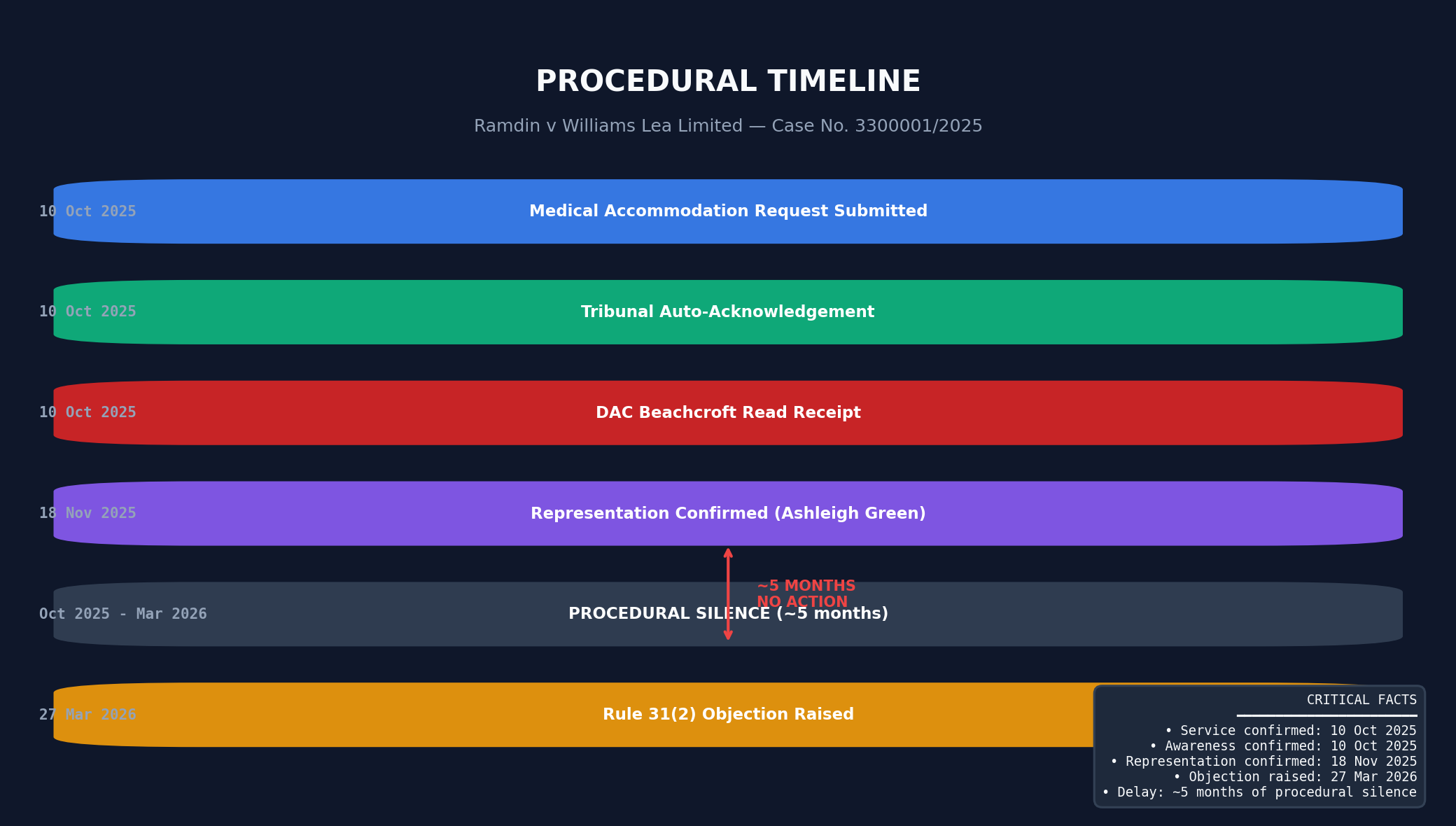
Procedural sequence showing service confirmation, representation, prolonged inactivity, and delayed Rule 31(2) objection.
The Respondent:
- received the communication
- read the communication
- confirmed representation
- maintained representation
Five months later, service was questioned.
Conflict of Interest — DAC Beachcroft
DAC Beachcroft LLP:
- act for the Respondent in the Employment Tribunal
- are subject to separate civil litigation involving the Claimant
- appear in multiple public disclosures
This creates:
- procedural conflict
- structural conflict
- appearance of unfairness
The procedural conduct outlined above occurred within this conflict context.
Breaches
I. Administrative Delay Following Medical Accommodation Request
Frameworks:
- Employment Tribunal Rules of Procedure 2013 — Rule 2 (Overriding Objective)
- Article 6 European Convention on Human Rights
- Principles of Procedural Fairness
Reason:
A medical-related procedural request submitted on 10 October 2025 remained unresolved for approximately five months. This delay undermines fair case management and effective participation.
II. Retrospective Service Objection
Frameworks:
- Employment Tribunal Rules of Procedure 2013 — Rule 31(2)
- Employment Tribunal Rules of Procedure 2013 — Rule 2
- Principles of Natural Justice
Reason:
Service was questioned after:
- confirmed receipt
- confirmed awareness
- confirmed representation
This constitutes retrospective procedural conduct inconsistent with procedural fairness.
III. Failure to Address Health-Related Participation Issue
Frameworks:
- Equality Act 2010 — Section 20 (Reasonable Adjustments)
- Equality Act 2010 — Section 149 (Public Sector Equality Duty)
- Article 6 European Convention on Human Rights
Reason:
Medical deterioration was notified and participation concerns raised. No accommodation decision was made.
IV. Procedural Silence Following Confirmed Representation
Frameworks:
- Employment Tribunal Rules of Procedure 2013 — Rule 2
- Article 6 European Convention on Human Rights
- Principles of Procedural Fairness
Reason:
Representation confirmed on 18 November 2025. No procedural determination followed.
V. Failure to Provide Reasonable Adjustments
Frameworks:
- Equality Act 2010 — Section 20
- Equality Act 2010 — Section 21
- Equality Act 2010 — Section 149
Reason:
Health deterioration notified. No reasonable adjustments considered or implemented.
VI. Procedural Prejudice
Frameworks:
- Article 6 European Convention on Human Rights
- Employment Tribunal Rules of Procedure 2013 — Rule 2
- Principles of Natural Justice
Reason:
Five-month delay created:
- participation disadvantage
- procedural imbalance
- health-related prejudice
VII. Conflict of Interest — DAC Beachcroft
Frameworks:
- Article 6 European Convention on Human Rights (Fair Hearing)
- Principles of Natural Justice (Bias / Appearance of Bias)
- Procedural Fairness Principles
Reason:
DAC Beachcroft:
- act for Respondent
- subject to separate civil litigation involving Claimant
- engaged in procedural conduct within this context
This creates structural conflict and appearance of unfairness.
Legal Frameworks
I. Employment Tribunal Rules of Procedure 2013 — Rule 2
Verbatim
“The overriding objective of these Rules is to enable Employment Tribunals to deal with cases fairly and justly.”
Analysis
Five-month delay undermines fairness and procedural balance.
II. Employment Tribunal Rules of Procedure 2013 — Rule 31(2)
Verbatim
“An application must be copied to all other parties.”
Analysis
Application copied, received, and acknowledged.
Retrospective objection inconsistent.
III. Equality Act 2010 — Section 20
Verbatim
“Where a provision… puts a disabled person at a substantial disadvantage… reasonable steps must be taken…”
Analysis
Health deterioration notified.
No adjustments made.
IV. Equality Act 2010 — Section 149
Verbatim
“A public authority must… have due regard…”
Analysis
Tribunal placed on notice.
No action taken.
V. Human Rights Act 1998 — Article 6
Verbatim
“Everyone is entitled to a fair hearing…”
Analysis
Delay affects participation and fairness.
VI. Natural Justice
Verbatim
“No man shall be condemned unheard.”
Analysis
Participation concerns raised without response.
Pattern Identified
Medical deterioration notified
Tribunal aware
Respondent aware
Representation confirmed
No decision issued
Five-month delay
Retrospective objection
Structural Pattern
Medical vulnerability notification
→ procedural silence
→ retrospective objection
→ participation risk
Public Interest
This disclosure concerns:
- procedural fairness
- reasonable adjustments
- tribunal conduct
- representation conduct
Conclusion
This disclosure records:
- confirmed service
- confirmed awareness
- five-month procedural silence
- retrospective service objection
- conflict of interest
The sequence raises procedural fairness concerns and records administrative conduct affecting participation within Employment Tribunal proceedings.
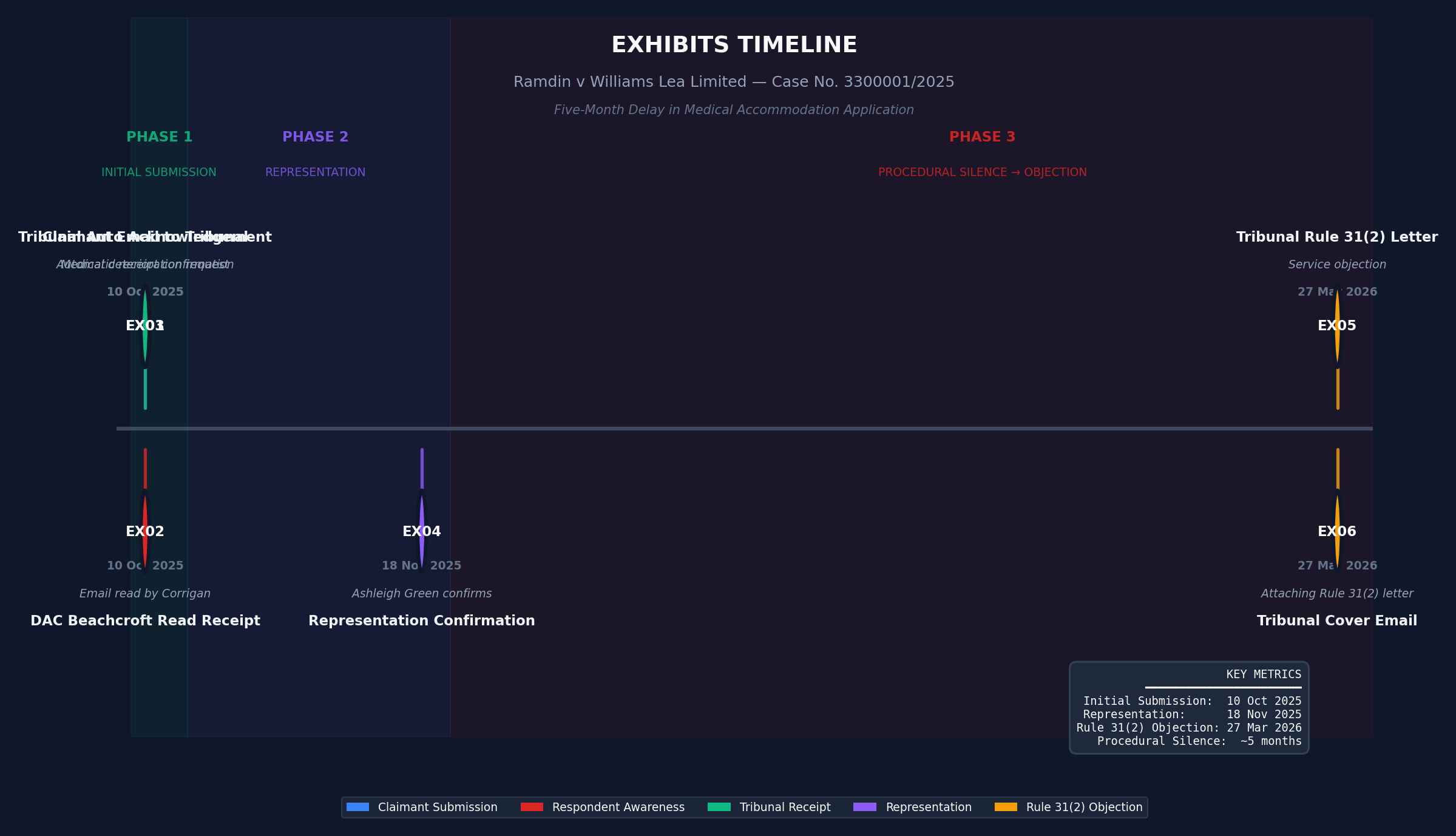
Chronological evidential mapping of submission, awareness, representation, and Rule 31(2) objection demonstrating five-month procedural silence.
Exhibits
| Exhibit | Date | Document Title | Description |
| EX01 | 10 October 2025 | Claimant Email to Tribunal | Medical deterioration request and procedural accommodation |
| EX02 | 10 October 2025 | DAC Beachcroft Read Receipt | Email read confirmation by Corrigan |
| EX03 | 10 October 2025 | Tribunal Auto Acknowledgement | Employment Tribunal automatic receipt confirmation |
| EX04 | 18 November 2025 | Representation Confirmation | Ashleigh Green confirms representation |
| EX05 | 27 March 2026 | Tribunal Rule 31(2) Letter | Tribunal service objection correspondence |
| EX06 | 27 March 2026 | Tribunal Cover Email | Tribunal email attaching Rule 31(2) letter |
| EX07 | 13 April 2026
| Delivery Status Notification
| Metadata receipt confirming successful delivery to DAC Beachcroft at asgreen@dacbeachcroft.com; status 2.0.0; diagnostic code smtp; 250 Ok |
| EX08 | 15 April | DAC Beachcroft Reply to Tribunal
| Ashleigh Green replies to Tribunal on behalf of the Respondent and confirms the Claimant was copied into the correspondence |
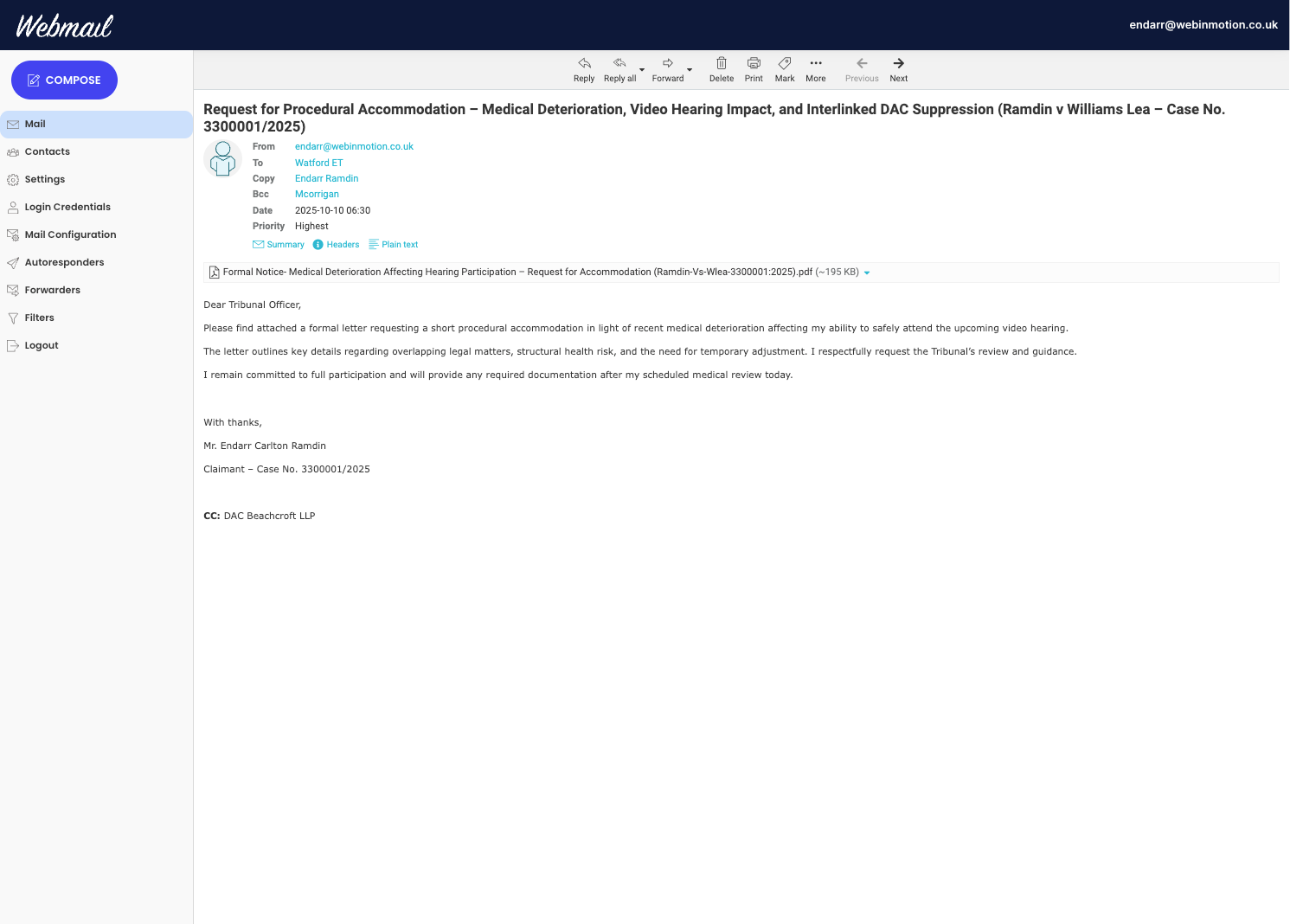
EX01 10 October 2025 Claimant Email to Tribunal Medical deterioration request and procedural accommodation
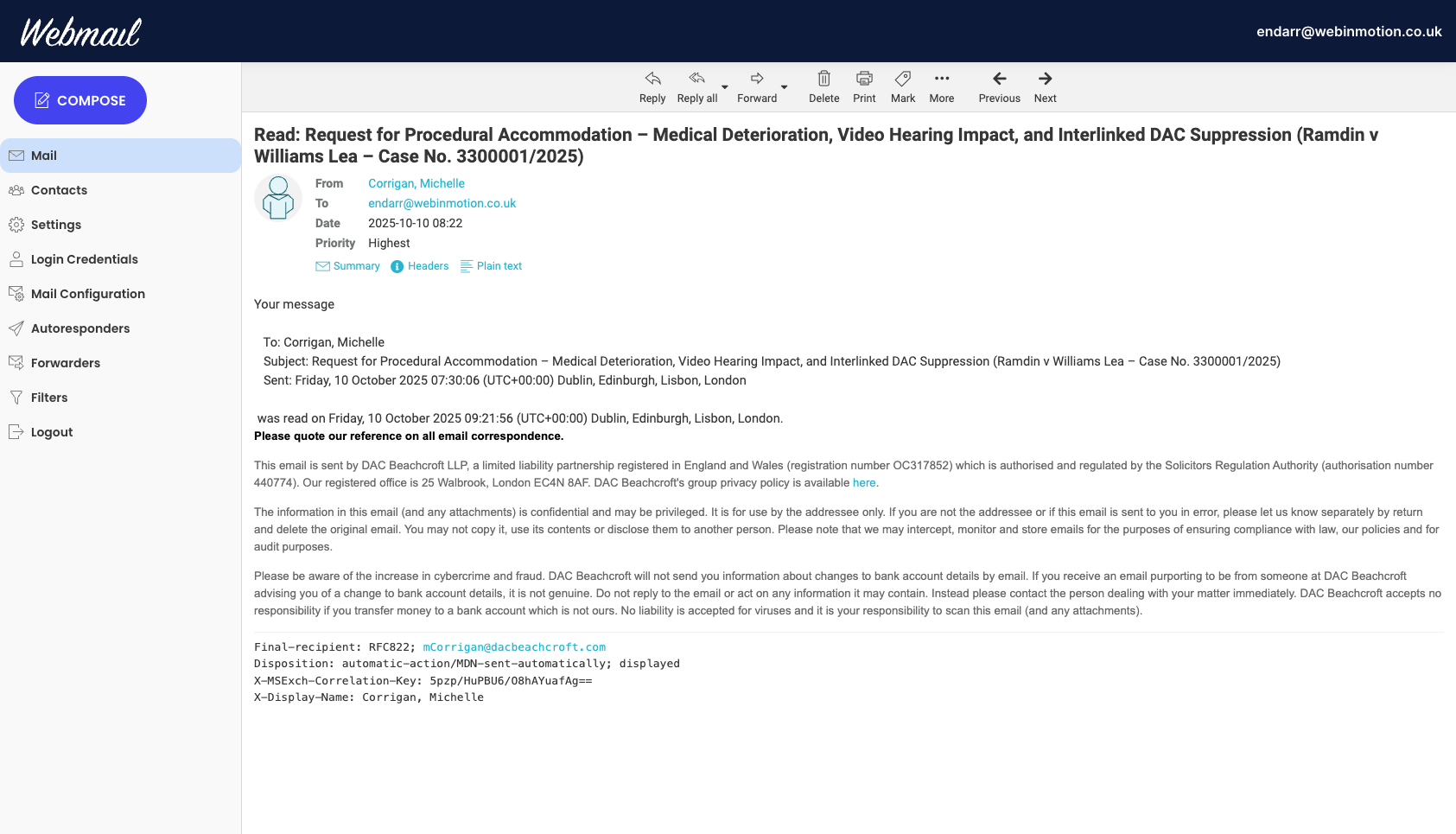
EX02 10 October 2025 DAC Beachcroft Read Receipt Email read confirmation by Corrigan
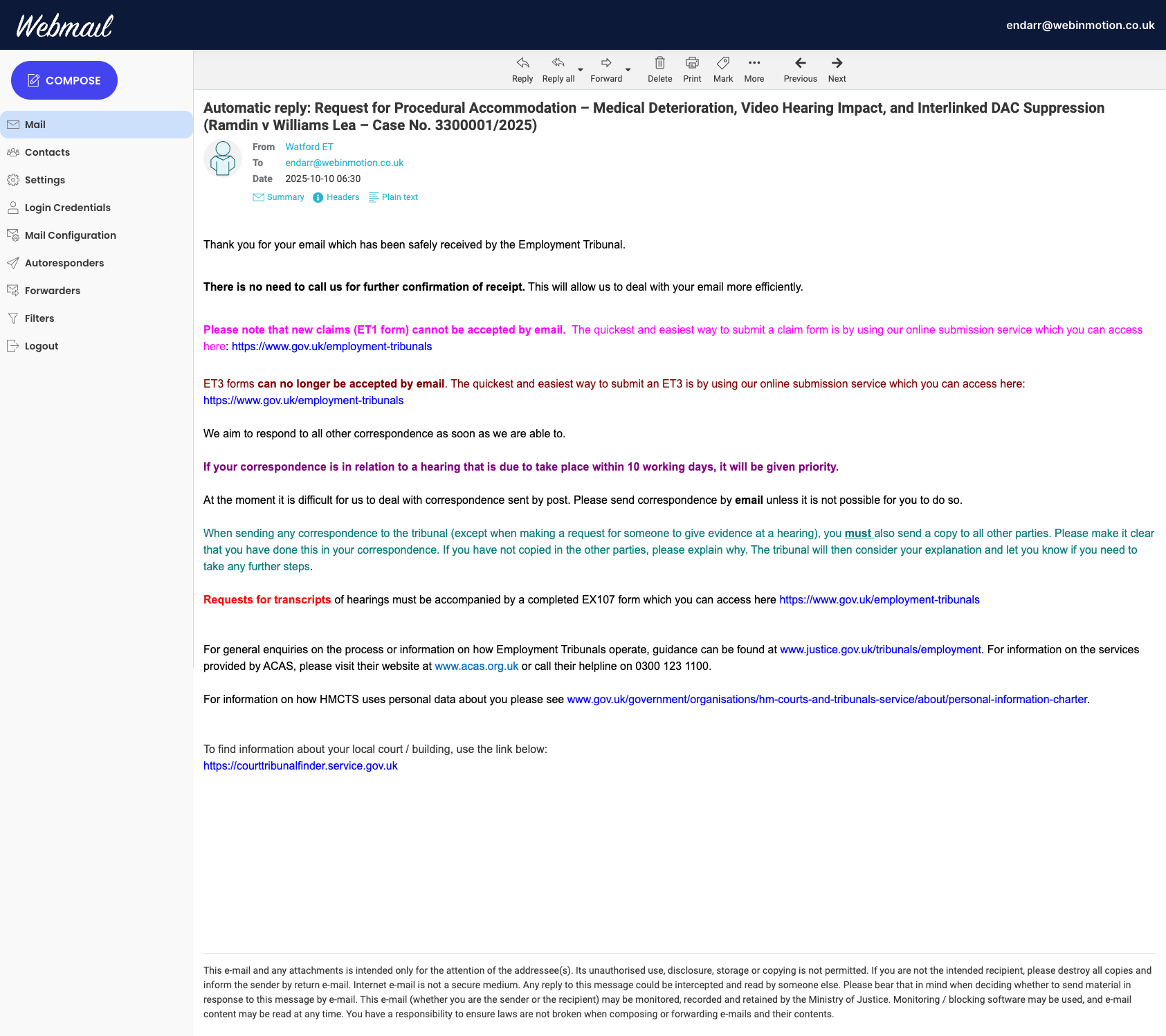
EX03 10 October 2025 Tribunal Auto Acknowledgement Employment Tribunal automatic receipt confirmation
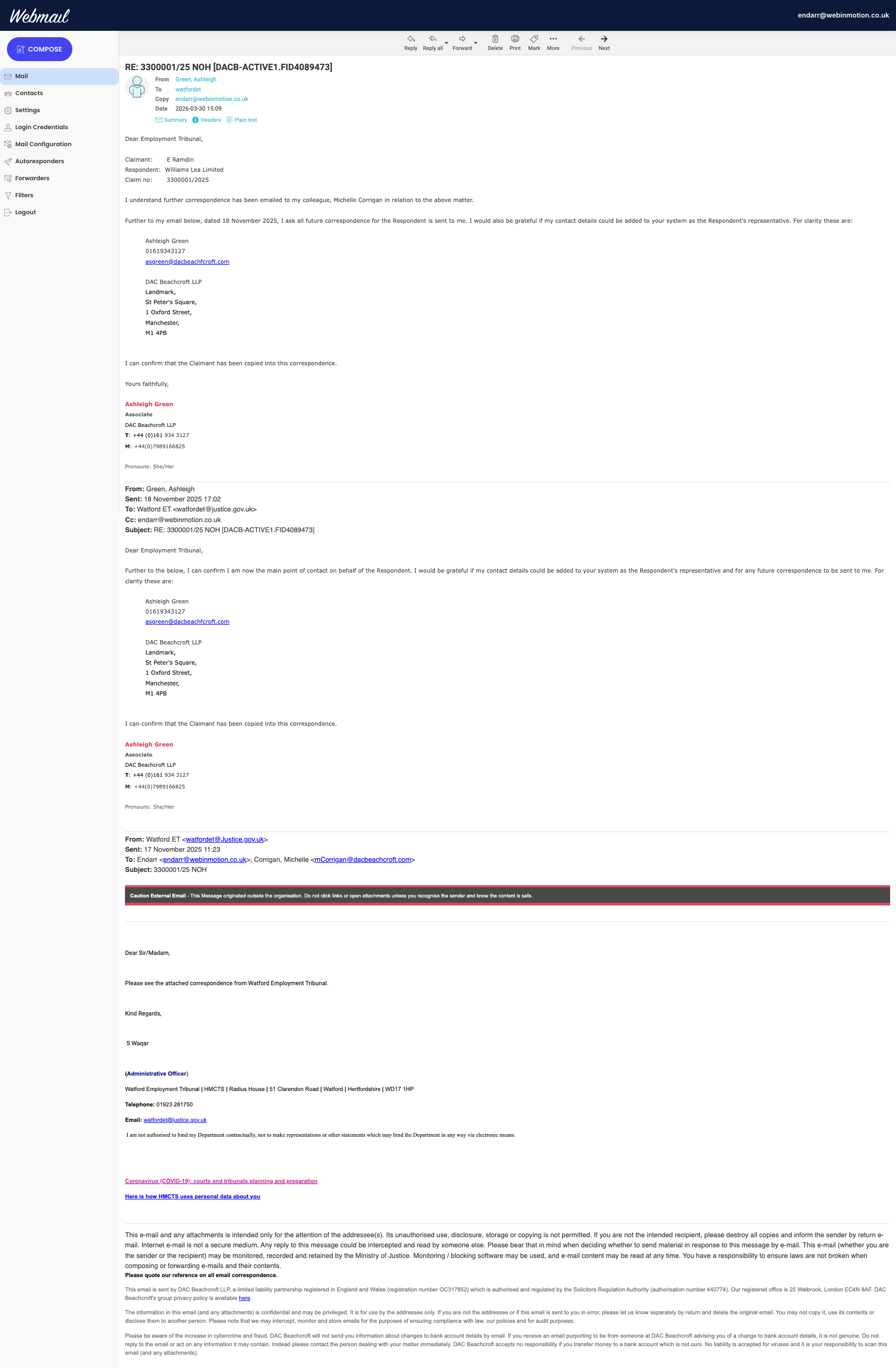
EX04 18 November 2025 Representation Confirmation Ashleigh Green confirms representation
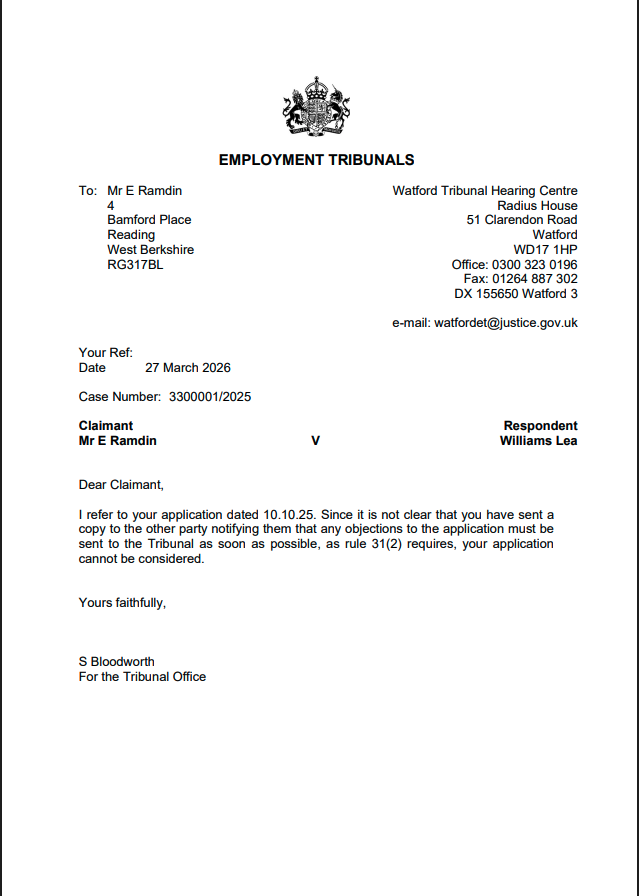
EX05 27 March 2026 Tribunal Rule 31(2) Letter Tribunal service objection correspondence
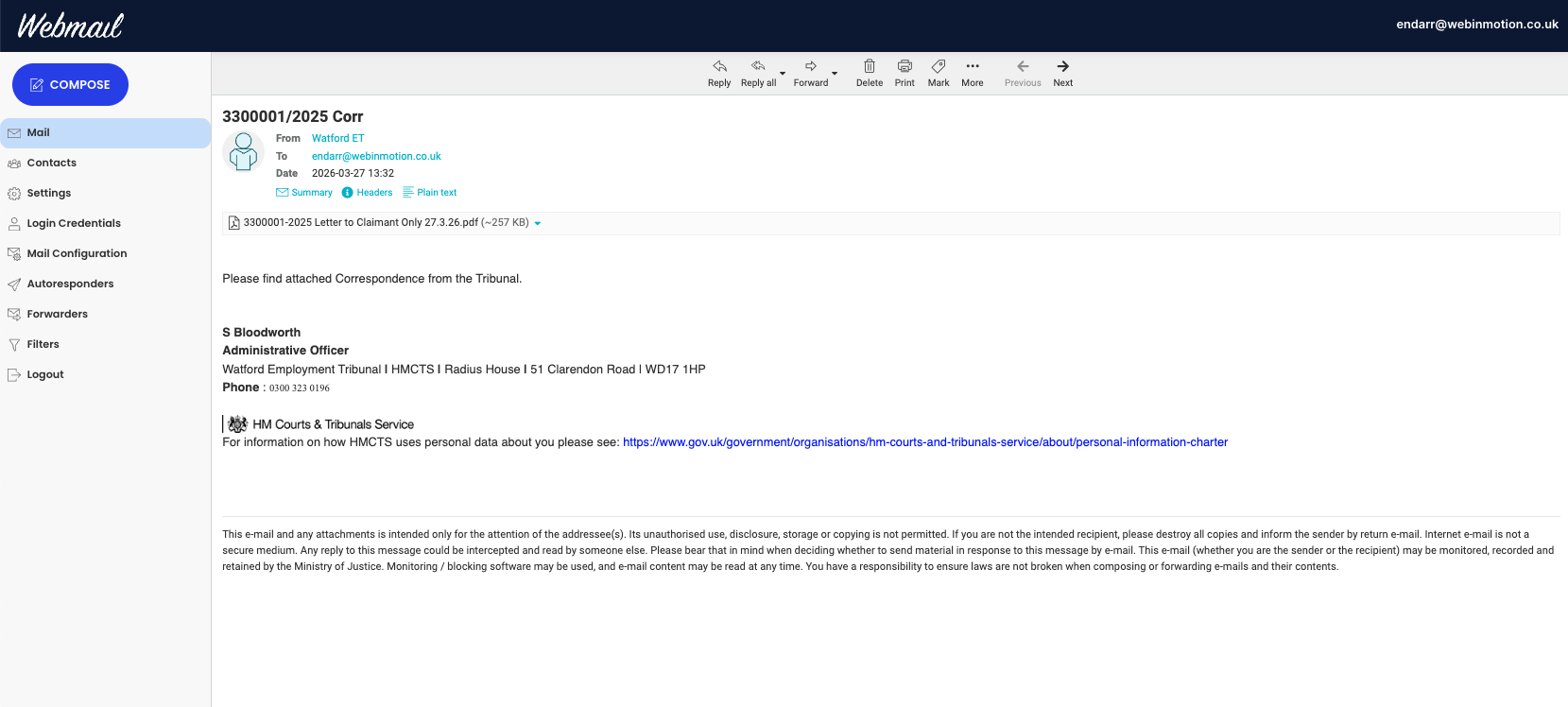
EX06 27 March 2026 Tribunal Cover Email Tribunal email attaching Rule 31(2) letter
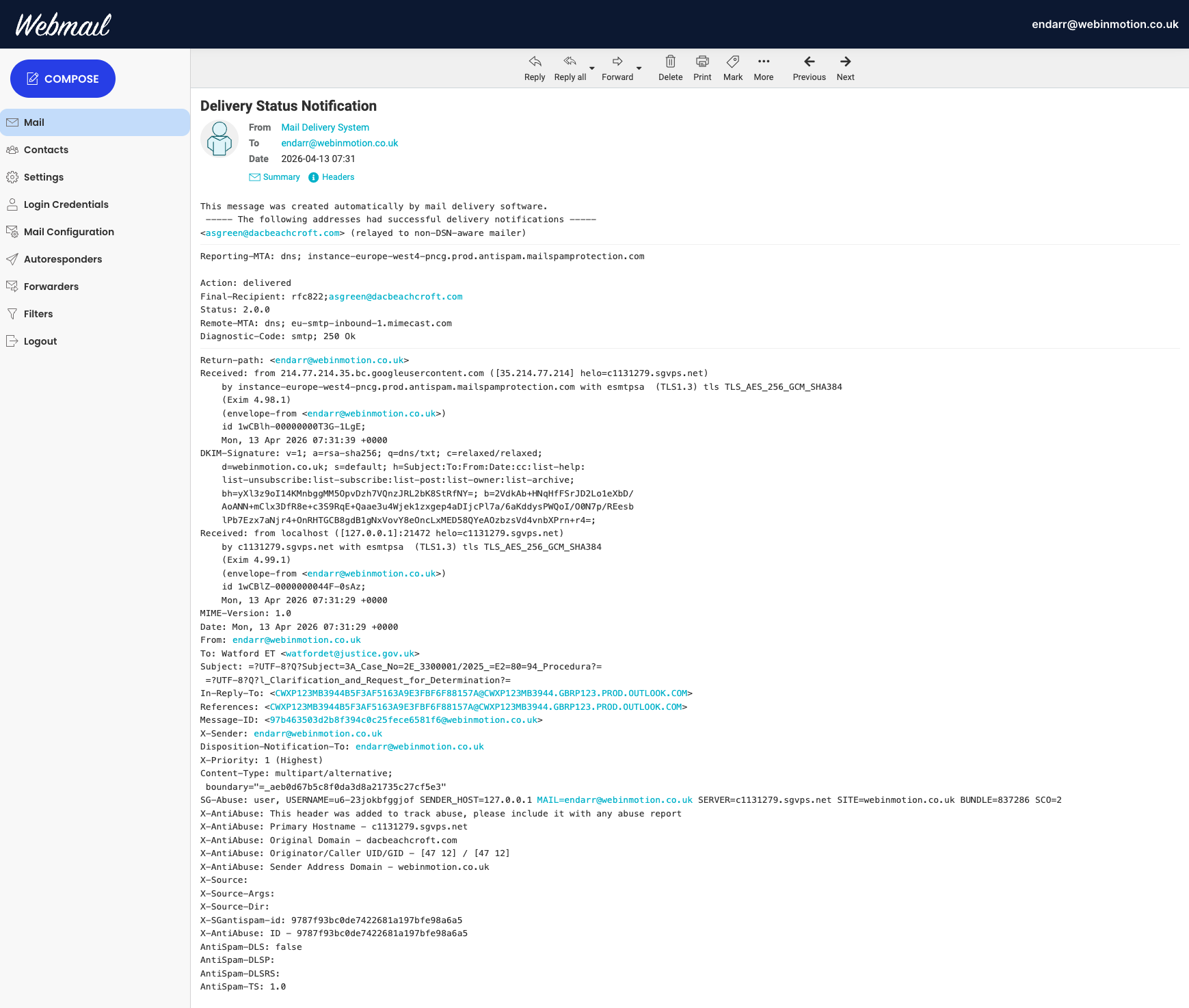
EX07 27 March 2026 Tribunal Cover Email Tribunal email attaching Rule 31(2) letter
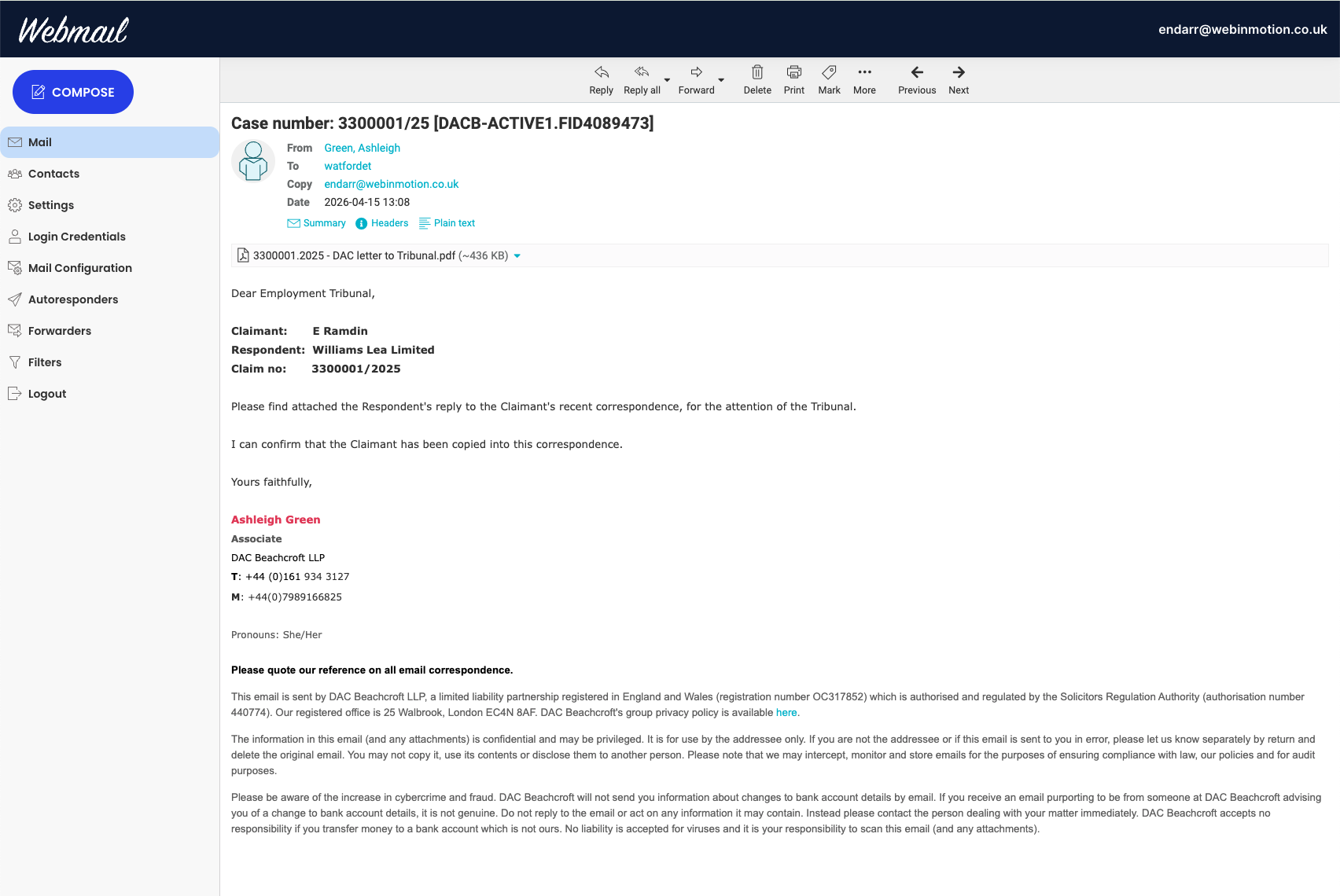
EX08 27 March 2026 Tribunal Cover Email Tribunal email attaching Rule 31(2) letter
Structural Impact Formula
The Structural Impact Score ($SIS$) is defined as:
$SIS = \left( w_P + w_C + w_D + w_T + w_V + w_R + w_I + w_{SC} \right)\left( 1 + \lambda \cdot 28 \right)$
Where:
- $P$ = Procedural Breakdown
- $C$ = Administrative Capture
- $D$ = Defence / Counterparty Interference
- $T$ = Tribunal / Welfare Disruption
- $V$ = Vulnerability Amplifier
- $R$ = Rights / Regulatory Misstatement
- $I$ = Institutional Interlock
- $SC$ = Structural Conflict
The interaction multiplier $\left(1 + \lambda \cdot 28\right)$ reflects $\binom{8}{2} = 28$ co-occurring structural interaction pairs.
Structural Impact Result
Activated Structural Variables:
$P = 1,\; C = 1,\; D = 1,\; T = 1,\; V = 1,\; R = 1,\; I = 1,\; SC = 1$
Interaction Pair Count: $\binom{8}{2} = 28$ distinct co-occurring variable pairs.
Resolved Structural Impact Score:
$SIS = \left( w_P + w_C + w_D + w_T + w_V + w_R + w_I + w_{SC} \right)\left( 1 + \lambda \cdot 28 \right)$
Structural Impact Meaning
An $SIS$ produced by eight concurrently active structural variables with $\binom{8}{2} = 28$ interaction pairs indicates compound systemic procedural distortion rather than isolated administrative delay.
The co-activation of procedural breakdown ($P$), administrative capture ($C$), defence or counterparty interference ($D$), tribunal involvement ($T$), vulnerability amplification ($V$), rights and regulatory interference ($R$), institutional interlock ($I$), and structural conflict ($SC$) demonstrates mutually reinforcing defects across tribunal administration, representation conduct, and procedural fairness.
The interaction multiplier $\left(1 + \lambda \cdot 28\right)$ confirms non-linear escalation. Each structural defect intensifies the others, producing a compounded systemic effect consistent with prolonged tribunal silence following medical vulnerability notification, retrospective procedural objection, and conflict-affected participation risk.