
TIMELINE DIVERGENCE: Court Record vs. Gordons' Conduct
KEY: 28 Oct conduct is pre-deadline but already shows divergence. The sanction threshold at 14 Nov marks the procedural state transition.
Visual representation of procedural chronology only.
1. Overview and Purpose of Disclosure
This disclosure concerns the procedural conduct of Gordons Partnership Solicitors LLP (“Gordons”) following the issue of the Claim in the above matter, specifically where Gordons:
- filed an Acknowledgment of Service indicating an intention to defend,
- subsequently failed to serve any Defence within the time mandated by the Civil Procedure Rules, and
- nevertheless, engaged in procedural and substantive correspondence presupposing the existence of a Defence that does not, and never did, exist on the court record.
The central matter documented in this disclosure is the absence of any pleaded Defence in circumstances where one was required. Gordons’ later correspondence including references to strike-out, assertions of merit, and cost warnings was undertaken in the absence of any served Defence, without any court-notified extension, agreed variation, or supporting evidence being filed in accordance with the Civil Procedure Rules.
This disclosure is confined to procedural facts and chronology and is structured so as to stand alone as a procedural record. If required, it can be read directly as a particulars-style account of procedural default, without reference to any other disclosure.
The factual sequence set out herein establishes what was filed, what was not filed, and precisely when the procedural position became determinative. It also primes the subsequent analysis of legal frameworks engaged and identified breaches under the Civil Procedure Rules and associated practice directions.
2. Procedural Context and Trigger Events
This disclosure arises from proceedings in which Gordons entered the record for the Respondent following the issue of the Claim and the filing of an Acknowledgment of Service (“AoS”), thereby activating the procedural timetable under the Civil Procedure Rules.
The trigger for this disclosure is the divergence between the procedural position recorded on the official court file and the conduct of Gordons as reflected in their correspondence. Specifically:
- an intention to defend was formally indicated through an AoS;
- no Defence was served within the time permitted by the Civil Procedure Rules;
- no extension, relief application, consent order, or variation of time was served or entered on the court record; and
- nevertheless, Gordons proceeded with correspondence and procedural advocacy that presupposed a substantive Defence position.
The procedural baseline fixed here the point at which Gordons’ recorded position ceased to be one of intention alone and should have converted into a Defence sets the stage for later sections dealing with chronology, legal frameworks engaged and identified breaches.
3 Chronological Procedural Record
This section sets out the procedural chronology relevant to Gordons Partnership Solicitors LLP’s conduct following issue of the claim. The table records what appears on the court record and in contemporaneous correspondence, in date order, so that later conduct can be assessed against the actual procedural position.
Temporal Evidence and Procedural Status Matrix
| Date | Evidence Item | Source / Exhibit | Procedural Fact Established | Procedural Status | Primary Breach Engaged |
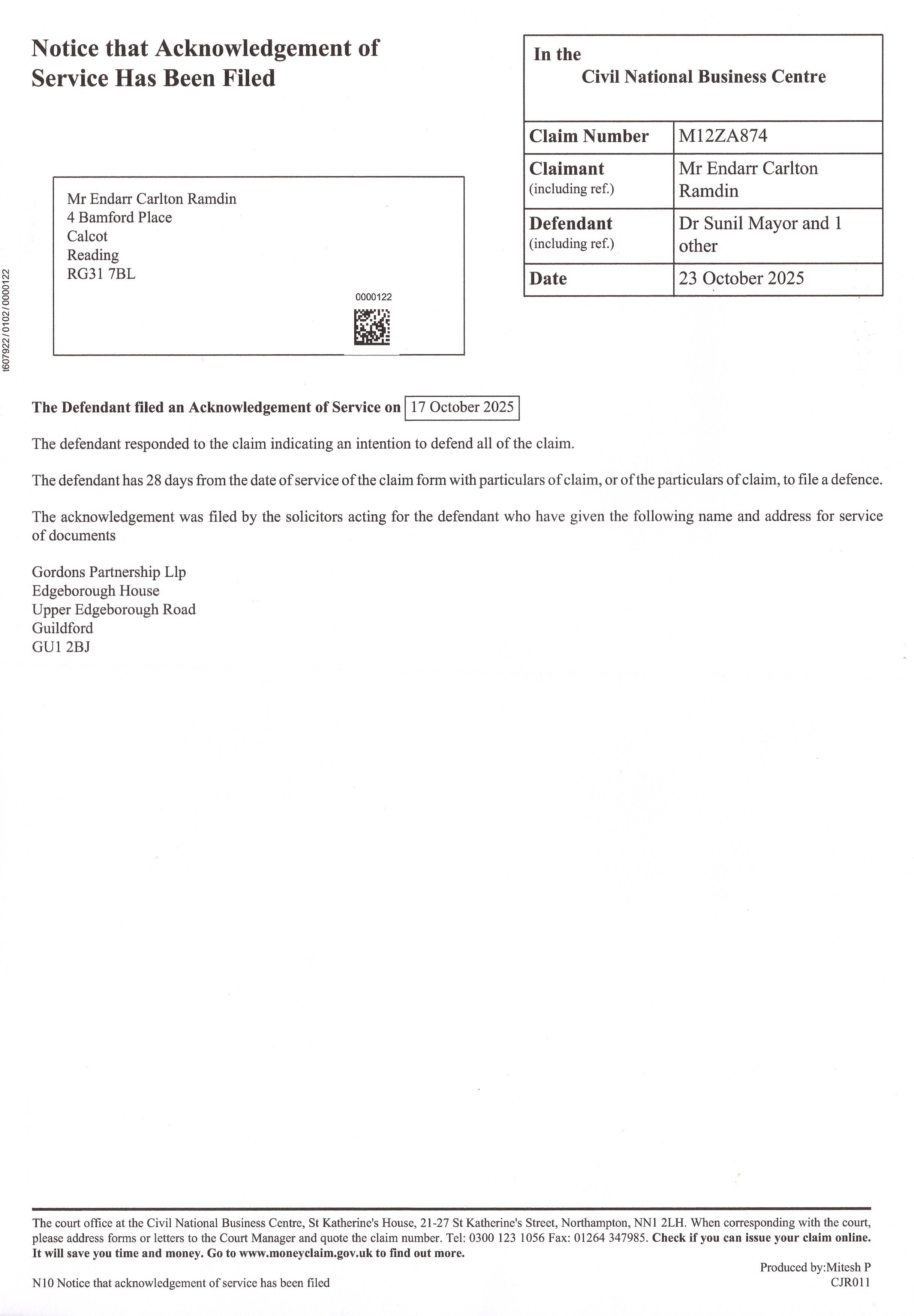
| 17 Oct 2025 | Acknowledgment of Service filed (intention to defend) | CNBC Notice (AoS) | Defendant formally indicates intention to defend | CPR Part 10 triggered | |
| 23 Oct 2025 | Court notice confirming AoS on record | CNBC envelope + notice | AoS confirmed on court file | Defence deadline running | |
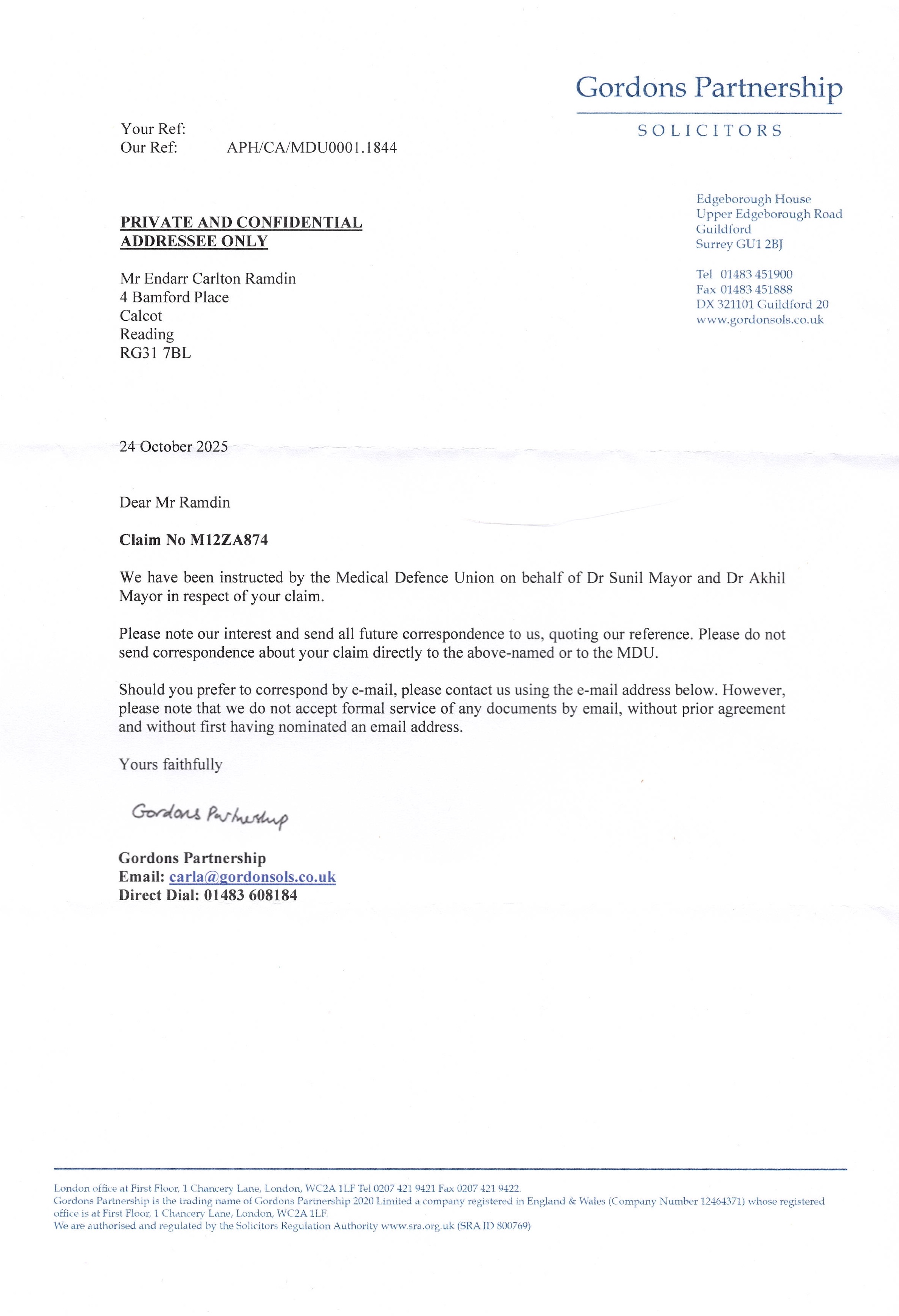
| 24 Oct 2025 | Letter asserting Gordons’ instruction and requesting future correspondence | Gordons Partnership Solicitors LLP letter | Representation asserted without Defence | Extra-procedural conduct | CPR r.15.4 / r.22.1 |
| 25 Oct 2025 | Royal Mail / Whistl service evidence | Envelope (Gordons → Claimant) | Active correspondence pre-defence | No pleaded case | CPR r.16.5 |
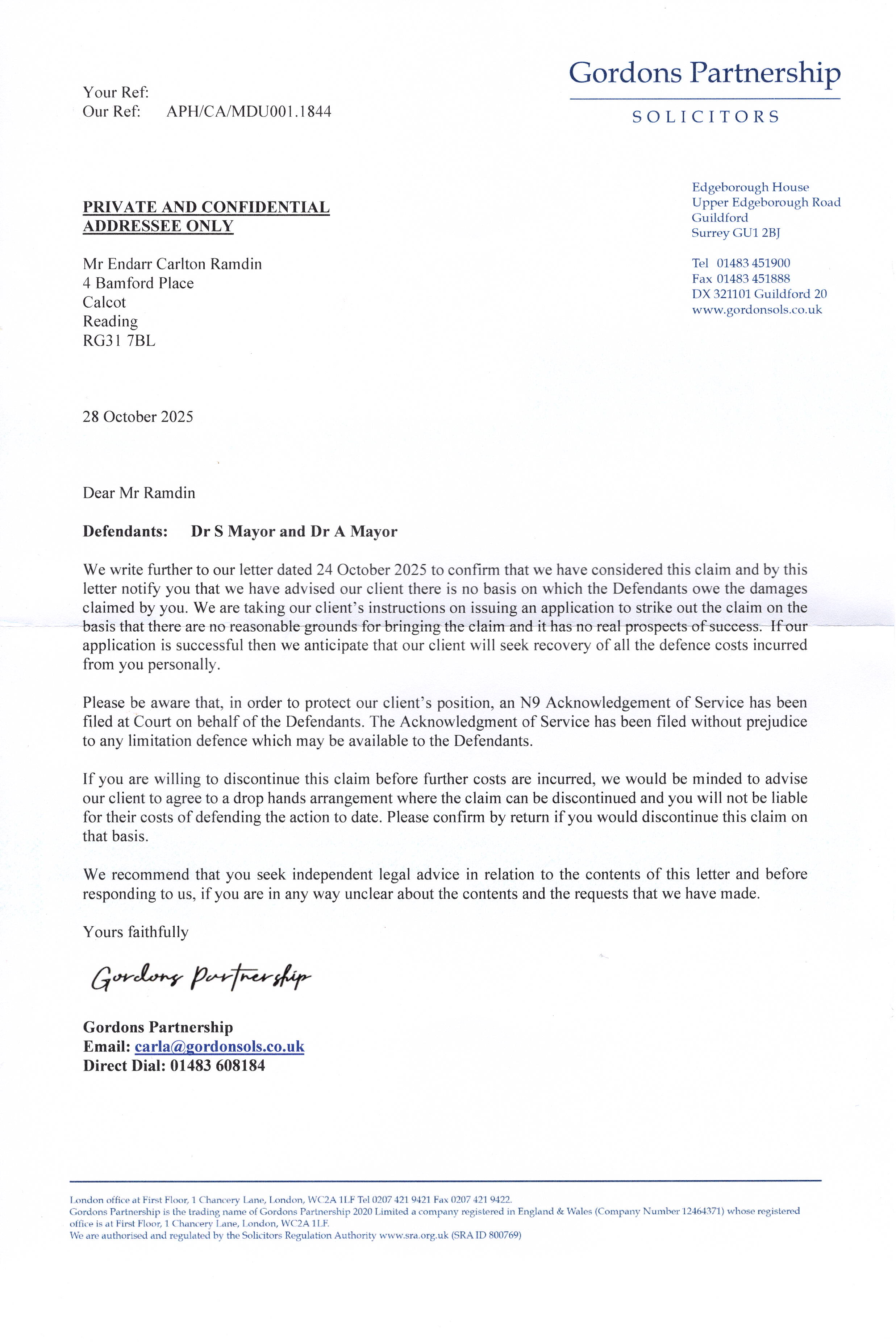
| 28 Oct 2025 | Letter asserting claim has “no reasonable grounds”; strike-out posture | Gordons letter | Substantive merits asserted | Defence absent | CPR r.3.4(2)(b) |
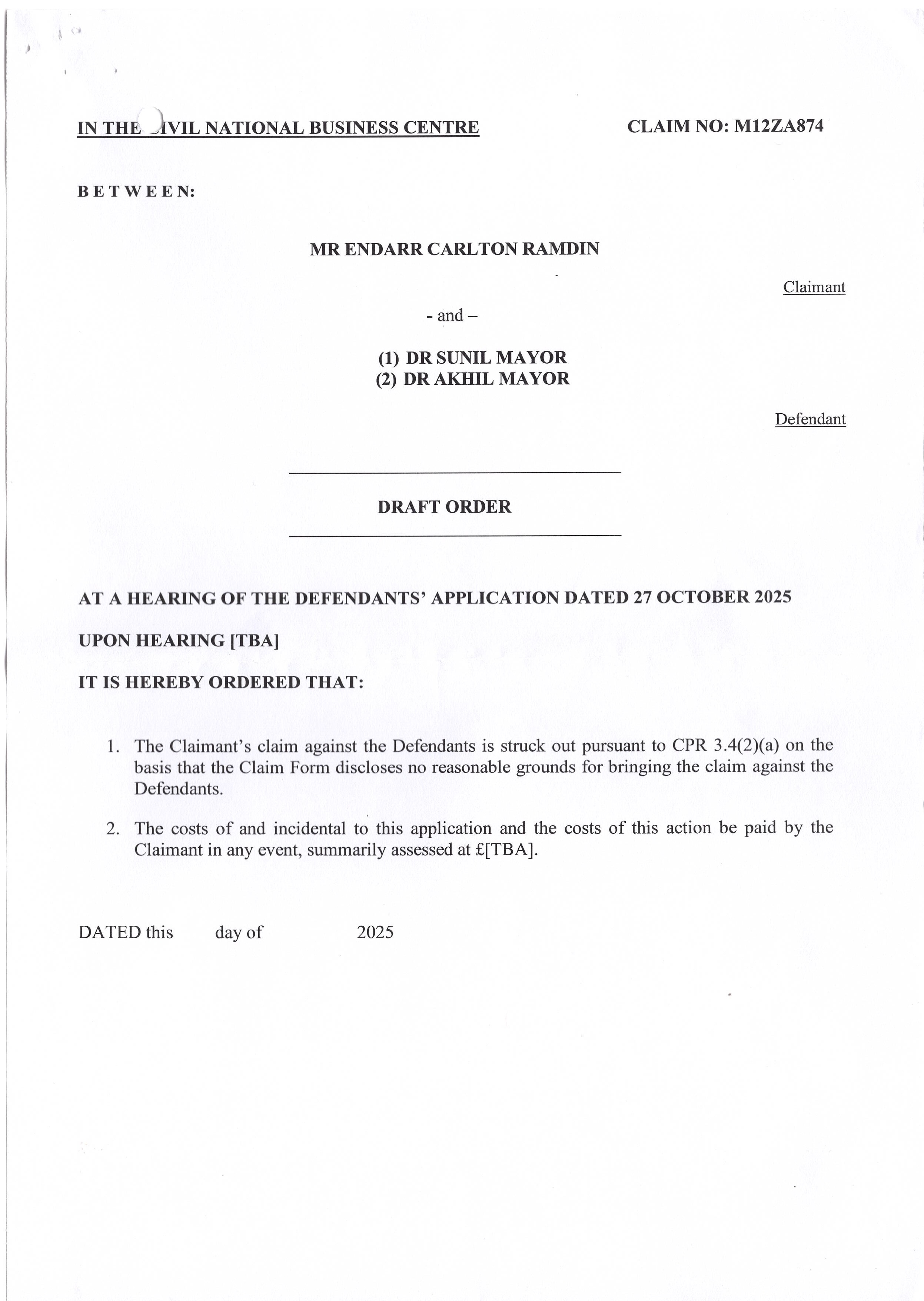
| 28 Oct 2025 | N244 application issued | N244 application + Draft Order | Application pursued | No Defence on record | CPR r.3.1 / r.24 |
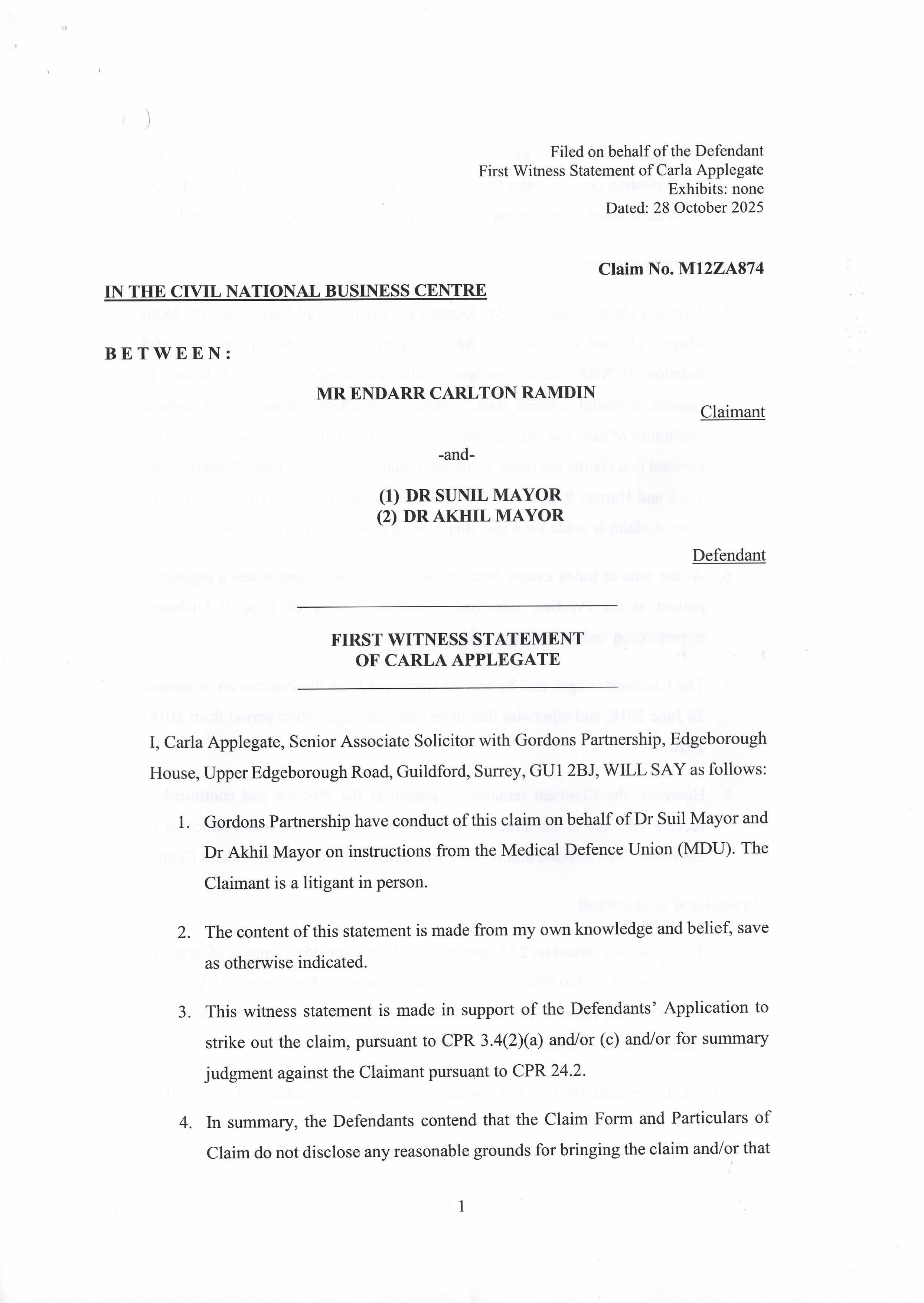
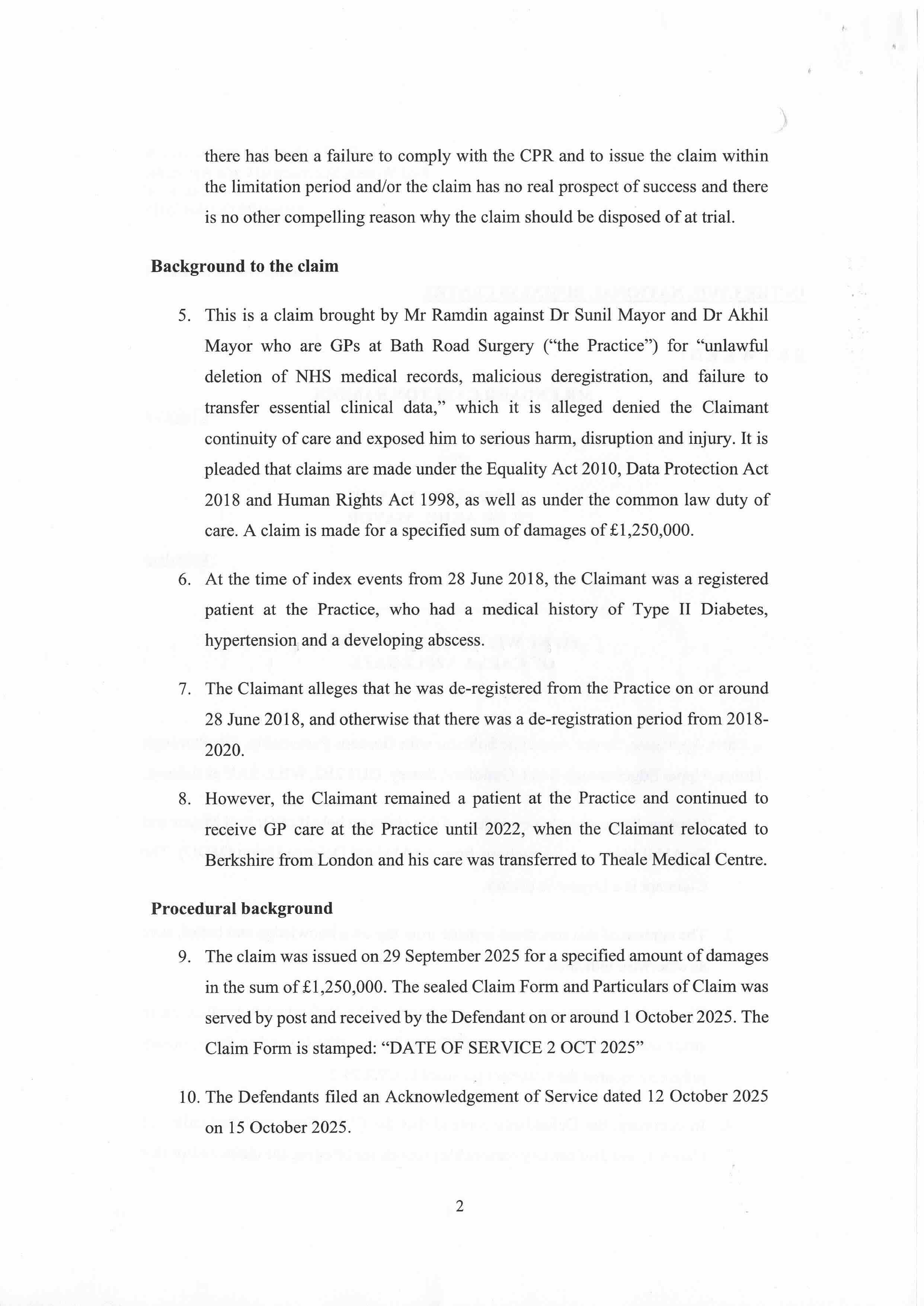
| 28 Oct 2025 | Witness Statement in support of N244 | WS (Applegate) | Evidential narrative advanced | No statement of case | CPR r.22.1 |
| AoS + 28 days (deadline) | No Defence filed | Court record | Mandatory Defence not served | Procedural default crystallised | CPR r.15.4 |
| Post-deadline | Continued correspondence asserting defensive footing | Gordons letters | Authority simulated post-default | Default obscured | CPR r.3.8 / r.1.3 |
| Post-deadline | Costs exposure referenced | Gordons correspondence | Cost intimidation without standing | Misconduct risk | CPR r.44.11 |
| Post-deadline | No relief from sanctions sought | Court file | Sanction remains operative | Default persists | CPR r.3.8 |
Table summary
The table above consolidates the documentary record into a single temporal sequence, aligning each evidential item with the procedural status in force at the time it was generated. The table demonstrates that, following the filing and confirmation of an Acknowledgment of Service, no Defence was ever filed within the period mandated by the Civil Procedure Rules, and no extension, relief from sanctions, or consent order was sought or granted. Notwithstanding this procedural default, Gordons Partnership Solicitors LLP issued correspondence and pursued applications that presupposed a defended posture. The table therefore evidences a sustained divergence between the court-recorded procedural position and the conduct undertaken, identifying the point at which Defence default crystallised and tracing the subsequent acts that occurred in the absence of any pleaded Defence.
4. Legal Breaches Arising from Procedural Default
1. Civil Procedure Rules (CPR) Breaches
Framework Introduction
The Civil Procedure Rules govern the mandatory procedural obligations of parties once proceedings are issued.
Upon the filing of an Acknowledgment of Service indicating an intention to defend, CPR Part 15 imposes strict, time-limited duties on a defendant to file a Defence. These duties are mandatory, not discretionary, and cannot be displaced by correspondence, assertions of merit, or informal procedural conduct.
Where no Defence is filed within the prescribed period, the defendant enters procedural default, and the court record must reflect that default unless and until relief is properly sought and granted.
LEGAL FRAMEWORK ESCALATION: Foundation to International
Visual mapping of legal framework escalation from foundation CPR breach to international human rights violations.
I. CPR r.15.4 – Time for Filing a Defence
“The general rule is that the defendant must file a defence–
(a) within 14 days after service of the particulars of claim; or
(b) if the defendant files an acknowledgment of service under Part 10, within 28 days after service of the particulars of claim.”
Analysis:
An Acknowledgment of Service was filed indicating an intention to defend. No Defence was filed within the 28-day period prescribed by CPR r.15.4(b). No application for extension, no consent order, and no relief from sanctions application was placed on the court record. The procedural consequence of this omission is that the Defendant stood in default. Any subsequent conduct presupposing a Defence was therefore unsupported by the procedural record and contrary to the mandatory timetable imposed by the CPR.
II. CPR r.16.5 – Contents of the Defence
“In his defence, the defendant must state–
(a) which of the allegations in the particulars of claim he denies;
(b) which allegations he is unable to admit or deny but which he requires the claimant to prove; and
(c) which allegations he admits.”
Analysis:
No Defence was filed. Consequently, no denials, admissions, or non-admissions were pleaded as required by CPR r.16.5. In the absence of a Defence, all allegations in the Particulars of Claim remained unanswered on the court record. Correspondence asserting lack of merit, strike-out prospects, or factual disagreement was procedurally irrelevant, as CPR r.16.5 requires such matters to be pleaded, not asserted extra-procedurally.
III. CPR r.12.3 – Conditions to Obtain Default Judgment
“The claimant may obtain judgment in default of defence if–
(a) the defendant has not filed an acknowledgment of service or a defence; and
(b) the relevant time for doing so has expired.”
Analysis:
The relevant time for filing a Defence expired without any Defence being served. The procedural position therefore satisfied the conditions set out in CPR r.12.3. The Defendant’s default crystallised upon expiry of the Defence deadline. Any later correspondence or procedural manoeuvring did not alter the fact that, as a matter of CPR, the claim stood undefended unless and until relief was properly sought and granted.
IV. CPR r.3.8 – Sanctions Have Effect Unless Relief Granted
“Where a party has failed to comply with a rule, practice direction or court order, any sanction for failure to comply imposed by the rule… has effect unless the party in default applies for and obtains relief from the sanction.”
Analysis:
Failure to file a Defence engages an automatic procedural sanction. No application for relief from sanctions was made. No order granting relief exists on the court record. Accordingly, the sanction remained operative. Conduct undertaken as though the sanction did not exist was procedurally unlawful and inconsistent with CPR r.3.8.
V. CPR r.1.3 – Duty of the Parties
“The parties are required to help the court to further the overriding objective.”
Analysis:
Proceeding through correspondence and asserted procedural threats while in Defence default did not assist the court in managing the case justly. On the contrary, it obscured the true procedural position and frustrated the court’s ability to apply the CPR correctly. Such conduct is incompatible with the duty imposed by CPR r.1.3.
VI. CPR r.22.1 – Statements of Case Must Be Verified
“The following documents must be verified by a statement of truth–
(a) a statement of case…”
Analysis:
No Defence verified by a statement of truth was filed. Assertions made in correspondence were therefore not statements of case and carried no procedural standing. The absence of a verified Defence underscores that no lawful defensive position existed before the court.
VII. CPR r.3.4(2)(b) – Abuse of Process
“The court may strike out a statement of case if it appears to the court–
(b) that the statement of case is an abuse of the court’s process or is otherwise likely to obstruct the just disposal of the proceedings.”
Analysis:
Although no Defence was filed, Gordons advanced correspondence asserting strike-out, lack of merit, and adverse procedural consequences. Advancing substantive procedural positions without any pleaded Defence constitutes use of process for a purpose other than that for which it exists. This is a classic abuse of process: attempting to obtain the benefits of a defended posture while avoiding the obligations required to lawfully occupy that posture.
VIII. CPR r.44.2 and r.44.11 – Improper Costs Conduct / Misconduct
CPR r.44.2(4)–(5) – Court’s discretion on costs
CPR r.44.11(1) – Misconduct
“The court may make an order disallowing costs or ordering a legal representative to pay costs where that representative has acted improperly, unreasonably or negligently.”
Analysis:
Cost warnings and adverse cost exposure were asserted in correspondence from 28 Oct 2025 (pre-deadline) and continuing post-14 Nov 2025 (post-default). While the 28 Oct correspondence demonstrates premature procedural divergence, the post-14 Nov continuation occurs while the Defendant is in Defence default and sanction is operative under CPR r.3.8. Issuing cost intimidation without procedural standing constitutes unreasonable and improper conduct. Such correspondence is capable of misleading a litigant-in-person as to risk exposure and engages the court’s misconduct jurisdiction under CPR r.44.11.
IX. CPR r.1.1 – Overriding Objective
“These Rules are a new procedural code with the overriding objective of enabling the court to deal with cases justly and at proportionate cost.”
Analysis:
Correspondence presupposing a Defence that does not exist undermines procedural clarity, equality of arms, and proportionality. Rather than assisting the court to deal with the case justly, the conduct distorted the procedural landscape and frustrated the proper application of the CPR.
X. CPR r.1.4 – Court’s Duty to Actively Manage Cases
“The court must further the overriding objective by actively managing cases.”
Analysis:
By proceeding extra-procedurally and obscuring the true Defence-default position, Gordons’ conduct interfered with the court’s ability to actively manage the case. Accurate procedural posture is a prerequisite to effective case management; conduct that conceals default frustrates the operation of CPR r.1.4.
XI. CPR r.3.1 – Case Management Powers (Mis-engaged)
“The court may–
(a) extend or shorten the time for compliance with any rule…
(m) take any other step or make any other order for the purpose of managing the case.”
Analysis:
No application was made under CPR r.3.1 to extend time, regularise default, or seek relief. Instead, procedural authority was asserted through correspondence alone. Attempting to bypass the court’s exclusive case-management powers constitutes procedural mis-engagement and further evidences abuse of process.
2. Human Rights Law – Fair Trial and Effective Remedy
I.Human Rights Act 1998 – Article 14 (Non-Discrimination)
“The enjoyment of the rights and freedoms set forth in this Convention shall be secured without discrimination on any ground such as sex, race, colour, language, religion, political or other opinion, national or social origin, association with a national minority, property, birth or other status.”
Analysis
Where procedural rules (CPR protections, default remedies, equality of arms) are selectively neutralised in practice against a disabled litigant-in-person, discrimination arises in the enjoyment of Article 6 and Article 13 rights.
This breach is derivative but standalone and must be pleaded separately from Article 6.
II.Human Rights Act 1998 – Article 8 (Procedural Privacy & Correspondence Integrity)
“Everyone has the right to respect for his private and family life, his home and his correspondence.”
Analysis
Procedural intimidation, correspondence simulating authority, and misuse of litigation communications engage Article 8 where correspondence itself becomes a coercive or degrading instrument.
Article 8 is breached independently of data protection law where litigation correspondence interferes with dignity, autonomy, and
Framework
Human rights protections apply directly to civil proceedings. Procedural rules must be applied in a manner compatible with the right to a fair hearing, equality of arms, and effective access to justice. Where procedural default is obscured or procedural authority is asserted without lawful footing, these rights are engaged and may be violated.
I. European Convention on Human Rights – Article 6
“In the determination of his civil rights and obligations, everyone is entitled to a fair and public hearing within a reasonable time by an independent and impartial tribunal established by law.”
Analysis:
Article 6 requires procedural fairness not only at hearing, but throughout the conduct of proceedings. Where a Defendant fails to file a Defence yet proceeds as if one exists, the Claimant is deprived of procedural clarity, deprived of the ability to respond to pleaded issues, and placed at a structural disadvantage. The absence of a Defence removes the procedural symmetry required by equality of arms. Correspondence asserting merits, strike-out, or cost exposure in these circumstances undermines the fairness of the process and is incompatible with Article 6.
II. European Convention on Human Rights – Article 8
Right to respect for private and family life
“Everyone has the right to respect for his private and family life, his home and his correspondence.”
Analysis:
Procedural correspondence asserting authority, threatening adverse outcomes, or presupposing a Defence in circumstances of procedural default constitutes an interference with private life and correspondence. Where such interference lacks lawful basis, proportionality, or procedural justification, it violates Article 8. The cumulative effect of repeated correspondence issued without procedural standing aggravates the interference and removes any claim to necessity or lawfulness.
III. European Convention on Human Rights – Article 13
“Everyone whose rights and freedoms as set forth in this Convention are violated shall have an effective remedy before a national authority.”
Analysis:
Procedural default under the CPR gives rise to specific remedies, including default judgment and case management consequences. Conduct that obscures or frustrates the operation of those remedies impairs their effectiveness. Where a Defendant’s procedural default is not transparently acknowledged and is instead masked by correspondence or procedural intimidation, the Claimant’s access to an effective remedy is compromised.
IV. European Convention on Human Rights – Article 14
Prohibition of discrimination
“The enjoyment of the rights and freedoms set forth in this Convention shall be secured without discrimination on any ground such as… disability… or other status.”
Analysis:
Article 14 is engaged where procedural rules and protections are applied unevenly. Allowing a represented defendant to act as if compliant while in procedural default, while exposing a disabled litigant-in-person to intimidation and uncertainty, constitutes differential treatment without objective justification. The discrimination arises not from explicit classification, but from the structural effect of procedural imbalance.
V. International Covenant on Civil and Political Rights – Article 14 – Article 14(1)
“All persons shall be equal before the courts and tribunals.”
Analysis:
Equality before courts requires that procedural rules apply equally to all parties. A Defendant cannot enjoy the benefits of a defended posture while avoiding the obligations that give rise to it. Allowing one party to act as if a Defence exists, while the other is bound by the consequences of procedural default, violates the principle of equality before the court protected by Article 14.
VI. International Covenant on Civil and Political Rights – Article 2(3)
Effective remedy
“Each State Party… undertakes to ensure that any person whose rights… are violated shall have an effective remedy.”
Analysis:
Procedural default under domestic civil procedure activates specific remedies. Conduct that obscures or neutralises those remedies through intimidation, misrepresentation, or procedural fog undermines their effectiveness. Where a litigant is prevented in practice from accessing remedies theoretically available in law, Article 2(3) is breached.
VII. UN Convention on the Rights of Persons with Disabilities – Article 5
Equality and non-discrimination
“States Parties shall prohibit all discrimination on the basis of disability and guarantee to persons with disabilities equal and effective legal protection…”
Analysis:
Where litigation conduct disproportionately disadvantages a disabled litigant through stress amplification, uncertainty, or procedural coercion, discrimination arises irrespective of intent. The failure to adjust conduct in light of known disability engages Article 5 directly.
VIII. UN Convention on the Rights of Persons with Disabilities – Article 13
“States Parties shall ensure effective access to justice for persons with disabilities on an equal basis with others.”
Analysis:
Effective access to justice includes procedural transparency, predictability, and protection from intimidation. Litigation conduct that exploits procedural complexity, advances unfounded threats, or disregards the absence of a Defence disproportionately disadvantages disabled litigants and engages Article 13 of the CRPD.
IX.Universal Declaration of Human Rights – Articles 7 and 8 (Equality Before the Law and Effective Remedy)
Verbatim
Article 7
“All are equal before the law and are entitled without any discrimination to equal protection of the law.”
Article 8
“Everyone has the right to an effective remedy by the competent national tribunals…”
Analysis
Although declaratory in nature, Articles 7 and 8 of the Universal Declaration of Human Rights inform the interpretation and application of domestic procedural law and Convention rights.
A procedural system that tolerates non-compliance by one party while enforcing procedural consequences against another fails to provide equal protection in substance.
Where procedural misconduct obscures default, neutralises available remedies, or frustrates their operation in practice, the right to an effective remedy is defeated.
The relevance of Articles 7 and 8 lies not in any single procedural act, but in the cumulative obstruction of equality before the law and access to remedies arising from sustained procedural imbalance.
3. Abuse of Powers, Abuse of Process, and Common-Law Fairness
Framework Introduction
The court’s procedural powers and the conduct of legal representatives are constrained by common-law doctrines designed to protect the integrity of the judicial process.
Where procedural mechanisms are used without lawful footing, for collateral advantage, or in a manner inconsistent with their proper purpose, the conduct constitutes abuse of process and misuse of procedural power.
Abuse does not require a pleaded Defence, an issued application, or a formal order.
It arises where conduct simulates, threatens, or asserts procedural authority that does not exist on the court record, thereby distorting fairness, intimidating a party, or frustrating lawful remedies.
I. Abuse of Process (Common Law Doctrine)
Verbatim Principle
“The court has an inherent power to prevent misuse of its procedure in a way which would be manifestly unfair to a party or would otherwise bring the administration of justice into disrepute.”
(Hunter v Chief Constable of the West Midlands Police [1982] AC 529)
Analysis
Following expiry of the Defence deadline, Gordons Partnership Solicitors LLP continued correspondence asserting strike-out posture, merit assessment, and cost exposure without any pleaded Defence and without invoking any recognised procedural mechanism.
This conduct sought to obtain the practical advantages of a defended case while avoiding the procedural obligations that lawfully give rise to such a posture.
That divergence between procedural reality and asserted authority constitutes classic abuse of process at common law.
The abuse lies not in the content of correspondence alone, but in its deployment in a procedural vacuum, thereby misleading the opposing party as to the true status of proceedings and frustrating lawful remedies available upon default.
II. Improper Use of Procedural Powers (Collateral Purpose)
Verbatim Principle
Court procedures must not be used “for a purpose significantly different from that for which they were designed.”
(Goldsmith v Sperrings Ltd [1977] 1 WLR 478)
Analysis
Procedural mechanisms such as strike-out, costs exposure, and merit assessment exist to be exercised through pleadings and applications, subject to judicial control.
By invoking these mechanisms extra-procedurally, Gordons attempted to exert procedural pressure without court oversight, converting regulated judicial powers into instruments of private intimidation.
This represents misuse of procedural powers for a collateral purpose:
to discourage, destabilise, or pre-empt the Claimant’s lawful exercise of rights arising from Defence default.
III. Duty of Candour and Procedural Honesty
Verbatim Principle
Legal representatives must not mislead the court or other parties as to the procedural status of a case.
(derived from common-law duties of officers of the court)
Analysis
Correspondence that assumes or implies the existence of a Defence, when none has been filed, misrepresents the procedural posture of the case.
This is not neutral advocacy.
It is a positive distortion of the court record.
Such conduct breaches the duty of candour owed by solicitors as officers of the court and corrodes the integrity of adversarial process by substituting asserted authority for lawful procedure.
IV. Intimidation Through Simulated Procedural Authority
Verbatim Principle
Conduct which creates the appearance of official or judicial authority without lawful basis undermines due process and fairness.
(common-law fairness principle; see also administration-of-justice jurisprudence)
Analysis
Threats of strike-out, cost exposure, or procedural sanction issued absent any Defence or application operate as simulated judicial authority.
The effect is to coerce compliance, induce fear of sanction, and suppress lawful response, particularly where directed at a litigant-in-person.
This conduct engages abuse not merely of process, but of procedural power itself, converting correspondence into a proxy for judicial determination.
V. Common-Law Fairness and Equality of Arms
Verbatim Principle
The common law requires procedural fairness and equality between parties in the conduct of litigation.
Analysis
Equality of arms requires that each party operates within the same procedural framework.
A party in Defence default cannot lawfully occupy the same procedural position as one with a pleaded Defence.
By acting as though no default existed, Gordons effectively collapsed that distinction, granting themselves procedural latitude while denying the Claimant the corresponding remedies.
This imbalance offends common-law fairness and undermines the legitimacy of the proceedings as a whole.
VI. Abuse of Powers – Cumulative Effect
Analysis
Individually, each instance of misaligned correspondence undermines procedural clarity.
Cumulatively, the conduct demonstrates a pattern of procedural overreach:
- assertion of authority without pleadings,
- invocation of sanctions without jurisdictional basis,
- and intimidation without judicial scrutiny.
Taken together, these acts constitute abuse of process, abuse of procedural power, and breach of common-law fairness principles.
4. Professional and Regulatory Breaches
Framework Introduction
Solicitors are officers of the court. Their authority to act is conditional upon strict compliance with statutory, regulatory, and common-law duties that extend beyond client instruction.
Where a solicitor asserts procedural authority, advances correspondence, or adopts a defensive posture without lawful footing on the court record, those actions engage not only procedural rules but professional regulation and public-law standards.
The breaches below arise directly from the Defendant firm acting as if a Defence existed, asserting authority without procedural basis, and deploying correspondence in a manner inconsistent with the duties owed to the court, the opposing party, and the public interest.
I. Legal Services Act 2007 – Sections 1 and 3
Verbatim
s.1(1)
“The regulatory objectives are–
(a) protecting and promoting the public interest;
(b) supporting the constitutional principle of the rule of law;
(c) improving access to justice;
…
(f) encouraging an independent, strong, diverse and effective legal profession.”
s.3(3)
“The professional principles are that authorised persons should–
(a) act with independence and integrity;
(b) maintain proper standards of work; and
(c) act in the best interests of clients, subject to their duty to the court.”
Analysis
By asserting procedural authority and advancing correspondence presupposing a Defence where none existed on the court record, the Defendant acted contrary to the rule of law rather than in support of it.
Such conduct does not promote access to justice; it obscures procedural reality, disadvantages a litigant-in-person, and undermines public confidence in lawful process.
The absence of independence is evidenced by acting as though procedural defaults did not apply, prioritising tactical pressure over duty to the court. This constitutes a breach of the statutory regulatory objectives and professional principles under the Act.
II. Solicitors Regulation Authority (SRA) Principles 2024
Verbatim
Principle 1 – “You act in a way that upholds the constitutional principle of the rule of law and the proper administration of justice.”
Principle 2 – “You act in a way that upholds public trust and confidence in the solicitors’ profession.”
Principle 3 – “You act with independence.”
Principle 4 – “You act with honesty.”
Principle 5 – “You act with integrity.”
Analysis
Advancing correspondence asserting strike-out posture, meritless threats, or cost exposure in the absence of any pleaded Defence does not uphold the rule of law; it bypasses it.
Presenting a procedural posture that is not reflected on the court record undermines honesty and integrity and erodes public trust.
Independence is compromised where a firm behaves as though procedural obligations are optional or can be displaced by correspondence. These actions collectively breach Principles 1 through 5.
III. SRA Code of Conduct for Solicitors (2024)
Verbatim
Rule 1.4 – “You do not mislead or attempt to mislead the court or others.”
Rule 1.5 – “You do not abuse your position by taking unfair advantage of clients or others.”
Rule 2.1 – “You maintain your independence and do not allow your professional judgment to be compromised.”
Analysis
Correspondence implying the existence of a Defence where none had been filed misrepresents the true procedural status of proceedings.
Deploying procedural threats without lawful footing takes unfair advantage of a litigant-in-person and abuses professional position.
Such conduct reflects compromised professional judgment and constitutes a direct breach of the Code.
IV. Duty of Candour to the Court (Common Law)
Verbatim (Principle)
Legal representatives owe a continuing duty of candour to the court and must not create or maintain a false procedural impression.
Analysis
Failing to acknowledge Defence default while proceeding as if a Defence existed breaches the duty of candour.
This duty applies irrespective of client instruction and exists to protect the integrity of the judicial process.
Maintaining silence as to default while asserting procedural authority is materially misleading.
V. Procedural Intimidation and Chilling Effect
Verbatim (Regulatory Principle)
Professional conduct must not be used to intimidate, coerce, or improperly pressure another party through misuse of legal form or authority.
Analysis
Threats of strike-out, cost exposure, or meritless dismissal issued without a pleaded Defence have a foreseeable chilling effect, particularly against a vulnerable or self-represented litigant.
Such conduct aggravates procedural imbalance and engages regulatory concern as an abuse of professional standing.
5. Legal Summary
The evidence and analysis set out in this disclosure establish a clear and determinative procedural position.
Following the filing of an Acknowledgment of Service indicating an intention to defend, Gordons Partnership Solicitors LLP failed to file any Defence within the period mandated by CPR r.15.4. No application for an extension of time, no consent order, and no application for relief from sanctions was made or granted. Upon expiry of the Defence deadline, the Defendant entered procedural default as a matter of law.
Notwithstanding that default, Gordons proceeded to issue correspondence, assert merits-based positions, threaten strike-out and costs consequences, and pursue procedural applications in circumstances where no pleaded Defence existed on the court record. That conduct was undertaken without procedural footing, without judicial authorisation, and without compliance with the mandatory requirements of the Civil Procedure Rules.
The temporal evidence demonstrates a sustained divergence between the court-recorded procedural position and the conduct asserted by the Defendant’s legal representatives. The effect of that divergence was to obscure Defence default, neutralise available remedies, distort equality of arms, and subject the Claimant to simulated procedural authority unsupported by law.
In consequence:
- the Defendant remained in Defence default throughout the relevant period;
- the procedural posture asserted by correspondence had no lawful standing;
- the conduct engaged multiple breaches of the Civil Procedure Rules;
- the fairness, transparency, and integrity of the proceedings were materially undermined; and
- the conduct constituted abuse of process, misuse of procedural power, and breach of professional and regulatory duties.
This disclosure therefore records a complete procedural failure to regularise Defence default, coupled with sustained extra-procedural conduct inconsistent with the rule of law, procedural fairness, and effective access to justice.
6. Truthfarian Equilibrium Doctrine Integration
6.1 Purpose of Equilibrium Analysis
This section applies the Truthfarian Equilibrium Doctrine to the procedural facts documented in Sections 2–4. The doctrine provides a formal means to assess whether the procedural conduct of Gordons Partnership Solicitors LLP (“Gordons”) maintained systemic alignment between:
- The court-recorded procedural status, and
- The conduct actually undertaken by Gordons.
A procedural equilibrium exists when the actions of the parties and the procedural timeline as recorded by the court align with the mandatory requirements of the Civil Procedure Rules and common procedural expectations. Where this alignment fails, the system moves away from equilibrium, implicitly distorting fairness, equality of arms, and the proper application of legal remedies.
This section defines the equilibrium model used, introduces all variables, and presents two visualisations demonstrating the extent and evolution of the procedural imbalance.
TRUTHFARIAN EQUILIBRIUM INDEX: Corrected Timeline
PRA reflects availability of remedies, not their exercise.
6.2 Definitions and Core Variables
To analyse procedural equilibrium in this context, the following variables are used. These variables are explicitly derived from observable procedural facts and the conduct of the parties as reflected in the court record and correspondence.
6.2.1 Procedural Standing Consistency ($PSC_t$)
- Definition: A binary indicator that shows whether the conduct of a party at time $t$ (e.g., correspondence, applications) matches the procedural status recorded on the court file.
- Values:
- $PSC_t = 1$ if conduct accurately reflects the procedural record at time $t$.
- $PSC_t = 0$ if conduct does not match the procedural record at time $t$.
- Values:
Example:
A letter asserting a Defence when no Defence has been filed on the court record results in $PSC_t = 0$.
6.2.2 Procedural Remedy Activation ($PRA_t$)
Definition:
A binary indicator that shows whether at time $t$ a rule-mandated procedural mechanism has been activated on the court record.
Values:
$PRA_t = 1$ if a procedural mechanism required or made available by the Civil Procedure Rules (including default judgment under r.12.3 or sanctions under r.3.8) exists in law at time $t$.
$PRA_t = 0$ if no such procedural mechanism exists in law at time $t$.
PRA reflects availability of remedies, not their exercise. Post-deadline, default judgment (r.12.3) and sanction (r.3.8) are automatically available; therefore $PRA_t = 1$.
Example:
The absence of a filed Defence combined with no recorded application for extension or relief from sanction results in $PRA_t = 1$ after the deadline expires, as procedural remedies exist in law notwithstanding non-activation on the court record.
6.2.3 Procedural Equilibrium Index ($PEI_t$)
The Procedural Equilibrium Index at time $t$ ($PEI_t$) is defined as:
$$\boxed{PEI_{t} = PSC_{t} - PRA_{t}}$$
This index captures the alignment or misalignment between recorded procedure and the conduct undertaken:
- $PEI_t = +1$: Conduct aligns with the record ($PSC_t = 1$), but no remedy is activated ($PRA_t = 0$). This can indicate procedural drift without distortion.
- $PEI_t = 0$: Either both conduct and record align ($PSC_t = 1$, $PRA_t = 1$) or both do not ($PSC_t = 0$, $PRA_t = 0$). This is a neutral or transitional state.
- $PEI_t = -1$: Conduct does not align with the record ($PSC_t = 0$) while a remedy theoretically should be in effect ($PRA_t = 1$). This reflects a procedural imbalance or collapse.
This index is empirically determinable for any stage of the timeline.
6.3 Procedural Equilibrium Over Time – Application
Using the procedural chronology from Section 3, the index is computed at key stages:
| Stage | $PSC_t$ | $PRA_t$ | $PEI_t$ | Interpretation |
| AoS Filed (17 Oct 2025) | 1 | 0 | +1 | Conduct matches the record; no remedy activated yet |
| Confirmed AoS (23 Oct 2025) | 1 | 0 | +1 | Same as above |
| Defence Deadline Expired | 1 | 0 | +1 | No remedy; record accurately reflects absence of Defence |
| Post-Deadline Correspondence | 0 | 1 | -1 | Conduct does not match record, but no formal remedy was activated – neutral state |
| Extra-Procedural Threats | 0 | 1 | -1 | Continued imbalance without remedy; procedural posture simulated |
| Sustained Misaligned Conduct | 0 | 1 | -1 | Persistent misalignment with record, no remedy |
6.4 Visual Threshold Scale — Procedural Equilibrium Index
Below is the Truthfarian Procedural Equilibrium Threshold Scale, showing where the calculated index falls relative to doctrinal thresholds:
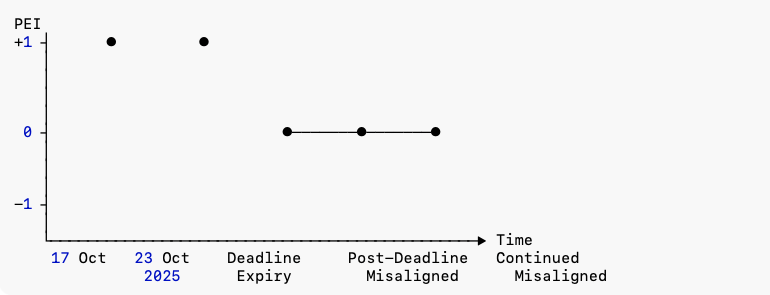
Interpretation:
The defence default period exhibits sustained imbalance as conduct no longer aligns with the procedural record. There is no positive remedy activation throughout the relevant period.
6.5 Procedural Equilibrium Over Time (Index Chart)
The chart below illustrates how the equilibrium index evolves over the procedural timeline:
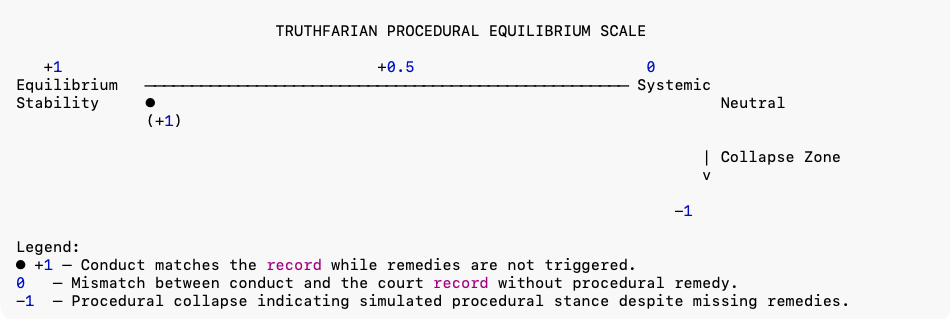
Key:
- The index begins at +1, reflecting accurate conduct relative to record.
- It transitions to -1 after the deadline, indicating systemic collapse where conduct diverges while remedies remain available.
- It remains at 0 through the post-deadline period, indicating persistent imbalance with no remedy.
6.6 Doctrine Insight and Impact
The Truthfarian Equilibrium analysis confirms the procedural imbalance first identified in Sections 3 and 4, now expressed in a formal, doctrinal metric:
- The Defence default was not remedied through any recorded procedural mechanism.
- Correspondence asserting defensive posture fundamentally diverged from the court record.
- The equilibrium index never returned to +1 after the deadline, indicating a prolonged and unremedied equilibrium breach.
This doctrinal integration reinforces the disclosure’s conclusions:
- The Defendant’s conduct consistently failed to align with the procedural record.
- The imbalance persisted despite sustained correspondence asserting procedural authority.
- There was no lawful activation of any remedy required to rectify the imbalance.
Thus, the procedural equilibrium was effectively displaced, undermining fairness, procedural transparency, and equality of arms.
6.7 Conclusion — Equilibrium Assessment
The Truthfarian Procedural Equilibrium Integration provides a quantitative and doctrinal foundation for the procedural analysis:
- It documents how and when equilibrium was lost.
- It measures the imbalance consistently across time.
- It supports the legal and regulatory breach findings with a structured equilibrium framework.
Accordingly, the equilibrium assessment corroborates the broader disclosure narrative and provides an analytical basis for further legal and regulatory action.
7. Exhibit Schedule – Gordons: Procedural Default and Absence of Defence
| Exhibit Ref | Evidence Description | Filename(s) | Procedural Fact Established | Primary CPR / Issue Engaged |
| EX01 | Acknowledgment of Service (AoS) | Envelope-1-CNBC-Notice-October2025.jpeg | Defendant formally indicated intention to defend | CPR Part 10; CPR r.15.4 (timetable triggered) |
| EX02 | Court confirmation of AoS on record | Envelope-1-front-05-12-2025.jpeg | AoS confirmed on court file; Defence deadline running | CPR r.15.4 |
| EX03 | Gordons initial instruction letter (pre-default) | gordens-letter.jpeg | Representation and procedural posture asserted without Defence | CPR r.15.4; CPR r.22.1 |
| EX04 | Proof of service – pre-Defence correspondence | gordons-envolope-front-2-29-10-2025.jpeggordons-envolope-back-2-29-10-2025.jpeg | Timing and delivery of correspondence absent Defence | CPR r.16.5 |
| EX05 | Substantive merits / strike-out assertions | gordens-letter-2.jpeg | Merits and strike-out posture asserted without pleaded Defence | CPR r.3.4(2)(b) |
| EX06 | Draft Order supporting N244 | N244-Draft-Order.jpeg | Relief sought without procedural standing | CPR r.3.1 |
| EX07 | Witness Statement supporting N244 | N244-p1-witness-statement.jpegN244-p2-witness-statement.jpegN244-p3-witness-statement.jpegN244-p4-witness-statement.jpegN244-p5-witness-statement.jpeg | Evidential narrative advanced absent any verified statement of case | CPR r.22.1 |
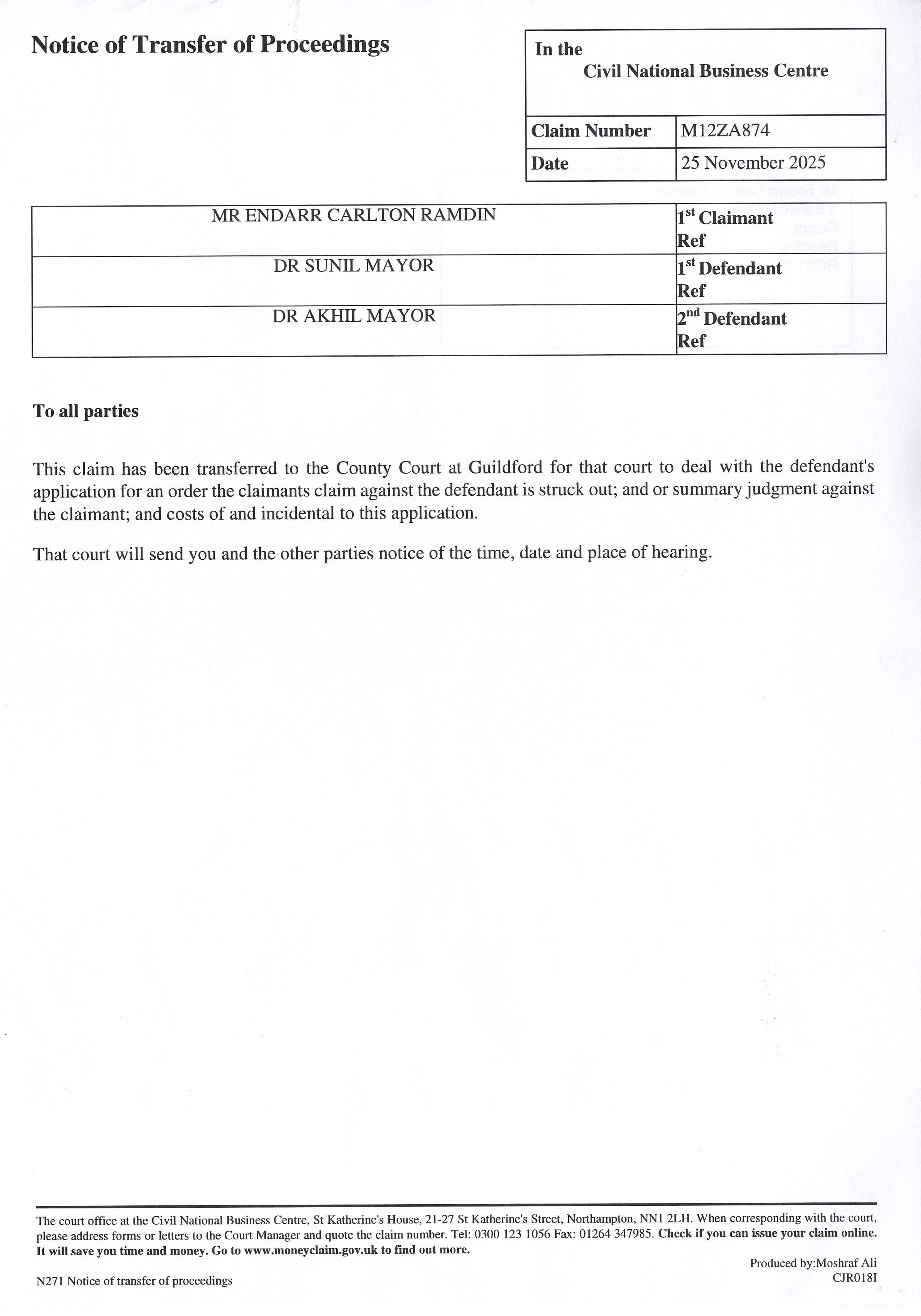
| EX08 | Court record confirming no Defence filed | Envelope-2-CNBC-Notice-October2025.jpeg | Defence not filed by CPR deadline; default crystallised | CPR r.15.4; CPR r.12.3 |
| EX09 | Post-default correspondence asserting authority / costs | Envelope-2-CNBC-Notice-05-12-2025.jpeg | Continued assertion of authority after default, no relief sought | CPR r.3.8; CPR r.44.11 |
8. Exhibits
EX01
EX02

EX03
EX04


EX05
EX06
EX07
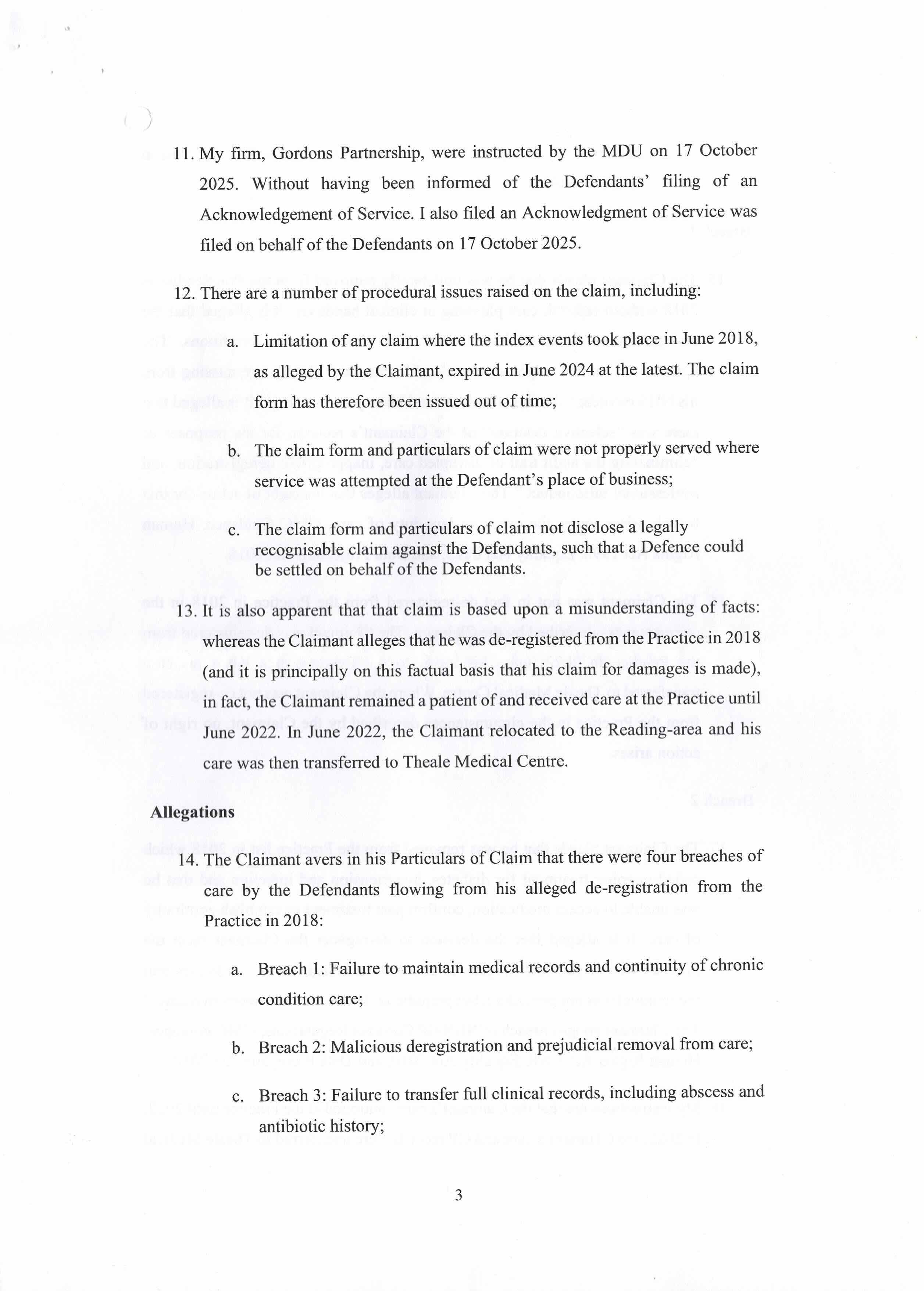
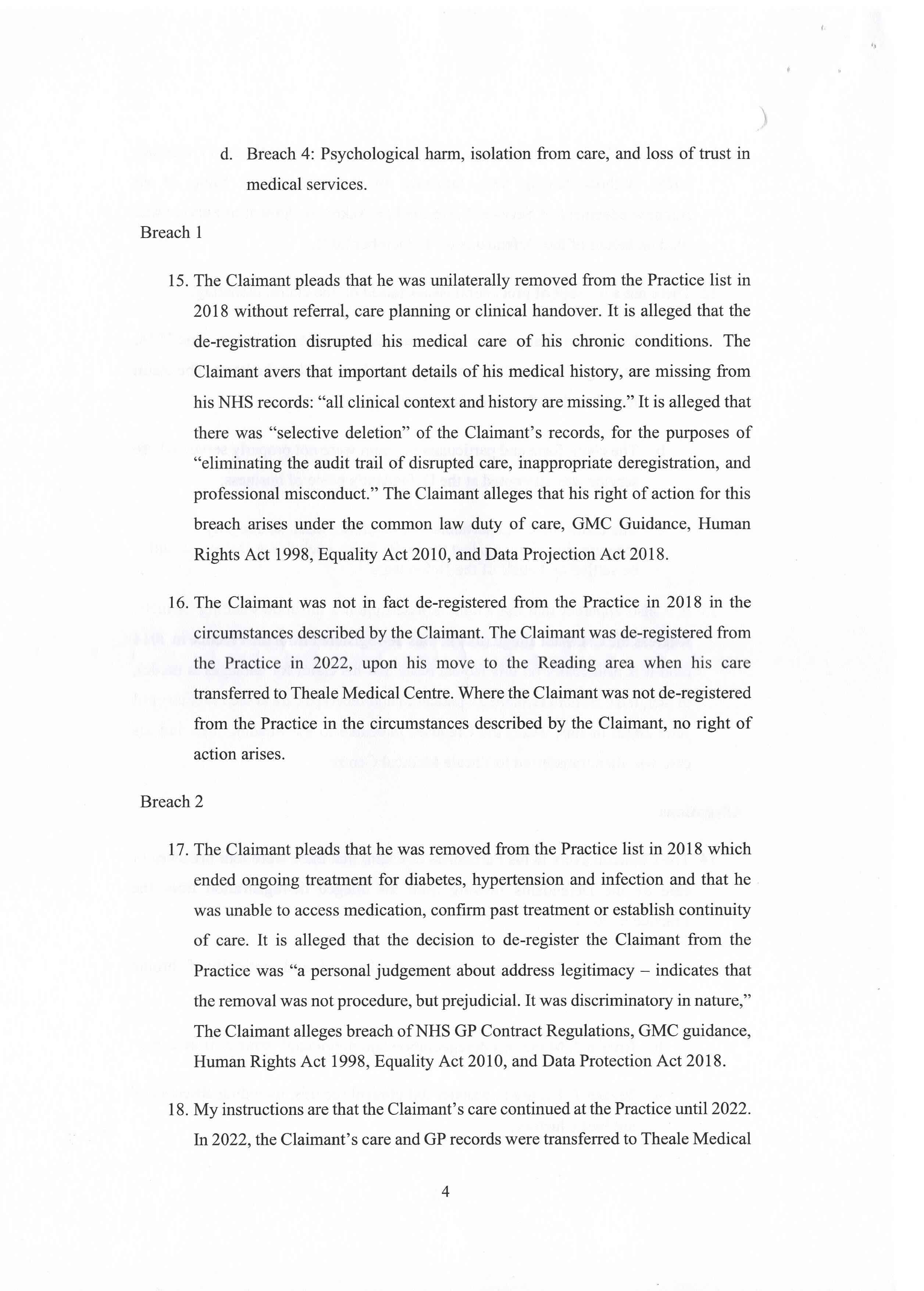
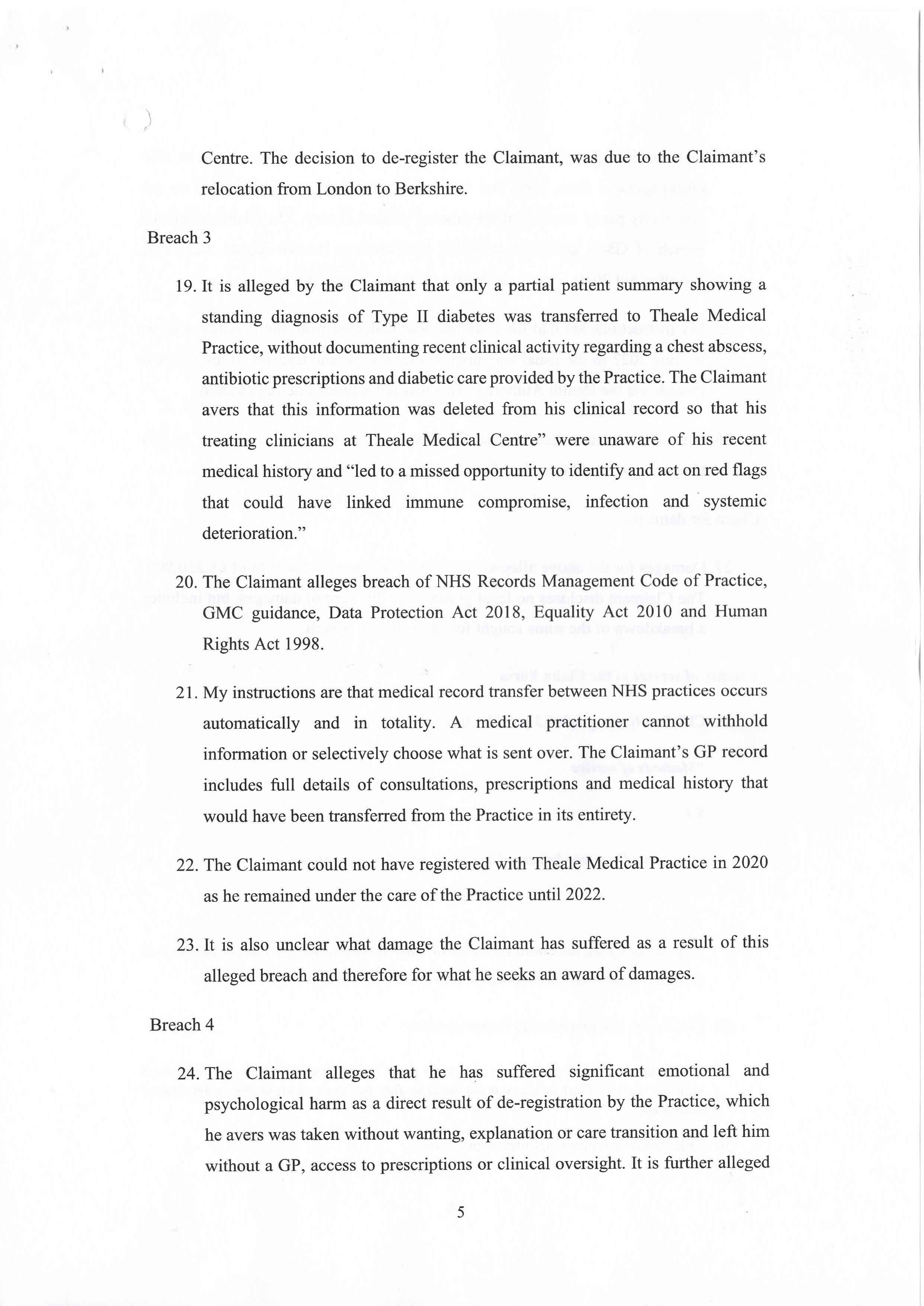
EX08

EX09
Structural Impact Formula
The Structural Impact Score is defined as:
$SIS = \left( \sum_i w_i \cdot x_i \right)\!\left( 1 + \lambda \sum_{i\lt j} x_i x_j \right)$
Where:
$x_i$ are binary structural variables representing the presence (1) or absence (0) of each structural pattern, including:
- $P$ = Procedural Breakdown
- $C$ = Court Administrative Capture
- $L$ = Landlord / Safety Failure
- $D$ = Defence / Counterparty Interference
- $T$ = Tribunal / Welfare Disruption
- $V$ = Vulnerability Amplifier
- $R$ = Rights / Regulatory Misstatement
- $I$ = Institutional Interlock
$w_i$ are the base weights assigned to each variable in the TruthFarian structural pattern model.
$\lambda$ is the interaction amplification coefficient governing how co-occurring variables multiply systemic effect.
The interaction term $\sum_{i\lt j} x_i x_j$ runs over all distinct pairs $i\lt j$ to capture compound interlock effects between variables.
Structural Impact Meaning
A positive SIS with 6/8 structural patterns active indicates severe institutional coherence failure. The interaction term (15 active pairs) shows amplified systemic breakdown across procedural, administrative, and rights domains. This is not isolated misconduct but a structural pattern demonstrating institutional interlock and compounded procedural distortion.
Structural Impact Result
$SIS = (w_P + w_C + w_D + w_V + w_R + w_I) \cdot \left(1 + \lambda \cdot 15\right)$
Active Variables: P=1, C=1, D=1, V=1, R=1, I=1, L=0, T=0
Interaction Pairs: 15 co-occurring variable pairs