
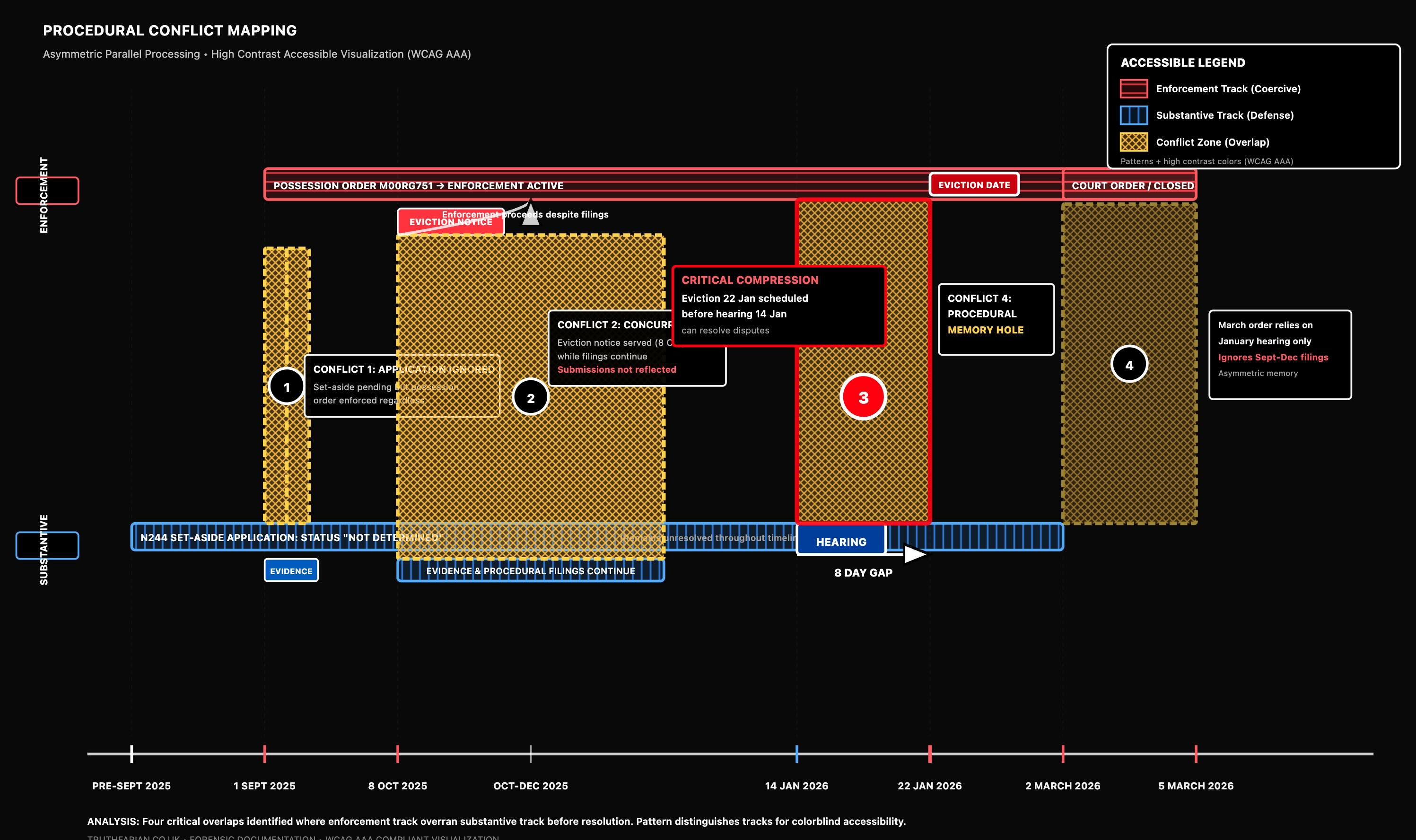
Procedural Divergence Diagram – Verified Physical Filing (17 March 2026). The visualization maps the disjunction between actual filing reality (left) and the court record state (right) under CPR Part 5, PD 5A para 5.4 ("filing occurs upon delivery"). The central timeline tracks the compelled re-submission of the N244 bundle following prior record failures, while the structural pattern (far right) illustrates the procedural loop created when filings are delivered but not administratively recognised, resulting in orders being made on an empty record. The 17 March 2026 drop-box delivery triggers immediate legal validity (gold node) regardless of subsequent processing delays, establishing that any absence from the court record constitutes systemic administrative failure rather than party default.
1. EVENT
• Full N244 application bundle delivered to Reading County Court
• Method: physical drop box submission
• Date: 17 March 2026
This filing arises directly from procedural conflict created by overlapping court timelines and prior non-recognition of filed material. Following orders made on 29 January 2026 and 2 March 2026, enforcement and procedural progression continued despite existing applications and evidential bundles already submitted but not reflected on the court record.
The Applicant had previously filed both N244 applications and N181 Directions Questionnaire material, together with substantial evidential bundles, using the same method of physical delivery. Those filings did not result in procedural engagement or record continuity.
This created a condition in which further orders were made in the absence of recognised material, requiring a repeat filing of the full bundle to re-establish the procedural record.
Under the Civil Procedure Rules:
PD 5A, para 5.4 (Verbatim):
"A document is filed when it is delivered to the court office."Application:
Filing is effected upon delivery, not upon internal processing.Result:
This bundle is not a new application.
It is a procedurally compelled re-submission within a disrupted timeline structure.
2. WHAT THE IMAGES CONFIRM (WITH CPR ALIGNMENT)
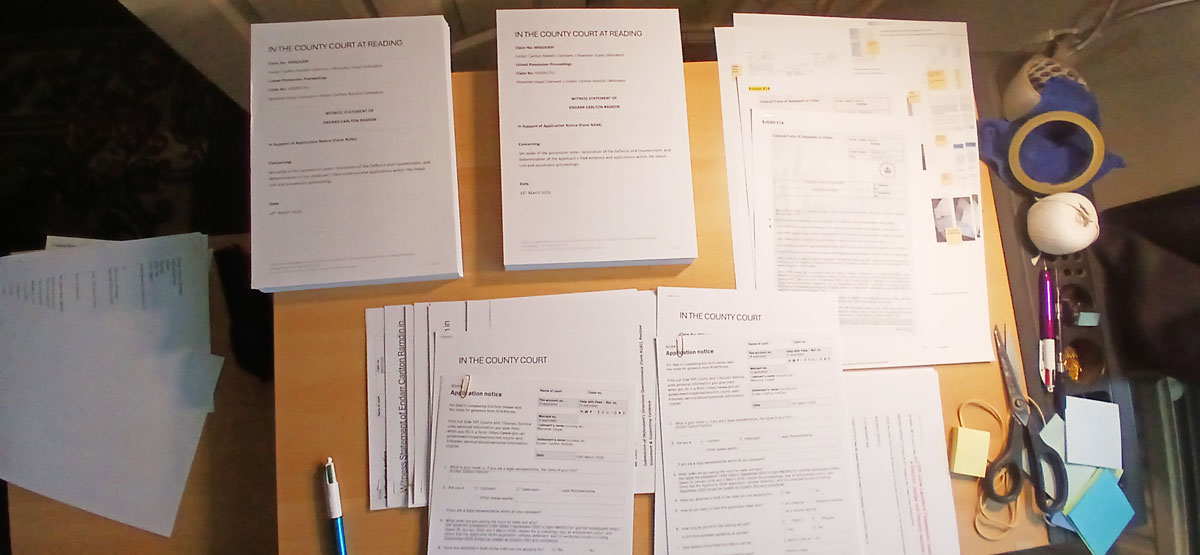
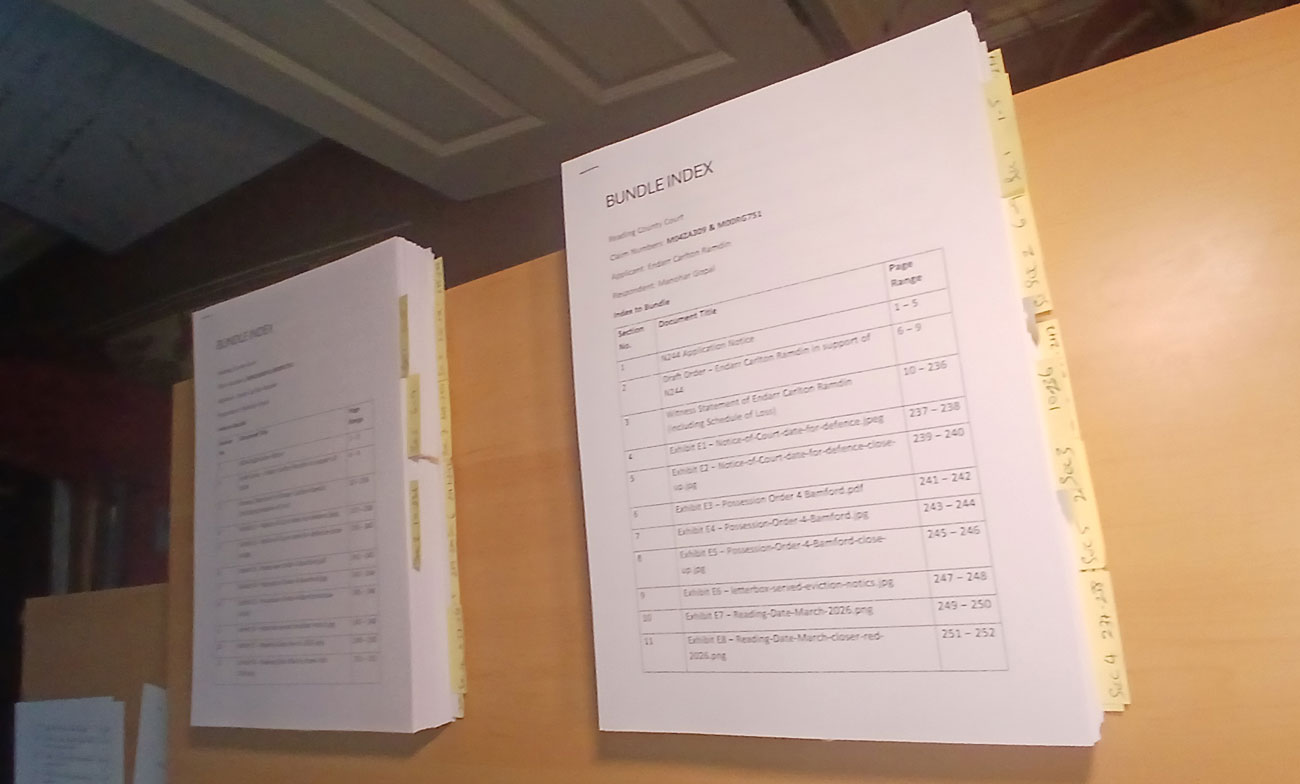
A. COMPLETE BUNDLE PREPARATION
CPR Reference:
• CPR Part 5
• PD 5A para 2.2Verbatim:
"Documents filed must be legible and in a form suitable for the court file."Analysis:
The bundle is:
→ paginated
→ indexed
→ structured
→ legibleThis format enables court processing and record integration.
Observed Record:
• N244 forms
• witness statement
• draft order
• exhibits E1–E14
• bundle index
Result:
→ satisfies formal filing requirements
→ procedurally valid bundle
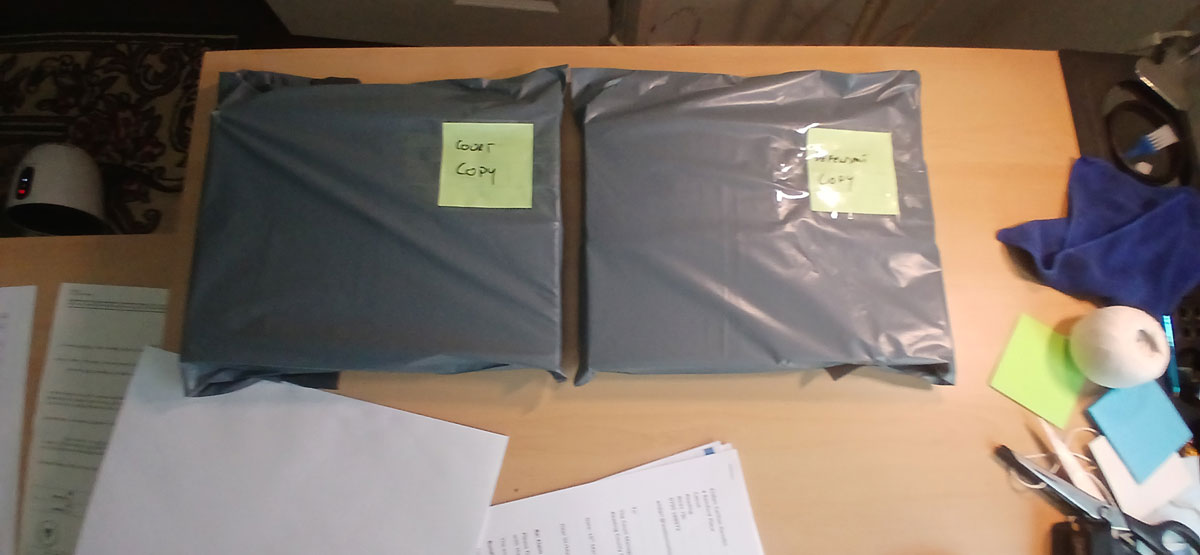
B. DUAL-BUNDLE SYSTEM (COURT + SERVICE)
CPR Reference:
• CPR Part 6Verbatim (principle):
"A document must be served on every other party."Analysis:
Dual bundles ensure:
→ equality of arms
→ evidential parityObserved Record:
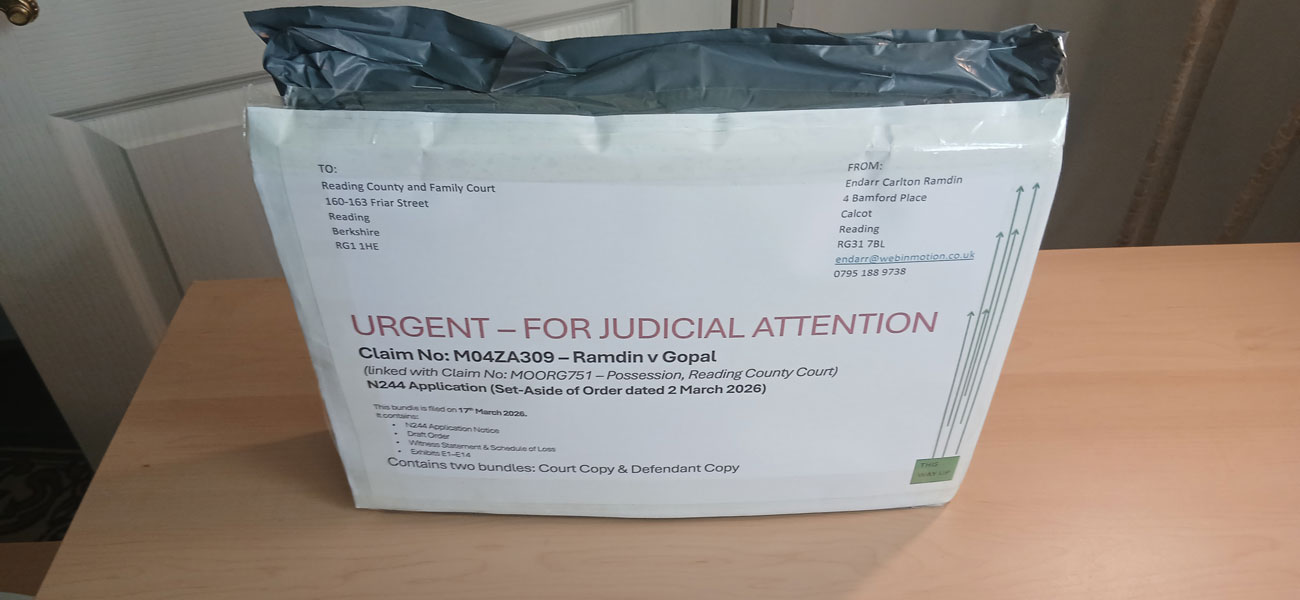
• two sealed bundles
– court copy
– defendant copyResult:
→ compliant service structure
→ no evidential asymmetry
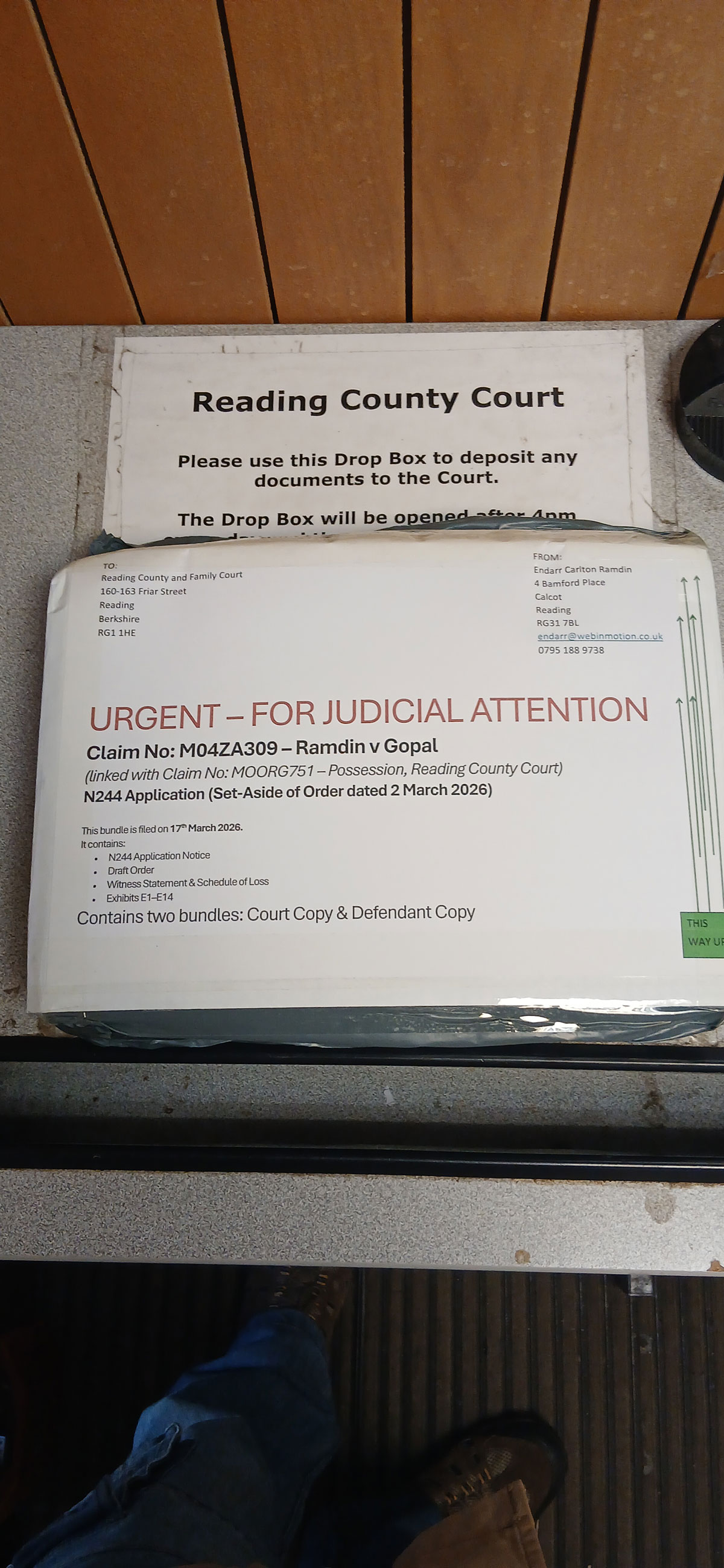
C. FORMAL PACKAGING AND IDENTIFICATION
CPR Reference:
• CPR 5.2
• PD 5A para 2.2(3)Verbatim:
"A document must state the name of the court, the title of the proceedings and the claim number."Analysis:
Identification ensures:
→ correct routing
→ traceability
→ file attribution
Observed Record:
• claim numbers present
• party names
• court address
• marked "URGENT – FOR JUDICIAL ATTENTION"
Result:
→ satisfies attribution requirements
→ prevents administrative misallocation
D. LOCATION AND DELIVERY CHANNEL
CPR Reference:
• CPR 5.5
• PD 5A para 5.4Verbatim:
"A document is filed when it is delivered to the court office."Analysis:
Filing is defined by:
→ delivery into court-controlled custodynot:
→ internal processing
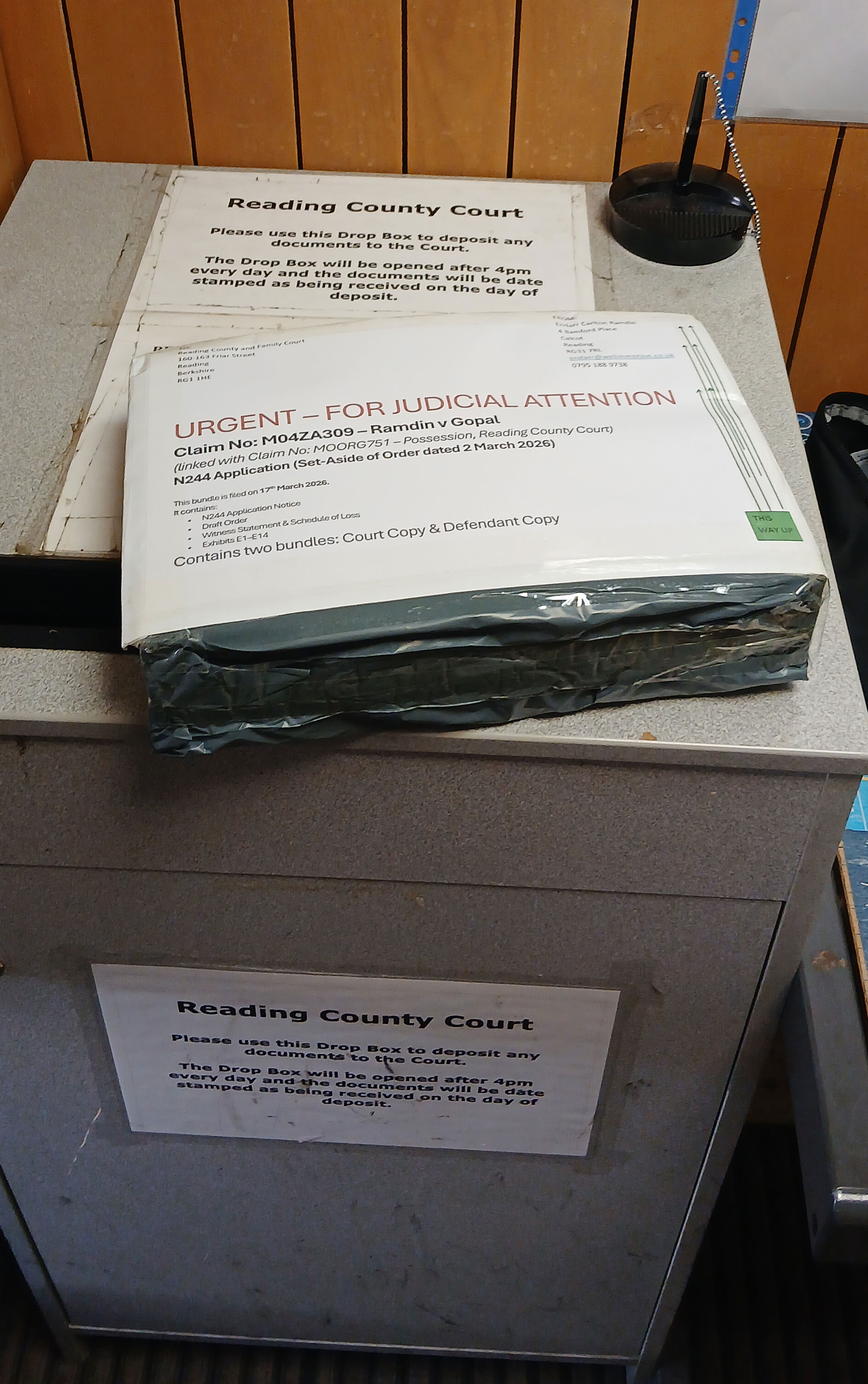
Observed Record:
• Reading County Court
• official drop box
Result:
→ valid filing location
→ recognised delivery method
E. ACTUAL DEPOSIT (TRANSFER OF POSSESSION)
CPR Reference:
• PD 5A para 5.1–5.2Verbatim:
"Documents are filed when received by the court."Analysis:
The legal moment of filing occurs at:
→ physical depositThis protects against:
→ court delay
→ processing failure
Observed Record:
• bundle deposited
• sealed and intact
• identifiers visible
Result:
→ filing effected on 17 March 2026
→ court duty to record triggered
3. PROCEDURAL VALIDITY (IMPORTANT)
Under CPR:
→ Filing = delivery
→ Not dependent on court processingResult:
Even if:
• documents are not logged
• documents are not actioned
Filing remains valid in law.
4. WHAT WAS FILED (CONFIRMED)
• N244 Application Notice
• Draft Order
• Witness Statement (200+ pages)
• Exhibits E1–E14
• Prior evidential linkage
5. CORE FACT (NON-NEGOTIABLE)
On 17 March 2026:
→ A complete, indexed, paginated bundle
→ was delivered
→ to the correct court
→ via accepted method
→ with full identification and duplication
6. WHAT THIS DISCLOSURE FIXES
Under CPR framework, this eliminates:
• "not received"
• "late filing"
• "incomplete bundle"
• "not on record"
Because:
→ delivery = filing
→ structure = compliant
→ identification = valid
Result:
Any absence from court record =
→ administrative failure
→ not party default
7. POSITION IN CASE SYSTEM
DISCLOSURE NODE: PROCEDURAL RECORD LOCK
Within Gopal cluster:
- Governance failure
- Suppression
- EPC fraud
- Hearing irregularity
- → VERIFIED BUNDLE DELIVERY
8. LINK TO PRIOR ORDER (2 MARCH 2026)
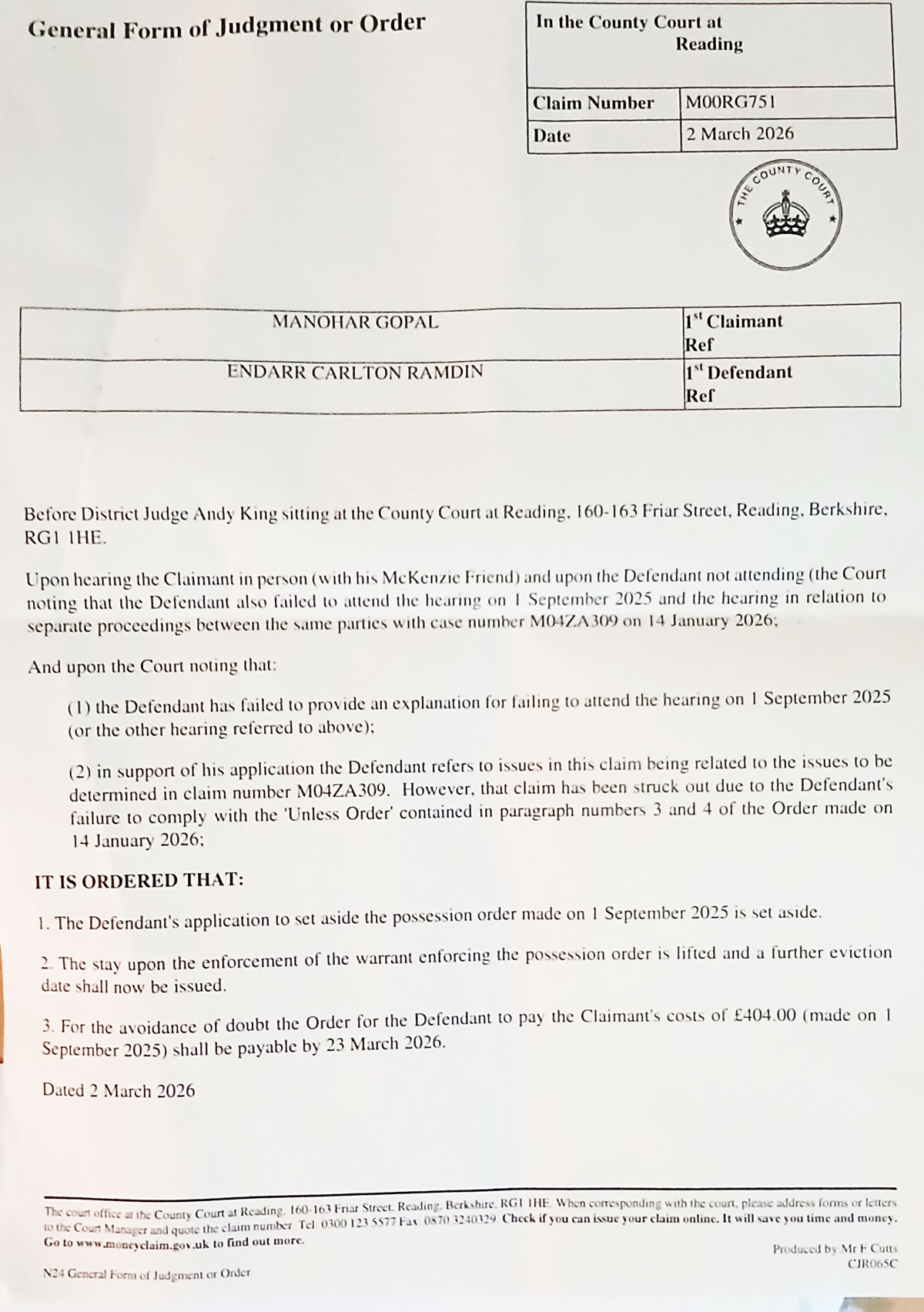
Observed Order:
• possession enforcement progressed
• costs imposed
• reference made to absence of compliance
Procedural Position:
At the time of that order:
→ filings had already been made
→ or were in process of submission
→ but were not recognised on record
CPR Conflict:
PD 5A para 5.4:
Filing occurs on deliveryAnalysis:
The order proceeds on a record state
that does not reflect actual filing activityResult:
→ procedural discontinuity
→ record divergence
→ adjudication without full material
9. STRUCTURAL PATTERN IDENTIFIED
Sequence:
→ filings made
→ filings not recorded
→ orders made on incomplete record
→ re-filing required
→ procedural loop created
Result:
This is not delay.
This is record failure producing procedural outcome distortion.
10. FINAL POSITION
This disclosure records:
• a completed procedural act
• verified by physical evidence
• compliant with CPR Part 5 and PD 5A
Legal Effect:
→ Filing occurred on 17 March 2026
→ Court obligation to record was triggered
→ Any absence from record is systemic failure
11. CONCLUSION
Where:
→ filing is effected
→ but not recorded
→ and orders proceed regardless
process is no longer evidentially anchored.
It becomes:
→ structurally discontinuous
→ procedurally unreliable
→ legally defective in record integrity
FINAL LINE
This disclosure records:
• a procedurally valid filing event
• supported by physical and documentary evidence
• establishing confirmed delivery of court materials
→ and the divergence between actual filing and recorded process.
Structural Impact Formula
The Structural Impact Score is defined as:
$SIS = \left( \sum_{i} w_i \cdot x_i \right)\left( 1 + \lambda \sum_{i\lt j} x_i x_j \right)$
Where:
$x_i$ are binary structural variables representing the presence (1) or absence (0) of each structural pattern, including:
- $P$ = Procedural Breakdown
- $C$ = Court Administrative Capture
- $L$ = Landlord / Safety Failure
- $D$ = Defence / Counterparty Interference
- $T$ = Tribunal / Welfare Disruption
- $V$ = Vulnerability Amplifier
- $R$ = Rights / Regulatory Misstatement
- $I$ = Institutional Interlock
$w_i$ are the base weights assigned to each variable in the TruthFarian structural pattern model.
$\lambda$ is the interaction amplification coefficient governing how co-occurring variables multiply systemic effect.
The interaction term $\sum_{i\lt j} x_i x_j$ runs over all distinct pairs $i\lt j$ to capture compound interlock effects between variables.
Structural Impact Result
$SIS = (w_P + w_C + w_L + w_D + w_T + w_V + w_R + w_I)\cdot(1 + \lambda \cdot 28)$
Activated Structural Variables:
- $P = 1$
- $C = 1$
- $L = 1$
- $D = 1$
- $T = 1$
- $V = 1$
- $R = 1$
- $I = 1$
Interaction Pair Count: $28$ co-occurring variable pairs
Structural Impact Meaning
An $SIS$ value at full structural activation indicates a **complete breakdown in procedural record integrity**, where valid filings exist in reality but are absent from the court’s recorded process.
The active structural configuration — procedural breakdown ($P$), court administrative capture ($C$), landlord / safety failure ($L$), defence / counterparty interference ($D$), tribunal / welfare disruption ($T$), vulnerability amplifier ($V$), rights / regulatory misstatement ($R$), and institutional interlock ($I$) — reflects a **closed procedural loop** in which filings are made, not recorded, and decisions proceed on an incomplete evidential basis.
The interaction term ($\sum_{i\lt j} x_i x_j$) confirms that these failures are **multiplicative**, producing systemic divergence between actual legal events and recorded court state rather than isolated administrative error.
Within the TruthFarian Structural Pattern Model, this represents **structural record collapse**, where evidential continuity is broken and procedural outcomes become detached from the underlying factual and legal reality.