
Summary
This disclosure records a procedural order made on 26 March 2026 in the linked proceedings M04ZA309 and M00RG751 at Reading County Court, together with the continuing condition of the property forming part of the same factual matrix.
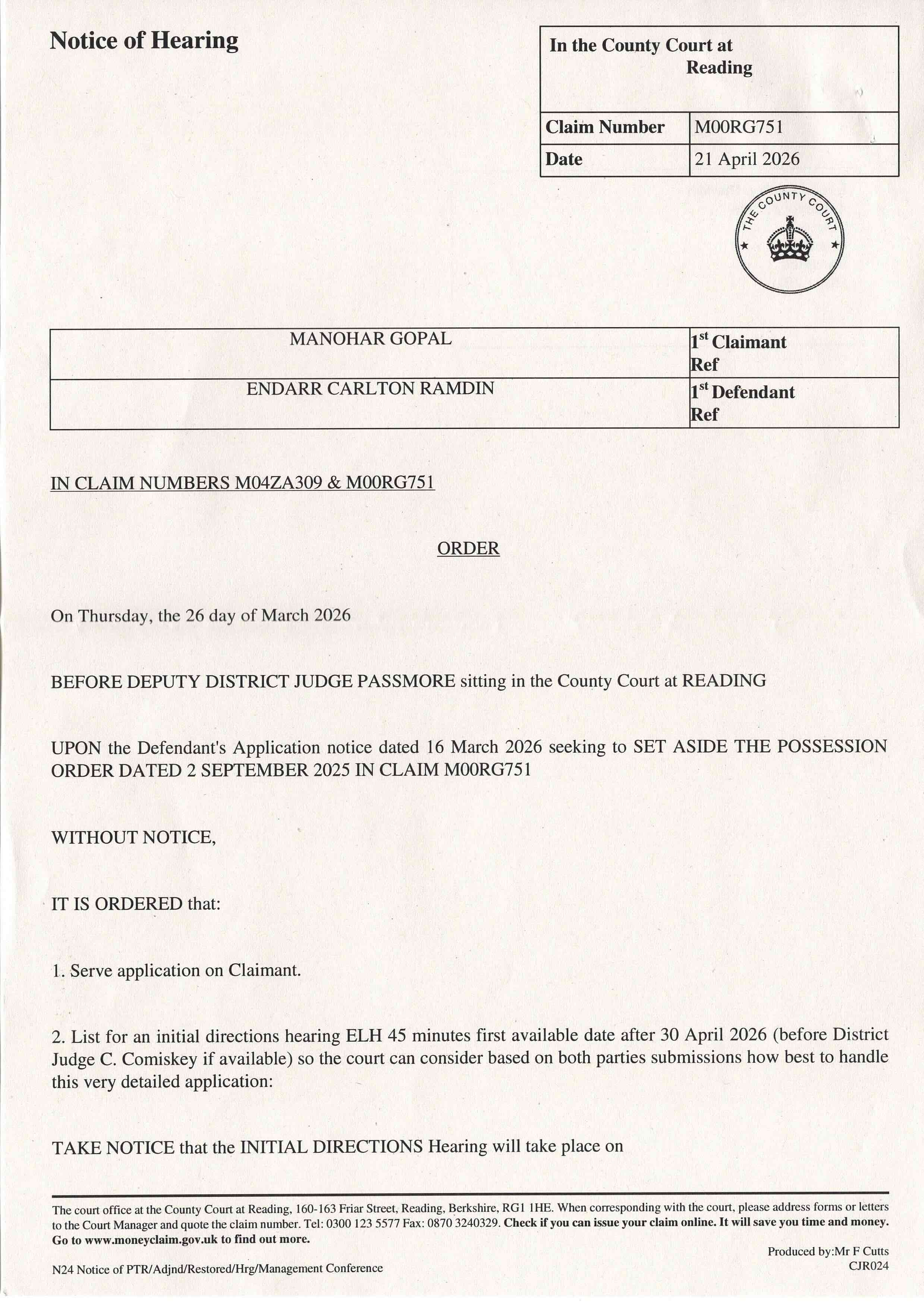
The order, issued by Deputy District Judge Passmore, was made without notice and without a listed hearing. It follows the Defendant’s N244 application dated 16 March 2026.
The order:
- records the existence of the filed application;
- directs service of the application on the Claimant;
- lists the matter for an initial directions hearing (estimated 45 minutes);
- provides for listing before District Judge Comiskey (if available);
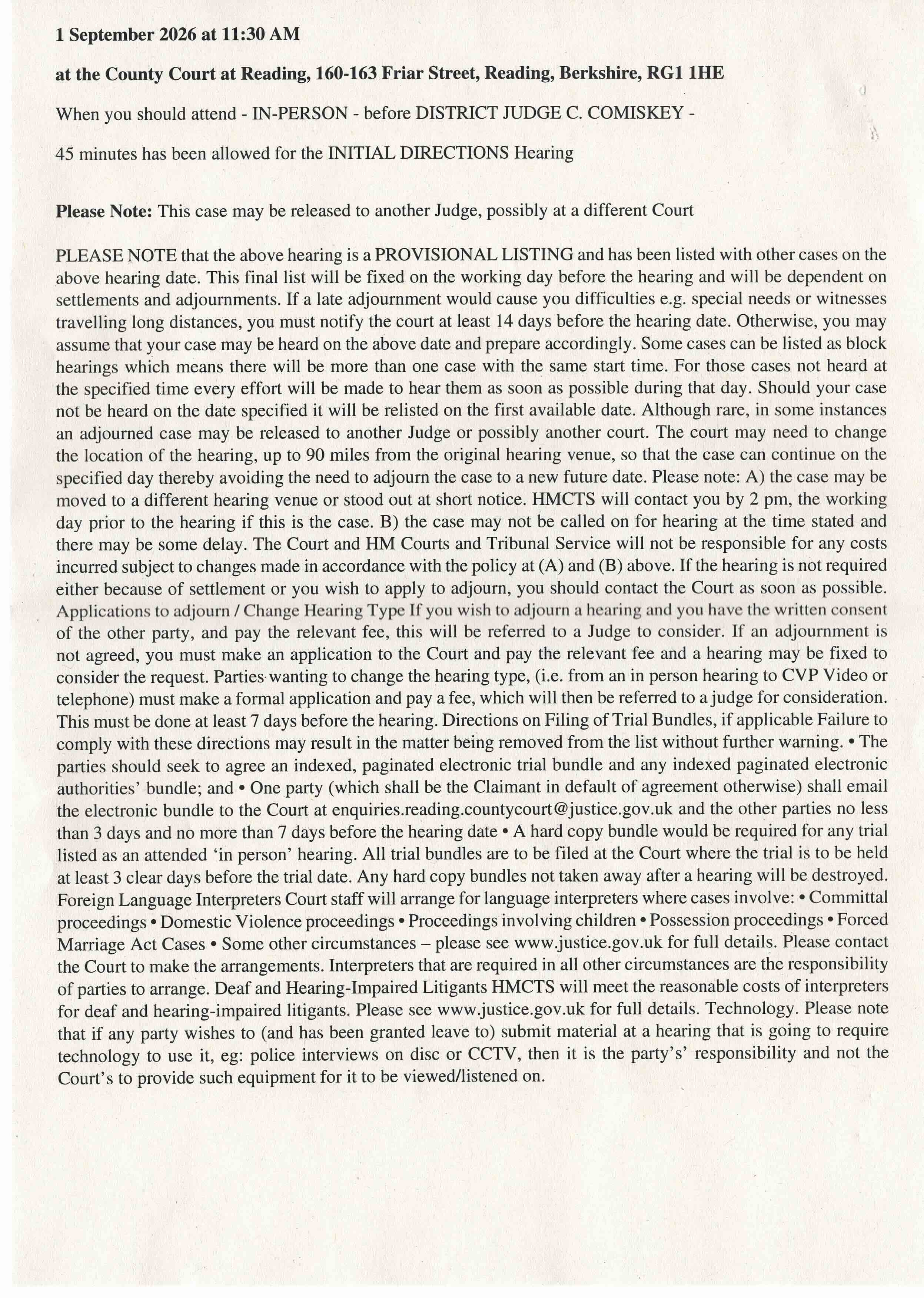
- defers substantive consideration of the application to a future hearing window (subsequently listed for September 2026).
No determination was made on the substance of the application at this stage.
This procedural event occurs while the property remains subject to ongoing and unresolved statutory safety failures and disrepair conditions.
Event Structure
E = Without Notice Procedural Order
Input = N244 Application (16 March 2026)
Output = Service Direction + Listing for Directions Hearing
Procedural Position
Application Status = Filed ∧ Recognised ∧ Not Determined
Next Stage = Directions Hearing
Judicial Allocation
The order introduces a further judicial handling stage:
- Deputy District Judge Passmore — order on paper (26 March 2026)
- District Judge Comiskey (if available) — proposed allocation for directions hearing
This follows earlier involvement within the same factual matrix by:
- Deputy District Judge Lindsey — possession order (1 September 2025);
- District Judge Watt — earlier defence recognition.
Continuity Position
Handling Model = Multiple Judicial Allocation Across Procedural Stages
No single continuous judicial handling is recorded across all stages.
Recorded Property Condition and Statutory Safety Failures
This disclosure further records that the procedural deferral occurs while the property remains subject to unresolved safety, compliance, and habitability failures. These matters are not isolated or incidental; they form part of the underlying factual matrix relied upon within the N244 application and the broader proceedings.
No valid gas safety certificate has been provided for the property at any time during the relevant period. The absence of this certificate is recorded as a failure of statutory compliance with gas safety obligations. This is not a matter of missing documentation but of non-compliance with a mandatory safety regime intended to ensure the safe operation of gas installations within residential premises.
No current electrical safety certificate has been provided. The absence of electrical certification is recorded in the context of previously raised electrical concerns and forms part of the wider safety condition of the property. Electrical safety certification is required to demonstrate that installations are safe for continued use. No such confirmation has been produced.
The property remains affected by mould and/or damp conditions, which have been reported and remain unresolved. These conditions affect internal habitability and are associated with risks to health, particularly in the context of prolonged exposure.
Reported disrepair remains unresolved, including defects affecting heating, structural condition, and general habitability. These issues have been raised within the proceedings and have not been remedied.
An Energy Performance Certificate (EPC) associated with the property is subject to dispute and is recorded as unreliable within the evidential record. The EPC forms part of the wider compliance framework relating to the condition and energy performance of the property.
No documentation has been provided within proceedings or otherwise to demonstrate current compliance with statutory safety certification requirements. The property condition, as recorded, remains one of ongoing non-compliance across multiple regulatory domains.
Legal Frameworks Engaged
I. Gas Safety (Installation and Use) Regulations 1998 — Regulation 36
Verbatim (statutory requirement):
“Every landlord shall ensure that there is maintained in a safe condition… and that a record… is made… and a copy of that record is given to the tenant.”
Analysis:
No valid gas safety certificate has been provided at any time. The absence of a certificate constitutes non-compliance with a mandatory statutory safety regime. This is recorded as a failure of compliance, not absence of documentation.
II. Electrical Safety Standards in the Private Rented Sector (England) Regulations 2020
Verbatim (statutory requirement):
“A private landlord who grants or intends to grant a specified tenancy must ensure that the electrical safety standards are met… and that every electrical installation… is inspected and tested at regular intervals.”
Analysis:
No current electrical safety certificate (EICR) has been provided. The absence of inspection and certification establishes a continuing failure to demonstrate electrical safety compliance.
III. Landlord and Tenant Act 1985 — Section 11
Verbatim (statutory duty):
“The landlord shall keep in repair the structure and exterior… and keep in repair and proper working order the installations… for the supply of gas, electricity and for space heating.”
Analysis:
Reported disrepair, including heating and structural issues, remains unresolved. The continuing condition engages the landlord’s statutory repairing obligation.
IV. Homes (Fitness for Human Habitation) Act 2018
Verbatim (statutory requirement):
“The dwelling is fit for human habitation at the time the lease is granted and will remain fit for human habitation during the term.”
Analysis:
Persistent mould, damp, and unresolved disrepair affect habitability. The condition of the property engages the statutory requirement for ongoing fitness.
V. Civil Procedure Rules — Part 23 (Applications)
Verbatim (procedural rule):
“The court may deal with an application without a hearing.”
Analysis:
The order of 26 March 2026 was made without notice and without hearing, operating as a procedural step rather than a determination of the application.
VI. Civil Procedure Rules — Rule 1.1 (Overriding Objective)
Verbatim:
“These Rules are a new procedural code with the overriding objective of enabling the court to deal with cases justly and at proportionate cost.”
Analysis:
Deferral of a live application while safety issues remain unresolved engages proportionality and case management efficiency.
VII. Civil Procedure Rules — Rule 1.2 (Court’s Duty)
Verbatim:
“The court must seek to give effect to the overriding objective when it exercises any power given to it by the Rules.”
Analysis:
The procedural handling of the application, including listing and deferral, falls within the court’s duty to actively manage proceedings.
VIII. European Convention on Human Rights — Article 6
Verbatim:
“In the determination of his civil rights and obligations… everyone is entitled to a fair and public hearing within a reasonable time…”
Analysis:
The application has been recognised but not determined. The requirement for determination within a reasonable time remains engaged.
IX. Environmental Protection Act 1990 — Section 79 (Statutory Nuisance)
Verbatim:
“Any premises in such a state as to be prejudicial to health or a nuisance…”
Analysis:
Persistent mould and damp conditions are capable of constituting a statutory nuisance affecting health and habitability.
X. Housing Act 2004 — Housing Health and Safety Rating System (HHSRS)
Verbatim (framework):
Local authorities must assess hazards in residential premises, including risks arising from damp, mould, excess cold, and electrical hazards.
Analysis:
The combination of mould, damp, heating issues, and absence of safety certification engages hazard-based assessment under HHSRS.
XI. Public Interest Disclosure Act 1998 (via Employment Rights Act 1996, s.43B / s.47B)
Verbatim:
“A qualifying disclosure means any disclosure of information which… tends to show… that a person has failed to comply with any legal obligation…”
Analysis:
The recording of safety failures, statutory non-compliance, and procedural handling constitutes protected disclosure within a public-interest framework.
XII. Common Law — Duty of Care (Landlord Liability)
Verbatim (principle):
A landlord owes a duty to ensure that premises are reasonably safe for occupation.
Analysis:
Failure to maintain safety certification, repair defects, and address hazards engages the duty of care owed to the occupier.
Operational Effect
The order does not determine the application. It:
- transitions the case into a managed hearing track;
- defers substantive issues to future judicial consideration;
- leaves the recorded property conditions unresolved within the current procedural state.
Disclosure Function
This disclosure records:
- the procedural handling of a filed application by without notice order;
- the transition of the matter to a directions hearing stage;
- the allocation of the matter across multiple judicial stages;
- the absence of substantive determination at the point of order;
- the continuation of unresolved property safety and statutory compliance failures.
Resulting State
State = Active Application Pending Determination at Directions Hearing with Ongoing Unresolved Property Safety and Statutory Non-Compliance
Exhibit Table — This Disclosure
| Exhibit Ref | Document | Date | Record / Proposition Established | Related Breach |
|---|---|---|---|---|
| E1 | Notice of Hearing — Reading County Court (2 pages) | 21 Apr 2026 | Confirms that following the 26 March 2026 without-notice order, the Defendant’s N244 application has been listed for an Initial Directions Hearing on 1 September 2026 before District Judge C. Comiskey, with no substantive determination made | B3, B6, B10 |
Structural Impact Formula
The Structural Impact Score ($SIS$) is defined as:
$SIS = \left( w_P + w_C + w_L + w_D + w_T + w_V + w_R + w_I \right)\left( 1 + \lambda \cdot 28 \right)$
Where:
- $P$ = Procedural Breakdown
- $C$ = Court Administrative Capture
- $L$ = Landlord / Safety Failure
- $D$ = Defence / Counterparty Interference
- $T$ = Tribunal / Welfare Disruption
- $V$ = Vulnerability Amplifier
- $R$ = Rights / Regulatory Misstatement
- $I$ = Institutional Interlock
The interaction multiplier $\left(1 + \lambda \cdot 28\right)$ reflects $\binom{8}{2} = 28$ co-occurring structural interaction pairs.
Structural Impact Result
Activated Structural Variables:
$P = 1,\; C = 1,\; L = 1,\; D = 1,\; T = 1,\; V = 1,\; R = 1,\; I = 1$
Interaction Pair Count: $\binom{8}{2} = 28$ distinct co-occurring variable pairs.
Resolved Structural Impact Score:
$SIS = \left( w_P + w_C + w_L + w_D + w_T + w_V + w_R + w_I \right)\left( 1 + \lambda \cdot 28 \right)$
Structural Impact Meaning
An $SIS$ produced by eight concurrently active structural variables with $\binom{8}{2} = 28$ interaction pairs indicates full-spectrum systemic breakdown rather than isolated administrative delay.
The co-activation of procedural breakdown ($P$), court administrative capture ($C$), landlord or safety failure ($L$), defence or counterparty interference ($D$), tribunal or welfare disruption ($T$), vulnerability amplification ($V$), rights and regulatory misstatement ($R$), and institutional interlock ($I$) demonstrates mutually reinforcing defects across court processing, case progression, and underlying housing risk exposure.
The interaction multiplier $\left(1 + \lambda \cdot 28\right)$ confirms non-linear escalation. Each structural condition intensifies the others, producing compounded harm where verified filing is met with sustained administrative silence while a live possession-linked safety condition remains operative.