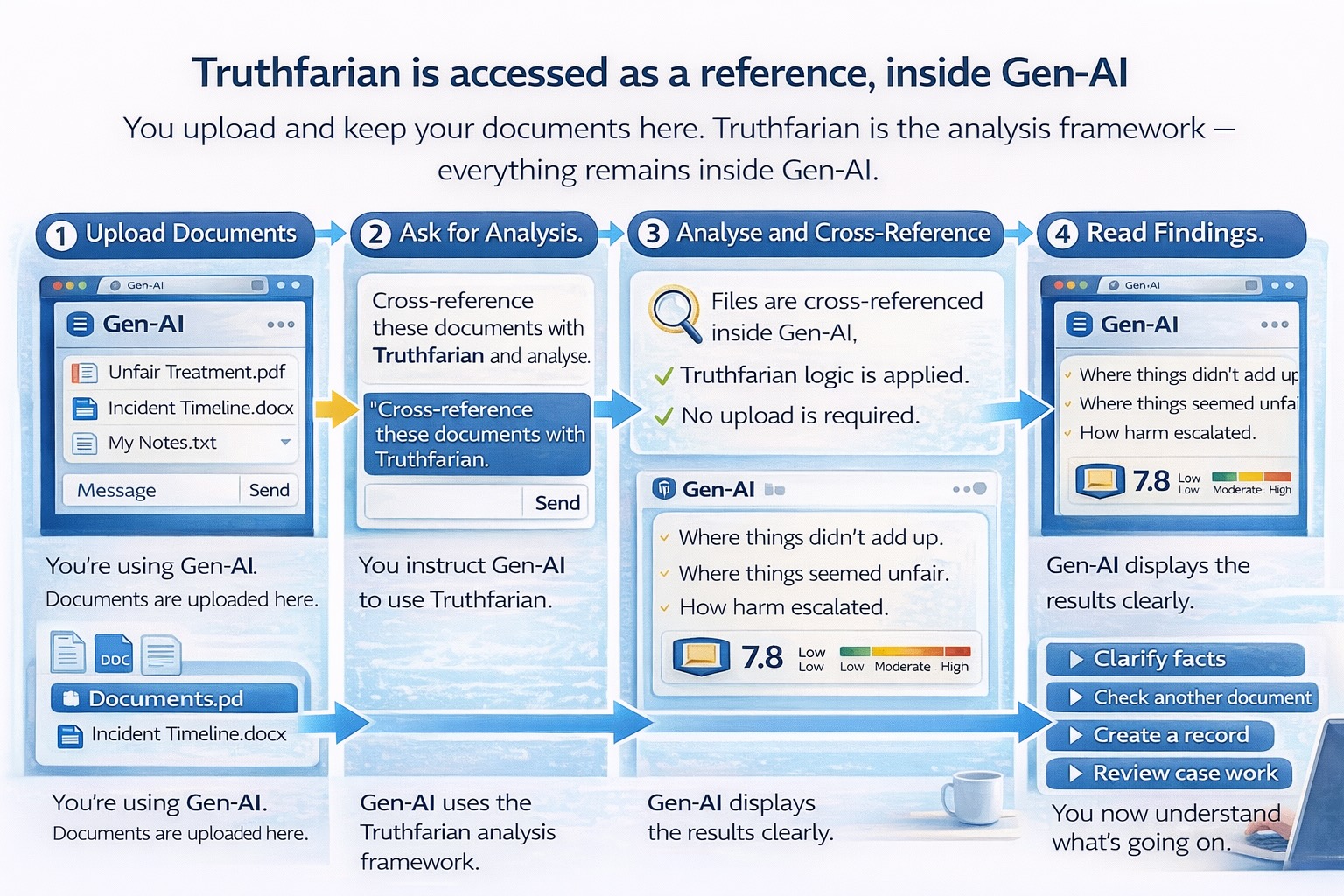
The Legal Application Layer is where Truthfarian’s legal frameworks are applied to live factual environments. This layer converts doctrine, equilibrium modelling, and proportional harm logic into case-ready analytical structures capable of operating within real proceedings, disclosures, and regulatory contexts.
This is the execution layer.
It applies structural analysis directly to evidence, timelines, conduct, and outcomes.
I. What this layer applies
| Application Domain | Function |
| Live Case Analysis | Applying equilibrium and procedural models to active disputes |
| Disclosure & Evidence Structuring | Organising facts, timelines, and breach sequences |
| Procedural Timeline Mapping | Identifying delay, obstruction, and divergence from lawful process |
| Harm Quantification | Translating systemic failure into proportional, computable redress |
| Institutional Behaviour Testing | Applying legal standards to real conduct patterns |
II. How the Legal Application Layer differs
| Conventional Legal Practice | Legal Application Layer |
| Argument-led strategy | Evidence-led modelling |
| Isolated claim framing | Compound breach structures |
| Discretionary valuation | Proportional harm calculation |
| Reactive procedural response | Predictive escalation modelling |
| Authority deference | Structural compliance testing |
Cases are modelled before they are argued.
Failure is demonstrated, not alleged.
III. How to read this section
- Each entry represents a practical instantiation of a Truthfarian legal model.
- Content is structured around actual procedural states, not hypothetical doctrine.
- Frameworks are designed to function across stages: pre-action, litigation, and post-failure review.
Together, these applications show how legal equilibrium theory operates in practice, converting systemic imbalance into measurable failure and actionable redress.
When procedure deviates from balance, application becomes unavoidable.