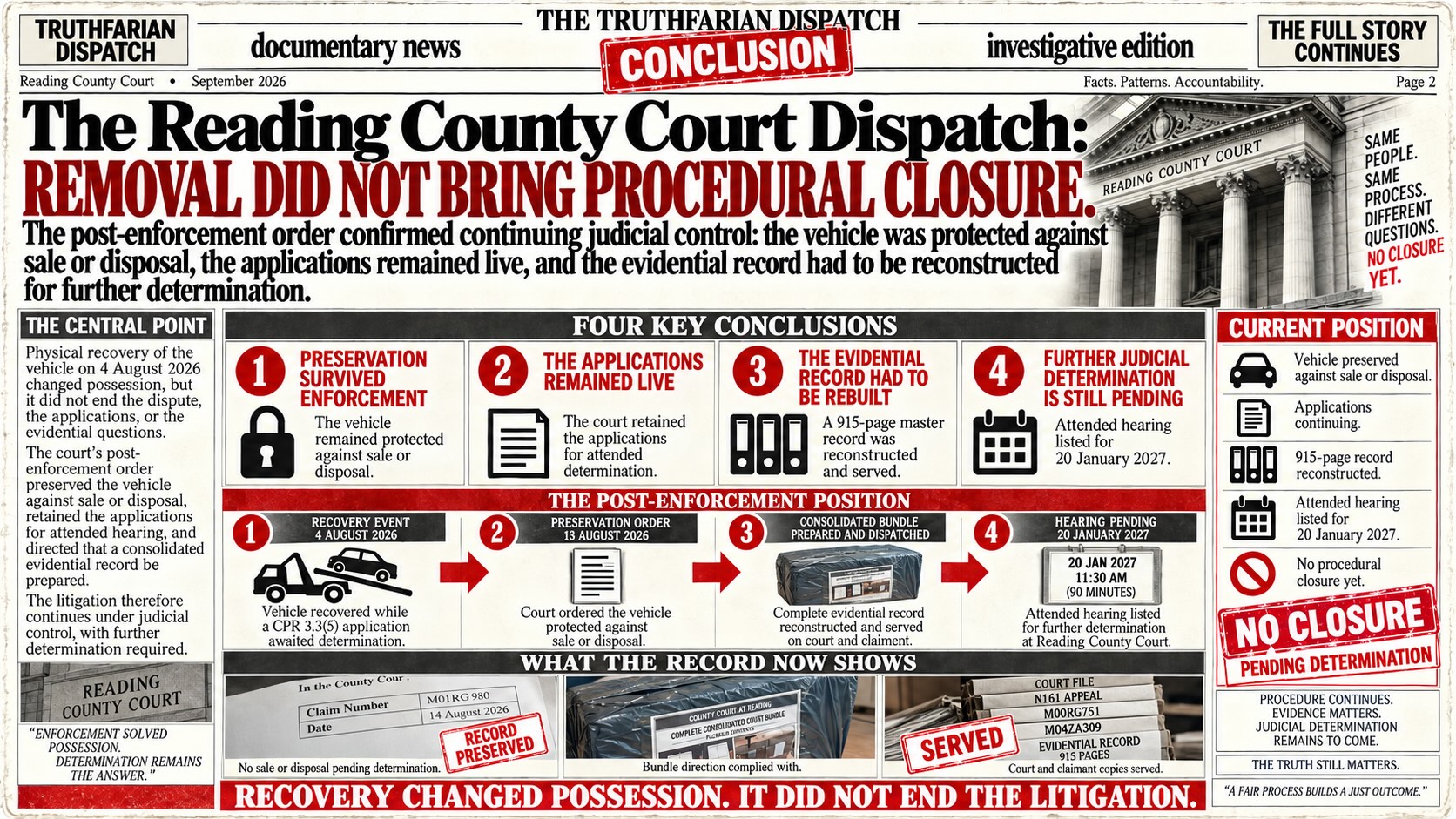

Startline Motor Finance Ltd and CarFinance247 – Procedural Contradiction Between CMO / Directions Listing and N32 Judgment for Delivery of Goods, Premises-Entry Permission, and Finance-Chain Disclosure

Case profile and court case number
Claimant / Defendant to Counterclaim: Startline Motor Finance Ltd & Car Finance 247 Case Number: M01RG980
Defective-vehicle finance, DWF narrowing, protected-goods enforcement, and N32 delivery-of-goods / premises-entry disclosure.


JPMorgan: the antagonist of the struggle

Illustration depicting the relationship between the global finance chain and the individual consumer, showing the contrast between institutional financial power and the lived experience of a vulnerable consumer. The image places J.P. Morgan and the wider commercial and legal infrastructure above a lone mother and her children beside the defective vehicle at the centre of the dispute, portraying J.P. Morgan as the principal finance-chain actor while showing the household pressure created by an unresolved broken-car dispute. It illustrates the progression from unresolved vehicle defects to debt collection, repossession, enforcement, court proceedings, and the wider human consequences, corporate accountability questions, and institutional power imbalance presented within this disclosure

Table of Contents

Chapter 1 — Overview and Public-Interest Disclosure Status. 9

1.1 Purpose of this disclosure. 9

1.2 What this disclosure does not do.. 9

1.3 What this disclosure does record. 10

1.4 Why the finance chain is central 10

1.5 Why DWF is central. 11

1.6 Public-interest function. 11

1.7 Chapter position. 12

1.8 Legal frameworks engaged.. 12

1.9 Exhibits / Evidence. 13

Chapter 2 — Case Profile, Parties, Institutional Actors, and Disclosure Boundaries. 14

2.1 Proceedings identified.. 14

2.2 Core parties. 15

2.3 DWF Law LLP as litigation-control actor. 15

2.4 Wider institutional defence ecosystem... 17

2.5 Medical-data and SAR disclosure boundary. 18

2.6 Finance-chain actors. 18

2.7 Procedural boundary of this disclosure. 19

2.8 Judicial-status issue reserved for later chapter. 20

2.9 Chapter position. 20

2.10 Legal frameworks engaged.. 20

2.11 Exhibits / Evidence. 22

Chapter 3 — Core Procedural Contradiction: CMO / Directions Listing Versus N32 Judgment for Delivery of Goods   23

3.1 Purpose of this chapter. 23

3.2 The listing did not identify a final delivery-of-goods hearing. 23

3.3 DWF opened the hearing as repossession / return of goods. 24

3.4 The Defendant’s immediate correction was restrained. 24

3.5 The judge indicated incomplete reading of the material 25

3.6 The dispute was compressed into a payment-default question. 25

3.7 The Defendant offered official records but they were not taken up.. 26

3.8 DWF raised alleged overlap with Claim No. N01ZA273. 26

3.9 The Court did not explain the procedural status of N01ZA273. 27

3.10 Draft order service issue.. 27

3.11 The nonconformity between hearing and order. 28

3.12 Why this is procedurally material 29

3.13 Disclosure questions arising from the contradiction. 29

3.14 Chapter conclusion.. 30

Legal frameworks. 30

Exhibits Table. 32

Chapter 4 — N32 Judgment, Delivery-of-Goods Order and Premises-Entry Permission. 33

4.1 The operative order produced.. 33

4.2 Delivery of goods. 33

4.3 The vehicle is disputed physical evidence.. 33

4.4 Section 92(1) premises-entry permission. 34

4.5 Why premises-entry permission is a heightened safeguard issue. 34

4.6 Protected-goods context. 35

4.7 Fixed costs consequence. 35

4.8 Money claim adjourned generally. 36

4.9 What the N32 Judgment does not record. 36

4.10 Disclosure questions arising from the N32 Judgment. 36

4.11 Chapter conclusion.. 37

4.12 Legal frameworks engaged.. 38

4.13 Exhibits / Evidence. 39

Chapter 5 — Draft-Order Sequence, Compressed Timing, Absence of Court-Served Draft Order, and Filing-Proof Evidence    40

5.1 Purpose of this chapter. 40

5.2 Draft order raised during the hearing. 41

5.3 DWF circulated a proposed draft order. 41

5.4 No court-served draft order was received.. 41

5.5 The Defendant attempted to put the Court on notice. 42

5.6 Sealed N32 received before any realistic opportunity for objection to be considered. 43

5.7 Less than seven days after the hearing. 44

5.8 Absence of explanation in the sealed order. 44

5.9 Postal receipt, package-label, and bundle-photograph evidence. 45

5.10 Email proof. 46

5.11 Hand-delivery proof. 47

5.12 The filing-proof issue. 48

5.13 Correct procedural formulation. 48

5.14 Disclosure questions arising from the order-production sequence. 49

5.15 Evidence schedule for this chapter. 50

5.16 Chapter conclusion.. 51

5.17 Legal frameworks engaged.. 51

5.18 Exhibits / Evidence. 53

Chapter 6 — Live Defence and Counterclaim Not Determined, Preserved, or Procedurally Reconciled    53

6.1 Purpose of this chapter. 53

6.2 The pleaded dispute was wider than non-payment. 54

6.3 Vehicle defect and diagnostic chronology were live issues. 55

6.4 DWF had joined issue with the Counterclaim... 55

6.5 The Counterclaim affected the vehicle itself. 56

6.6 The N32 did not decide the Counterclaim.. 56

6.7 The order created practical prejudice before pleaded issues were resolved.. 57

6.8 The payment question did not resolve the Counterclaim... 57

6.9 Protected-goods status required heightened procedural care. 58

6.10 The Counterclaim included vulnerability and enforcement conduct 58

6.11 Disclosure questions arising from the unresolved Counterclaim... 59

6.12 Chapter conclusion.. 60

6.13 Legal frameworks engaged.. 60

6.14 Exhibits / Evidence. 62

Chapter 7 — DWF Reply and Defence to Counterclaim: Admissions, Narrowing Strategy, Template / AI-Pattern Features, and Failure to Engage with the Pleaded Breach Chronology. 63

7.1 Purpose of this chapter. 63

7.2 The Reply and Defence to Counterclaim confirms that the pleaded dispute was live. 64

7.3 Admission: protected-goods status and need for Court order. 64

7.4 Admission: Crystal Collections and enforcement-chain involvement. 65

7.5 Admission: CarFinance247’s broker and diagnostic involvement. 66

7.6 Narrowing strategy: reduction of the case to arrears and non-payment. 66

7.7 Narrowing strategy: fragmentation of the pleaded chronology. 67

7.8 Failure to engage with the defective-vehicle foundation. 68

7.9 Failure to engage with vulnerability as an operational safeguard issue. 68

7.10 Failure to engage with DSAR and data-handling chronology. 69

7.11 Failure to engage with N01ZA273. 69

7.12 Quantum attack without engagement with harm architecture. 69

7.13 Template / AI-pattern concern arising from pleading structure.. 70

7.14 Legal-operations concern. 71

7.15 Why this made the N32 Judgment unsafe. 72

7.16 Disclosure questions arising from the Reply and Defence to Counterclaim... 72

7.17 Chapter conclusion.. 73

7.18 Legal frameworks engaged.. 74

7.19 Exhibits / Evidence. 76

Chapter 8 — Failure to Reconcile Associated Claim No. N01ZA273 Before Producing the N32 Judgment   77

8.1 Purpose of this chapter. 77

8.2 N01ZA273 was a separately issued civil claim... 77

8.3 N01ZA273 pre-dated the later return-of-goods framing. 78

8.4 DWF placed overlap / abuse-of-process into issue. 78

8.5 Hearing account: overlap raised and disputed. 79

8.6 No clear procedural ruling on N01ZA273. 79

8.7 Why N01ZA273 mattered before N32 relief. 80

8.8 The vehicle connected both procedural tracks. 80

8.9 The N32 did not explain the relationship between the claims. 81

8.10 Why the omission prejudiced the Defendant. 81

8.11 Natural justice and procedural clarity. 82

8.12 DWF’s overlap argument could not replace a Court ruling. 82

8.13 Disclosure questions arising from N01ZA273. 83

8.14 Chapter conclusion.. 83

8.19 Legal frameworks. 84

8.20 Exhibits / Evidence. 86

Chapter 9 — AI / Template-Assisted Defence Concern. 87

9.1 Formal defence filed on behalf of a major finance company. 87

9.2 Structural regularity and repeated denial matrix. 88

9.3 Circular internal cross-reference pattern.. 89

9.4 Low evidential engagement with cumulative pleaded chronology. 89

9.5 Semantic compression of vulnerability, enforcement, DSAR, and residential attendance issues   90

9.6 Disclosure question: whether AI, automation, template systems, or document-generation tools were used    91

9.7 Disclosure question: what human review, legal supervision, and verification safeguards were applied   92

9.8 Statement-of-truth reliability and professional responsibility. 93

9.9 Legal frameworks engaged.. 94

9.10 Exhibits / Evidence. 97

Chapter 10 — Protected-Goods Status and Enforcement Safeguard Failure. 97

10.1 One-third payment threshold admitted. 97

10.2 Court order required before possession or recovery. 98

10.3 N32 Judgment becomes the statutory gateway. 99

10.4 Why a defective procedural gateway creates enforcement risk. 99

10.5 Interaction with section 90 and section 92 Consumer Credit Act 1974. 100

10.6 Legal frameworks engaged.. 101

10.7 Exhibits / evidence.. 103

Chapter 11 — Premises-Entry Permission and Residential Risk. 104

11.1 Section 92(1) permission as home-entry authority. 104

11.2 Distinction between lawful court-authorised entry and trespass. 105

11.3 Absence of proportionality safeguards. 105

11.4 Absence of disability and vulnerability safeguards. 106

11.5 Absence of evidence-preservation conditions before recovery. 107

Legal frameworks engaged.. 108

Exhibits / evidence. 110

Chapter 12 — Vehicle as Disputed Physical Evidence. 111

12.1 Vehicle-condition dispute remains live.. 111

12.2 Diagnostic chronology remains live. 111

12.3 Counterclaim depends on vehicle condition and preservation. 112

12.4 Risk of alteration, repair, disposal, sale, transfer, or evidential loss. 113

12.5 Required preservation and inspection safeguards. 114

12.6 Legal frameworks engaged.. 115

12.7 Exhibits / evidence.. 117

Chapter 13 — Disability, Vulnerability, and Litigant-in-Person Status. 119

13.1 Type 2 diabetes and vulnerability chronology. 119

13.2 Mobility, stress, health, and participation consequences. 119

13.3 Absence of reasonable-adjustment recording. 120

13.4 Equality-of-arms issue. 121

13.5 Procedural pressure created by immediate enforcement and costs consequences. 122

13.6 Legal frameworks engaged.. 122

13.7 Exhibits / evidence.. 124

Chapter 14 — Finance-Chain Disclosure. 126

14.1 Startline as front-facing lender. 126

14.2 CarFinance247 as broker / intermediary platform.. 127

14.3 DWF as litigation representative. 128

14.4 Recovery / collection chain. 128

14.5 J.P. Morgan, NatWest, Coutts, and institutional finance-chain exposure. 129

14.6 Funding, servicing, banking, securitisation, assignment, payment, and governance records requiring disclosure   130

14.7 Why institutional finance-chain actors are named.. 132

14.8 Legal frameworks engaged.. 133

14.9 Exhibits / evidence.. 135

Chapter 15 — Disclosure Questions for Startline, CarFinance247, DWF, and Finance-Chain Institutions    137

15.1 Who authorised the N32 / delivery-of-goods route?. 137

15.2 Who instructed or approved premises-entry permission?. 138

15.3 Who instructed recovery agents or collection agents?. 139

15.4 Who reviewed vulnerability and disability risk?. 139

15.5 Who reviewed protected-goods status?. 140

15.6 Who approved the Defence to Counterclaim and statement of truth?. 141

15.7 Were AI, automation, templates, or document-generation systems used?. 142

15.8 What finance-chain entities funded, serviced, controlled, assigned, insured, securitised, or benefited from the agreement?   143

15.9 Legal frameworks engaged.. 144

15.10 Exhibits / evidence. 147

Chapter 16 — Legal and Procedural Frameworks Engaged. 149

16.1 Common law natural justice and right to be heard.. 149

16.2 CPR 1.1 Overriding Objective. 149

16.3 CPR Part 3 case management powers. 150

16.4 CPR Part 16 statements of case.. 151

16.5 CPR Part 22 statements of truth. 152

16.6 CPR 32.14 false statements verified by statement of truth.. 153

16.7 Consumer Credit Act 1974 sections 90, 92 and 140A. 153

16.8 Equality Act 2010. 154

16.9 Human Rights Act 1998 / Article 6. 155

16.10 Article 8 and home-entry consequences. 156

16.11 Data Protection Act 2018 / UK GDPR where personal data and residential attendance are engaged    157

Chapter 17 — Public-Interest and Search Visibility Context. 159

17.1 Disclosure publication as evidence preservation. 159

17.2 Public-interest disclosure status. 160

17.3 Indexed court-process and Startline disclosure cluster. 161

17.4 Why public visibility strengthens the need for accurate record preservation.. 162

17.5 Legal frameworks engaged.. 163

17.6 Exhibits / evidence.. 164

Chapter 18 — Current Position. 166

18.1 N32 Judgment received. 166

18.2 N244 application filed.. 166

18.3 Vehicle not returned. 167

18.4 Defence and Counterclaim remain unresolved.. 167

18.5 N01ZA273 remains unresolved. 168

18.6 Hearing record and reasons outstanding. 168

18.7 Disclosure and preservation requests outstanding. 169

18.8 Legal frameworks engaged.. 170

18.9 Exhibits / evidence.. 172

Chapter 19 — Conclusion. 173

19.1 Procedural contradiction summarised.. 173

19.2 Enforcement consequences summarised. 174

19.3 Live Defence, Counterclaim, and N01ZA273 summarised. 175

19.4 Vehicle and vulnerability safeguards summarised. 175

19.5 DWF, AI / template, and finance-chain disclosure issues summarised.. 176

19.6 Public-interest conclusion.. 176

19.7 Final position

20 Legal Frameworks engaged . 177


The Reading County Court Dispatch_ The N32 Judgment & The Procedural Contradiction 1

Figure 1 — N32 Judgment and procedural contradiction.

This image illustrates the central contradiction examined in the disclosure: a hearing understood as a Case Management / Directions listing producing an N32 Judgment for Delivery of Goods, with delivery, fixed-cost, and statutory enforcement consequences. The figure connects the N32 order to the protected-goods framework under the Consumer Credit Act 1974, the disputed status of the vehicle as physical evidence, and the unresolved question of whether the procedural route visibly applied the safeguards required before delivery-of-goods and premises-entry consequences were produced.


The Reading County Court Dispatch_ The N32 Judgment & The Procedural Contradiction 2

Figure 2. Chapter overview defining the scope, evidential methodology, and public-interest purpose of the Startline disclosure. This introductory chapter establishes the disclosure as a documentary record rather than a judicial determination. It explains that the material examines the chronology of documents, procedural events, and matters of public interest arising from the case, while making clear that it does not determine liability, presume facts beyond the disclosed evidence, or constitute a legal verdict. The chapter provides the framework through which the subsequent evidence, chronology, correspondence, and institutional relationships are examined.


Chapter 1 — Overview and Public-Interest Disclosure Status

1.1 Purpose of this disclosure

This disclosure concerns Startline Motor Finance Ltd, CarFinance247, DWF Law LLP, the N32 Judgment for Delivery of Goods produced following the hearing of 16 June 2026, and the wider finance-chain and institutional-defence structure connected to those proceedings.

The central issue is the procedural contradiction between:

  • a hearing listed and understood as a Case Management / Directions hearing; and
  • an N32 Judgment for Delivery of Goods carrying immediate delivery-of-goods, premises-entry, costs, and enforcement consequences.

The disclosure records that the proceedings were already live, contested, and procedurally incomplete when the N32 Judgment was produced. The existing disclosure records that the 16 June 2026 hearing was understood as a Case Management / Directions hearing before District Judge Nicholson, yet produced an operative N32 Judgment requiring vehicle return, granting section 92(1) Consumer Credit Act 1974 premises-entry permission, adjourning the money claim generally, and ordering fixed costs of £502.00 by 30 June 2026.

The disclosure also records a quantum-characterisation issue. During the procedural handling of the matter, the Defendant understood that the value of the Counterclaim was treated or referred to as if it were a fixed “£12.1 million” claim. The Defendant’s position is that this was incorrect. The pleaded valuation was based on a proportional harm / percentage formulation, including the pleaded 121% figure, not a simple fixed-value demand detached from the harm model. That distinction matters because mischaracterising the Counterclaim as a bare £12.1 million claim risks making it appear excessive or incoherent, when the Defendant’s pleaded case was that the figure arose from the stated proportional methodology and wider harm architecture.

1.2 What this disclosure does not do

This disclosure does not ask the public to determine liability.

It does not determine the Defence and Counterclaim.

It does not determine Claim No. N01ZA273.

It does not assert, without disclosure, the precise role of J.P. Morgan, NatWest or Coutts.

It does not assert, without disclosure, that AI was used in the formal Defence to Counterclaim.

It records the observable structure, procedural sequence, institutional actors, disclosure questions, and public-interest risk arising from the case.

1.3 What this disclosure does record

This disclosure records:

  • the CMO / Directions listing;
  • the production of an N32 Judgment for Delivery of Goods;
  • the delivery-of-goods and premises-entry consequences;
  • the DWF draft-order sequence;
  • the unresolved Defence and Counterclaim;
  • the unresolved associated claim, N01ZA273;
  • the protected-goods and Consumer Credit Act context;
  • the absence of visible disability, vulnerability, vehicle-preservation, and hearing-record safeguards;
  • the role of DWF as litigation-control actor;
  • the finance-chain disclosure issues involving Startline, CarFinance247, J.P. Morgan, NatWest and Coutts;
  • the formal-defence production issue, including whether AI, automation, templates, legal-operations systems, or document-generation tools were used;
  • and the wider public-interest concern that vulnerable litigants may face similar procedural compression without the ability to document or publish it.

1.4 Why the finance chain is central

The finance-chain issue is not secondary.

The alleged conduct did not arise in a vacuum. It arose within a regulated motor-finance structure involving lending, brokerage, payment flow, loan-book interest, enforcement strategy, recovery instruction, litigation control, and institutional risk management.

Startline appears as the front-facing regulated finance claimant.

CarFinance247 appears as broker / intermediary / complaint-handling participant.

DWF appears as the litigation-control and procedural-defence actor.

J.P. Morgan, NatWest and Coutts are identified as finance-chain disclosure targets because the beneficial ownership, funding, banking, receivables, securitisation, servicing, governance, enforcement-benefit and institutional-risk structure behind the visible claim requires disclosure.

Their precise role is not assumed. Their precise role is the subject of disclosure.

1.5 Why DWF is central

DWF is not treated in this disclosure as a mere correspondence address for Startline.

DWF is identified because it appears as the formal litigation actor in the Startline / CarFinance247 proceedings. The DWF chronology disclosure records asserted strike-out positioning, delayed documentary production, unsealed application transmission, and temporal dissonance concerning N01ZA273.

The earlier Startline defence-structure disclosure records a Defence to Counterclaim structure involving denial, semantic narrowing, compartmentalisation, circular paragraph reliance, and limited engagement with the cumulative pleaded chronology.

DWF is therefore addressed as:

  • litigation representative;
  • procedural narrowing actor;
  • draft-order sequence actor;
  • formal defence-production actor;
  • public-sector / institutional defence-network actor;
  • and a disclosure target in relation to AI, automation, legal-operations tools, templates, human verification, filing, service, and statement-of-truth responsibility.

1.6 Public-interest function

This disclosure is not published for personal commentary.

It is published as a public-interest record because the case raises issues capable of affecting other vulnerable consumers, litigants in person, disabled parties, court users, and persons subject to regulated finance enforcement.

The public-interest concern is that a litigant may face:

  • procedural reclassification of hearings;
  • delivery-of-goods or possession consequences from a hearing listed as case management;
  • premises-entry consequences under consumer-credit legislation;
  • finance-chain opacity;
  • institutional legal-defence pressure;
  • automated or template-driven legal response structures;
  • delayed disclosure of procedural documents;
  • and difficulty proving what happened without public preservation of the record.

1.7 Chapter position

This opening chapter frames the disclosure.

Understood. We do not write insults or loaded labels into the disclosure. The judge issue will be dealt with later as judicial deployment, sitting-in-retirement status, published judicial-conduct record, and order-production safeguards.


1.8 Legal frameworks engaged

  1. CPR is a procedural code; it does not sit above common law fairness or Convention rights. CPR 1.1 itself says it is “a procedural code” for dealing with cases justly. (Justice.gov.uk) The Human Rights Act makes it unlawful for a court/public authority to act incompatibly with Convention rights. (Legislation.gov.uk) Common law natural justice is the underlying fair-procedure foundation. (UK Constitutional Law Association)
  2. Corrected Chapter 1 order:
  3. Common law natural justice — right to notice, right to be heard, and no final adverse determination without fair opportunity to respond.
  4. Common law open justice principle — public scrutiny of court process, subject to lawful reporting and contempt limits.
  5. Human Rights Act 1998, section 6 — duty of public authorities, including courts, to act compatibly with Convention rights.
  6. Human Rights Act 1998, Schedule 1, Article 6 — right to a fair and public hearing in the determination of civil rights and obligations.
  7. Universal Declaration of Human Rights, Article 10 — right to a fair and public hearing by an independent and impartial tribunal.
  8. International Covenant on Civil and Political Rights, Article 14 — equality before courts and tribunals and right to a fair and public hearing.
  9. Human Rights Act 1998, Schedule 1, Article 8 — right to respect for private life, family life, home, and correspondence.
  10. Universal Declaration of Human Rights, Article 12 — protection against arbitrary interference with privacy, family, home, or correspondence.
  11. International Covenant on Civil and Political Rights, Article 17 — protection against arbitrary or unlawful interference with privacy, family, home, or correspondence.
  12. Human Rights Act 1998, Schedule 1, Article 10 — freedom of expression, including the right to receive and impart information and ideas.
  13. Universal Declaration of Human Rights, Article 8 — right to an effective remedy by competent national tribunals.
  14. International Covenant on Civil and Political Rights, Article 2(3) — right to an effective remedy.
  15. Defamation Act 2013, section 4 — publication on matter of public interest.
  16. Contempt of Court Act 1981, sections 1–2 — strict liability rule and publication risk in active proceedings.
  17. Data Protection Act 2018 / UK GDPR — lawful processing, fairness, transparency, accuracy, data minimisation, storage limitation, integrity/confidentiality, and accountability.
  18. Equality Act 2010 — disability, vulnerability, reasonable adjustments, and non-discriminatory access to civil justice process.
  19. Convention on the Rights of Persons with Disabilities, Article 5 — equality and non-discrimination.
  20. Convention on the Rights of Persons with Disabilities, Article 9 — accessibility.
  21. Convention on the Rights of Persons with Disabilities, Article 12 — equal recognition before the law.
  22. Convention on the Rights of Persons with Disabilities, Article 13 — access to justice.
  23. Convention on the Rights of Persons with Disabilities, Article 21 — freedom of expression and opinion, and access to information.
  24. Civil Procedure Rules 1998, CPR 1.1 — Overriding Objective.
  25. Civil Procedure Rules 1998, CPR 1.3 — Duty of parties to help the Court further the Overriding Objective.


1.9 Exhibits / Evidence

Exhibit Ref.Document / Evidence
EX01Notice of Adjourned Hearing dated 4 March 2026
EX02Reading County Court letter confirming Defence and Counterclaim served / placed on file for the 16 June 2026 hearing
EX08DWF email characterising the 16 June 2026 hearing as return-of-goods / possession hearing
EX10DWF post-hearing email circulating proposed draft order dated 17 June 2026
EX11N32 Judgment for Delivery of Goods received 23 June 2026
EX12Claimant’s Reply and Defence to Counterclaim dated 8 May 2026 / Statement of Truth dated 19 May 2026
EX13Defendant’s 22 June 2026 letter to Reading County Court with proof of dispatch / filing / delivery


The Reading County Court Dispatch_ The N32 Judgment & The Procedural Contradiction 3

Figure 3. Identification of the parties, litigation participants, and finance-chain entities examined within the Startline disclosure. This chapter defines the principal actors and the scope of the investigation by identifying the claimant, broker, defendant/counterclaimant, and litigation representatives, together with finance-chain organisations referenced elsewhere in the disclosure. It establishes the disclosure boundaries by distinguishing identified participants, recorded procedural roles, and organisations requiring examination from any determination of legal liability, providing the structural framework for the documentary chronology that follows.


Chapter 2 — Case Profile, Parties, Institutional Actors, and Disclosure Boundaries

2.1 Proceedings identified

This disclosure concerns the following proceedings:

Claim No. M01RG980
Court: County Court at Reading
Claimant: Startline Motor Finance Limited
Defendant / Counterclaimant: Endarr Carlton Ramdin
Subject matter: financed vehicle proceedings, Defence and Counterclaim, protected-goods issues, delivery-of-goods order, premises-entry permission, costs consequences, and N32 Judgment following the hearing of 16 June 2026.

Associated Claim No. N01ZA273
Court: Civil National Business Centre / associated civil-procedure pathway
Claimant: Endarr Carlton Ramdin
Defendants: Startline Motor Finance Limited and CarFinance247
Subject matter: associated civil claim arising from the same vehicle-finance relationship, defect chronology, broker-lender relationship, protected-goods issues, complaint handling, data handling, and wider procedural conduct.

The relationship between Claim No. M01RG980 and Claim No. N01ZA273 is material because DWF Law LLP placed alleged overlap, duplication, and abuse-of-process issues into the procedural record. The existing DWF disclosure records asserted strike-out positioning, delayed production of application material, unsealed application transmission, and temporal dissonance concerning N01ZA273.

2.2 Core parties

The core parties in the Startline / CarFinance247 disclosure chain are:

Startline Motor Finance Limited
Startline is the front-facing regulated motor-finance claimant in Claim No. M01RG980. The N32 Judgment for Delivery of Goods was produced in favour of Startline following a hearing listed and understood as Case Management / Directions. The existing N32 disclosure records that the order requires return of the vehicle, grants section 92(1) Consumer Credit Act 1974 premises-entry permission, adjourns the money claim generally with liberty to restore, and orders fixed costs of £502.00 payable by 30 June 2026.

CarFinance247
CarFinance247 is identified as broker, intermediary, referral, complaint-handling and finance-origination participant within the wider dispute. The existing defence-structure disclosure records CarFinance247 as part of the litigation and complaint chronology, including vehicle-condition, diagnostic, complaint, DSAR, vulnerability, protected-goods, and enforcement-related issues.

Endarr Carlton Ramdin
Endarr Carlton Ramdin is the Defendant / Counterclaimant in Claim No. M01RG980 and Claimant in associated Claim No. N01ZA273. He is a litigant in person and has raised disability, vulnerability, protected-goods, enforcement, DSAR, unfair-relationship, procedural, and public-interest disclosure issues.

2.3 DWF Law LLP as litigation-control actor

DWF Law LLP is not identified merely as a solicitor on the record.

DWF is identified because it appears as a litigation-control actor in the Startline / CarFinance247 proceedings and because its wider institutional profile extends into legal services, legal operations, public-sector work, healthcare-related defence, claims handling, and institutional litigation management.

In the Startline matter, DWF’s role includes:

  • serving or transmitting formal litigation documents;
  • serving the Reply and Defence to Counterclaim;
  • advancing procedural narrowing following counterclaim escalation;
  • asserting positions concerning Claim No. N01ZA273;
  • transmitting unsealed application material;
  • circulating the proposed post-hearing draft order;
  • participating in the sequence by which a CMO / Directions listing produced an N32 Judgment for Delivery of Goods.

DWF’s own public material describes its Government and Public Sector work as covering national, regional and local government, healthcare, education, charities and social enterprise, acting for public bodies, quasi-public bodies and institutions, as well as private-sector suppliers and partners connected to them. (DWF)

Raw URL:
https://dwfgroup.com/en/sectors/government-and-public-sector

NHS Resolution has also published that DWF Law was appointed to its legal panel for health-related legal services covering clinical and non-clinical liabilities and complex health-related issues. (NHS Resolution)

Raw URL:
https://resolution.nhs.uk/2022/01/21/legal-firms-appointed-to-nhs-resolution-legal-panel/

DWF’s public-sector prospectus further describes DWF as a global provider of integrated legal and business services, and states that its Government and Public Sector team works for central government bodies, regional and local authorities, police authorities, charities, education and healthcare providers. (DWF)

Raw URL:
https://dwfgroup.com/-/media/dwf-global-site/pdfs/sectors/public-sector/dwf-rm6240-public-sector-legal-services-prospectus.pdf


2.4 Wider institutional defence ecosystem

This disclosure does not repeat every previous Truthfarian disclosure. It incorporates the wider disclosure map by reference where relevant.

DWF is not the only institutional legal-defence actor within the wider disclosure architecture. DAC Beachcroft and Gordons Partnership Solicitors LLP also appear within connected disclosure pathways concerning NHS, healthcare, medical-data, court-processing, procedural attrition, and institutional defence conduct.

DAC Beachcroft’s own public material describes its medical-malpractice team as serving NHS Resolution, private healthcare providers, insurers and indemnifiers. (DAC Beachcroft)

Raw URL:
https://www.dacbeachcroft.com/en/What-we-do/Services/Insurance/Clinical-Negligence-and-Medical-Malpractice

Gordons Partnership’s public material describes its clinical-negligence defence team as defendant-focused and aligned with the needs of insurers, healthcare providers and professionals. (Gordons Partnership Solicitors)

Raw URL:
https://www.gordonsols.co.uk/clinical-negligence-defence/

This matters because the Startline disclosure is not being treated as an isolated paperwork dispute. It is being placed within a wider public-interest disclosure map involving institutional legal defence, public-sector data handling, court-processing routes, SAR / DSAR access issues, vulnerability chronology, and procedural pressure against a litigant in person.


2.5 Medical-data and SAR disclosure boundary

This disclosure must distinguish between public medical summaries and private SAR material.

The public disclosures may contain summaries of medical vulnerability, disability, diabetes, health impact, litigation stress, procedural harm, and public-interest context.

Those public summaries are not the same thing as the full private SAR medical record.

The disclosure question is therefore not simply whether medical matters were publicly mentioned. The disclosure question is:

  • who had access to public medical summaries;
  • who had access to private SAR, DSAR, medical, court, vulnerability, or litigation records;
  • whether private medical or SAR material was shared beyond its lawful purpose;
  • whether public-sector, healthcare, legal-defence, court-processing, finance, or litigation actors had access to material not visible in the public disclosure record;
  • whether any such access informed procedural strategy, litigation posture, enforcement pressure, costs pressure, delivery-of-goods relief, or premises-entry positioning.

This disclosure does not determine that unlawful sharing occurred. It records that the question requires disclosure.


2.6 Finance-chain actors

This disclosure identifies J.P. Morgan, NatWest and Coutts as finance-chain disclosure targets.

They are not named as peripheral commentary. They are named because the alleged conduct arises within a regulated finance architecture involving possible funding, banking rails, receivables, loan-book control, servicing, assignment, securitisation, insurance, risk management, default handling, enforcement benefit, and institutional governance.

Their precise role is not assumed.

Their precise role is what requires disclosure.

The disclosure questions include:

  • who funded or financed the relevant lending structure;
  • who held any beneficial interest in the agreement or receivables;
  • who serviced, assigned, purchased, insured, securitised, or controlled the loan book;
  • who benefited from default, enforcement, recovery, costs, vehicle return, sale or disposal;
  • who knew of protected-goods status, vulnerability, live counterclaim, residential attendance, DSAR issues, or N32 premises-entry permission;
  • who authorised, approved, funded, reviewed, insured, or benefited from the enforcement pathway.


2.7 Procedural boundary of this disclosure

The procedural issue remains the core contradiction:

a CMO / Directions listing produced an N32 Judgment for Delivery of Goods.

That contradiction is the procedural gateway into the wider disclosure.

The case did not move from ordinary case management into a neutral administrative order. It produced:

  • return of vehicle forthwith;
  • premises-entry permission under section 92(1) Consumer Credit Act 1974;
  • fixed costs of £502.00;
  • adjournment of the money claim generally with liberty to restore;
  • unresolved Defence and Counterclaim;
  • unresolved N01ZA273 status;
  • unresolved hearing-record and reasons issue;
  • unresolved disability, vulnerability and evidence-preservation safeguards.


2.8 Judicial-status issue reserved for later chapter

The question of District Judge Nicholson’s sitting-in-retirement status, deployment authority, published judicial-conduct record, and order-production safeguards is material but will be addressed in a later chapter.

It is not the starting point.

The starting point is the procedural contradiction in the Startline proceedings.

The judicial-status issue becomes relevant later because the N32 Judgment was produced following a hearing listed and understood as case management, and because the production, timing, content, and safeguards of the resulting order require inquiry.


2.9 Chapter position

This chapter identifies the proceedings, parties, institutional actors, finance-chain targets, public-sector defence-network context, and data-disclosure boundaries.


2.10 Legal frameworks engaged

  1. Common law natural justice — notice, fair opportunity to respond, procedural fairness, and equality of arms.
  2. Human Rights Act 1998, section 6 — duty of public authorities, including courts, to act compatibly with Convention rights.
  3. Human Rights Act 1998, Schedule 1, Article 6 — right to a fair hearing in determination of civil rights and obligations.
  4. Human Rights Act 1998, Schedule 1, Article 8 — right to respect for private life, family life, home, and correspondence.
  5. Civil Procedure Rules 1998, CPR Part 7 — Commencement of proceedings.
  6. Civil Procedure Rules 1998, CPR Part 16 — Statements of case.
  7. Civil Procedure Rules 1998, CPR Part 20 — Counterclaims and additional claims.
  8. Civil Procedure Rules 1998, CPR Part 22 — Statements of truth.
  9. Civil Procedure Rules 1998, CPR 1.1 — Overriding Objective.
  10. Civil Procedure Rules 1998, CPR 1.3 — Duty of parties to help the Court further the Overriding Objective.
  11. Consumer Credit Act 1974 — Regulated consumer credit agreement framework.
  12. Consumer Credit Act 1974, section 90 — Restriction on recovery of protected goods.
  13. Consumer Credit Act 1974, section 92 — Recovery of protected goods from premises.
  14. Consumer Credit Act 1974, section 140A — Unfair relationship between creditor and debtor.
  15. Consumer Rights Act 2015 — Consumer contract, satisfactory quality, fitness for purpose, and remedies for faulty goods.
  16. Financial Services and Markets Act 2000 — Regulated financial services framework.
  17. FCA Consumer Credit Sourcebook (CONC) — Consumer credit conduct rules.
  18. FCA Principles for Businesses — fair treatment, due skill, care and diligence, customer interests, communications, and complaints handling.
  19. FCA Consumer Duty — obligation to act to deliver good outcomes for retail customers.
  20. Data Protection Act 2018 / UK GDPR — processing of personal data, complaint records, account records, DSAR material, vulnerability markers, and litigation-related data.
  21. Equality Act 2010 — disability, vulnerability, reasonable adjustments, and non-discriminatory treatment.
  22. Universal Declaration of Human Rights, Article 8 — right to an effective remedy by competent national tribunals.
  23. Universal Declaration of Human Rights, Article 10 — right to a fair and public hearing by an independent and impartial tribunal.
  24. Universal Declaration of Human Rights, Article 12 — protection against arbitrary interference with privacy, family, home, or correspondence.
  25. International Covenant on Civil and Political Rights, Article 2(3) — right to an effective remedy.
  26. International Covenant on Civil and Political Rights, Article 14 — equality before courts and tribunals and right to a fair and public hearing.
  27. International Covenant on Civil and Political Rights, Article 17 — protection against arbitrary or unlawful interference with privacy, family, home, or correspondence.
  28. Convention on the Rights of Persons with Disabilities, Article 5 — equality and non-discrimination.
  29. Convention on the Rights of Persons with Disabilities, Article 9 — accessibility.
  30. Convention on the Rights of Persons with Disabilities, Article 12 — equal recognition before the law.
  31. Convention on the Rights of Persons with Disabilities, Article 13 — access to justice.
  32. Convention on the Rights of Persons with Disabilities, Article 21 — freedom of expression and opinion, and access to information.


2.11 Exhibits / Evidence

Exhibit Ref.Document / Evidence
EX01Notice of Adjourned Hearing dated 4 March 2026
EX02Reading County Court letter confirming Defence and Counterclaim served / placed on file for the 16 June 2026 hearing
EX03Notice that Acknowledgment of Service has been filed in N01ZA273, dated 26 March 2026
EX04DWF email serving Reply and Defence to Counterclaim in M01RG980
EX05DWF N244 Application Notice in N01ZA273, dated 31 March 2026
EX06Witness Statement of Jonathan Hall in support of DWF’s N244 application in N01ZA273
EX07Draft order attached to DWF’s N244 application in N01ZA273
EX11N32 Judgment for Delivery of Goods received 23 June 2026
EX12Claimant’s Reply and Defence to Counterclaim dated 8 May 2026 / Statement of Truth dated 19 May 2026


The Reading County Court Dispatch_ The N32 Judgment & The Procedural Contradiction 4

Figure 4. Documentary comparison between the listed purpose of the hearing and the procedure that was subsequently conducted. This chapter examines the procedural divergence between the official court listing, understood by the defendant as a Case Management Order (CMO) / Directions hearing, and the opening of the hearing as a repossession matter. The figure records the immediate objection raised, the reported judicial response, and the resulting procedural contradiction that forms one of the central issues examined throughout the disclosure concerning notice, fairness, participation, and the scope of the proceedings.


Chapter 3 — Core Procedural Contradiction: CMO / Directions Listing Versus N32 Judgment for Delivery of Goods

3.1 Purpose of this chapter

This chapter records the core procedural contradiction in the Startline proceedings.

The contradiction is that the hearing of 16 June 2026 was listed and understood as a Case Management / Directions hearing, but the outcome produced was an N32 Judgment for Delivery of Goods carrying delivery-of-goods, premises-entry, costs, and enforcement consequences.

The issue is not merely that an adverse order was made. The issue is that the hearing function and the order produced do not conform to one another.

A CMO / Directions hearing manages the future conduct of the claim.

An N32 Judgment for Delivery of Goods creates an operative coercive outcome.

That distinction sits at the centre of this disclosure.

3.2 The listing did not identify a final delivery-of-goods hearing

The Defendant understood the hearing of 16 June 2026 to be listed for case management and directions.

The Defendant did not understand the hearing to be listed as:

  • a final hearing;
  • a repossession hearing;
  • a delivery-of-goods hearing;
  • a premises-entry permission hearing;
  • a costs determination;
  • a final determination of the Defence and Counterclaim;
  • or a hearing determining the relationship between Claim No. M01RG980 and associated Claim No. N01ZA273.

The existing N32 disclosure records that the hearing was listed and understood as Case Management / Directions, yet produced an N32 Judgment requiring vehicle return, granting section 92(1) Consumer Credit Act 1974 premises-entry permission, adjourning the money claim generally, and ordering fixed costs of £502.00 by 30 June 2026.

3.3 DWF opened the hearing as repossession / return of goods

At the hearing, the Claimant’s representative opened by characterising the matter as being for repossession or return of the vehicle.

The Defendant immediately objected to that characterisation and stated, in substance, that this was not correct because the hearing was a CMO / Directions hearing.

This moment is important because the procedural contradiction appeared at the very start of the hearing.

The represented party framed the hearing as repossession.

The litigant in person objected that the official procedural listing did not support that framing.

3.4 The Defendant’s immediate correction was restrained

The judge interrupted the Defendant and said words to the effect of:

“Mr Ramdin, you will get your chance to speak. Be quiet.”

The Defendant records that this was said in a raised or forceful manner.

The significance is procedural, not personal. The Defendant was a litigant in person, facing a represented finance company, and the first opportunity to correct the disputed hearing characterisation was restrained rather than clarified.

The Court did not first resolve whether the matter was properly before it as CMO / Directions or as repossession / delivery of goods.

That failure matters because the rest of the hearing proceeded against the disputed procedural characterisation.

3.5 The judge indicated incomplete reading of the material

The judge indicated that he had read the Defence, but also said words to the effect that he had not read all of the wider case material.

That is material because the case was not confined to a simple arrears or return-of-vehicle issue.

By the date of the hearing, the proceedings included:

  • a live Defence and Counterclaim;
  • DWF’s Reply and Defence to Counterclaim;
  • protected-goods issues;
  • vehicle-defect allegations;
  • complaint chronology;
  • DSAR chronology;
  • vulnerability issues;
  • enforcement chronology;
  • associated Claim No. N01ZA273;
  • and section 140A Consumer Credit Act 1974 unfair-relationship allegations.

The existing N32 disclosure records that the Court file contained a live Defence and Counterclaim, a Reply and Defence to Counterclaim served by DWF, pleaded issues concerning vehicle condition, protected-goods status, Crystal Collections, vulnerability, complaint chronology, DSAR chronology, and unfair relationship allegations.

If the full material had not been read, it was not procedurally safe to move beyond case management into an N32 delivery-of-goods and premises-entry outcome.

3.6 The dispute was compressed into a payment-default question

The judge then asked the Defendant words to the effect of:

“Did you stop paying for the vehicle?”

The Defendant queried the question. The judge repeated the substance of it.

The Defendant answered that he had stopped paying, but the judge appeared to treat that answer as sufficient, saying words to the effect of:

“Well, that’s fine then.”

The Defendant had to force the full answer into the hearing and stated, in substance:

“No, it is not fine. That is the whole point. I stopped paying because the vehicle I bought was broken / faulty.”

This is one of the clearest hearing-record points.

The issue was compressed into non-payment, when the pleaded dispute concerned a defective vehicle, unresolved complaint chronology, consumer-rights issues, protected-goods status, live counterclaim, and unfair-relationship allegations.

3.7 The Defendant offered official records but they were not taken up

The Defendant stated that the hearing was a CMO / Directions hearing and offered official letters or records to support the procedural position.

The judge did not take up those records or engage with them before proceeding through the repossession / delivery-of-goods framing.

That is material because the Defendant attempted to anchor the hearing in the official procedural record. The Court did not visibly resolve that issue before allowing the hearing to continue toward an enforcement outcome.

3.8 DWF raised alleged overlap with Claim No. N01ZA273

DWF also raised alleged overlap between Claim No. M01RG980 and associated Claim No. N01ZA273.

The Defendant disputed that characterisation.

The Defendant’s position was that N01ZA273 was a separate civil claim issued through the Civil National Business Centre before the later repossession / return-of-goods pathway developed.

That chronology matters because the associated civil claim could not simply be treated as a duplicate or procedural obstacle without a clear ruling and explanation.

The DWF chronology disclosure records that DWF advanced an abuse-of-process / strike-out position concerning N01ZA273, that application material was later transmitted unsealed, and that there was temporal dissonance around the asserted application chronology.

3.9 The Court did not explain the procedural status of N01ZA273

The Defendant records that the Court did not explain how N01ZA273 was being treated.

The Court did not visibly state whether N01ZA273 was:

  • stayed;
  • struck out;
  • dismissed;
  • consolidated;
  • transferred;
  • severed;
  • merged;
  • preserved;
  • or left to proceed separately.

That omission is significant because the sealed N32 Judgment in M01RG980 created delivery-of-goods and premises-entry consequences without visibly reconciling the associated claim.

3.10 Draft order service issue

The judge indicated that a draft order was required.

DWF’s representative indicated that they would email the order.

The Defendant queried whether the order should instead be served by the Court.

The judge accepted, or said words to the effect, that it should be served by the Court.

This is important because the post-hearing sequence then became disputed.

DWF circulated a proposed draft order by email on 17 June 2026. The Defendant sent an objection letter to Reading County Court on 22 June 2026. The sealed N32 Judgment was then received on 23 June 2026. The existing N32 disclosure records that sequence.

That sequence raises a direct question: whether the draft-order safeguard was bypassed or compressed before the sealed N32 was produced.

3.11 The nonconformity between hearing and order

The hearing sequence therefore shows the nonconformity.

The hearing was listed and understood as CMO / Directions.

DWF opened it as repossession / return of goods.

The Defendant objected.

The judge restrained the immediate objection.

The judge indicated incomplete reading of the full material.

The issue was compressed into whether payments had stopped.

The Defendant had to force the explanation that payment stopped because the vehicle was defective.

The Defendant offered official records concerning the procedural status.

DWF raised alleged overlap with N01ZA273.

The Court gave no clear explanation of how N01ZA273 was treated.

The judge indicated a draft order was needed, and the Defendant raised the question of Court service.

The final result was not a CMO / Directions order.

The final result was an N32 Judgment for Delivery of Goods.

3.12 Why this is procedurally material

This matters because a hearing listed for case management should not produce an operative enforcement order unless the parties have had proper notice, a fair opportunity to address the relief, and a clear procedural basis for the order.

The N32 Judgment affected:

  • possession / delivery of the vehicle;
  • statutory premises-entry permission;
  • costs;
  • property;
  • home-entry risk;
  • disability and vulnerability;
  • evidence preservation;
  • the live Defence and Counterclaim;
  • and the status of associated Claim No. N01ZA273.

Those issues required careful procedural handling.

They were not ordinary case-management housekeeping.

3.13 Disclosure questions arising from the contradiction

The following questions require disclosure or clarification:

  1. What was the official purpose of the 16 June 2026 listing?
  2. Did the Court list the hearing as CMO / Directions?
  3. Did any Court notice identify the hearing as repossession, delivery of goods, premises-entry permission, fixed costs, or final determination?
  4. What did DWF rely upon when opening the hearing as repossession / return of goods?
  5. What hearing note records the Defendant’s objection to that characterisation?
  6. What hearing note records the judge’s indication that he had not read all of the material?
  7. What hearing note records the payment-default questioning and the Defendant’s explanation that payment stopped because the vehicle was defective?
  8. What hearing note records the Defendant offering official records concerning the listing and procedural status?
  9. What hearing note records DWF’s alleged-overlap position concerning N01ZA273?
  10. What hearing note records the Court’s treatment of N01ZA273?
  11. What hearing note records the draft-order service discussion?
  12. What hearing note justifies production of an N32 Judgment from a CMO / Directions listing?

3.14 Chapter conclusion

The procedural contradiction is not abstract.

It arose in the hearing itself.

The hearing was listed and understood as CMO / Directions, but was opened by DWF as repossession. The Defendant objected. The Court did not first resolve that contradiction. The dispute was compressed into non-payment, despite the Defendant explaining that non-payment arose from a defective vehicle and unresolved dispute. The associated claim was not clearly reconciled. The draft-order route became unclear. The sealed outcome was an N32 Judgment for Delivery of Goods.

That is the nonconformity at the centre of this disclosure.


Legal frameworks

  1. Civil Procedure Rules 1998, CPR 1.1 — Overriding Objective.
  2. Civil Procedure Rules 1998, CPR 1.3 — Duty of parties to help the Court further the Overriding Objective.
  3. Civil Procedure Rules 1998, CPR 3.1 — Court’s general case-management powers.
  4. Civil Procedure Rules 1998, CPR 3.3 — Court’s power to make orders of its own initiative and requirement for opportunity to make representations where applicable.
  5. Civil Procedure Rules 1998, CPR Part 23 — Applications for Court orders and notice of applications.
  6. Practice Direction 23A — Applications, including restrictions and safeguards around applications without service.
  7. Civil Procedure Rules 1998, CPR Part 26 — Case management, allocation, directions, and procedural control of defended proceedings.
  8. Practice Direction 26 — Case management expectations and cooperation with parties to deal with the case justly.
  9. Civil Procedure Rules 1998, CPR Part 40 — Judgments and orders.
  10. Common law natural justice — notice, right to be heard, fair opportunity to respond, and no final adverse determination without procedural fairness.
  11. Common law procedural fairness — requirement that a party understands the issue being determined before an adverse enforcement outcome is made.
  12. Human Rights Act 1998, section 6 — duty of the Court as a public authority to act compatibly with Convention rights.
  13. Human Rights Act 1998, Schedule 1, Article 6 — right to a fair and public hearing in the determination of civil rights and obligations.
  14. Practice Direction 1A — participation of vulnerable parties or witnesses in civil proceedings.
  15. Equality Act 2010 — reasonable adjustments, disability-related procedural safeguards, and non-discriminatory access to justice.
  16. Consumer Credit Act 1974, section 90 — restriction on recovery of protected goods without Court order.
  17. Consumer Credit Act 1974, section 92 — restriction and Court control concerning entry to premises for recovery of protected goods.
  18. Consumer Credit Act 1974, section 140A — unfair relationship between creditor and debtor.


Exhibits Table

Exhibit Ref.Document / Evidence
EX01Notice of Adjourned Hearing dated 4 March 2026
EX02Reading County Court letter confirming Defence and Counterclaim served / placed on file for the 16 June 2026 hearing
EX08DWF email characterising the 16 June 2026 hearing as return-of-goods / possession hearing
EX10DWF post-hearing email circulating proposed draft order dated 17 June 2026
EX11N32 Judgment for Delivery of Goods received 23 June 2026
EX12Claimant’s Reply and Defence to Counterclaim dated 8 May 2026 / Statement of Truth dated 19 May 2026
EX13Defendant’s 22 June 2026 letter to Reading County Court with proof of dispatch / filing / delivery


The Reading County Court Dispatch_ The N32 Judgment & The Procedural Contradiction 5

Figure 5. The hearing dialogue recording the central factual dispute and the compression of unresolved issues into a repossession hearing. This chapter documents the exchange in which the Court asked why vehicle payments had ceased and the Defendant stated they stopped because the vehicle supplied was defective. The figure records the disclosure's position that the underlying consumer dispute, documentary evidence, and wider pleaded issues remained unresolved while the proceedings continued on a repossession basis. It also identifies disputed procedural matters concerning the hearing, including references to related proceedings, the status of parallel claims, document service, and the scope of material considered by the Court.


Chapter 4 — N32 Judgment, Delivery-of-Goods Order and Premises-Entry Permission

4.1 The operative order produced

The order produced following the 16 June 2026 hearing was not a neutral case-management direction.

It was an N32 Judgment for Delivery of Goods.

The order created immediate operative consequences against the Defendant / Counterclaimant. It required return of the vehicle, granted permission under section 92(1) Consumer Credit Act 1974 for entry onto premises, adjourned the money claim generally with liberty to restore, and imposed fixed costs of £502.00 payable by 4pm on 30 June 2026.

4.2 Delivery of goods

The N32 Judgment required delivery of the vehicle “forthwith”.

That requirement is materially different from a direction to exchange evidence, file statements, clarify pleadings, or attend a further case-management hearing.

A delivery-of-goods order changes the practical position immediately. It places the Defendant under pressure to surrender the vehicle before the live Defence and Counterclaim have been determined, before the associated claim has been reconciled, and before evidential preservation safeguards have been imposed.

4.3 The vehicle is disputed physical evidence

The vehicle is not merely the subject of finance enforcement.

It is disputed physical evidence.

The live dispute includes vehicle-condition issues, diagnostic chronology, complaint history, protected-goods status, vulnerability, DSAR issues, enforcement conduct, and unfair-relationship allegations. The existing N32 disclosure records that the live Defence and Counterclaim had not been visibly determined, preserved, stayed, severed, transferred, consolidated, or left for trial within the sealed order.

The absence of preservation safeguards is therefore material.

If the vehicle is removed, altered, repaired, sold, disposed of, transferred, stored outside reach, or otherwise interfered with before proper inspection and preservation directions are made, the Defendant’s ability to prove the Defence and Counterclaim may be prejudiced.

4.4 Section 92(1) premises-entry permission

The most serious consequence of the N32 Judgment is the premises-entry permission.

The order creates a statutory gateway under section 92(1) Consumer Credit Act 1974 permitting Startline, including through servants or agents, to enter the Defendant’s residential premises to recover the vehicle. The existing disclosure records this as a court-authorised gateway created on a procedural record already live, contested, and structurally incomplete.

That is not ordinary case management.

It is a home-entry consequence.

4.5 Why premises-entry permission is a heightened safeguard issue

Permission to enter premises requires heightened procedural care because it engages:

  • the home;
  • privacy;
  • property;
  • personal security;
  • disability and vulnerability;
  • proportionality;
  • evidence preservation;
  • consumer-credit safeguards;
  • and fair-hearing rights.

The issue is not whether a court can ever grant such permission.

The issue is whether it was procedurally safe to grant such permission following a hearing listed and understood as CMO / Directions, without visible notice that premises-entry permission would be considered, and without visible reconciliation of the live Defence and Counterclaim.

4.6 Protected-goods context

The protected-goods context is central.

DWF’s Defence to Counterclaim admitted that more than one-third of the sum payable under the agreement had been paid and that Startline did not have authority to take possession of the vehicle without a court order. The N32 disclosure records these admissions from the Reply and Defence to Counterclaim.

That means the court order was the statutory safeguard.

The concern is that the statutory safeguard itself became procedurally unsafe where the order was produced through a CMO / Directions route without clear notice, without resolving the pleaded dispute, and without preservation or vulnerability safeguards.

4.7 Fixed costs consequence

The N32 Judgment also imposed fixed costs of £502.00 payable by 4pm on 30 June 2026.

That costs order forms part of the same procedural conversion.

It is not separate from the delivery-of-goods issue. It adds financial pressure to a litigant in person while the Defence and Counterclaim, associated claim, hearing record, draft-order objection, disability safeguards, and vehicle-preservation issues remain unresolved.

4.8 Money claim adjourned generally

The N32 Judgment adjourned the money claim generally with liberty to restore.

That creates a further structural issue.

The order produces delivery-of-goods and premises-entry consequences while leaving the wider money claim and pleaded dispute unresolved. The practical effect is that Startline obtains the coercive benefit of vehicle return and premises-entry permission while the live Defence and Counterclaim remain undetermined on the face of the order.

4.9 What the N32 Judgment does not record

The N32 Judgment does not visibly record:

  • determination of the Defence and Counterclaim;
  • preservation of the Defence and Counterclaim;
  • treatment of associated Claim No. N01ZA273;
  • reasons for converting CMO / Directions into N32 Judgment;
  • hearing record or transcript basis;
  • disability or vulnerability consideration;
  • reasonable-adjustment consideration;
  • vehicle inspection or preservation safeguards;
  • non-disposal or non-alteration safeguards;
  • treatment of the Defendant’s objection letter dated 22 June 2026.

Those omissions are material because the order does not merely manage the case. It changes the Defendant’s position.

4.10 Disclosure questions arising from the N32 Judgment

The N32 Judgment gives rise to the following disclosure questions:

  1. Who requested the N32 form of order?
  2. Who drafted the proposed order?
  3. Who approved the inclusion of delivery-of-goods wording?
  4. Who approved section 92(1) premises-entry permission?
  5. Was the Defendant given notice that section 92(1) premises-entry permission would be considered?
  6. Was the live Defence and Counterclaim considered before the N32 Judgment was produced?
  7. Was Claim No. N01ZA273 considered before the N32 Judgment was produced?
  8. Was the Defendant’s 22 June 2026 objection placed before the judge before sealing?
  9. What hearing note, transcript, record, or reasons justify the final form of the N32 Judgment?
  10. What safeguards were considered for disability, vulnerability, mobility, health, evidence preservation, and home-entry proportionality?

4.11 Chapter conclusion

The N32 Judgment is the operative instrument that converted the procedural position from case management into enforcement consequence.

It required vehicle return.

It authorised premises-entry.

It imposed costs.

It left the wider pleaded dispute unresolved.

It did not visibly preserve the vehicle as evidence.

It did not visibly reconcile the associated claim.

It did not visibly record disability, vulnerability, or reasonable-adjustment safeguards.

For those reasons, the N32 Judgment is not a mere administrative outcome. It is the point at which procedural contradiction became coercive legal effect.


4.12 Legal frameworks engaged

  1. Common law natural justice — notice, right to be heard, fair opportunity to answer.
  2. Common law procedural fairness — no final adverse enforcement order without fair process.
  3. Common law duty to give sufficient reasons — reasons adequate to explain an adverse judicial outcome.
  4. Common law protection of the home — residential entry requires clear lawful authority.
  5. Human Rights Act 1998, section 6 — Court as public authority must act compatibly with Convention rights.
  6. Human Rights Act 1998, Schedule 1, Article 6 — right to a fair and public hearing in the determination of civil rights and obligations.
  7. Human Rights Act 1998, Schedule 1, Article 8 — right to respect for private life, family life, home, and correspondence.
  8. Consumer Credit Act 1974, section 90 — restriction on recovery of protected goods without a Court order.
  9. Consumer Credit Act 1974, section 91 — consequence of breach of protected-goods recovery restrictions.
  10. Consumer Credit Act 1974, section 92 — restriction on entry to premises for recovery of protected goods.
  11. Consumer Credit Act 1974, section 129 — time orders.
  12. Consumer Credit Act 1974, section 140A — unfair relationship between creditor and debtor.
  13. Equality Act 2010 — disability, vulnerability, reasonable adjustments, and non-discriminatory access to civil justice.
  14. Practice Direction 1A — participation of vulnerable parties and witnesses in civil proceedings.
  15. Civil Procedure Rules 1998, CPR 1.1 — Overriding Objective.
  16. Civil Procedure Rules 1998, CPR 1.3 — duty of parties to help the Court further the Overriding Objective.
  17. Civil Procedure Rules 1998, CPR 3.1 — Court’s general case-management powers.
  18. Civil Procedure Rules 1998, CPR Part 40 — judgments and orders.
  19. Practice Direction 40B — judgments and orders.
  20. Civil Procedure Rules 1998, CPR Part 44 — general rules about costs.
  21. Civil Procedure Rules 1998, CPR Part 45 — fixed costs.
  22. Civil Procedure Rules 1998, CPR Part 70 — enforcement of judgments and orders.
  23. Civil Procedure Rules 1998, CPR Part 83 — writs and warrants, including enforcement consequences for delivery of goods.


4.13 Exhibits / Evidence

Exhibit Ref.Document / Evidence
EX01Notice of Adjourned Hearing dated 4 March 2026
EX02Reading County Court letter confirming Defence and Counterclaim served / placed on file for the 16 June 2026 hearing
EX08DWF email characterising the 16 June 2026 hearing as return-of-goods / possession hearing
EX10DWF post-hearing email circulating proposed draft order dated 17 June 2026
EX11N32 Judgment for Delivery of Goods received 23 June 2026
EX12Claimant’s Reply and Defence to Counterclaim dated 8 May 2026 / Statement of Truth dated 19 May 2026
EX13Defendant’s 22 June 2026 letter to Reading County Court with proof of dispatch / filing / delivery


The Reading County Court Dispatch_ The N32 Judgment & The Procedural Contradiction 6

Figure 6. The operative N32 Judgment for Delivery of Goods and the enforcement directions arising from the 16 June 2026 hearing. This chapter examines the operative terms of the N32 Judgment, recording the order for delivery of the vehicle, the associated costs order, and the adjournment of the money claim. It also identifies matters which the disclosure contends were not addressed within the judgment, including the pleaded Defence and Counterclaim, the status of related proceedings, disability and vulnerability safeguards, preservation of the disputed vehicle as evidence, and the reasons for the procedural transition from a listed case-management hearing to an enforcement order.


Chapter 5 — Draft-Order Sequence, Compressed Timing, Absence of Court-Served Draft Order, and Filing-Proof Evidence

5.1 Purpose of this chapter

This chapter records the post-hearing order-production sequence following the hearing of 16 June 2026.

The issue is not simply that an order was produced after the hearing. The issue is that a hearing listed and understood as CMO / Directions was followed, in less than seven days, by a sealed N32 Judgment for Delivery of Goods, without the Defendant receiving any court-served draft order and without any visible explanation of whether the Defendant’s procedural objection, hearing-record challenge, Defence and Counterclaim, or associated Claim No. N01ZA273 had been processed or considered.

This chapter therefore addresses:

  • the draft-order discussion at the hearing;
  • the DWF draft-order email;
  • the absence of any court-served draft order;
  • the Defendant’s attempt to put the Court on notice;
  • the compressed timing of the sealed N32 Judgment;
  • postal, email, and hand-delivery proof;
  • and the procedural uncertainty created by the Court’s order-production process.

5.2 Draft order raised during the hearing

During the hearing, the judge indicated that a draft order was required.

The Claimant’s representative indicated that DWF would email the order.

The Defendant queried whether the order should instead be served by the Court.

The Defendant records that the judge accepted, or said words to the effect, that the order should be served by the Court.

That exchange is material because the Defendant understood that any draft order would be controlled through the Court process, not simply circulated by the represented party after a hearing whose characterisation was already disputed.

5.3 DWF circulated a proposed draft order

Following the hearing, DWF circulated a proposed draft order.

The Defendant’s position is that a DWF-circulated draft order is not the same as a court-served draft order.

That distinction matters because the Defendant had not accepted that the hearing was properly before the Court as a repossession, return-of-goods, delivery-of-goods, premises-entry, or final enforcement hearing.

The Defendant’s position was that the hearing was a CMO / Directions hearing.

Accordingly, any proposed order that converted the hearing outcome into delivery of goods, premises-entry permission, fixed costs, or enforcement consequences required proper Court control, proper service, and proper opportunity for objection.

5.4 No court-served draft order was received

No court-served draft order was received by the Defendant before the sealed N32 Judgment arrived.

That is a central procedural fact.

The Defendant does not assert, without disclosure, that the judge personally received or read the Defendant’s objection before the N32 was sealed.

The point is narrower and stronger:

  • the hearing took place on 16 June 2026;
  • the Defendant objected to the repossession / delivery-of-goods characterisation;
  • DWF circulated a proposed draft order;
  • no court-served draft order was received;
  • the Defendant prepared and sent a written objection to the Court;
  • the sealed N32 Judgment arrived in the same compressed post-hearing window, less than seven days after the hearing;
  • the sealed order gave no explanation as to whether the Defendant’s objection, hearing-record challenge, or CMO / Directions point had been received, processed, placed before the judge, considered, or rejected.

5.5 The Defendant attempted to put the Court on notice

The Defendant prepared correspondence to Reading County Court addressing:

  • the proposed draft order;
  • the hearing record;
  • the procedural chronology;
  • the fact that the hearing was listed and understood as CMO / Directions;
  • the absence of a court-served draft order;
  • the live Defence and Counterclaim;
  • the unresolved status of Claim No. N01ZA273;
  • and the need for review before the order took operative effect.

The Defendant’s position is not that internal Court timing can be assumed without disclosure.

The Defendant’s position is that he took active steps to put the Court on notice within the same compressed post-hearing period in which the sealed N32 Judgment was produced or received.


5.6 Sealed N32 received before any realistic opportunity for objection to be considered

The hearing took place on 16 June 2026.

DWF circulated a proposed draft order after the hearing.

The Defendant did not receive any Court-served draft order before the sealed N32 Judgment arrived.

The Defendant received the sealed N32 Judgment in the morning, less than seven days after the hearing.

That timing is material. If the sealed N32 was already received by the Defendant that morning, the order must already have been produced, sealed, dispatched, and placed into the postal / Court communication route before the Defendant’s objection letter could realistically have been read, processed, placed before the judge, or acted upon.

The Defendant’s objection letter therefore does not prove that the Court had notice before sealing.

It proves the opposite procedural problem:

the order-production process had already moved to a sealed N32 Judgment before the Defendant had any effective Court-controlled draft-order opportunity to object.

The supported procedural point is:

Between the hearing of 16 June 2026 and receipt of the sealed N32 Judgment, the Defendant received no Court-served draft order. The only proposed draft order received was circulated by DWF. The sealed N32 then arrived before there was any realistic opportunity for the Defendant’s objection to be considered through a proper Court-controlled draft-order process.


5.7 Less than seven days after the hearing

The sealed N32 Judgment arrived less than seven days after the hearing.

That timing matters because the order was not a simple administrative direction. It was an N32 Judgment for Delivery of Goods with consequences for:

  • return of the vehicle;
  • premises-entry permission;
  • fixed costs;
  • the Defendant’s home;
  • the Defendant’s position as a litigant in person;
  • disability and vulnerability safeguards;
  • the preservation of disputed physical evidence;
  • the Defence and Counterclaim;
  • and associated Claim No. N01ZA273.

A compressed order-production process may be lawful where the procedural route is clear and agreed.

Here, the procedural route was not clear and was not agreed.

5.8 Absence of explanation in the sealed order

The sealed N32 Judgment did not visibly explain:

  • why a CMO / Directions listing produced an N32 Judgment;
  • whether a court-served draft order had been issued;
  • whether DWF’s draft order was treated as the operative draft;
  • whether the Defendant’s objection was received;
  • whether the Defendant’s objection was placed before the judge;
  • whether the Defendant’s hearing-record challenge was considered;
  • whether the Defence and Counterclaim were preserved;
  • whether Claim No. N01ZA273 was reconciled;
  • whether vehicle-preservation safeguards were considered;
  • whether disability and vulnerability safeguards were considered;
  • or why section 92(1) Consumer Credit Act 1974 premises-entry permission was included.

That absence of explanation is central to this disclosure.


5.9 Postal receipt, package-label, and bundle-photograph evidence

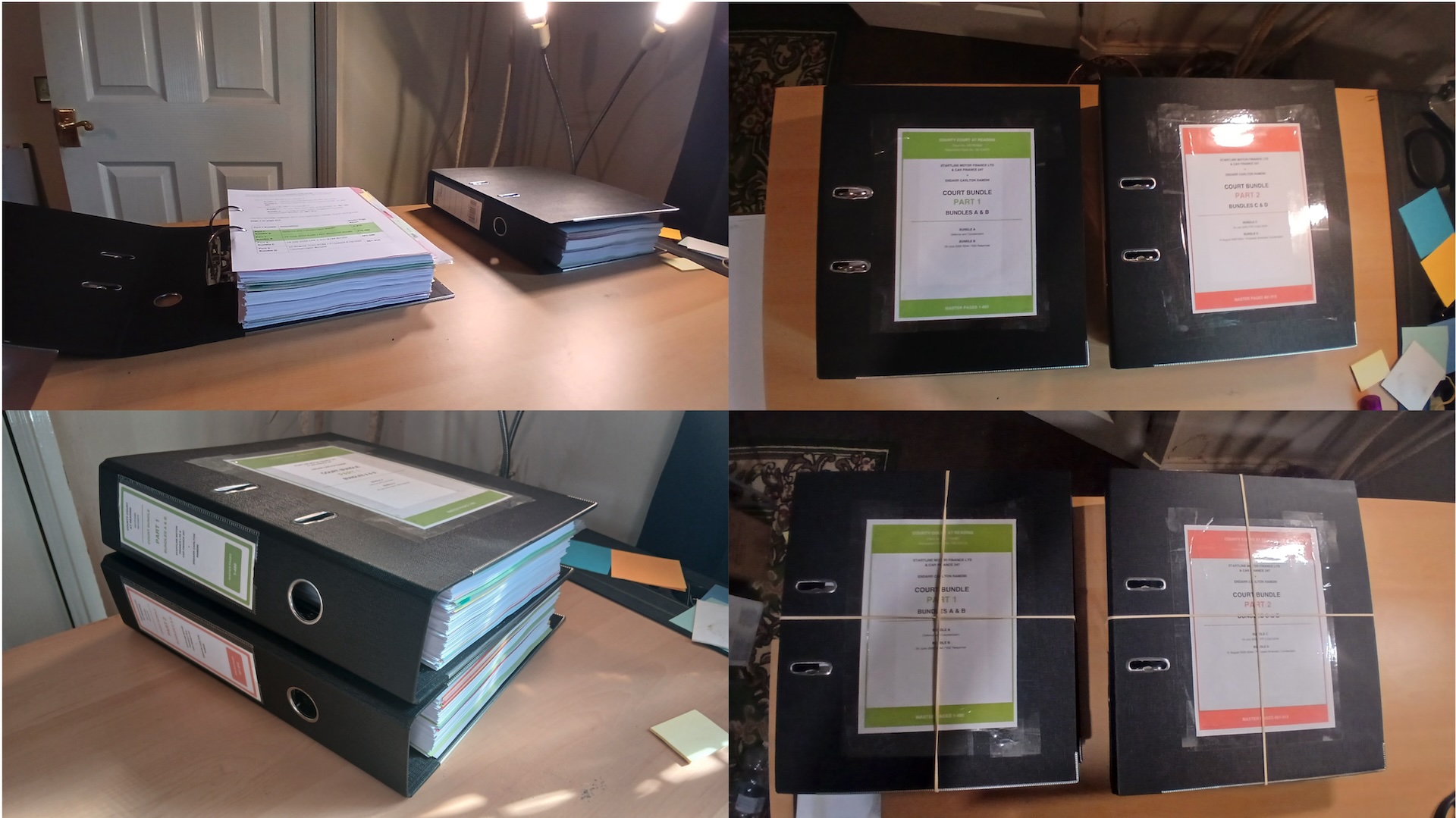
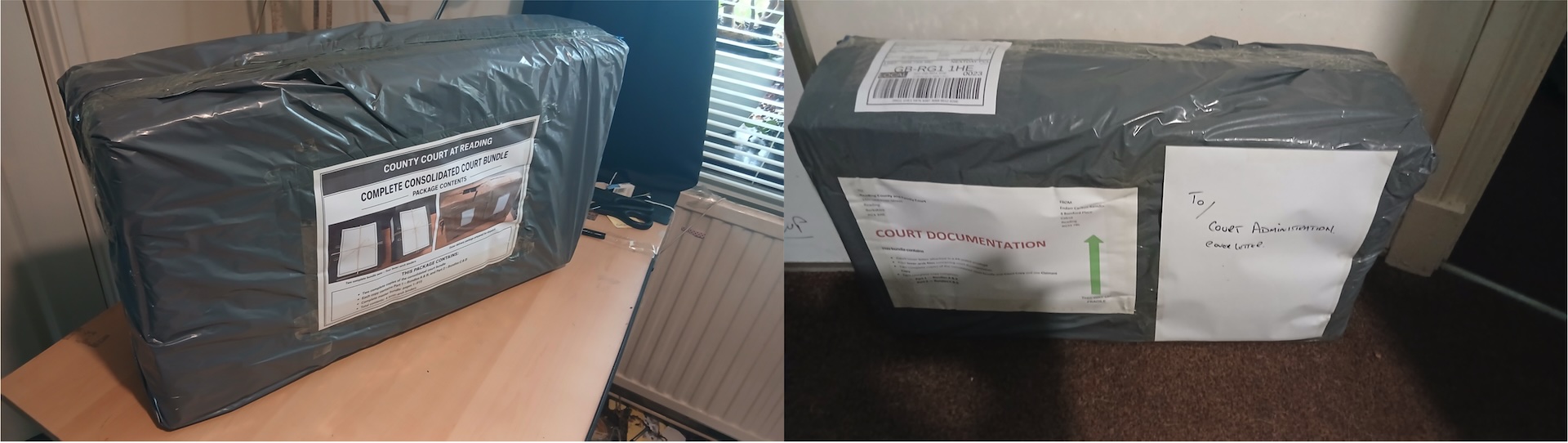
The Defendant relies on postal and photographic evidence concerning the urgent Court bundle sent after the hearing of 16 June 2026.

The Post Office receipt and certificate of posting prove that a Special Delivery package was posted on 22 June 2026 at 16:33 to:

Reading County and Family Court
160–163 Friar Street
Reading
Berkshire
RG1 1HE

The receipt records Royal Mail Special Delivery by 1pm, payment of £10.95, weight of approximately 0.350 kg, and tracking/reference number appearing as:

AS449079656GB

The external package photographs prove that the package was visibly addressed to Reading County and Family Court and marked:

“URGENT — FOR JUDICIAL ATTENTION”

The external label also identified:

Claim No: M01RG980
Associated Claim No: N01ZA273
Re: Hearing of 16 June 2026
Presiding Judge: District Judge Nicholson
Proposed Draft Order, Hearing Record, Procedural Chronology, and Request Before Sealing

The sealed-package photograph proves the external labelling and dispatch condition of the package. It does not, by itself, prove what was inside the sealed package.

The contents of the bundle are proved separately by the Defendant’s retained copy bundle, the pre-dispatch photographs of the bundle documents, the visible cover letter and exhibit tabs, and the Defendant’s witness evidence confirming what was enclosed.

The evidential point is therefore limited and precise:

The Defendant can prove that an urgent, labelled, tracked package was posted to Reading County and Family Court on 22 June 2026 concerning the 16 June 2026 hearing, the proposed draft order, the hearing record, the procedural chronology, and the request before sealing.

The Defendant does not rely on the postal receipt as proof that the Court opened, processed, read, or placed the bundle before the judge before the sealed N32 Judgment was received.


5.10 Email proof

The Defendant also relies on email evidence showing communication with Reading County Court.

The email evidence should include:

  • sent email screenshots;
  • recipient address;
  • subject line;
  • date and time sent;
  • attachments;
  • any automatic Court response;
  • any delivery confirmation;
  • and any absence of substantive response.

This evidence matters because it shows the Defendant was actively attempting to place the objection before the Court through multiple routes.

5.11 Hand-delivery proof

The Defendant received the sealed N32 Judgment in the morning.

At that point, the procedural position changed.

The issue was no longer simply whether the Defendant could place an objection before sealing. The order had already been sealed and received.

The Defendant therefore moved to urgent application procedure, including preparation and filing of an N244 application seeking stay, suspension, variation, revocation, or setting aside of the N32 Judgment.

That change matters because it confirms the compressed sequence:

  • the hearing took place on 16 June 2026;
  • DWF circulated the proposed draft order;
  • no Court-served draft order was received;
  • the Defendant attempted to put the Court on notice;
  • the sealed N32 arrived before any effective Court-controlled draft-order objection stage;
  • the Defendant then had to respond by urgent application.

The procedural route therefore moved from objection before sealing to application after sealing because the sealed N32 Judgment had already been issued and received.


5.12 The filing-proof issue

The filing-proof evidence matters because the Court may later need to explain:

  • when the Defendant’s objection was received;
  • when it was logged;
  • whether it was linked to Claim No. M01RG980;
  • whether it was placed before the judge;
  • whether the sealed N32 had already been produced;
  • whether the order had already been posted;
  • whether the objection was considered at all;
  • and whether any administrative safeguard was applied before enforcement consequences took effect.

The point is not to guess the Court’s internal process.

The point is to require disclosure of it.


5.13 Correct procedural formulation

The issue is not that the Court definitely had the Defendant’s 22 June 2026 letter before the N32 was sealed.

That should not be asserted unless the Court’s internal timing proves it.

The point is the opposite.

By the time the Defendant received the sealed N32 Judgment in the morning on 23 June 2026, the order had already been produced, sealed, dispatched, and placed into the Court/postal communication route.

That means there was no effective Court-controlled draft-order stage before the sealed order arrived.

The supported procedural point is therefore:

  • the hearing took place on 16 June 2026;
  • DWF circulated the proposed draft order after the hearing;
  • no Court-served draft order was received;
  • the Defendant did not receive a proper Court-controlled opportunity to object to a draft before sealing;
  • the sealed N32 Judgment arrived less than seven days after the hearing;
  • the sealed order did not explain why a CMO / Directions hearing had produced a delivery-of-goods judgment with section 92(1) premises-entry permission and fixed costs. 

The procedural defect is not that the Court ignored a letter it had definitely read.

The procedural defect is that the order was already sealed and received before the Defendant had any realistic Court-controlled draft-order opportunity to challenge the conversion from CMO / Directions into N32 Judgment.


5.14 Disclosure questions arising from the order-production sequence

The following questions require disclosure or clarification:

  1. Who drafted the N32 Judgment?
  2. Was DWF’s proposed draft order used as the basis for the sealed N32?
  3. Was any court-served draft order ever produced?
  4. If a court-served draft order was produced, when and how was it served?
  5. When was the sealed N32 drafted?
  6. When was it approved?
  7. When was it sealed?
  8. When was it posted or issued?
  9. When was the Defendant’s objection received by the Court?
  10. When was the Defendant’s objection logged?
  11. Was the objection placed before the judge?
  12. Was the objection considered before or after sealing?
  13. Was the hearing record reviewed before the N32 was produced?
  14. Was the CMO / Directions listing reviewed before the N32 was produced?
  15. Was the Defence and Counterclaim reviewed before the N32 was produced?
  16. Was Claim No. N01ZA273 reviewed before the N32 was produced?
  17. Who authorised the section 92(1) premises-entry wording?
  18. What record exists explaining why no court-served draft order was received before the sealed N32 arrived?

5.15 Evidence schedule for this chapter

The evidence for this chapter should include:

  • DWF post-hearing email circulating proposed draft order;
  • Defendant’s letter to Reading County Court concerning proposed draft order, hearing record, procedural chronology, and request before sealing;
  • email submission to Reading County Court;
  • any Court auto-response or acknowledgement;
  • Post Office receipt / proof of posting;
  • photograph of hand-delivery at Reading County Court once available;
  • sealed N32 Judgment;
  • envelope or covering letter showing receipt / posting / issue details;
  • any Court letter accompanying the sealed N32;
  • any later Court response confirming whether the objection was received or considered.

5.16 Chapter conclusion

The draft-order sequence is a central procedural issue.

The Defendant was told, or understood from the hearing, that a draft order should be served by the Court. No court-served draft order was received. DWF circulated a proposed draft. The Defendant attempted to place the Court on notice within the same compressed post-hearing period. The sealed N32 Judgment arrived less than seven days after the hearing, without any visible explanation of whether the Defendant’s objection or procedural challenge had been considered.

That sequence supports the wider disclosure point:

A disputed CMO / Directions hearing was converted into an N32 delivery-of-goods and premises-entry order through an order-production process that remains unexplained, compressed, and procedurally unsafe.


5.17 Legal frameworks engaged

  1. Common law natural justice — notice, right to be heard, fair opportunity to object, and no adverse order without fair process.
  2. Common law procedural fairness — a party must know the case / order being advanced before it is sealed or relied upon.
  3. Common law duty to give sufficient reasons — reasons adequate to explain why an order was made despite objection or unresolved procedural dispute.
  4. Common law fairness in judicial order production — draft-order process must not bypass a party’s opportunity to correct or object.
  5. Human Rights Act 1998, section 6 — Court as public authority must act compatibly with Convention rights.
  6. Human Rights Act 1998, Schedule 1, Article 6 — right to a fair hearing in the determination of civil rights and obligations.
  7. Consumer Credit Act 1974, section 90 — protected-goods recovery requires Court order.
  8. Consumer Credit Act 1974, section 92 — Court-controlled premises-entry permission for recovery of protected goods.
  9. Consumer Credit Act 1974, section 140A — unfair relationship between creditor and debtor.
  10. Civil Procedure Rules 1998, CPR 1.1 — Overriding Objective.
  11. Civil Procedure Rules 1998, CPR 1.3 — duty of parties to help the Court further the Overriding Objective.
  12. Civil Procedure Rules 1998, CPR 3.1 — Court’s general case-management powers.
  13. Civil Procedure Rules 1998, CPR 3.3 — Court’s power to make orders of its own initiative and representations safeguards.
  14. Civil Procedure Rules 1998, CPR Part 6 — service of documents.
  15. Civil Procedure Rules 1998, CPR Part 23 — applications for Court orders and notice of applications.
  16. Practice Direction 23A — application notice, service, and procedural safeguards for applications.
  17. Civil Procedure Rules 1998, CPR Part 40 — judgments and orders.
  18. Practice Direction 40B — drawing up, sealing, service, correction, and form of judgments and orders.
  19. Practice Direction 1A — vulnerable parties and effective participation in civil proceedings.
  20. Equality Act 2010 — reasonable adjustments, disability / vulnerability safeguards, and non-discriminatory access to civil justice.


5.18 Exhibits / Evidence
 

Exhibit Ref.Document / Evidence
EX02Reading County Court letter confirming Defence and Counterclaim served / placed on file for the 16 June 2026 hearing
EX08DWF email characterising the 16 June 2026 hearing as return-of-goods / possession hearing
EX10DWF post-hearing email circulating proposed draft order dated 17 June 2026
EX11N32 Judgment for Delivery of Goods received 23 June 2026
EX13Defendant’s 22 June 2026 letter to Reading County Court with proof of dispatch / filing / delivery


The Reading County Court Dispatch_ The N32 Judgment & The Procedural Contradiction 7

Figure 7. Seven-day chronology examining the production, circulation, and sealing of the N32 order following the hearing of 16 June 2026. This chapter reconstructs the sequence of events beginning with the hearing, followed by the circulation of a proposed draft order, the Defendant's urgent Special Delivery submission to the Court, and the subsequent receipt of the sealed N32 Judgment. The chronology is presented to examine the timing of document production, opportunities for objection, and the procedural sequence through which the operative order was finalised, forming part of the wider disclosure concerning transparency, participation, and procedural fairness.

Chapter 6 — Live Defence and Counterclaim Not Determined, Preserved, or Procedurally Reconciled

6.1 Purpose of this chapter

This chapter records the status of the Defence and Counterclaim at the time the N32 Judgment was produced.

The point is simple.

The proceedings were not a bare arrears claim.

By the time of the 16 June 2026 hearing, the Court file contained a live Defence and Counterclaim, DWF had served a Reply and Defence to Counterclaim, and the pleaded dispute extended far beyond simple non-payment.

That live pleaded position had to be determined, preserved, stayed, severed, consolidated, transferred, or clearly directed before the Court produced an N32 Judgment requiring return of the vehicle and granting premises-entry permission.

The sealed N32 did not visibly do that.

6.2 The pleaded dispute was wider than non-payment

The Defence and Counterclaim placed in issue matters including:

  • the condition of the Mazda vehicle;
  • latent defects;
  • diagnostic engagement;
  • complaint chronology;
  • Consumer Rights Act 2015 breaches;
  • Consumer Credit Act 1974 unfair relationship issues;
  • protected-goods status;
  • Startline’s enforcement conduct;
  • CarFinance247’s broker / intermediary role;
  • vulnerability disclosures;
  • DSAR / data handling;
  • Crystal Collections;
  • residential enforcement escalation;
  • psychological, procedural, and reputational harm.

The Particulars of Counterclaim expressly pleaded sale of defective goods, Consumer Rights Act breaches, FCA conduct failures, unfair relationship under the Consumer Credit Act 1974, data protection breaches, harassment, residential escalation, procedural obstruction, reputational harm, aggravated damages and exemplary damages.

That pleading structure is incompatible with treating the matter as a narrow stopped-payment return-of-goods issue.

6.3 Vehicle defect and diagnostic chronology were live issues

The vehicle-defect chronology was not marginal.

The original civil claim pleaded latent defects, unsafe condition, diagnostic engagement, subsequent denial, Consumer Rights Act breaches, vulnerability disclosure, enforcement escalation, DSAR issues, and failure to suspend enforcement during dispute.

CarFinance247’s own complaint correspondence recorded that the Claimant had been advised to obtain a diagnostic report and that CarFinance247 would reimburse diagnostic cost, while refusing to uphold the complaint and directing the Claimant to Startline as the finance lender.

Earlier correspondence also records CarFinance247 stating it would act as mediator between the customer, dealership and finance lender in line with the Consumer Rights Act 2015.

Those documents show that the stopped-payment issue could not fairly be separated from the defective-vehicle dispute.

6.4 DWF had joined issue with the Counterclaim

By the time of the hearing, DWF had served a Reply and Defence to Counterclaim.

That matters because Startline was not merely asking the Court to manage an uncontested arrears position. It had formally joined issue with the pleaded counterclaim.

The existing disclosure records that DWF’s Defence structure narrowed the dispute, denied liability, resisted the cumulative chronology, admitted protected-goods features in substance, and sought to reframe the matter as an ordinary finance dispute.

Once DWF joined issue, the Court needed to deal with the Defence and Counterclaim procedurally before producing an operative N32 delivery-of-goods outcome.

6.5 The Counterclaim affected the vehicle itself

The vehicle was not just property subject to finance.

It was also disputed physical evidence.

The pleaded dispute concerned whether the vehicle was defective, whether defects existed at or near delivery, whether diagnostics were properly handled, whether the Defendants wrongly denied liability, and whether enforcement was escalated during a live dispute.

An N32 order requiring return of the vehicle risks prejudicing the Counterclaim unless the Court first imposes evidence-preservation safeguards.

Those safeguards should have addressed:

  • inspection;
  • storage;
  • non-repair;
  • non-disposal;
  • non-sale;
  • preservation of diagnostic condition;
  • photographic record;
  • mileage record;
  • independent inspection;
  • and access to the vehicle for evidential purposes.

The sealed N32 did not visibly contain those safeguards.

6.6 The N32 did not decide the Counterclaim

The N32 Judgment did not visibly determine the Defence and Counterclaim.

It did not state that the Counterclaim was dismissed.

It did not state that it was stayed.

It did not state that it was severed.

It did not state that it was consolidated with any other proceeding.

It did not state that it was transferred.

It did not state that it remained live with directions.

It did not state that vehicle-preservation directions were imposed to protect the Counterclaim.

That omission is material because the order gave Startline the coercive benefit of delivery of goods and premises-entry permission while leaving the Defendant’s pleaded counterclaim position unresolved.

6.7 The order created practical prejudice before pleaded issues were resolved

The practical prejudice is direct.

If the vehicle is returned before the Counterclaim is determined, then Startline obtains control of the core physical evidence.

If the vehicle is then moved, stored, repaired, inspected unilaterally, altered, sold, disposed of, or allowed to deteriorate, the Defendant’s ability to prove the defective-vehicle case may be damaged.

This is why return of goods could not safely be ordered without proper evidential directions.

The Court did not have to decide the entire Counterclaim at the hearing.

But it did have to preserve it.

6.8 The payment question did not resolve the Counterclaim

The hearing account records that the judge asked whether the Defendant had stopped paying for the vehicle.

The Defendant answered that he had stopped paying, but explained that the reason was the defective vehicle and unresolved dispute.

That answer did not resolve the Counterclaim.

A stopped-payment admission does not determine:

  • whether the vehicle was defective;
  • whether the Defendants breached consumer rights;
  • whether the relationship was unfair under section 140A Consumer Credit Act 1974;
  • whether the Defendants mishandled vulnerability;
  • whether enforcement activity was properly suspended;
  • whether CarFinance247 and Startline misrepresented their roles;
  • whether Crystal Collections acted improperly;
  • whether data handling and DSAR duties were breached;
  • whether the vehicle should be preserved as evidence.

The payment question therefore could not provide a safe basis for bypassing the pleaded Defence and Counterclaim.

6.9 Protected-goods status required heightened procedural care

The protected-goods position increased the need for procedural care.

The dispute already engaged the Consumer Credit Act 1974 protections concerning repossession or recovery where more than one-third of the total price had been paid.

The existing disclosure records that protected-goods admissions and statutory recovery restrictions were part of the live pleaded and defence structure before the N32 Judgment was produced.

That means the Court order was the safeguard.

Where the Court order itself becomes procedurally unclear, the statutory safeguard is weakened.

6.10 The Counterclaim included vulnerability and enforcement conduct

The Counterclaim also included vulnerability, enforcement, harassment and residential escalation matters.

The pleaded case was that Startline and its agents continued enforcement pressure during live dispute, complaint, and vulnerability chronology.

The Startline automated voicemail of 17 July 2025 instructed contact “to avoid further action” during an ongoing legal dispute and unresolved complaint.

The Crystal Collections voicemail of 16 July 2025 referred to arranging collection of the vehicle / finance during an active dispute, with unclear and potentially intimidating language.

These issues were not collateral. They formed part of the pleaded chronology and were directly relevant to whether return-of-goods and premises-entry relief should be granted.

6.11 Disclosure questions arising from the unresolved Counterclaim

The following questions require disclosure or clarification:

  1. Was the live Defence and Counterclaim read in full before the N32 Judgment was produced?
  2. Was DWF’s Reply and Defence to Counterclaim read before the N32 Judgment was produced?
  3. Did the Court determine any part of the Counterclaim at the 16 June 2026 hearing?
  4. If not, why did the sealed N32 not expressly preserve the Counterclaim?
  5. Why did the sealed N32 not include vehicle-preservation safeguards?
  6. Why did the sealed N32 not provide inspection directions?
  7. Why did the sealed N32 not state whether the vehicle could be repaired, altered, sold, stored, moved, or disposed of?
  8. Why did the sealed N32 not reconcile the delivery-of-goods order with the pleaded defective-vehicle dispute?
  9. Why did the sealed N32 not address vulnerability and enforcement conduct before granting premises-entry permission?
  10. Why did the sealed N32 not explain how the Counterclaim would proceed after vehicle return?

6.12 Chapter conclusion

The N32 Judgment was produced while the Defence and Counterclaim remained live.

The Counterclaim was not a side issue. It went to the vehicle, the finance agreement, the conduct of Startline and CarFinance247, the enforcement chronology, protected-goods status, vulnerability, data handling, and the fairness of the creditor-debtor relationship.

The sealed N32 did not visibly determine, preserve, stay, sever, consolidate, transfer, or direct the Counterclaim.

That omission is a structural defect.

An order requiring return of the vehicle and granting premises-entry permission should not have been produced without first resolving or preserving the live Defence and Counterclaim and protecting the vehicle as disputed physical evidence.


6.13 Legal frameworks engaged

  1. Common law natural justice — notice, right to be heard, fair opportunity to answer, and no adverse determination without fair process.
  2. Common law procedural fairness — live pleaded issues must be determined, preserved, or procedurally directed before enforcement relief is granted.
  3. Common law duty to give sufficient reasons — reasons adequate to explain what happened to a live Defence and Counterclaim.
  4. Common law equality of arms — unrepresented party must not be procedurally disadvantaged where represented party’s pleaded response is before the Court.
  5. Human Rights Act 1998, section 6 — Court as public authority must act compatibly with Convention rights.
  6. Human Rights Act 1998, Schedule 1, Article 6 — right to a fair hearing in the determination of civil rights and obligations.
  7. Human Rights Act 1998, Schedule 1, Article 8 — right to respect for private life, family life, home, and correspondence where vehicle recovery and premises-entry consequences are engaged.
  8. Consumer Credit Act 1974, section 90 — restriction on recovery of protected goods without Court order.
  9. Consumer Credit Act 1974, section 91 — consequences of breach of protected-goods recovery restrictions.
  10. Consumer Credit Act 1974, section 92 — restriction on recovery of protected goods from premises.
  11. Consumer Credit Act 1974, section 140A — unfair relationship between creditor and debtor.
  12. Consumer Rights Act 2015, section 9 — goods to be of satisfactory quality.
  13. Consumer Rights Act 2015, section 10 — goods to be fit for particular purpose.
  14. Consumer Rights Act 2015, section 19 — consumer’s statutory rights to remedies for faulty goods.
  15. Consumer Rights Act 2015, section 20 — short-term right to reject.
  16. Consumer Rights Act 2015, section 23 — right to repair or replacement.
  17. Equality Act 2010 — disability, vulnerability, reasonable adjustments, and non-discriminatory access to civil justice.
  18. Practice Direction 1A — vulnerable parties and effective participation in civil proceedings.
  19. Data Protection Act 2018 / UK GDPR — DSAR, accuracy, transparency, accountability, and litigation-relevant personal-data processing.
  20. Civil Procedure Rules 1998, CPR 1.1 — Overriding Objective.
  21. Civil Procedure Rules 1998, CPR 1.3 — duty of parties to help the Court further the Overriding Objective.
  22. Civil Procedure Rules 1998, CPR 3.1 — Court’s general case-management powers, including stay, directions, and management of live issues.
  23. Civil Procedure Rules 1998, CPR Part 15 — Defence and Reply.
  24. Civil Procedure Rules 1998, CPR Part 16 — Statements of case.
  25. Civil Procedure Rules 1998, CPR Part 20 — Counterclaims and additional claims.
  26. Civil Procedure Rules 1998, CPR Part 22 — Statements of truth.
  27. Civil Procedure Rules 1998, CPR 32.14 — false statement verified by statement of truth.
  28. Civil Procedure Rules 1998, CPR Part 26 — case management, allocation, and directions in defended proceedings.
  29. Civil Procedure Rules 1998, CPR Part 40 — judgments and orders. 


6.14 Exhibits / Evidence

Exhibit Ref.Document / Evidence
EX02Reading County Court letter confirming Defence and Counterclaim served / placed on file for the 16 June 2026 hearing
EX04DWF email serving Reply and Defence to Counterclaim in M01RG980
EX10DWF post-hearing email circulating proposed draft order dated 17 June 2026
EX11N32 Judgment for Delivery of Goods received 23 June 2026
EX12Claimant’s Reply and Defence to Counterclaim dated 8 May 2026 / Statement of Truth dated 19 May 2026
EX13Defendant’s 22 June 2026 letter to Reading County Court with proof of dispatch / filing / delivery


The Reading County Court Dispatch_ The N32 Judgment & The Procedural Contradiction 8

Figure 8. The unresolved Defence and Counterclaim demonstrating that the dispute extended beyond payment default into substantive consumer, evidential, and procedural issues. This chapter identifies the pleaded Defence and Counterclaim as live matters that remained unresolved following the N32 Judgment. It records allegations concerning the condition of the vehicle, statutory consumer rights, protected goods, disclosure obligations, vulnerability, enforcement conduct, and the preservation of the vehicle as disputed physical evidence. The figure examines whether the vehicle should first have been preserved for evidential purposes before becoming the subject of enforcement, while noting that the Counterclaim had already been joined and remained outstanding.


Chapter 7 — DWF Reply and Defence to Counterclaim: Admissions, Narrowing Strategy, Template / AI-Pattern Features, and Failure to Engage with the Pleaded Breach Chronology

7.1 Purpose of this chapter

This chapter examines the Reply and Defence to Counterclaim served by DWF on behalf of Startline Motor Finance Limited.

The purpose is not to repeat the whole pleading.

The purpose is to identify what the pleading does structurally:

  • it confirms that the Defence and Counterclaim were live;
  • it admits key parts of the protected-goods framework;
  • it attempts to narrow the dispute into ordinary arrears and return of goods;
  • it separates Startline from CarFinance247 despite the broker / lender chronology;
  • it reframes enforcement pressure as ordinary collection activity;
  • it fails to engage with the pleaded chronology as a cumulative breach sequence;
  • and it displays highly regularised pleading features consistent with template-assisted, generated-pattern, or legal-operations drafting.

The significance for this disclosure is direct.

If DWF had served a Reply and Defence to Counterclaim, then the Counterclaim was live and joined. The Court should not have produced an N32 Judgment for Delivery of Goods without determining, preserving, or giving directions for that pleaded dispute.

7.2 The Reply and Defence to Counterclaim confirms that the pleaded dispute was live

DWF’s Reply and Defence to Counterclaim confirms that the Counterclaim was not dormant, ignored, or procedurally irrelevant.

It had been answered.

That means Startline and DWF had joined issue with the pleaded allegations before the N32 Judgment was produced.

The Court was therefore dealing with proceedings in which both sides had taken pleaded positions. It was not dealing with an undefended or uncontested return-of-goods matter.

This matters because the N32 Judgment did not visibly explain how the live Counterclaim was being treated.

It did not say the Counterclaim was dismissed.

It did not say it was stayed.

It did not say it was severed.

It did not say it was preserved.

It did not give vehicle-preservation directions.

It did not explain how a delivery-of-goods order could safely be made while the vehicle itself remained disputed physical evidence.

7.3 Admission: protected-goods status and need for Court order

One of the most important features of the Defence to Counterclaim is that it accepts the protected-goods issue in substance.

Startline’s position is that it was not entitled to take possession of the vehicle without a Court order once the statutory threshold had been reached.

That admission matters because the Court order was not administrative.

It was the statutory gateway.

The statutory protection exists to prevent creditors from bypassing judicial safeguards where the debtor has paid sufficient sums under a regulated agreement.

The issue in this disclosure is that the judicial safeguard itself became procedurally unsafe where a CMO / Directions hearing produced an N32 Judgment for Delivery of Goods, section 92(1) premises-entry permission, and fixed costs consequences without visible determination or preservation of the Defence and Counterclaim.

7.4 Admission: Crystal Collections and enforcement-chain involvement

The Defence to Counterclaim seeks to limit the role of Crystal Collections by characterising their involvement as contact, address confirmation, vehicle-condition enquiry, or voluntary-surrender activity rather than repossession.

That distinction is itself significant.

The Defendant’s pleaded case concerns the effect of third-party collection contact during an active dispute, known vulnerability, protected-goods context, complaint chronology, and litigation setting.

The issue is not limited to whether Crystal Collections physically removed the vehicle.

The issue is whether Startline, through agents or third-party recovery structures, escalated enforcement pressure while the dispute was unresolved and while statutory and vulnerability protections were engaged.

DWF’s pleading attempts to isolate the event.

The Counterclaim pleaded it as part of a cumulative enforcement chronology.

That difference is central.

7.5 Admission: CarFinance247’s broker and diagnostic involvement

The Defence to Counterclaim acknowledges CarFinance247’s role as broker or intermediary in the finance transaction.

It also acknowledges that diagnostic engagement occurred through the broker / sales channel.

However, the Defence then seeks to separate Startline from CarFinance247 and reduce Startline’s responsibility for the complaint and diagnostic chronology.

That is a key narrowing strategy.

The pleaded chronology does not treat Startline and CarFinance247 as identical entities. It treats them as functionally connected actors in the same regulated finance transaction and post-sale complaint pathway.

CarFinance247 handled the customer-facing complaint and diagnostic route. Startline was the finance lender. The vehicle was financed through that chain. The customer was pushed between those entities.

The legal issue is not whether the entities have separate corporate personalities.

The legal issue is whether the regulated finance chain produced unfairness, misrepresentation, complaint-handling failure, enforcement pressure, and procedural harm.

7.6 Narrowing strategy: reduction of the case to arrears and non-payment

The Defence to Counterclaim attempts to reduce the dispute to arrears, non-payment, and entitlement to return of the vehicle.

That narrowing is directly reflected in the hearing, where the judge asked whether the Defendant had stopped paying for the vehicle.

The Defendant’s answer was that payment had stopped because the vehicle was defective and the dispute remained unresolved.

That answer matters because non-payment was not an isolated admission of default. It was part of the pleaded consumer-rights and unfair-relationship chronology.

DWF’s pleading structure supports the Claimant’s / Defendant’s concern that the real dispute was compressed into a payment-default frame.

That compression is procedurally unsafe because it bypasses the pleaded reasons for non-payment.

7.7 Narrowing strategy: fragmentation of the pleaded chronology

The Defence to Counterclaim does not properly answer the pleaded chronology as a cumulative sequence.

Instead, it treats the events as isolated compartments:

  • sale of vehicle;
  • complaint;
  • diagnostic;
  • arrears;
  • collections;
  • Crystal Collections;
  • DSAR;
  • vulnerability;
  • litigation;
  • quantum.

That is not how the Counterclaim was pleaded.

The Counterclaim pleaded a chain:

defective vehicle → diagnostic engagement → denial of liability → vulnerability disclosure → unresolved complaint → arrears pressure → protected-goods issue → third-party collection pressure → data / DSAR concerns → residential escalation → procedural harm → unfair relationship.

The harm arises from the cumulative sequence.

By answering fragments, DWF avoids the system.

That is a central defect in the Defence structure.

7.8 Failure to engage with the defective-vehicle foundation

The Defence to Counterclaim seeks to prevent the defective-vehicle issue from controlling the case.

However, the defective-vehicle issue is the foundation of the entire dispute.

If the vehicle was defective, then the payment issue, complaint issue, diagnostic issue, enforcement issue, and unfair-relationship issue all change character.

The Defendant’s case is not that he stopped paying randomly.

The Defendant’s case is that he stopped paying because the vehicle supplied was defective, the complaint was mishandled, and the finance chain failed to resolve the statutory consumer-rights issue before escalating enforcement.

DWF’s Defence does not properly confront that foundation as the reason the arrears issue arose.

7.9 Failure to engage with vulnerability as an operational safeguard issue

The Defence to Counterclaim also narrows vulnerability.

It treats vulnerability as a fact to be disputed, minimised, or proceduralised, rather than as an operational safeguard that should have altered how Startline and its agents acted.

The pleaded issue was not merely whether vulnerability had been mentioned.

The pleaded issue was whether Startline and the finance chain adjusted their conduct once vulnerability, financial hardship, medical issues, litigation pressure, and self-representation were known.

That matters because delivery-of-goods and premises-entry relief against a vulnerable litigant requires heightened procedural caution.

The N32 Judgment contains no visible vulnerability safeguard.

7.10 Failure to engage with DSAR and data-handling chronology

The Defence to Counterclaim also fails to engage fully with the procedural significance of DSAR and data-handling issues.

The DSAR issue is not simply a data-protection complaint.

It affects litigation equality.

If relevant records, call notes, complaint records, system notes, agent instructions, vulnerability markers, recovery notes, and internal decision logs were not disclosed, then the Defendant’s ability to understand and answer the case was impaired.

That becomes more serious where the Court then produces an N32 Judgment without a clear hearing record, without preserving the Counterclaim, and without explaining the order-production route.

7.11 Failure to engage with N01ZA273

The Defence to Counterclaim and DWF’s wider procedural conduct also placed associated Claim No. N01ZA273 into issue.

DWF advanced an overlap / duplication / abuse-of-process position.

The Defendant’s position is that N01ZA273 was separately issued through the Civil National Business Centre and was not a later duplicate invented to obstruct return-of-goods proceedings.

The significance is that DWF had already created a procedural issue requiring reconciliation.

The N32 Judgment did not visibly reconcile it.

That is a defect.

If N01ZA273 was said to overlap, the Court needed to say what was happening to it before making an order that materially affected the same vehicle-finance dispute.

7.12 Quantum attack without engagement with harm architecture

DWF’s Defence attacks the Schedule of Loss and quantum. 

That was expected.

However, the difficulty is that the pleading attacks the figure without properly engaging with the harm architecture behind it.

The pleaded harm was not just vehicle inconvenience.

It included:

  • defective-goods harm;
  • complaint-handling harm;
  • regulatory harm;
  • vulnerability harm;
  • data-rights harm;
  • enforcement pressure;
  • protected-goods intimidation;
  • litigation prejudice;
  • residential escalation;
  • reputational harm;
  • and procedural obstruction.

A pleading can deny quantum.

But if it does not engage with the cumulative harm structure, it does not answer the case as pleaded.

The Defendant’s position is that any reference to the claim as a simple “£12.1 million” demand failed to engage with the pleaded proportional basis, including the 121% harm formulation, and therefore mischaracterised the quantum structure rather than answering it.

7.13 Template / AI-pattern concern arising from pleading structure

The Defendant does not ask the Court or public reader at this stage to determine whether artificial intelligence, document automation, template pleading, or legal-operations drafting was used.

The issue is functional, not authorship.

The Reply and Defence to Counterclaim displays features consistent with generated, template-assisted, or highly standardised legal drafting, including:

  • repeated denial formulae;
  • narrow admissions followed by broad denial;
  • fragmentation of the pleaded chronology;
  • repeated internal cross-reference patterns;
  • low engagement with the cumulative breach sequence;
  • reduction of systemic conduct into ordinary arrears / finance enforcement language;
  • compartmentalisation of facts that were pleaded as a connected chronology;
  • avoidance of the pleaded causal sequence;
  • and failure to engage with the Defendant’s public-interest, vulnerability, enforcement, data, and protected-goods architecture as a single case theory.

The concern is not whether a machine drafted the document.

The concern is whether the pleading properly engaged with the live Counterclaim before the Court produced an N32 Judgment for Delivery of Goods.

A standardised defence pattern may be efficient for a law firm.

It is not sufficient if it prevents proper engagement with a pleaded chronology involving statutory consumer rights, regulated credit, vulnerability, protected goods, enforcement conduct, and live associated proceedings.

7.14 Legal-operations concern

DWF is not treated in this disclosure as a mere postal address for Startline.

It is treated as a legal-operations actor.

The issue is whether the defence structure, strike-out positioning, draft-order sequence, and hearing framing formed part of a broader procedural narrowing strategy.

That strategy appears to operate as follows:

  1. Narrow the dispute to arrears and return of goods.
  2. Separate Startline from CarFinance247.
  3. Treat the Counterclaim as excessive or incoherent.
  4. Treat N01ZA273 as overlapping or abusive.
  5. Treat Crystal Collections as non-repossession contact.
  6. Treat vulnerability as immaterial or already handled.
  7. Treat DSAR and data issues as collateral.
  8. Treat the vehicle as recoverable property rather than disputed evidence.
  9. Produce or support an order route that results in N32 delivery-of-goods consequences.

That is the structure being disclosed.

7.15 Why this made the N32 Judgment unsafe

The Reply and Defence to Counterclaim made the N32 Judgment more unsafe, not less.

It confirmed that the Counterclaim was live.

It confirmed that protected-goods issues existed.

It confirmed that Startline required a Court order.

It confirmed that CarFinance247 had some role in the transaction / complaint pathway.

It confirmed that the dispute had to be answered through pleadings.

It showed that DWF was actively narrowing and contesting the pleaded chronology.

In that context, the Court should not have produced an N32 Judgment without visible determination, preservation, or directions for the Counterclaim.

7.16 Disclosure questions arising from the Reply and Defence to Counterclaim

The following questions require disclosure or clarification:

  1. Was the Reply and Defence to Counterclaim read in full before the N32 Judgment was produced?
  2. Did the Court identify which parts of the Counterclaim remained live after the N32?
  3. Did the Court consider DWF’s admissions concerning protected-goods status and the need for a Court order?
  4. Did the Court consider the defective-vehicle chronology before ordering delivery of the vehicle?
  5. Did the Court consider whether the vehicle required evidence-preservation safeguards?
  6. Did the Court consider CarFinance247’s broker / intermediary role?
  7. Did the Court consider the DSAR and data-handling chronology?
  8. Did the Court consider vulnerability and reasonable-adjustment safeguards?
  9. Did the Court consider whether DWF’s Defence answered the cumulative chronology or merely fragmented it?
  10. Did the Court consider whether N01ZA273 had to be reconciled before delivery-of-goods relief?
  11. Did DWF use any template, document automation, AI-assisted drafting, legal-operations workflow, or standard defence matrix in preparing the pleading?
  12. If standardised drafting was used, what human review was applied to ensure engagement with the pleaded Counterclaim chronology?

7.17 Chapter conclusion

DWF’s Reply and Defence to Counterclaim is important because it confirms that the case was fully contested.

It was not a simple arrears matter.

It was not an uncontested vehicle-return application.

It was a pleaded dispute involving defective goods, regulated finance, broker-lender conduct, protected-goods safeguards, vulnerability, DSAR, enforcement pressure, associated proceedings, and substantial counterclaim allegations.

The Defence attempted to narrow that dispute.

It did not extinguish it.

The Court therefore needed to determine, preserve, or direct the Counterclaim before producing an N32 Judgment.

The sealed N32 did not visibly do that.

That is why the Reply and Defence to Counterclaim supports the disclosure: it shows that the pleaded dispute was live, complex, and unresolved when the N32 delivery-of-goods and premises-entry order was produced.


7.18 Legal frameworks engaged

  1. Common law natural justice — notice, right to be heard, fair opportunity to answer, and no adverse procedural determination without fair process.
  2. Common law procedural fairness — associated proceedings must be identified, reconciled, stayed, struck out, consolidated, transferred, or preserved before enforcement consequences are imposed.
  3. Common law abuse-of-process jurisdiction — Court control of duplicative, oppressive, collateral, or procedurally abusive proceedings.
  4. Common law duty to give sufficient reasons — reasons adequate to explain whether associated proceedings were treated as live, overlapping, abusive, stayed, struck out, or preserved.
  5. Common law equality of arms — represented party’s procedural attack on associated proceedings must not leave the litigant-in-person without clarity or fair opportunity to respond.
  6. Human Rights Act 1998, section 6 — Court as public authority must act compatibly with Convention rights.
  7. Human Rights Act 1998, Schedule 1, Article 6 — right to a fair hearing in the determination of civil rights and obligations.
  8. Civil Procedure Rules 1998, CPR 1.1 — Overriding Objective.
  9. Civil Procedure Rules 1998, CPR 1.3 — duty of parties to help the Court further the Overriding Objective.
  10. Civil Procedure Rules 1998, CPR 3.1 — Court’s general case-management powers, including stay, consolidation, directions, and management of related proceedings.
  11. Civil Procedure Rules 1998, CPR 3.3 — Court’s power to make orders of its own initiative and safeguards for representations.
  12. Civil Procedure Rules 1998, CPR 3.4 — strike-out of statement of case.
  13. Civil Procedure Rules 1998, CPR Part 6 — service of documents.
  14. Civil Procedure Rules 1998, CPR Part 7 — commencement of proceedings.
  15. Civil Procedure Rules 1998, CPR Part 16 — statements of case.
  16. Civil Procedure Rules 1998, CPR Part 22 — statements of truth.
  17. Civil Procedure Rules 1998, CPR Part 23 — applications for Court orders.
  18. Practice Direction 23A — application notice, evidence, service, and procedural safeguards for applications.
  19. Civil Procedure Rules 1998, CPR Part 26 — case management, allocation, and directions in defended proceedings.
  20. Civil Procedure Rules 1998, CPR Part 40 — judgments and orders.
  21. Consumer Credit Act 1974, section 90 — protected-goods recovery requiring Court order.
  22. Consumer Credit Act 1974, section 92 — Court control of premises-entry for recovery of protected goods.
  23. Consumer Credit Act 1974, section 140A — unfair relationship between creditor and debtor.
  24. Consumer Rights Act 2015 — defective-goods framework underlying the associated civil claim.


7.19 Exhibits / Evidence


Exhibit Ref.Document / Evidence
EX02Reading County Court letter confirming Defence and Counterclaim served / placed on file for the 16 June 2026 hearing
EX03Notice that Acknowledgment of Service has been filed in N01ZA273, dated 26 March 2026
EX05DWF N244 Application Notice in N01ZA273, dated 31 March 2026
EX06Witness Statement of Jonathan Hall in support of DWF’s N244 application in N01ZA273
EX07Draft order attached to DWF’s N244 application in N01ZA273
EX11N32 Judgment for Delivery of Goods received 23 June 2026
EX13Defendant’s 22 June 2026 letter to Reading County Court with proof of dispatch / filing / delivery


The Reading County Court Dispatch_ The N32 Judgment & The Procedural Contradiction 9

Figure 9. DWF's Reply and Defence illustrating the admissions made, the progressive narrowing of the pleaded dispute, and the resulting non-engagement with the full pleaded chronology. This chapter examines the Defence served by DWF LLP on behalf of the finance parties, identifying admissions concerning protected goods, Crystal Collections, and the broker relationship, while contrasting those admissions with the reduction of the dispute to arrears and non-payment. The figure records the alleged narrowing of pleaded issues and considers whether significant matters, including vulnerability, DSAR, enforcement conduct, and the cumulative breach chronology, remained insufficiently addressed within the Defence.


Chapter 8 — Failure to Reconcile Associated Claim No. N01ZA273 Before Producing the N32 Judgment

8.1 Purpose of this chapter

This chapter addresses the unresolved procedural relationship between Claim No. M01RG980 and associated Claim No. N01ZA273.

The issue is not whether the two claims are factually connected. They plainly arise from the same wider vehicle-finance dispute.

The issue is whether N01ZA273 was properly dealt with before the Court produced the N32 Judgment in M01RG980.

The Defendant’s position is that N01ZA273 was a separate civil claim, issued through the Civil National Business Centre, served on Startline Motor Finance Limited and CarFinance247, and later placed into issue by DWF through alleged overlap / abuse-of-process arguments.

Once DWF raised alleged overlap, the Court had to reconcile the procedural position before making an N32 order in M01RG980.

The sealed N32 Judgment did not visibly do that.

8.2 N01ZA273 was a separately issued civil claim

N01ZA273 was not a mere informal complaint, duplicated letter, or late obstruction to Startline’s claim.

It was a separate civil claim issued through the Civil National Business Centre against Startline Motor Finance Limited and CarFinance247.

The N510 forms identify Claim No. N01ZA273, the Civil National Business Centre, Endarr Carlton Ramdin as Claimant, and Startline Motor Finance Limited / CarFinance247 Limited as Defendants, with the forms signed by the Claimant on 23 February 2026.

The covering letter to the Civil National Business Centre dated 24 February 2026 records filing of Certificates of Service N215 and Forms N510 for both Startline and CarFinance247, together with proof of posting / postal receipts.

The N215 Certificates of Service record service of the claim documents on Startline and CarFinance247 on 23 February 2026, with deemed service on 25 February 2026.

That documentary sequence matters because it demonstrates a formal civil-procedure route, not a collateral or informal objection.

8.3 N01ZA273 pre-dated the later return-of-goods framing

The Defendant’s position is that N01ZA273 existed as a separate civil claim before the later return-of-goods / repossession framing was advanced in M01RG980.

That chronology matters.

If N01ZA273 was already issued and served before the later return-of-goods pathway became the operative focus, it cannot fairly be treated as a late duplicate without a clear procedural ruling.

The Court needed to decide whether N01ZA273 was:

  • a separate claim;
  • an overlapping claim requiring consolidation;
  • a claim requiring transfer;
  • a claim requiring a stay;
  • a claim requiring directions;
  • a claim requiring strike-out;
  • or a claim to proceed alongside M01RG980.

The sealed N32 Judgment did not provide that answer.

8.4 DWF placed overlap / abuse-of-process into issue

DWF did not ignore N01ZA273.

DWF placed it into issue.

The DWF chronology disclosure records that DWF advanced abuse-of-process / strike-out positioning in relation to N01ZA273, that the Defendant challenged the position and requested application material, and that DWF later transmitted unsealed application material while asserting that an application had been filed on 31 March 2026.

That matters because DWF’s own conduct made N01ZA273 a live procedural question.

Once DWF relied on alleged overlap, the Court could not safely proceed as if N01ZA273 did not matter.

8.5 Hearing account: overlap raised and disputed

At the 16 June 2026 hearing, the Claimant’s representative raised alleged overlap between the cases.

The Defendant disputed that characterisation.

The Defendant stated, in substance, that N01ZA273 was a separate civil claim that had been issued through the Civil National Business Centre, and that the later repossession / return-of-goods framing came after the civil claim had already been issued.

The Defendant’s position was not simply disagreement.

It was a chronology objection.

The Court was required to deal with that chronology before producing an order that materially affected the same vehicle, same finance agreement, same broker-lender structure, and same pleaded dispute.

8.6 No clear procedural ruling on N01ZA273

The Defendant records that the Court did not clearly rule on the status of N01ZA273.

The Court did not visibly state whether N01ZA273 was:

  • struck out;
  • stayed;
  • consolidated;
  • transferred;
  • dismissed;
  • severed;
  • adjourned;
  • preserved;
  • or left to continue independently.

That absence matters because the N32 Judgment in M01RG980 then proceeded to impose delivery-of-goods, premises-entry, and costs consequences.

Those consequences affected the same factual nucleus that sat behind N01ZA273.

8.7 Why N01ZA273 mattered before N32 relief

N01ZA273 mattered because it concerned the wider civil claim arising from the vehicle-finance dispute.

Its subject matter included defective goods, Consumer Rights Act issues, FCA conduct, Startline / CarFinance247 relationship, vulnerability, DSAR, enforcement conduct, and relief connected to the finance chain.

The original Particulars of Claim in the civil claim pleaded sale of defective goods, breach of consumer rights, FCA conduct failures, negligent dismissal of fault, vulnerable customer discrimination, reputational risk, enforcement pressure, DSAR failure, and failure to suspend enforcement during dispute.

That means N01ZA273 was directly relevant to whether the vehicle should be returned before evidence-preservation and procedural safeguards were imposed.

8.8 The vehicle connected both procedural tracks

The vehicle was central to both M01RG980 and N01ZA273.

In M01RG980, Startline sought return of the vehicle.

In N01ZA273, the Defendant / Claimant had pleaded that the vehicle was defective and that the finance / broker / complaint / enforcement chain had caused statutory and procedural harm.

The same object was therefore both:

  • the subject of Startline’s delivery-of-goods claim; and
  • disputed evidence in the Defendant’s civil claim and counterclaim structure.

That made reconciliation essential.

The Court could not safely order return of the vehicle without explaining what would happen to the evidence, inspection rights, defect proof, and linked civil claim.

8.9 The N32 did not explain the relationship between the claims

The sealed N32 Judgment did not visibly explain the relationship between M01RG980 and N01ZA273.

It did not state:

  • whether N01ZA273 remained live;
  • whether N01ZA273 had been stayed;
  • whether DWF’s strike-out position had been determined;
  • whether the Court accepted DWF’s overlap argument;
  • whether the Court rejected the Defendant’s chronology objection;
  • whether the two claims should be consolidated;
  • whether N01ZA273 should be transferred to Reading;
  • whether M01RG980 should await directions in N01ZA273;
  • or whether evidence-preservation directions were needed across both claims.

That omission is structurally significant.

8.10 Why the omission prejudiced the Defendant

The omission prejudiced the Defendant because it left him without knowing how his separate civil claim was affected by the N32 Judgment.

If the vehicle is returned under M01RG980, the practical foundation of N01ZA273 may be affected.

If the vehicle is later altered, repaired, sold, disposed of, or stored outside the Defendant’s control, the evidential position in N01ZA273 may be impaired.

If N01ZA273 is said to overlap, then the Court should identify the procedural route.

If N01ZA273 is said not to matter, the Court should explain why.

The sealed N32 did neither.

8.11 Natural justice and procedural clarity

Natural justice required clarity.

Where a represented party advances an overlap / abuse-of-process argument against an unrepresented litigant, the Court should not leave the procedural position unclear.

The Defendant was entitled to know:

  • what issue was being decided;
  • what claim was being considered;
  • what claim remained live;
  • what procedural rule was being applied;
  • whether any application was being determined;
  • what the effect was on N01ZA273;
  • and what steps the Defendant was required to take.

The N32 Judgment did not provide that clarity.

8.12 DWF’s overlap argument could not replace a Court ruling

DWF’s assertion of overlap was not itself a ruling.

Even if DWF argued that N01ZA273 was abusive, duplicative, or overlapping, that did not determine the claim.

Only the Court could do that.

If the Court accepted DWF’s argument, the order needed to say so.

If the Court rejected it, the order needed to preserve N01ZA273.

If the Court deferred the issue, directions were required.

The sealed N32 Judgment did not identify any of those outcomes.

8.13 Disclosure questions arising from N01ZA273

The following questions require disclosure or clarification:

  1. Was Claim No. N01ZA273 before the judge at the 16 June 2026 hearing?
  2. Was the judge aware that N01ZA273 had been issued through the Civil National Business Centre?
  3. Was the judge aware that N01ZA273 had been served on Startline and CarFinance247?
  4. Was DWF’s alleged overlap / abuse-of-process position considered at the hearing?
  5. Was any DWF application concerning N01ZA273 before the Court?
  6. If so, was that application determined?
  7. If not, why was N01ZA273 not preserved or expressly reserved?
  8. Did the Court decide that N01ZA273 overlapped with M01RG980?
  9. If so, what rule or case-management power was applied?
  10. Did the Court decide that N01ZA273 should be stayed, struck out, consolidated, transferred, or left to proceed?
  11. Why did the sealed N32 Judgment not state the status of N01ZA273?
  12. What evidence-preservation safeguards were considered given the vehicle’s relevance to both procedural tracks?

8.14 Chapter conclusion

N01ZA273 was a separate civil claim arising from the same vehicle-finance dispute.

It had been issued, served, and placed into procedural dispute by DWF’s own overlap / abuse-of-process position.

The Defendant disputed that characterisation at the hearing and stated that N01ZA273 pre-dated the later return-of-goods pathway.

The Court did not visibly reconcile that procedural position.

The sealed N32 Judgment then produced delivery-of-goods, premises-entry, and costs consequences in M01RG980 without explaining what happened to N01ZA273.

That is a procedural defect.

Where two live proceedings concern the same vehicle-finance relationship, the Court must identify the procedural relationship between them before making an order that materially affects the vehicle, the evidence, and the Defendant’s pleaded civil claim.


8.19 Legal frameworks

  1. Common law natural justice — notice, right to be heard, fair opportunity to answer, and no procedural narrowing without fair engagement.
  2. Common law procedural fairness — a live pleaded chronology must be answered as pleaded, not reduced into an artificial or incomplete frame.
  3. Common law duty to give sufficient reasons — reasons adequate to explain why pleaded chronology was narrowed, rejected, or treated as immaterial.
  4. Common law equality of arms — represented party’s formal defence strategy must not place the litigant-in-person at procedural disadvantage.
  5. Common law duty not to mislead the Court — legal representatives must not advance a materially incomplete or misleading case theory.
  6. Human Rights Act 1998, section 6 — Court as public authority must act compatibly with Convention rights.
  7. Human Rights Act 1998, Schedule 1, Article 6 — right to a fair hearing in the determination of civil rights and obligations.
  8. Consumer Credit Act 1974, section 90 — protected-goods recovery restriction.
  9. Consumer Credit Act 1974, section 92 — restriction on entry to premises for recovery of protected goods.
  10. Consumer Credit Act 1974, section 140A — unfair relationship between creditor and debtor.
  11. Consumer Rights Act 2015, section 9 — goods to be of satisfactory quality.
  12. Consumer Rights Act 2015, section 10 — goods to be fit for particular purpose.
  13. Consumer Rights Act 2015, section 19 — consumer’s statutory rights to remedies for faulty goods.
  14. Equality Act 2010 — disability, vulnerability, reasonable adjustments, and non-discriminatory access to civil justice.
  15. Data Protection Act 2018 / UK GDPR — DSAR, accuracy, transparency, accountability, and litigation-relevant personal-data processing.
  16. Civil Procedure Rules 1998, CPR 1.1 — Overriding Objective.
  17. Civil Procedure Rules 1998, CPR 1.3 — duty of parties to help the Court further the Overriding Objective.
  18. Civil Procedure Rules 1998, CPR Part 16 — statements of case and proper pleading of admissions, denials, and allegations.
  19. Practice Direction 16 — statements of case and pleading requirements.
  20. Civil Procedure Rules 1998, CPR Part 22 — statements of truth.
  21. Practice Direction 22 — statement-of-truth verification requirements.
  22. Civil Procedure Rules 1998, CPR 32.14 — false statement verified by statement of truth.
  23. Civil Procedure Rules 1998, CPR Part 20 — counterclaims and additional claims.
  24. Civil Procedure Rules 1998, CPR Part 3 — Court case-management powers where pleadings require narrowing, clarification, strike-out, stay, or directions.
  25. SRA Principles — independence, honesty, integrity, acting in the best interests of each client, and acting in a way that upholds public trust in the profession.
  26. SRA Code of Conduct for Solicitors — duty not to mislead the Court, duty to make only properly arguable assertions, and duty not to take unfair advantage.
  27. SRA Code of Conduct for Firms — proper systems, supervision, compliance, and governance of litigation work.


8.20 Exhibits / Evidence

Exhibit Ref.Document / Evidence
EX02Reading County Court letter confirming Defence and Counterclaim served / placed on file for the 16 June 2026 hearing
EX04DWF email serving Reply and Defence to Counterclaim in M01RG980
EX08DWF email characterising the 16 June 2026 hearing as return-of-goods / possession hearing
EX10DWF post-hearing email circulating proposed draft order dated 17 June 2026
EX11N32 Judgment for Delivery of Goods received 23 June 2026
EX12Claimant’s Reply and Defence to Counterclaim dated 8 May 2026 / Statement of Truth dated 19 May 2026
EX13Defendant’s 22 June 2026 letter to Reading County Court with proof of dispatch / filing / delivery


The Reading County Court Dispatch_ The N32 Judgment & The Procedural Contradiction 11

Figure 10. Slide identifying associated proceedings N01ZA273 as a separately issued civil claim, with a “Lost Case” stamp, a legal-notice panel, and a procedural chronology showing that the claim pre-dated the return-of-goods framing, was raised by DWF as an overlap issue, and remained unresolved on the face of the N32 Judgment.


Chapter 9 — AI / Template-Assisted Defence Concern

9.1 Formal defence filed on behalf of a major finance company

DWF Law LLP served a formal Reply and Defence to Counterclaim on behalf of Startline Motor Finance Limited.

That pleading was not casual correspondence.

It was a formal litigation document, verified by statement of truth, served in active County Court proceedings, and relied upon in circumstances where the Court later produced an N32 Judgment for Delivery of Goods.

The significance is therefore not limited to drafting style.

The significance is that the document formed part of the procedural environment in which:

  • the Defendant’s Counterclaim remained live;
  • protected-goods status was engaged;
  • the vehicle remained disputed physical evidence;
  • CarFinance247’s broker / intermediary role remained unresolved;
  • enforcement conduct remained pleaded;
  • vulnerability and disability issues remained pleaded;
  • DSAR and data-processing concerns remained pleaded;
  • and associated Claim No. N01ZA273 remained unresolved.

A formal defence filed by a major finance company through a national law firm should show clear human legal engagement with the pleaded chronology.

The concern raised in this chapter is that the Defence structure does not appear to engage with the case as a connected pleaded chronology. It appears to reduce, compartmentalise, and standardise the issues into a defence matrix.

This chapter does not assert, as a fact, that artificial intelligence was used.

It identifies a disclosure question.

The question is whether the Defence to Counterclaim was prepared, reviewed, verified, or supported by:

  • artificial intelligence;
  • document automation;
  • template pleading systems;
  • standardised defence matrices;
  • legal-operations workflow tools;
  • precedent-bank drafting;
  • or other document-generation processes.

9.2 Structural regularity and repeated denial matrix

The Defence to Counterclaim displays a high degree of structural regularity.

The pleading repeatedly appears to operate by:

  • making narrow admissions;
  • denying the remaining allegation;
  • requiring strict proof;
  • cross-referring to earlier paragraphs;
  • treating factual sequences as discrete pleading compartments;
  • avoiding the cumulative pattern of the alleged misconduct;
  • and reducing the dispute to arrears, return of goods, and ordinary finance enforcement.

That structure is material because the Counterclaim was not pleaded as a collection of disconnected events.

It was pleaded as a cumulative breach chronology.

The Defendant’s case was that the dispute unfolded through a connected sequence involving defective goods, diagnostic engagement, complaint mishandling, finance-chain denial, vulnerability disclosure, enforcement pressure, protected-goods restrictions, third-party recovery contact, DSAR issues, residential escalation, and procedural harm.

A repeated denial matrix may answer paragraphs formally.

It does not necessarily answer the case substantively.

Where a pleading repeatedly fragments the chronology, the Court and parties are placed at risk of treating the dispute as narrower than it is.

9.3 Circular internal cross-reference pattern

The Defence also appears to rely on internal cross-reference patterns that risk circularity.

Where a pleading repeatedly denies allegations by reference to earlier denials or generic pleaded positions, it may create the appearance of an answer while avoiding direct engagement with the specific factual allegation.

The concern is not the existence of cross-referencing itself.

Cross-referencing is ordinary in legal pleading.

The concern is whether cross-referencing was used to avoid answering the pleaded chronology in its cumulative form.

The relevant disclosure question is whether DWF used any automated or template-assisted process that generated, suggested, or standardised these internal cross-references.

If such a system was used, the further question is what human review ensured that the final pleading accurately answered the actual Counterclaim rather than merely applying a standard defence structure.

9.4 Low evidential engagement with cumulative pleaded chronology

The Defence to Counterclaim appears to engage more heavily with pleading form than with evidential chronology.

The pleaded case included a chain of events and evidence concerning:

  • defective vehicle condition;
  • diagnostic report history;
  • CarFinance247 complaint handling;
  • Startline’s enforcement position;
  • protected-goods status;
  • vulnerability and health disclosures;
  • Crystal Collections contact;
  • DSAR / data issues;
  • associated proceedings;
  • and the relationship between enforcement pressure and procedural harm.

The Defence structure did not properly engage with that chain as one connected case theory.

Instead, it appeared to isolate and neutralise components.

That matters because the Court later produced an N32 Judgment that also appears to treat the matter as if it had narrowed into return of goods.

The Defence structure therefore becomes relevant to the procedural outcome.

If the pleading narrowed the case artificially, and the hearing then followed that narrowed frame, the N32 Judgment may have been produced on an incomplete understanding of the live dispute.

9.5 Semantic compression of vulnerability, enforcement, DSAR, and residential attendance issues

The Defence also gives rise to concern because serious pleaded issues appear to be semantically compressed into ordinary litigation or finance language.

Vulnerability is not merely background.

It affects participation, reasonable adjustments, enforcement proportionality, communication duties, and the fairness of recovery action.

Enforcement is not merely collection activity.

It is pleaded as pressure applied during a live dispute, complaint chronology, protected-goods context, and vulnerability setting.

DSAR and data-processing issues are not merely collateral data complaints.

They affect whether the Defendant had access to records necessary to understand the case, challenge the chronology, identify internal decision-making, and test the accuracy of the Claimant’s position.

Residential attendance or premises-entry risk is not merely practical enforcement.

It engages home, privacy, vulnerability, proportionality, and section 92 Consumer Credit Act safeguards.

The Defence structure appears to compress these issues into narrower categories.

That compression is significant because it may have assisted the transformation of a complex pleaded dispute into an N32 delivery-of-goods outcome.

9.6 Disclosure question: whether AI, automation, template systems, or document-generation tools were used

The Defendant seeks disclosure of whether DWF, Startline, CarFinance247, or any related legal-operations provider used AI, automation, template systems, precedent-bank generation, or document-generation tools in the preparation, review, approval, or verification of the Reply and Defence to Counterclaim.

The disclosure question includes:

  • whether any generative AI tool was used;
  • whether any automated pleading tool was used;
  • whether any standard defence template was used;
  • whether any precedent-bank pleading was applied;
  • whether any legal-operations workflow system generated or populated denial language;
  • whether any automated cross-reference or pleading matrix was used;
  • whether any document-review tool was used to summarise or classify the Counterclaim;
  • whether any system compressed the pleaded chronology into issue categories;
  • whether any internal tool assisted with admissions, denials, or strict-proof wording;
  • and whether any human lawyer checked each allegation against the underlying evidence before statement-of-truth verification.

The issue is not technological hostility.

The issue is procedural reliability.

A formal defence verified by statement of truth must be based on proper instructions, evidence, legal review, and professional responsibility.

9.7 Disclosure question: what human review, legal supervision, and verification safeguards were applied

If AI, automation, templates, legal-operations tools, or document-generation systems were used, the Defendant seeks disclosure of the safeguards applied.

Those safeguards should identify:

  • who reviewed the Counterclaim;
  • who checked the chronology;
  • who checked the underlying documents;
  • who approved admissions;
  • who approved denials;
  • who authorised strict-proof responses;
  • who verified protected-goods issues;
  • who considered vulnerability and disability issues;
  • who considered DSAR and data-processing issues;
  • who considered CarFinance247’s role;
  • who considered Crystal Collections’ role;
  • who considered N01ZA273;
  • who approved the statement of truth;
  • and whether the signatory had personal knowledge or documentary basis for the matters verified.

The Court and parties are entitled to know whether the formal Defence was the product of proper legal supervision or merely standardised output.

Where a pleading is relied upon to support an enforcement outcome, the verification chain matters.

9.8 Statement-of-truth reliability and professional responsibility

The statement of truth is central.

A statement of truth is not a formality.

It verifies that the party believes the facts stated are true.

Where a pleading denies, narrows, or reframes allegations concerning a defective vehicle, protected goods, vulnerability, enforcement pressure, DSAR matters, associated proceedings, and residential risk, the basis for that verification becomes important.

If the Defence was produced through a template or automated process, then the statement-of-truth signatory must still have applied proper human judgment.

If AI or document-generation tools were used, the professional obligation is not avoided.

The responsibility remains with the legal representatives and the party verifying the document.

The Defendant therefore seeks disclosure sufficient to establish whether the Defence to Counterclaim was:

  • properly reviewed;
  • properly instructed;
  • properly evidenced;
  • properly supervised;
  • properly verified;
  • and properly served as a human-accountable litigation document.

This is material because the N32 Judgment was produced after DWF’s formal pleaded response had narrowed the case.

If that narrowing arose from a standardised or automated defence structure without proper engagement with the actual pleaded chronology, then the procedural reliability of the subsequent enforcement outcome is called into question.

The issue is therefore not simply whether a pleading looks automated.

The issue is whether a major finance company, through a national law firm, filed a verified Defence that properly answered the live Counterclaim before the Court produced delivery-of-goods and premises-entry consequences.

That question remains unresolved and requires disclosure.


9.9 Legal frameworks engaged

  1. Common law natural justice — notice, fair opportunity to answer, and no adverse procedural consequence arising from an untested or improperly verified pleading.
  2. Common law procedural fairness — pleadings relied upon in civil proceedings must engage fairly with the pleaded case and must not obscure the real issues.
  3. Common law equality of arms — a represented finance company must not gain procedural advantage over a litigant-in-person through standardised, opaque, or unexplained pleading methods.
  4. Common law duty not to mislead the Court — a party and its legal representatives must not present a materially incomplete, misleading, or artificially narrowed case theory.
  5. Common law integrity of the Court process — formal litigation documents verified by statement of truth must be human-accountable, evidentially grounded, and procedurally reliable.
  6. Human Rights Act 1998, section 6 — the Court, as a public authority, must act compatibly with Convention rights.
  7. Human Rights Act 1998, Schedule 1, Article 6 — right to a fair and public hearing in the determination of civil rights and obligations.
  8. Data Protection Act 2018 / UK GDPR — lawful, fair, transparent, accurate, accountable, and secure processing of personal data where litigation documents, automated tools, data extraction, profiling, chronology processing, or document-generation systems are used.
  9. UK GDPR, Article 5 — principles of lawfulness, fairness, transparency, accuracy, data minimisation, integrity, confidentiality, and accountability.
  10. UK GDPR, Article 15 — right of access where personal data, internal records, automated processing records, or litigation-related data are processed.
  11. UK GDPR, Article 22 — automated decision-making safeguards, where any automated processing is relied upon to make decisions producing legal or similarly significant effects.
  12. Civil Procedure Rules 1998, CPR 1.1 — Overriding Objective.
  13. Civil Procedure Rules 1998, CPR 1.3 — duty of parties to help the Court further the Overriding Objective.
  14. Civil Procedure Rules 1998, CPR Part 16 — statements of case, including proper admissions, denials, non-admissions, and pleaded responses.
  15. Practice Direction 16 — pleading requirements and proper identification of disputed facts.
  16. Civil Procedure Rules 1998, CPR Part 22 — statements of truth.
  17. Practice Direction 22 — verification and statement-of-truth requirements.
  18. Civil Procedure Rules 1998, CPR 32.14 — false statement verified by statement of truth.
  19. Civil Procedure Rules 1998, CPR Part 31 — disclosure and inspection of documents.
  20. Civil Procedure Rules 1998, CPR Part 18 — requests for further information and clarification.
  21. Civil Procedure Rules 1998, CPR 3.1 — Court’s case-management powers, including directions for clarification, disclosure, and issue management.
  22. Civil Procedure Rules 1998, CPR 3.4 — strike-out where a statement of case discloses no reasonable grounds, is an abuse of process, or obstructs just disposal.
  23. SRA Principles 2019 — rule of law and proper administration of justice, public trust, independence, honesty, integrity, and acting in the client’s best interests subject to duties to the Court.
  24. SRA Code of Conduct for Solicitors, RELs and RFLs 2019 — duty not to mislead the Court or others; duty not to take unfair advantage; duty to ensure assertions are properly arguable and properly supported.
  25. SRA Code of Conduct for Firms 2019 — governance, supervision, compliance systems, competence, and accountability for legal-service delivery, including technology-assisted workflows.
  26. Consumer Credit Act 1974, section 140A — unfair relationship between creditor and debtor, where standardised litigation conduct forms part of the creditor’s enforcement relationship.
  27. Equality Act 2010 — disability, vulnerability, reasonable adjustments, and non-discriminatory access to civil justice where automated or template pleading fails to account for vulnerability.


9.10 Exhibits / Evidence

Exhibit Ref.Document / Evidence
EX04DWF email serving Reply and Defence to Counterclaim in M01RG980
EX05DWF N244 Application Notice in N01ZA273, dated 31 March 2026
EX06Witness Statement of Jonathan Hall in support of DWF’s N244 application in N01ZA273
EX07Draft order attached to DWF’s N244 application in N01ZA273
EX10DWF post-hearing email circulating proposed draft order dated 17 June 2026
EX11N32 Judgment for Delivery of Goods received 23 June 2026
EX12Claimant’s Reply and Defence to Counterclaim dated 8 May 2026 / Statement of Truth dated 19 May 2026
EX13Defendant’s 22 June 2026 letter to Reading County Court with proof of dispatch / filing / delivery


The Reading County Court Dispatch_ The N32 Judgment & The Procedural Contradiction 11

Documentary-style slide illustrating the protected-goods provisions under the Consumer Credit Act 1974 through a central statutory safeguard graphic within a courtroom setting, accompanied by explanatory panels describing the one-third payment threshold, the requirement for a court order before recovery, and the judicial safeguards associated with delivery of goods under the N32 Judgment.


Chapter 10 — Protected-Goods Status and Enforcement Safeguard Failure

10.1 One-third payment threshold admitted

The vehicle was subject to a regulated consumer credit agreement.

By the time enforcement and recovery issues arose, the protected-goods threshold was engaged. The effect of that status was that Startline Motor Finance Limited could not recover possession of the vehicle merely by ordinary collection pressure, recovery-agent attendance, or self-help enforcement.

The protected-goods position required Court control.

That means the issue before the Court was not simply whether arrears existed. The issue was whether statutory enforcement safeguards were being properly observed before recovery of the vehicle was authorised.

DWF’s pleaded position accepted, in substance, that Startline required a Court order before taking possession. That admission is significant because it confirms that the Court order was the statutory gateway.

The protected-goods issue therefore sits at the centre of the procedural defect.

If the N32 Judgment was produced through an unsafe procedural route, then the statutory gateway itself became unsafe.

10.2 Court order required before possession or recovery

The requirement for a Court order is not a technicality.

It is the statutory protection that prevents a creditor from recovering protected goods without judicial control once the debtor has paid the relevant proportion of the total price.

The purpose of that safeguard is to prevent unilateral recovery where the debtor has acquired a protected interest in the goods.

In this case, that safeguard was especially important because the vehicle was not merely financed property. It was also the subject of a live defective-goods dispute, a live Defence and Counterclaim, vulnerability issues, enforcement-conduct allegations, and associated proceedings.

A Court order in those circumstances should have addressed:

  • whether the Defence and Counterclaim remained live;
  • whether the vehicle was disputed physical evidence;
  • whether inspection and preservation directions were required;
  • whether vulnerability safeguards were required;
  • whether premises-entry permission was proportionate;
  • whether associated Claim No. N01ZA273 had been reconciled;
  • and whether enforcement should be stayed pending further directions.

The N32 Judgment did not visibly resolve those matters.

10.3 N32 Judgment becomes the statutory gateway

The N32 Judgment became the operative mechanism by which Startline obtained delivery-of-goods relief.

That makes the procedural route to the N32 critical.

Where protected goods are involved, the Court order is not merely the final paper record. It is the legal threshold that permits enforcement action which would otherwise be restricted.

The Defendant’s concern is that the N32 Judgment was produced after a hearing listed and understood as Case Management / Directions, without clear notice that final delivery-of-goods relief, section 92(1) premises-entry permission, and fixed costs consequences were to be determined.

That creates a structural problem:

  • the protected-goods safeguard depended on judicial process;
  • the judicial process depended on notice, participation, and fair opportunity to respond;
  • the hearing proceeded on a disputed procedural footing;
  • the live Counterclaim was not visibly determined or preserved;
  • and the sealed N32 then authorised return of the vehicle.

If the process was defective, the statutory safeguard was defective.

10.4 Why a defective procedural gateway creates enforcement risk

A defective procedural gateway creates practical and legal enforcement risk.

The risk is not theoretical.

Once an N32 Judgment for Delivery of Goods is produced, Startline may seek recovery of the vehicle. If premises-entry permission is included, the risk extends to residential attendance and home-entry consequences.

That is materially different from ordinary debt correspondence.

It engages:

  • possession and control of disputed goods;
  • possible attendance at the Defendant’s home;
  • risk of intimidation or distress;
  • risk to a vulnerable litigant-in-person;
  • evidential loss if the vehicle is moved, altered, repaired, sold, or disposed of;
  • and prejudice to the live Defence, Counterclaim, and associated civil claim.

The statutory protection exists precisely because recovery of protected goods can have severe consequences.

Where the Court order is produced without proper procedural safeguards, the risk is that statutory protection is converted into a creditor enforcement tool rather than a debtor safeguard.

10.5 Interaction with section 90 and section 92 Consumer Credit Act 1974

Section 90 and section 92 operate together as safeguards.

Section 90 restricts recovery of protected goods without a Court order once the statutory payment threshold has been reached.

Section 92 restricts recovery from premises and requires Court control before entry to premises is authorised.

In this case, the N32 Judgment engaged both safeguards.

The Court order authorised delivery of the vehicle and included premises-entry permission under section 92(1).

That means the Court needed to be satisfied not only that Startline could seek delivery of the vehicle, but also that entry-related consequences were lawful, proportionate, and procedurally fair.

The N32 Judgment did not visibly record:

  • reasons for granting delivery of goods;
  • reasons for granting premises-entry permission;
  • consideration of vulnerability;
  • consideration of the live Counterclaim;
  • consideration of the vehicle as disputed evidence;
  • consideration of associated Claim No. N01ZA273;
  • or preservation safeguards before recovery.

That absence is material.

The protected-goods framework required heightened judicial care. The N32 Judgment did not visibly demonstrate that such care was applied.

10.6 Legal frameworks engaged

  1. Common law natural justice — notice, right to be heard, fair opportunity to answer, and no enforcement consequence without fair process.
  2. Common law procedural fairness — statutory enforcement safeguards must not be bypassed through unclear listing, compressed hearing scope, or unresolved pleaded issues.
  3. Common law protection of the home — residential entry requires clear lawful authority and proportionate judicial control.
  4. Common law duty to give sufficient reasons — reasons adequate to explain delivery-of-goods and premises-entry consequences.
  5. Human Rights Act 1998, section 6 — Court as public authority must act compatibly with Convention rights.
  6. Human Rights Act 1998, Schedule 1, Article 6 — right to a fair hearing in the determination of civil rights and obligations.
  7. Human Rights Act 1998, Schedule 1, Article 8 — right to respect for private life, family life, home, and correspondence.
  8. Consumer Credit Act 1974, section 90 — restriction on recovery of protected goods without a Court order.
  9. Consumer Credit Act 1974, section 91 — consequences of breach of protected-goods recovery restrictions.
  10. Consumer Credit Act 1974, section 92 — restriction on recovery of protected goods from premises.
  11. Consumer Credit Act 1974, section 129 — time orders.
  12. Consumer Credit Act 1974, section 140A — unfair relationship between creditor and debtor.
  13. Consumer Rights Act 2015, section 9 — goods to be of satisfactory quality.
  14. Consumer Rights Act 2015, section 10 — goods to be fit for particular purpose.
  15. Consumer Rights Act 2015, section 19 — consumer’s statutory rights to remedies for faulty goods.
  16. Equality Act 2010 — disability, vulnerability, reasonable adjustments, and non-discriminatory access to civil justice.
  17. Practice Direction 1A — vulnerable parties and effective participation in civil proceedings.
  18. Civil Procedure Rules 1998, CPR 1.1 — Overriding Objective.
  19. Civil Procedure Rules 1998, CPR 1.3 — duty of parties to help the Court further the Overriding Objective.
  20. Civil Procedure Rules 1998, CPR 3.1 — Court’s general case-management powers.
  21. Civil Procedure Rules 1998, CPR Part 23 — applications for Court orders and notice safeguards.
  22. Civil Procedure Rules 1998, CPR Part 40 — judgments and orders.
  23. Practice Direction 40B — drawing up, sealing, service, correction, and form of judgments and orders.
  24. Civil Procedure Rules 1998, CPR Part 70 — enforcement of judgments and orders.
  25. Civil Procedure Rules 1998, CPR Part 83 — warrants and enforcement consequences for delivery of goods.
  26. FCA Consumer Credit Sourcebook (CONC) — fair treatment, arrears handling, vulnerability, and consumer-credit enforcement conduct.
  27. FCA Consumer Duty — obligation to act to deliver good outcomes for retail customers.

10.7 Exhibits / evidence

Exhibit Ref.Document / Evidence
EX02Reading County Court letter confirming Defence and Counterclaim served / placed on file for the 16 June 2026 hearing
EX04DWF email serving Reply and Defence to Counterclaim in M01RG980
EX08DWF email characterising the 16 June 2026 hearing as return-of-goods / possession hearing
EX10DWF post-hearing email circulating proposed draft order dated 17 June 2026
EX11N32 Judgment for Delivery of Goods received 23 June 2026
EX12Claimant’s Reply and Defence to Counterclaim dated 8 May 2026 / Statement of Truth dated 19 May 2026
EX13Defendant’s 22 June 2026 letter to Reading County Court with proof of dispatch / filing / delivery
Supplemental EvidenceEarlier Startline / CarFinance247 complaint, diagnostic, enforcement, voicemail, DSAR, vulnerability, and recovery-chain disclosure material relied upon in the existing disclosure record


The Reading County Court Dispatch_ The N32 Judgment & The Procedural Contradiction 11

Figure 11. The premises-entry provisions of Section 92(1) of the Consumer Credit Act 1974 using a home-entry authority graphic, explanatory panels describing the legal effect of court-authorised entry to premises, and accompanying references to proportionality, vulnerability, privacy, and evidence-preservation safeguards associated with enforcement


Chapter 11 — Premises-Entry Permission and Residential Risk

11.1 Section 92(1) permission as home-entry authority

The N32 Judgment did more than order return of the vehicle.

It also included permission under section 92(1) Consumer Credit Act 1974, which concerns recovery of protected goods from premises.

That is materially different from an ordinary money judgment or ordinary case-management direction.

The order created a pathway by which Startline could seek recovery of the vehicle in a residential context.

The Defendant’s concern is that such permission was granted without visible reasons, without recorded proportionality analysis, without visible vulnerability safeguards, without evidence-preservation conditions, and without reconciliation of the live Defence, Counterclaim, and associated Claim No. N01ZA273.

Premises-entry permission should be treated as a serious civil-enforcement consequence.

It affects the home.

It affects privacy.

It affects safety.

It affects participation by a vulnerable litigant-in-person.

It affects the preservation of disputed physical evidence.

11.2 Distinction between lawful court-authorised entry and trespass

Section 92 permission is significant because, without lawful authority, entry onto premises for recovery of protected goods may risk trespass or unlawful interference with the home.

The Court order is therefore not a minor formality.

It is the legal boundary between unauthorised residential interference and court-controlled recovery.

That boundary must be clear.

The N32 Judgment did not visibly explain:

  • what premises-entry permission was being granted;
  • why premises-entry permission was proportionate;
  • what notice would be required before attendance;
  • whether any attendance could occur without further notice;
  • whether recovery agents were permitted to attend;
  • whether force was excluded;
  • whether entry was limited to external areas only;
  • whether any vulnerability safeguards applied;
  • whether any police attendance was contemplated or excluded;
  • or whether the vehicle had to be preserved before recovery.

That absence creates residential risk.

11.3 Absence of proportionality safeguards

The order did not visibly include proportionality safeguards.

This is material because premises-entry permission sits at the point where consumer-credit enforcement intersects with the home.

The Court should have considered whether the least intrusive route was available.

That could have included:

  • no entry pending further order;
  • advance written notice;
  • fixed attendance window;
  • no attendance by third-party recovery agents without further notice;
  • no attendance at night;
  • no attendance while vulnerability issues remained unresolved;
  • no entry into the dwelling;
  • no contact with neighbours;
  • no removal without independent inspection;
  • no sale, repair, alteration, or disposal pending further order;
  • and preservation of the vehicle as evidence.

No such safeguards were visibly recorded in the N32 Judgment.

11.4 Absence of disability and vulnerability safeguards

The Defendant’s vulnerability, health, stress, litigant-in-person status, and participation difficulties were part of the wider pleaded chronology.

Where premises-entry consequences are imposed against a vulnerable litigant-in-person, the Court should expressly consider participation and enforcement safeguards.

The risk is not only legal.

It is practical.

Residential enforcement can cause distress, intimidation, confusion, escalation, and health-related harm, especially where the person affected is unrepresented and already engaged in complex litigation against a represented finance company.

The N32 Judgment did not visibly record:

  • vulnerability consideration;
  • reasonable-adjustment consideration;
  • enforcement-communication safeguards;
  • limits on recovery-agent conduct;
  • notice requirements;
  • participation protections;
  • or any route for the Defendant to object before residential attendance.

That omission is material.

11.5 Absence of evidence-preservation conditions before recovery

The vehicle remained disputed physical evidence.

Premises-entry permission created a risk that the vehicle could be recovered before the defective-vehicle issues were preserved.

The Court should have imposed evidence-preservation conditions before any recovery or removal.

Those conditions should have addressed:

  • current vehicle condition;
  • mileage;
  • warning lights;
  • mechanical state;
  • diagnostic history;
  • photographic record;
  • independent inspection;
  • prohibition on repair;
  • prohibition on alteration;
  • prohibition on sale;
  • prohibition on disposal;
  • prohibition on transfer;
  • storage location;
  • and access for inspection by the Defendant or independent expert.

The N32 Judgment did not visibly impose those conditions.

That failure is serious because recovery of the vehicle may prejudice the Defendant’s ability to prove the Counterclaim and associated civil claim.

Legal frameworks engaged

  1. Common law natural justice — notice, right to be heard, fair opportunity to answer, and no residential-enforcement consequence without fair process.
  2. Common law procedural fairness — premises-entry permission should not be granted without clear notice, reasons, and opportunity to address proportionality.
  3. Common law protection of the home — residential entry requires clear lawful authority and strict judicial control.
  4. Common law trespass principles — unauthorised entry onto land or premises may constitute trespass unless justified by lawful authority.
  5. Common law duty to give sufficient reasons — reasons adequate to explain why home-entry permission was granted.
  6. Common law equality of arms — a represented creditor must not obtain residential enforcement advantage against a litigant-in-person without proper safeguards.
  7. Human Rights Act 1998, section 6 — Court as public authority must act compatibly with Convention rights.
  8. Human Rights Act 1998, Schedule 1, Article 6 — right to a fair hearing in the determination of civil rights and obligations.
  9. Human Rights Act 1998, Schedule 1, Article 8 — right to respect for private life, family life, home, and correspondence.
  10. Consumer Credit Act 1974, section 90 — restriction on recovery of protected goods without a Court order.
  11. Consumer Credit Act 1974, section 91 — consequences of breach of protected-goods recovery restrictions.
  12. Consumer Credit Act 1974, section 92 — restriction on recovery of protected goods from premises.
  13. Consumer Credit Act 1974, section 140A — unfair relationship between creditor and debtor.
  14. Equality Act 2010 — disability, vulnerability, reasonable adjustments, and non-discriminatory access to civil justice.
  15. Practice Direction 1A — vulnerable parties and effective participation in civil proceedings.
  16. Protection from Harassment Act 1997 — protection against oppressive, repeated, or intimidating conduct in enforcement or recovery context.
  17. Data Protection Act 2018 / UK GDPR — processing of residential address data, vulnerability markers, recovery-agent instructions, attendance records, and enforcement communications.
  18. Civil Procedure Rules 1998, CPR 1.1 — Overriding Objective.
  19. Civil Procedure Rules 1998, CPR 1.3 — duty of parties to help the Court further the Overriding Objective.
  20. Civil Procedure Rules 1998, CPR 3.1 — Court’s general case-management powers, including safeguards, stays, directions, and conditions.
  21. Civil Procedure Rules 1998, CPR Part 23 — applications for Court orders and notice safeguards.
  22. Civil Procedure Rules 1998, CPR Part 40 — judgments and orders.
  23. Practice Direction 40B — drawing up, sealing, service, correction, and form of judgments and orders.
  24. Civil Procedure Rules 1998, CPR Part 70 — enforcement of judgments and orders.
  25. Civil Procedure Rules 1998, CPR Part 83 — warrants and enforcement consequences relevant to delivery of goods.
  26. FCA Consumer Credit Sourcebook (CONC) — arrears handling, fair treatment, vulnerability, and consumer-credit enforcement conduct.
  27. FCA Consumer Duty — obligation to act to deliver good outcomes for retail customers.

Exhibits / evidence

Exhibit Ref.Document / Evidence
EX02Reading County Court letter confirming Defence and Counterclaim served / placed on file for the 16 June 2026 hearing
EX04DWF email serving Reply and Defence to Counterclaim in M01RG980
EX08DWF email characterising the 16 June 2026 hearing as return-of-goods / possession hearing
EX10DWF post-hearing email circulating proposed draft order dated 17 June 2026
EX11N32 Judgment for Delivery of Goods received 23 June 2026
EX12Claimant’s Reply and Defence to Counterclaim dated 8 May 2026 / Statement of Truth dated 19 May 2026
EX13Defendant’s 22 June 2026 letter to Reading County Court with proof of dispatch / filing / delivery
Supplemental EvidenceEarlier Startline / CarFinance247 complaint, diagnostic, enforcement, voicemail, DSAR, vulnerability, recovery-chain, and residential-attendance disclosure material relied upon in the existing disclosure record


The Reading County Court Dispatch_ The N32 Judgment & The Procedural Contradiction 12

Figure 12. Documentary slide depicting the financed vehicle as disputed physical evidence rather than recoverable property, using an evidence-secured vehicle illustration, preservation notices, and supporting panels describing evidential risks, preservation measures, and the importance of maintaining the evidential chain before recovery, repair, disposal, or transfer.


Chapter 12 — Vehicle as Disputed Physical Evidence

12.1 Vehicle-condition dispute remains live

The vehicle remains central to the pleaded dispute.

The Defendant’s case is not limited to arrears, missed payments, or return of goods. The pleaded dispute concerns whether the vehicle was defective, whether defects existed at or near the point of supply, whether the diagnostic chronology was properly handled, and whether Startline Motor Finance Limited and CarFinance247 acted lawfully in response to the dispute.

The vehicle is therefore not merely financed property.

It is disputed physical evidence.

Any recovery, movement, inspection, repair, alteration, sale, disposal, storage change, or transfer of the vehicle may affect the Defendant’s ability to prove the Defence, Counterclaim, and associated claim.

That is why the N32 Judgment should not have produced delivery-of-goods consequences without preservation and inspection safeguards.

12.2 Diagnostic chronology remains live

The diagnostic chronology remains unresolved.

The pleaded case concerns the vehicle’s condition, the diagnostic process, CarFinance247’s handling of complaint and diagnostic steps, Startline’s reliance on enforcement rather than resolution, and the later narrowing of the dispute into non-payment.

The diagnostic record is relevant to:

  • whether the vehicle was of satisfactory quality;
  • whether the vehicle was fit for purpose;
  • whether the defect was present at or near supply;
  • whether repair, rejection, or other consumer remedies were engaged;
  • whether the finance relationship became unfair;
  • whether enforcement should have been suspended;
  • and whether the vehicle must be preserved for inspection.

If the vehicle is returned to Startline before independent preservation steps are taken, the evidential chain may be compromised.

12.3 Counterclaim depends on vehicle condition and preservation

The Counterclaim depends on the vehicle’s condition.

The vehicle is the physical object through which the defective-goods dispute must be tested.

If the vehicle is altered, repaired, disposed of, sold, transferred, dismantled, inspected unilaterally, or stored in conditions that affect its state, the Defendant’s pleaded position may be prejudiced.

The Court should therefore have treated the vehicle as evidence before treating it as recoverable property.

The N32 Judgment did not visibly impose:

  • independent inspection directions;
  • preservation duties;
  • repair prohibition;
  • alteration prohibition;
  • sale or disposal prohibition;
  • storage-location disclosure;
  • mileage record;
  • photographic record;
  • diagnostic freeze;
  • or access rights for the Defendant or independent expert.

That omission is material.

12.4 Risk of alteration, repair, disposal, sale, transfer, or evidential loss

The risk is practical.

Once the vehicle is recovered, Startline or an instructed agent may obtain physical control of it.

Physical control creates risk of:

  • repair;
  • alteration;
  • cleaning;
  • disposal;
  • sale;
  • auction;
  • transfer;
  • loss of diagnostic data;
  • loss of mileage / usage evidence;
  • loss of stored fault codes;
  • loss of condition evidence;
  • or unilateral inspection without Defendant participation.

Even if no improper conduct is intended, the evidential position may still be damaged if preservation is not ordered.

The Court should have imposed safeguards before authorising return of the vehicle.

12.5 Required preservation and inspection safeguards

The Defendant seeks preservation and inspection safeguards before any delivery, recovery, movement, sale, repair, alteration, or disposal of the vehicle.

Those safeguards should include:

  • no recovery or removal pending further order, or alternatively recovery only under strict preservation conditions;
  • written notice before any attendance;
  • full photographic and video record before movement;
  • mileage record;
  • dashboard / warning-light record;
  • diagnostic scan before movement;
  • independent inspection by agreed expert or Court-directed expert;
  • prohibition on repair;
  • prohibition on alteration;
  • prohibition on sale;
  • prohibition on disposal;
  • prohibition on transfer;
  • disclosure of storage location;
  • access for inspection;
  • preservation of service, diagnostic, recovery, storage, and auction records;
  • and no reliance on any unilateral inspection without Defendant participation.

Without those safeguards, the vehicle’s return may prejudice the live Defence, Counterclaim, and associated civil claim.


12.6 Legal frameworks engaged

  1. Common law natural justice — notice, right to be heard, fair opportunity to answer, and no adverse evidential consequence without fair process.
  2. Common law procedural fairness — disputed physical evidence must be preserved where its loss, alteration, unilateral inspection, sale, repair, or disposal may prejudice a live claim, defence, counterclaim, or associated proceeding.
  3. Common law evidential preservation principles — a party should not obtain unilateral control of core disputed evidence where that control may impair the opposing party’s ability to prove pleaded issues.
  4. Common law equality of arms — a represented creditor should not obtain control of the vehicle while the Defendant’s defective-goods case, Defence, Counterclaim, and associated claim remain unresolved.
  5. Common law duty to give sufficient reasons — reasons adequate to explain why delivery of disputed physical evidence was ordered without preservation, inspection, or non-disposal safeguards.
  6. Human Rights Act 1998, section 6 — Court as public authority must act compatibly with Convention rights.
  7. Human Rights Act 1998, Schedule 1, Article 6 — right to a fair hearing in the determination of civil rights and obligations, including effective ability to prove the pleaded case.
  8. Consumer Rights Act 2015, section 9 — goods to be of satisfactory quality.
  9. Consumer Rights Act 2015, section 10 — goods to be fit for particular purpose.
  10. Consumer Rights Act 2015, section 11 — goods to be as described.
  11. Consumer Rights Act 2015, section 19 — consumer’s statutory rights to remedies for faulty goods.
  12. Consumer Rights Act 2015, section 20 — short-term right to reject.
  13. Consumer Rights Act 2015, section 23 — right to repair or replacement.
  14. Consumer Credit Act 1974, section 90 — restriction on recovery of protected goods without a Court order.
  15. Consumer Credit Act 1974, section 91 — consequences of breach of protected-goods recovery restrictions.
  16. Consumer Credit Act 1974, section 92 — restriction on recovery of protected goods from premises.
  17. Consumer Credit Act 1974, section 129 — time orders.
  18. Consumer Credit Act 1974, section 140A — unfair relationship between creditor and debtor, including enforcement conduct and treatment of the defective-goods dispute.
  19. Equality Act 2010 — disability, vulnerability, reasonable adjustments, and non-discriminatory access to civil justice where enforcement affects participation and evidence preservation.
  20. Practice Direction 1A — vulnerable parties and witnesses: effective participation in civil proceedings.
  21. Data Protection Act 2018 / UK GDPR — preservation and disclosure of diagnostic records, account records, recovery records, inspection records, storage records, auction records, and litigation-related personal data.
  22. Civil Procedure Rules 1998, CPR 1.1 — Overriding Objective.
  23. Civil Procedure Rules 1998, CPR 1.3 — duty of parties to help the Court further the Overriding Objective.
  24. Civil Procedure Rules 1998, CPR 3.1 — Court’s case-management powers, including directions, stays, conditions, preservation orders, and issue management.
  25. Civil Procedure Rules 1998, CPR Part 25 — interim remedies, including preservation, restraint, and injunction-type protection where property or evidence may be at risk.
  26. Civil Procedure Rules 1998, CPR Part 31 — disclosure and inspection of documents and evidence.
  27. Civil Procedure Rules 1998, CPR Part 32 — evidence, witness evidence, and evidential proof.
  28. Civil Procedure Rules 1998, CPR Part 35 — expert evidence, including independent vehicle inspection or diagnostic evidence.
  29. Civil Procedure Rules 1998, CPR Part 40 — judgments and orders.
  30. FCA Consumer Credit Sourcebook (CONC) — fair treatment, arrears handling, dispute handling, vulnerability, and consumer-credit enforcement conduct.
  31. FCA Consumer Duty — obligation to act to deliver good outcomes for retail customers.


12.7 Exhibits / evidence

Exhibit Ref.Document / Evidence
EX02Reading County Court letter confirming Defence and Counterclaim served / placed on file for the 16 June 2026 hearing
EX04DWF email serving Reply and Defence to Counterclaim in M01RG980
EX08DWF email characterising the 16 June 2026 hearing as return-of-goods / possession hearing
EX10DWF post-hearing email circulating proposed draft order dated 17 June 2026
EX11N32 Judgment for Delivery of Goods received 23 June 2026
EX12Claimant’s Reply and Defence to Counterclaim dated 8 May 2026 / Statement of Truth dated 19 May 2026
EX13Defendant’s 22 June 2026 letter to Reading County Court with proof of dispatch / filing / delivery
Supporting EvidenceVehicle diagnostic evidence, CarFinance247 complaint correspondence, Startline complaint / enforcement correspondence, Crystal Collections voicemail evidence, Startline automated voicemail evidence, DSAR material, vulnerability evidence, and earlier disclosure material concerning the vehicle-condition chronology. Supporting public disclosure: https://truthfarian.co.uk/public-disclosures-PIDA-whistleblowing/startline-motor-finance-ltd-and-carfinance-247-defence
Supporting EvidenceDWF correspondence chronology, Defence to Counterclaim service, N01ZA273 positioning, alleged strike-out / abuse-of-process chronology, delayed documentary production, unsealed application material, and hearing-characterisation evidence. Supporting public disclosure: https://truthfarian.co.uk/public-disclosures-PIDA-whistleblowing/dwf-correspondence-chronology-defence-counterclaim-service


The Reading County Court Dispatch_ The N32 Judgment & The Procedural Contradiction 13

Figure 13. the relationship between disability, medical vulnerability, and litigant-in-person status through panels depicting medical vulnerability, procedural impact, and compounding enforcement pressure, together with a visual representation of the sealed N32 order, references to equality of arms, and the absence of recorded procedural safeguards or reasonable adjustments.


Chapter 13 — Disability, Vulnerability, and Litigant-in-Person Status

13.1 Type 2 diabetes and vulnerability chronology

The Defendant’s vulnerability was not peripheral to the proceedings.

The pleaded chronology included health, stress, vulnerability, financial pressure, and self-representation issues. Those matters were relevant to how Startline Motor Finance Limited, CarFinance247, DWF, any recovery agents, and the Court should have approached enforcement, communication, participation, and procedural safeguards.

The Defendant’s position is that vulnerability and disability-related circumstances were known, or ought to have been known, within the wider dispute chronology.

The issue is not merely whether the Defendant had a diagnosis.

The issue is whether the litigation and enforcement process properly recognised:

  • vulnerability;
  • health-related pressure;
  • Type 2 diabetes;
  • stress and participation impact;
  • self-representation;
  • financial hardship;
  • residential enforcement risk;
  • and the need for safeguards before delivery-of-goods and premises-entry consequences were produced.

13.2 Mobility, stress, health, and participation consequences

The N32 Judgment created immediate practical consequences.

It required return of the vehicle, included premises-entry permission, imposed fixed costs, and left the wider pleaded dispute unresolved.

For a vulnerable litigant-in-person, that creates more than ordinary litigation pressure.

It affects the ability to participate effectively because the Defendant must simultaneously deal with:

  • enforcement risk;
  • possible residential attendance;
  • vehicle-preservation concerns;
  • costs consequences;
  • live Defence and Counterclaim issues;
  • associated Claim No. N01ZA273;
  • draft-order dispute;
  • N244 application preparation;
  • and evidence-preservation risk.

That cumulative pressure is relevant to procedural fairness.

A litigant-in-person should not be placed under immediate enforcement pressure while unresolved pleaded issues, vulnerability matters, and associated proceedings remain procedurally unclear.

13.3 Absence of reasonable-adjustment recording

The N32 Judgment does not visibly record any reasonable-adjustment consideration.

It does not record:

  • whether vulnerability was considered;
  • whether disability-related participation needs were considered;
  • whether the Defendant’s litigant-in-person status was considered;
  • whether additional time was required;
  • whether enforcement should be stayed pending clarification;
  • whether the Defendant needed written directions;
  • whether the hearing scope had been properly understood;
  • whether premises-entry permission required additional safeguards;
  • or whether communication and enforcement restrictions were necessary.

That absence is material.

Where vulnerability is part of the pleaded chronology, the Court process should visibly demonstrate that effective participation and reasonable adjustments were considered.

13.4 Equality-of-arms issue

The equality-of-arms issue is acute.

Startline was represented by DWF.

The Defendant was a litigant-in-person.

DWF had produced formal pleadings, correspondence, draft orders, and application material. The Defendant was required to respond to a represented finance company, a national law firm, a live Counterclaim defence, an associated claim dispute, and a post-hearing draft-order process.

That imbalance required careful procedural management.

The Court should have ensured that the Defendant understood:

  • what hearing was taking place;
  • what relief was being sought;
  • whether final delivery-of-goods relief was being determined;
  • whether premises-entry permission was being considered;
  • whether the Counterclaim remained live;
  • whether N01ZA273 was being dealt with;
  • whether DWF’s draft order was to be served by the Court;
  • and what time existed to object before sealing.

The N32 Judgment does not visibly record that such safeguards were applied.

13.5 Procedural pressure created by immediate enforcement and costs consequences

The immediate enforcement and costs consequences increased the procedural pressure.

The N32 Judgment did not merely give directions.

It created a delivery-of-goods obligation, premises-entry permission, and fixed costs liability.

Those consequences were imposed while the Defendant’s Defence and Counterclaim, vehicle-condition dispute, vulnerability position, and associated claim issues remained unresolved.

That creates a compounding pressure sequence:

vulnerability → self-representation → unclear hearing scope → delivery-of-goods order → premises-entry risk → costs order → urgent application burden → evidence-preservation risk.

That sequence is central to this chapter.

The issue is not that a vulnerable litigant can never face enforcement.

The issue is that enforcement against a vulnerable litigant-in-person must be procedurally clear, proportionate, reasoned, and safeguarded.

13.6 Legal frameworks engaged

  1. Common law natural justice — notice, right to be heard, fair opportunity to answer, and effective participation before adverse enforcement consequences.
  2. Common law procedural fairness — vulnerability and litigant-in-person status must be considered where they affect participation, understanding, response time, and ability to contest relief.
  3. Common law equality of arms — a represented finance company must not obtain procedural or enforcement advantage against an unrepresented vulnerable party without proper safeguards.
  4. Common law duty to give sufficient reasons — reasons adequate to explain whether vulnerability, disability, litigant-in-person status, and participation safeguards were considered.
  5. Common law protection of the home — residential enforcement consequences require heightened procedural caution where vulnerability is engaged.
  6. Human Rights Act 1998, section 6 — Court as public authority must act compatibly with Convention rights.
  7. Human Rights Act 1998, Schedule 1, Article 6 — right to a fair hearing in the determination of civil rights and obligations, including effective participation.
  8. Human Rights Act 1998, Schedule 1, Article 8 — right to respect for private life, family life, home, and correspondence.
  9. Equality Act 2010, section 6 — disability definition.
  10. Equality Act 2010, sections 20 and 21 — duty to make reasonable adjustments and consequences of failure to comply.
  11. Equality Act 2010, section 29 — provision of services and public functions, including non-discriminatory access to services and functions.
  12. Practice Direction 1A — vulnerable parties and witnesses: effective participation in civil proceedings.
  13. Consumer Credit Act 1974, section 90 — restriction on recovery of protected goods without Court order.
  14. Consumer Credit Act 1974, section 92 — restriction on recovery of protected goods from premises.
  15. Consumer Credit Act 1974, section 140A — unfair relationship between creditor and debtor, including enforcement conduct and treatment of vulnerability.
  16. Data Protection Act 2018 / UK GDPR — processing of vulnerability markers, health-related personal data, account records, recovery records, and litigation-related personal data.
  17. Civil Procedure Rules 1998, CPR 1.1 — Overriding Objective, including dealing with cases justly and ensuring parties are on an equal footing.
  18. Civil Procedure Rules 1998, CPR 1.3 — duty of parties to help the Court further the Overriding Objective.
  19. Civil Procedure Rules 1998, CPR 3.1 — Court’s general case-management powers, including stays, directions, safeguards, and conditions.
  20. Civil Procedure Rules 1998, CPR Part 23 — applications for Court orders and notice safeguards.
  21. Civil Procedure Rules 1998, CPR Part 40 — judgments and orders.
  22. FCA Consumer Credit Sourcebook (CONC) — fair treatment, arrears handling, vulnerability, and consumer-credit enforcement conduct.
  23. FCA Consumer Duty — obligation to act to deliver good outcomes for retail customers.
  24. SRA Principles 2019 — proper administration of justice, integrity, independence, honesty, and public trust in legal services.
  25. SRA Code of Conduct for Solicitors, RELs and RFLs 2019 — duty not to mislead the Court, duty not to take unfair advantage, and duties where dealing with litigants-in-person.

13.7 Exhibits / evidence

Exhibit Ref.Document / Evidence
EX02Reading County Court letter confirming Defence and Counterclaim served / placed on file for the 16 June 2026 hearing.
EX04DWF email serving Reply and Defence to Counterclaim in M01RG980.
EX08DWF email characterising the 16 June 2026 hearing as return-of-goods / possession hearing.
EX10DWF post-hearing email circulating proposed draft order dated 17 June 2026.
EX11N32 Judgment for Delivery of Goods received 23 June 2026.
EX12Claimant's Reply and Defence to Counterclaim dated 8 May 2026 / Statement of Truth dated 19 May 2026.
EX13Defendant's 22 June 2026 letter to Reading County Court with proof of dispatch / filing / delivery.
Supporting EvidenceMedical / vulnerability evidence, Universal Credit records, Startline vulnerability correspondence, DSAR material, enforcement correspondence, Crystal Collections voicemail evidence, Startline automated voicemail evidence, and earlier disclosure material concerning vulnerability, hardship, residential risk, and participation impact. Supporting public disclosure: https://truthfarian.co.uk/public-disclosures-PIDA-whistleblowing/startline-motor-finance-ltd-and-carfinance-247-defence
Supporting EvidenceDWF correspondence chronology, Defence to Counterclaim service, N01ZA273 positioning, asserted strike-out / abuse-of-process chronology, delayed documentary production, unsealed application material, and hearing-characterisation evidence. Supporting public disclosure: https://truthfarian.co.uk/public-disclosures-PIDA-whistleblowing/dwf-correspondence-chronology-defence-counterclaim-service
Supporting EvidenceMedical Health Disclosure – Comprehensive Medical History with Supporting Evidence: June 2018 – December 2025. This supports the Defendant's pleaded medical vulnerability, Type 2 diabetes context, health deterioration chronology, participation-impact evidence, clinical-record issues, SAR-derived medical evidence, and vulnerability basis relied upon in Chapter 13. URL: https://truthfarian.co.uk/public-disclosures-PIDA-whistleblowing/medical-health-disclosure-comprehensive-medical-history


The Reading County Court Dispatch_ The N32 Judgment & The Procedural Contradiction 14

Figure 14. slide presenting a finance-chain disclosure flowchart linking the visible lender, intermediary platform, litigation representative, and wider funding and securitisation structure, together with panels identifying disclosure targets relating to funding records, servicing and assignment, securitisation data, banking governance, and recovery-chain decision making.


Chapter 14 — Finance-Chain Disclosure

14.1 Startline as front-facing lender

Startline Motor Finance Limited is the front-facing finance company in the regulated vehicle finance relationship.

The Defendant’s position is that Startline cannot be treated merely as a passive finance name on the agreement. Startline was the entity pursuing the finance relationship, arrears position, enforcement route, delivery-of-goods outcome, protected-goods recovery process, and premises-entry consequences.

Startline was therefore responsible for ensuring that the consumer-credit relationship was handled lawfully, fairly, proportionately, and with proper regard to the defective-goods dispute, vulnerability chronology, DSAR issues, complaint history, protected-goods status, and live litigation.

The finance-chain issue arises because the visible lender may not be the only entity with an economic, operational, servicing, funding, assignment, securitisation, insurance, banking, governance, or recovery interest in the agreement.

Where enforcement is pursued through the Court, and where protected-goods recovery and premises-entry permission are sought, the Defendant is entitled to know who controlled, funded, instructed, benefited from, or approved the enforcement path.

14.2 CarFinance247 as broker / intermediary platform

CarFinance247 was not peripheral to the pleaded chronology.

CarFinance247 acted as broker / intermediary platform in the finance transaction and was involved in the complaint and diagnostic history.

The Defendant’s position is that CarFinance247’s role cannot be artificially separated from the Startline finance relationship where CarFinance247:

  • introduced or facilitated the finance arrangement;
  • communicated with the Defendant regarding vehicle issues;
  • engaged with the diagnostic chronology;
  • acted as a post-sale complaint contact point;
  • directed the Defendant toward Startline;
  • and formed part of the factual chain through which the defective-goods dispute developed.

The finance-chain disclosure question therefore includes the operational relationship between Startline and CarFinance247.

That includes commission, introducer arrangements, broker records, affordability records, underwriting records, complaint allocation, diagnostic handling, responsibility allocation, data sharing, and any internal communications concerning who was responsible for the vehicle-condition dispute.

14.3 DWF as litigation representative

DWF Law LLP acts as litigation representative for Startline Motor Finance Limited and CarFinance247 in the relevant proceedings.

DWF’s role is significant because it sits at the point where the finance-chain position became formal litigation conduct.

DWF served the Reply and Defence to Counterclaim, advanced procedural positions concerning M01RG980 and N01ZA273, raised or relied upon alleged overlap / abuse-of-process arguments, circulated a proposed draft order after the 16 June 2026 hearing, and characterised the hearing route in a manner that supported return-of-goods / possession consequences.

The Defendant does not treat DWF as merely a messenger.

DWF’s correspondence, pleadings, draft-order activity, application material, and procedural framing form part of the disclosure chain because they show how the finance companies’ position was translated into litigation action.

Disclosure is therefore required as to:

  • who instructed DWF;
  • who approved the litigation strategy;
  • who approved the Defence to Counterclaim;
  • who authorised the statement of truth;
  • who instructed or approved the return-of-goods route;
  • who authorised premises-entry permission;
  • who reviewed vulnerability and protected-goods issues;
  • who reviewed the vehicle as disputed evidence;
  • and whether any finance-chain institution or servicing entity influenced the litigation position.

14.4 Recovery / collection chain

The recovery / collection chain is also material.

The pleaded history includes enforcement communications, third-party collection contact, automated voicemail, recovery pressure, and residential-risk context.

The Defendant’s position is that the recovery chain requires disclosure because it identifies who was instructed, by whom, on what authority, using what data, and under what safeguards.

The relevant disclosure questions include:

  • who instructed any collection or recovery agent;
  • what information was provided to the agent;
  • whether vulnerability markers were provided;
  • whether the agent was told the matter was disputed;
  • whether the agent was told litigation was live;
  • whether protected-goods status was identified;
  • whether premises-entry restrictions were identified;
  • whether the vehicle was identified as disputed physical evidence;
  • whether the Defendant’s residential address was processed or transmitted;
  • what safeguards governed contact;
  • whether any automated workflow triggered contact;
  • and whether Startline, CarFinance247, DWF, or another finance-chain entity controlled or approved the recovery steps.

This is material because enforcement conduct cannot be assessed properly without knowing the instruction chain.

14.5 J.P. Morgan, NatWest, Coutts, and institutional finance-chain exposure

The Defendant names institutional finance-chain actors because the visible consumer-credit relationship may sit within a wider funding, banking, servicing, assignment, securitisation, or governance structure.

The Defendant’s position is not that every named institution is automatically liable without disclosure.

The position is that disclosure is required to identify whether any institutional finance-chain entity had:

  • funding exposure;
  • servicing involvement;
  • banking involvement;
  • assignment interest;
  • securitisation interest;
  • payment-flow involvement;
  • recovery-control involvement;
  • governance oversight;
  • insurance involvement;
  • litigation-cost involvement;
  • credit-risk exposure;
  • or economic benefit from the agreement or enforcement route.

J.P. Morgan, NatWest, Coutts, and related institutional actors are therefore named as finance-chain disclosure subjects, not as conclusively determined wrongdoers at this stage.

The purpose is to prevent the visible lender from concealing the wider economic and operational control structure behind the regulated consumer-credit relationship.

14.6 Funding, servicing, banking, securitisation, assignment, payment, and governance records requiring disclosure

The Defendant seeks disclosure of records sufficient to identify the finance-chain structure behind the agreement, the litigation, and the enforcement route.

That disclosure includes:

  • funding records;
  • servicing records;
  • broker-introducer records;
  • commission records;
  • assignment records;
  • securitisation records;
  • payment-flow records;
  • banking records;
  • recovery-agent instruction records;
  • litigation-instruction records;
  • governance records;
  • underwriting records;
  • affordability records;
  • complaint-handling records;
  • DSAR / data-sharing records;
  • vulnerability-marker records;
  • protected-goods assessment records;
  • enforcement approval records;
  • premises-entry approval records;
  • vehicle-preservation records;
  • and records showing who benefited economically from the agreement, arrears, recovery, enforcement, or litigation outcome.

Those records are necessary because the N32 Judgment produced delivery-of-goods and premises-entry consequences while the broader dispute remained live.

If finance-chain entities funded, controlled, authorised, serviced, instructed, or benefited from the enforcement path, that must be disclosed.

14.7 Why institutional finance-chain actors are named

The institutional finance-chain actors are named because this dispute cannot safely be understood as a simple two-party arrears matter.

The pleaded chronology involves:

  • defective goods;
  • broker involvement;
  • regulated consumer finance;
  • complaint handling;
  • diagnostic denial;
  • vulnerability disclosure;
  • DSAR issues;
  • enforcement escalation;
  • protected-goods statutory safeguards;
  • recovery / collection contact;
  • residential risk;
  • litigation framing by DWF;
  • N01ZA273 procedural interaction;
  • and an N32 Judgment authorising return of goods and premises-entry permission.

Those features raise a finance-chain disclosure question.

The Defendant seeks to identify whether the enforcement route was driven only by Startline as visible lender, or whether wider finance-chain interests shaped the litigation and recovery strategy.

That question is material to unfair relationship, consumer-credit conduct, data processing, vulnerability handling, litigation conduct, and proportionality.

14.8 Legal frameworks engaged

  1. Common law natural justice — notice, right to be heard, fair opportunity to answer, and proper disclosure of the real parties, interests, and instruction chain behind enforcement action.
  2. Common law procedural fairness — a litigant must be able to understand who controlled, funded, instructed, authorised, or benefited from the litigation and enforcement route.
  3. Common law duty not to mislead the Court — parties and legal representatives must not present a materially incomplete picture of the finance-chain, recovery-chain, or litigation-instruction structure.
  4. Common law equality of arms — a represented finance company must not obscure the institutional or operational structure behind the claim where that structure affects disclosure, liability, control, and enforcement.
  5. Common law duty to give sufficient reasons — reasons adequate to explain enforcement relief where finance-chain actors, recovery agents, protected goods, and live pleaded disputes are engaged.
  6. Human Rights Act 1998, section 6 — Court as public authority must act compatibly with Convention rights.
  7. Human Rights Act 1998, Schedule 1, Article 6 — right to a fair hearing in the determination of civil rights and obligations.
  8. Human Rights Act 1998, Schedule 1, Article 8 — right to respect for private life, family life, home, and correspondence where residential data, recovery action, and premises-entry consequences are engaged.
  9. Consumer Credit Act 1974, section 90 — restriction on recovery of protected goods without a Court order.
  10. Consumer Credit Act 1974, section 91 — consequences of breach of protected-goods recovery restrictions.
  11. Consumer Credit Act 1974, section 92 — restriction on recovery of protected goods from premises.
  12. Consumer Credit Act 1974, section 140A — unfair relationship between creditor and debtor, including enforcement conduct, broker conduct, third-party conduct, and finance-chain conduct.
  13. Consumer Rights Act 2015, section 9 — goods to be of satisfactory quality.
  14. Consumer Rights Act 2015, section 10 — goods to be fit for particular purpose.
  15. Consumer Rights Act 2015, section 19 — consumer’s statutory rights to remedies for faulty goods.
  16. Financial Services and Markets Act 2000 — regulated financial services framework and consumer-credit conduct context.
  17. FCA Principles for Businesses — fair treatment, due skill, care and diligence, customer interests, clear communications, systems and controls, and responsible conduct.
  18. FCA Consumer Credit Sourcebook (CONC) — arrears handling, dispute handling, forbearance, vulnerability, third-party collection, and consumer-credit enforcement conduct.
  19. FCA Consumer Duty — obligation to act to deliver good outcomes for retail customers.
  20. Equality Act 2010 — disability, vulnerability, reasonable adjustments, and non-discriminatory access to services and civil justice.
  21. Data Protection Act 2018 / UK GDPR — lawful, fair, transparent, accurate, accountable, and secure processing of personal data, including residential address data, vulnerability markers, complaint records, recovery-agent instructions, litigation records, and finance-chain data sharing.
  22. Civil Procedure Rules 1998, CPR 1.1 — Overriding Objective.
  23. Civil Procedure Rules 1998, CPR 1.3 — duty of parties to help the Court further the Overriding Objective.
  24. Civil Procedure Rules 1998, CPR 3.1 — Court’s general case-management powers, including disclosure directions, stays, conditions, and issue management.
  25. Civil Procedure Rules 1998, CPR Part 16 — statements of case and proper pleading of parties, roles, admissions, denials, and disputed facts.
  26. Civil Procedure Rules 1998, CPR Part 18 — further information and clarification where the finance-chain, instruction-chain, and enforcement-chain require explanation.
  27. Civil Procedure Rules 1998, CPR Part 22 — statements of truth.
  28. Civil Procedure Rules 1998, CPR 32.14 — false statement verified by statement of truth.
  29. Civil Procedure Rules 1998, CPR Part 31 — disclosure and inspection of documents.
  30. Civil Procedure Rules 1998, CPR Part 40 — judgments and orders.
  31. SRA Principles 2019 — proper administration of justice, integrity, independence, honesty, public trust, and professional accountability.
  32. SRA Code of Conduct for Solicitors, RELs and RFLs 2019 — duty not to mislead the Court, duty not to take unfair advantage, proper basis for assertions, and duties when dealing with litigants-in-person.
  33. SRA Code of Conduct for Firms 2019 — governance, supervision, compliance systems, competence, and accountability for litigation work and technology-assisted legal-service delivery.

14.9 Exhibits / evidence

Exhibit Ref.Document / Evidence
EX02Reading County Court letter confirming Defence and Counterclaim served / placed on file for the 16 June 2026 hearing
EX03Notice that Acknowledgment of Service has been filed in N01ZA273, dated 26 March 2026
EX04DWF email serving Reply and Defence to Counterclaim in M01RG980
EX05DWF N244 Application Notice in N01ZA273, dated 31 March 2026
EX06Witness Statement of Jonathan Hall in support of DWF's N244 application in N01ZA273
EX07Draft order attached to DWF's N244 application in N01ZA273
EX08DWF email characterising the 16 June 2026 hearing as return-of-goods / possession hearing
EX10DWF post-hearing email circulating proposed draft order dated 17 June 2026
EX11N32 Judgment for Delivery of Goods received 23 June 2026
EX12Claimant's Reply and Defence to Counterclaim dated 8 May 2026 / Statement of Truth dated 19 May 2026
EX13Defendant's 22 June 2026 letter to Reading County Court with proof of dispatch / filing / delivery
Supporting EvidenceStartline Motor Finance Ltd and CarFinance247 defence-structure disclosure, including pleaded breach chronology, Defence to Counterclaim structure, protected-goods issues, complaint chronology, DSAR chronology, vulnerability chronology, enforcement chronology, and procedural narrowing. Supporting public disclosure: https://truthfarian.co.uk/public-disclosures-PIDA-whistleblowing/startline-motor-finance-ltd-and-carfinance-247-defence
Supporting EvidenceDWF correspondence chronology, Defence to Counterclaim service, N01ZA273 positioning, asserted strike-out / abuse-of-process chronology, delayed documentary production, hearing-characterisation evidence, and continuing relationship between M01RG980 and N01ZA273. Supporting public disclosure: https://truthfarian.co.uk/public-disclosures-PIDA-whistleblowing/dwf-correspondence-chronology-defence-counterclaim-service
Finance-Chain Records to be DisclosedFunding, servicing, banking, securitisation, assignment, payment-flow, underwriting, commission, recovery-agent instruction, litigation-instruction, governance, insurance, and institutional-control records involving Startline, CarFinance247, DWF, J.P. Morgan, NatWest, Coutts, and any related finance-chain entities.


The Reading County Court Dispatch_ The N32 Judgment & The Procedural Contradiction 15

Figure 15. Eight structured disclosure questions directed at Startline Motor Finance Ltd, CarFinance247, DWF, and the wider finance chain, covering authorisation of the N32 delivery-of-goods route, premises-entry approval, recovery instructions, vulnerability assessment, protected-goods review, approval of the Defence to Counterclaim, the use of AI or document-generation systems, and the institutional entities involved in funding, servicing, assignment, insurance, and governance.


Chapter 15 — Disclosure Questions for Startline, CarFinance247, DWF, and Finance-Chain Institutions

15.1 Who authorised the N32 / delivery-of-goods route?

The first disclosure question is who authorised the route that resulted in the N32 Judgment for Delivery of Goods.

This requires identification of the person, team, department, solicitor, litigation handler, recovery handler, decision-maker, or finance-chain actor who approved treating the hearing of 16 June 2026 as capable of producing delivery-of-goods relief.

The Defendant seeks disclosure of:

  • who requested delivery-of-goods relief;
  • who selected the N32 form of order;
  • who drafted or approved the proposed draft order;
  • who decided that the vehicle should be returned forthwith;
  • who considered whether the hearing was listed as Case Management / Directions;
  • who considered whether the Defendant had notice of final delivery-of-goods relief;
  • who considered the live Defence and Counterclaim;
  • who considered Claim No. N01ZA273;
  • and who authorised the sealed form of order sought or supported by Startline / DWF.

This is necessary because the N32 Judgment converted the procedural position into an enforcement outcome.

15.2 Who instructed or approved premises-entry permission?

The second disclosure question concerns section 92(1) Consumer Credit Act 1974 premises-entry permission.

Premises-entry permission is a heightened enforcement consequence. It engages the home, privacy, vulnerability, proportionality, recovery-agent conduct, data sharing, and safeguarding.

The Defendant seeks disclosure of:

  • who requested premises-entry permission;
  • who drafted the premises-entry wording;
  • who approved reliance on section 92(1);
  • whether Startline instructed DWF to seek premises-entry permission;
  • whether DWF advised Startline on the proportionality of premises-entry relief;
  • whether CarFinance247 had any input;
  • whether any recovery agent requested or influenced the wording;
  • whether vulnerability was considered before requesting premises-entry permission;
  • whether Article 8 / home-entry implications were considered;
  • and whether any safeguards were proposed, rejected, omitted, or overlooked.

The absence of visible safeguards in the N32 Judgment makes this disclosure necessary.

15.3 Who instructed recovery agents or collection agents?

The third disclosure question concerns the recovery / collection chain.

The Defendant seeks disclosure of:

  • who instructed Crystal Collections or any recovery / collection agent;
  • when the instruction was given;
  • what documents or data were supplied;
  • whether the Defendant’s residential address was supplied;
  • whether vulnerability markers were supplied;
  • whether the agent was told that the matter was disputed;
  • whether the agent was told litigation was live;
  • whether the agent was told a complaint was live;
  • whether the agent was told protected-goods status was engaged;
  • whether the agent was told Court permission was required;
  • whether any instruction referred to “voluntary surrender”, “repossession”, “collection”, “field visit”, “asset recovery”, “finance”, or similar wording;
  • and whether any automated system generated or triggered the recovery instruction.

This is necessary because the recovery-chain conduct is part of the pleaded enforcement chronology and the premises-entry risk created by the N32 Judgment.

15.4 Who reviewed vulnerability and disability risk?

The fourth disclosure question concerns vulnerability and disability review.

The Defendant seeks disclosure of:

  • when Startline recorded vulnerability;
  • when CarFinance247 recorded vulnerability;
  • when DWF became aware of vulnerability;
  • whether any vulnerability marker existed on Startline’s systems;
  • whether any vulnerability marker was shared with DWF;
  • whether any vulnerability marker was shared with recovery agents;
  • whether the Defendant’s Type 2 diabetes, health deterioration, stress-impact evidence, medical vulnerability, financial hardship, and litigant-in-person status were considered;
  • whether any reasonable-adjustment assessment was conducted;
  • whether enforcement was reviewed for proportionality;
  • whether premises-entry permission was reviewed for vulnerability risk;
  • and whether the medical-health disclosure material was considered before continuing the enforcement route.

The Defendant does not rely on vulnerability as a shield against all litigation. The issue is whether known vulnerability was ignored when enforcement, residential attendance, premises-entry permission, and costs consequences were pursued.

15.5 Who reviewed protected-goods status?

The fifth disclosure question concerns protected-goods status.

DWF’s pleaded position accepted, in substance, that Startline required a Court order before taking possession of the vehicle once the relevant statutory threshold had been met.

The Defendant seeks disclosure of:

  • who calculated the one-third payment threshold;
  • who recorded protected-goods status;
  • who advised that a Court order was required;
  • who reviewed section 90 Consumer Credit Act 1974;
  • who reviewed section 92 Consumer Credit Act 1974;
  • who approved escalation despite the protected-goods position;
  • who reviewed whether recovery-agent contact was lawful before Court order;
  • who reviewed whether premises-entry permission was proportionate;
  • who reviewed whether the vehicle was disputed physical evidence;
  • and who considered whether return should be stayed pending inspection and preservation.

This matters because the N32 Judgment became the statutory gateway for recovery.

15.6 Who approved the Defence to Counterclaim and statement of truth?

The sixth disclosure question concerns the Reply and Defence to Counterclaim.

The Defendant seeks disclosure of:

  • who drafted the Defence to Counterclaim;
  • who reviewed the Counterclaim before drafting;
  • who approved admissions;
  • who approved denials;
  • who approved strict-proof wording;
  • who approved the protected-goods admissions;
  • who approved the treatment of CarFinance247;
  • who approved the treatment of Crystal Collections;
  • who approved the treatment of vulnerability;
  • who approved the treatment of DSAR / data issues;
  • who approved the treatment of N01ZA273;
  • who approved the statement of truth;
  • and what documents the statement-of-truth signatory reviewed before verification.

This is necessary because the Defence to Counterclaim formed part of the procedural environment in which the N32 Judgment was later produced.

15.7 Were AI, automation, templates, or document-generation systems used?

The seventh disclosure question concerns AI, automation, templates, legal-operations tools, and document-generation systems.

The Defendant does not assert as fact, without disclosure, that AI was used.

The disclosure question is whether any of the following were used in preparing, reviewing, classifying, summarising, drafting, or verifying the Reply and Defence to Counterclaim, draft order, application material, or correspondence:

  • generative AI;
  • document automation;
  • precedent-bank systems;
  • template pleading systems;
  • automated denial matrices;
  • legal-operations workflow tools;
  • automated chronology extraction;
  • automated case summarisation;
  • automated issue classification;
  • automated cross-reference tools;
  • or any other document-generation system.

If any such system was used, the Defendant seeks disclosure of:

  • what tool was used;
  • who used it;
  • what input data was provided;
  • whether the Defendant’s personal data was processed;
  • whether medical / vulnerability data was processed;
  • whether the Counterclaim was summarised by automation;
  • whether any output was checked by a solicitor;
  • and who remained professionally responsible for the final verified document.

15.8 What finance-chain entities funded, serviced, controlled, assigned, insured, securitised, or benefited from the agreement?

The eighth disclosure question concerns the wider finance-chain.

The Defendant seeks disclosure of any entity that funded, serviced, assigned, insured, securitised, controlled, administered, banked, benefited from, or held an economic interest in the agreement, receivables, arrears, recovery, vehicle return, enforcement pathway, or litigation outcome.

The disclosure sought includes:

  • Startline funding records;
  • CarFinance247 introducer / broker records;
  • commission records;
  • underwriting records;
  • affordability records;
  • servicing records;
  • payment-flow records;
  • receivables records;
  • assignment records;
  • securitisation records;
  • insurance records;
  • recovery-cost records;
  • litigation-cost records;
  • governance records;
  • bank-facility records;
  • and any records involving J.P. Morgan, NatWest, Coutts, or related institutional finance-chain entities.

The Defendant does not assert, without disclosure, that every named institution directed the litigation. The position is that the finance-chain structure must be disclosed because the visible lender may not be the only entity with economic or operational interest in the enforcement route.

15.9 Legal frameworks engaged

  1. Common law natural justice — notice, right to be heard, fair opportunity to answer, and disclosure of the real decision-making chain behind adverse enforcement relief.
  2. Common law procedural fairness — a litigant must be able to understand who authorised, controlled, funded, instructed, approved, or benefited from the litigation and enforcement route.
  3. Common law duty not to mislead the Court — parties and legal representatives must not present an incomplete or misleading picture of the instruction, recovery, finance, or decision-making chain.
  4. Common law equality of arms — a represented finance company must not obscure material control, instruction, recovery, or finance-chain information from a litigant-in-person.
  5. Common law duty to give sufficient reasons — reasons adequate to explain enforcement relief where live counterclaim, protected goods, vulnerability, recovery agents, and finance-chain issues are engaged.
  6. Human Rights Act 1998, section 6 — Court as public authority must act compatibly with Convention rights.
  7. Human Rights Act 1998, Schedule 1, Article 6 — right to a fair hearing in the determination of civil rights and obligations.
  8. Human Rights Act 1998, Schedule 1, Article 8 — right to respect for private life, family life, home, and correspondence where residential data, vulnerability, recovery action, and premises-entry consequences are engaged.
  9. Consumer Credit Act 1974, section 90 — restriction on recovery of protected goods without a Court order.
  10. Consumer Credit Act 1974, section 91 — consequences of breach of protected-goods recovery restrictions.
  11. Consumer Credit Act 1974, section 92 — restriction on recovery of protected goods from premises.
  12. Consumer Credit Act 1974, section 140A — unfair relationship between creditor and debtor, including enforcement conduct, third-party conduct, broker conduct, litigation conduct, and finance-chain conduct.
  13. Consumer Rights Act 2015, section 9 — goods to be of satisfactory quality.
  14. Consumer Rights Act 2015, section 10 — goods to be fit for particular purpose.
  15. Consumer Rights Act 2015, section 19 — consumer’s statutory rights to remedies for faulty goods.
  16. Financial Services and Markets Act 2000 — regulated financial services framework and consumer-credit conduct context.
  17. FCA Principles for Businesses — fair treatment, due skill, care and diligence, customer interests, clear communications, systems and controls, and responsible conduct.
  18. FCA Consumer Credit Sourcebook (CONC) — arrears handling, dispute handling, forbearance, vulnerability, third-party collection, and consumer-credit enforcement conduct.
  19. FCA Consumer Duty — obligation to act to deliver good outcomes for retail customers.
  20. Equality Act 2010 — disability, vulnerability, reasonable adjustments, and non-discriminatory access to services and civil justice.
  21. Data Protection Act 2018 / UK GDPR — lawful, fair, transparent, accurate, accountable, and secure processing of personal data, including residential address data, medical / vulnerability data, complaint records, recovery-agent instructions, litigation records, and finance-chain data sharing.
  22. Civil Procedure Rules 1998, CPR 1.1 — Overriding Objective.
  23. Civil Procedure Rules 1998, CPR 1.3 — duty of parties to help the Court further the Overriding Objective.
  24. Civil Procedure Rules 1998, CPR 3.1 — Court’s general case-management powers, including disclosure directions, stays, conditions, and issue management.
  25. Civil Procedure Rules 1998, CPR Part 16 — statements of case and proper pleading of parties, roles, admissions, denials, and disputed facts.
  26. Civil Procedure Rules 1998, CPR Part 18 — further information and clarification where the decision-making, instruction, recovery, finance-chain, and enforcement-chain require explanation.
  27. Civil Procedure Rules 1998, CPR Part 22 — statements of truth.
  28. Civil Procedure Rules 1998, CPR 32.14 — false statement verified by statement of truth.
  29. Civil Procedure Rules 1998, CPR Part 31 — disclosure and inspection of documents.
  30. Civil Procedure Rules 1998, CPR Part 40 — judgments and orders.
  31. SRA Principles 2019 — proper administration of justice, integrity, independence, honesty, public trust, and professional accountability.
  32. SRA Code of Conduct for Solicitors, RELs and RFLs 2019 — duty not to mislead the Court, duty not to take unfair advantage, proper basis for assertions, and duties when dealing with litigants-in-person.
  33. SRA Code of Conduct for Firms 2019 — governance, supervision, compliance systems, competence, and accountability for litigation work and technology-assisted legal-service delivery.

15.10 Exhibits / evidence

Exhibit Ref.Document / Evidence
EX02Reading County Court letter confirming Defence and Counterclaim served / placed on file for the 16 June 2026 hearing
EX03Notice that Acknowledgment of Service has been filed in N01ZA273, dated 26 March 2026
EX04DWF email serving Reply and Defence to Counterclaim in M01RG980
EX05DWF N244 Application Notice in N01ZA273, dated 31 March 2026
EX06Witness Statement of Jonathan Hall in support of DWF's N244 application in N01ZA273
EX07Draft order attached to DWF's N244 application in N01ZA273
EX08DWF email characterising the 16 June 2026 hearing as return-of-goods / possession hearing
EX10DWF post-hearing email circulating proposed draft order dated 17 June 2026
EX11N32 Judgment for Delivery of Goods received 23 June 2026
EX12Claimant's Reply and Defence to Counterclaim dated 8 May 2026 / Statement of Truth dated 19 May 2026
EX13Defendant's 22 June 2026 letter to Reading County Court with proof of dispatch / filing / delivery
Supporting EvidenceMedical Health Disclosure – Comprehensive Medical History with Supporting Evidence: June 2018 – December 2025. This supports the medical vulnerability, Type 2 diabetes context, health deterioration chronology, participation-impact evidence, SAR-derived medical evidence, and vulnerability basis relevant to disclosure questions concerning reasonable adjustments, vulnerability review, and enforcement proportionality. 

URL: https://truthfarian.co.uk/public-disclosures-PIDA-whistleblowing/medical-health-disclosure-comprehensive-medical-history 
Supporting EvidenceStartline Motor Finance Ltd and CarFinance247 defence-structure disclosure, including pleaded breach chronology, Defence to Counterclaim structure, protected-goods issues, complaint chronology, DSAR chronology, vulnerability chronology, enforcement chronology, and procedural narrowing. 

Supporting public disclosure: https://truthfarian.co.uk/public-disclosures-PIDA-whistleblowing/startline-motor-finance-ltd-and-carfinance-247-defence 
Supporting EvidenceDWF correspondence chronology, Defence to Counterclaim service, N01ZA273 positioning, asserted strike-out / abuse-of-process chronology, delayed documentary production, unsealed application material, hearing-characterisation evidence, and continuing relationship between M01RG980 and N01ZA273. 

Supporting public disclosure: https://truthfarian.co.uk/public-disclosures-PIDA-whistleblowing/dwf-correspondence-chronology-defence-counterclaim-service 
Finance-Chain Records to be DisclosedFunding, servicing, banking, securitisation, assignment, payment-flow, underwriting, commission, recovery-agent instruction, litigation-instruction, governance, insurance, AI / automation / template-use records, and institutional-control records involving Startline, CarFinance247, DWF, J.P. Morgan, NatWest, Coutts, and any related finance-chain entities.


The Reading County Court Dispatch_ The N32 Judgment & The Procedural Contradiction 16

Figure 16. summarising the principal legal frameworks referenced throughout the disclosure, including common law principles, the Civil Procedure Rules, the Consumer Credit Act 1974, the Equality Act 2010, the Human Rights Act 1998, and UK data protection legislation, presented as the statutory and procedural framework governing the hearing, the production of the order, and the treatment of a vulnerable litigant.


Chapter 16 — Legal and Procedural Frameworks Engaged

16.1 Common law natural justice and right to be heard

The common law natural justice framework is engaged because the Defendant’s position is that a hearing listed and understood as Case Management / Directions produced an operative N32 Judgment for Delivery of Goods without clear prior notice that final delivery-of-goods relief, premises-entry permission, fixed costs, and enforcement consequences would be determined.

Natural justice required that the Defendant be given a fair opportunity to understand and answer the actual issue being determined.

The procedural concern is that the Defendant was placed in a hearing framed by DWF as return-of-goods / repossession, while the Defendant understood the hearing to be case management / directions and immediately objected to the characterisation.

The right to be heard is engaged because the N32 Judgment affected:

  • possession and control of the vehicle;
  • premises-entry permission;
  • fixed costs;
  • the live Defence and Counterclaim;
  • the associated Claim No. N01ZA273;
  • the vehicle as disputed physical evidence;
  • vulnerability and participation;
  • and the Defendant’s ability to preserve and prove the pleaded case.

A party cannot properly answer a final enforcement outcome if the hearing has not been clearly listed, notified, or conducted as a final enforcement hearing.

16.2 CPR 1.1 Overriding Objective

CPR 1.1 is engaged because the Court must deal with cases justly and at proportionate cost.

The Defendant’s position is that the Overriding Objective required the Court to manage the proceedings in a way that preserved fairness between a represented finance company and a litigant-in-person facing delivery-of-goods, premises-entry, and costs consequences.

The Overriding Objective required attention to:

  • equal footing between the parties;
  • the seriousness of the N32 outcome;
  • the live Defence and Counterclaim;
  • the associated claim;
  • disability and vulnerability matters;
  • evidence-preservation risk;
  • protected-goods statutory safeguards;
  • the procedural status of DWF’s proposed draft order;
  • and whether the Defendant had a fair opportunity to object before sealing.

The issue is not whether the Court had case-management powers.

The issue is whether those powers were exercised consistently with justice, fairness, proportionality, and the live pleaded dispute.

16.3 CPR Part 3 case management powers

CPR Part 3 is engaged because the Court had wide case-management powers available before producing an operative N32 Judgment.

The Court could have directed:

  • clarification of the hearing purpose;
  • further written submissions;
  • a stay of enforcement;
  • preservation of the vehicle;
  • independent inspection;
  • disclosure of the hearing record;
  • disclosure of the draft-order chain;
  • directions for the Defence and Counterclaim;
  • directions for N01ZA273;
  • consolidation / transfer / stay / issue management;
  • vulnerability and participation safeguards;
  • and a further hearing before any delivery-of-goods or premises-entry order took effect.

The Defendant’s position is that the Court did not visibly use case-management powers to manage the live complexity before producing the N32 Judgment.

Instead, the practical effect was that delivery-of-goods relief and premises-entry permission were produced while major procedural issues remained unresolved.

16.4 CPR Part 16 statements of case

CPR Part 16 is engaged because the proceedings included live pleaded issues.

The Defence and Counterclaim placed in issue defective goods, Consumer Rights Act breaches, Consumer Credit Act unfair relationship, protected-goods status, complaint handling, DSAR matters, vulnerability, enforcement conduct, third-party recovery contact, and associated proceedings.

DWF’s Reply and Defence to Counterclaim joined issue with that pleaded case.

The Court therefore had before it more than a simple arrears dispute.

The N32 Judgment did not visibly identify:

  • which pleaded issues were determined;
  • which pleaded issues remained live;
  • whether the Counterclaim was preserved;
  • whether the Counterclaim was severed;
  • whether the Counterclaim was stayed;
  • whether the Counterclaim would proceed to trial;
  • or how delivery of the disputed vehicle could occur without prejudice to the pleaded defective-goods case.

The statements of case therefore required procedural reconciliation before enforcement consequences were produced.

16.5 CPR Part 22 statements of truth

CPR Part 22 is engaged because DWF’s Reply and Defence to Counterclaim was verified by statement of truth.

The statement of truth matters because the pleading did not merely express legal argument. It advanced admissions, denials, non-admissions, and strict-proof positions on factual matters relevant to protected goods, vehicle condition, enforcement, vulnerability, DSAR, CarFinance247, Crystal Collections, and N01ZA273.

The Defendant seeks disclosure of the verification chain because the formal Defence structure appears to narrow and compartmentalise the pleaded chronology.

The relevant questions include:

  • who approved the statement of truth;
  • what documents were reviewed;
  • what instructions were relied upon;
  • whether the signatory reviewed the Counterclaim in full;
  • whether protected-goods issues were checked;
  • whether vulnerability and DSAR issues were checked;
  • whether CarFinance247’s role was checked;
  • whether N01ZA273 was checked;
  • and whether any AI, automation, template, or legal-operations tool contributed to the final pleaded document.

A statement of truth is part of the integrity of the Court process.

16.6 CPR 32.14 false statements verified by statement of truth

CPR 32.14 is engaged because a verified statement of case carries consequences if a false statement is made without honest belief in its truth.

The Defendant does not ask this disclosure to determine that CPR 32.14 has been breached.

The point is that CPR 32.14 makes the reliability of the verification process material.

Where a formal Defence to Counterclaim is served by a national law firm for a finance claimant, and where that Defence is later part of the procedural environment leading to an N32 Judgment, the basis of factual verification matters.

The disclosure question is whether the pleading was properly:

  • instructed;
  • reviewed;
  • evidenced;
  • supervised;
  • verified;
  • and checked against the actual pleaded chronology.

If automated, template, AI-assisted, or legal-operations systems were used, the issue is what human legal review ensured the verified pleading remained accurate, case-specific, and properly grounded.

16.7 Consumer Credit Act 1974 sections 90, 92 and 140A

The Consumer Credit Act 1974 is central.

Section 90 is engaged because the vehicle was protected goods and Startline required a Court order before recovery.

Section 92 is engaged because the N32 Judgment included premises-entry permission.

Section 140A is engaged because the Defendant’s pleaded case includes unfair relationship allegations concerning the creditor-debtor relationship, broker / lender handling, defective-goods dispute, enforcement conduct, vulnerability, DSAR issues, recovery pressure, and litigation conduct.

The statutory concern is that the Court order was the protected-goods safeguard.

If the order was produced through an unclear or procedurally unsafe route, then the statutory safeguard itself becomes compromised.

The section 90 / section 92 framework required the Court to consider:

  • protected-goods status;
  • whether recovery should be permitted;
  • whether premises-entry permission was justified;
  • whether vulnerability affected proportionality;
  • whether the vehicle remained disputed evidence;
  • whether the live Counterclaim required preservation;
  • whether the associated claim had to be reconciled;
  • and whether enforcement should be stayed or conditioned.

Section 140A is engaged because the Court has power to consider the relationship between creditor and debtor broadly, including things done or not done by or on behalf of the creditor.

16.8 Equality Act 2010

The Equality Act 2010 is engaged because disability, vulnerability, health, participation, and reasonable-adjustment issues form part of the pleaded chronology and procedural context.

The Defendant’s position is that vulnerability and disability-related circumstances were known, or ought to have been known, within the Startline / CarFinance247 / DWF / recovery-chain litigation environment.

The Equality Act framework is relevant to:

  • effective participation;
  • reasonable adjustments;
  • vulnerability-sensitive communication;
  • enforcement proportionality;
  • residential attendance risk;
  • premises-entry consequences;
  • litigant-in-person status;
  • hearing understanding;
  • and whether the Defendant was placed at a procedural disadvantage by the way the hearing and order-production sequence unfolded.

The issue is not whether disability prevents litigation or enforcement altogether.

The issue is whether disability and vulnerability required procedural safeguards before coercive delivery-of-goods and home-entry consequences were produced.

16.9 Human Rights Act 1998 / Article 6

Article 6 is engaged because the N32 Judgment affected the determination of civil rights and obligations.

The Defendant’s Article 6 concern is that the proceedings required fairness, equality of arms, clear notice, effective participation, and adequate procedural opportunity before enforcement consequences were produced.

Article 6 is engaged by:

  • hearing characterisation;
  • the Defendant’s objection to the return-of-goods framing;
  • the judge’s indication that not all material had been read;
  • compression of the dispute into non-payment;
  • the live Defence and Counterclaim;
  • the unresolved status of N01ZA273;
  • the draft-order sequence;
  • absence of Court-served draft order;
  • sealed N32 Judgment received within a compressed timeframe;
  • and lack of visible reasons explaining the procedural conversion.

The Defendant’s position is that Article 6 required the Court to ensure that the Defendant could effectively understand and answer the actual relief being determined.

16.10 Article 8 and home-entry consequences

Article 8 is engaged because the N32 Judgment included premises-entry permission under section 92(1) Consumer Credit Act 1974.

Premises-entry permission affects the home, privacy, security, family life, and personal autonomy.

The Article 8 concern is not abstract.

The N32 Judgment potentially enabled Startline, servants, agents, or recovery personnel to attend at or enter premises to recover the vehicle.

That required visible proportionality safeguards.

The order did not visibly record:

  • why premises-entry permission was necessary;
  • whether less intrusive alternatives were considered;
  • whether written notice was required;
  • whether attendance limits were imposed;
  • whether vulnerability safeguards were imposed;
  • whether recovery agents were restricted;
  • whether entry into the dwelling was excluded;
  • whether force was excluded;
  • whether evidence-preservation conditions applied;
  • or whether the Defendant had an effective opportunity to object before residential consequences could arise.

Article 8 therefore supports the need for disclosure, stay, variation, or further safeguards.

16.11 Data Protection Act 2018 / UK GDPR where personal data and residential attendance are engaged

The Data Protection Act 2018 and UK GDPR are engaged because the dispute involves processing of personal data across the finance, broker, solicitor, recovery, litigation, vulnerability, medical, DSAR, and residential-attendance chain.

The relevant data categories include:

  • account records;
  • payment records;
  • complaint records;
  • call notes;
  • DSAR records;
  • vulnerability markers;
  • medical / health-related information;
  • residential address data;
  • recovery-agent instructions;
  • litigation correspondence;
  • draft-order records;
  • internal decision logs;
  • vehicle-recovery records;
  • finance-chain records;
  • and any AI / automation / template-use records if personal data was processed to generate, classify, summarise, or verify litigation material.

The Defendant’s position is that disclosure is required to identify:

  • who processed the Defendant’s data;
  • what data was shared;
  • who received it;
  • whether recovery agents received vulnerability or dispute markers;
  • whether DWF received medical, vulnerability, DSAR, or residential-risk material;
  • whether any automated system processed the Defendant’s data;
  • whether any finance-chain institution received or accessed personal data;
  • whether data accuracy was maintained;
  • and whether data processing was lawful, fair, transparent, necessary, proportionate, and accountable.

The data-protection framework is therefore not collateral.

It is part of the evidential and procedural structure behind the enforcement route.


The Reading County Court Dispatch_ The N32 Judgment & The Procedural Contradiction 17

Figure 17. the public-interest purpose of the disclosure through editorial and special-dispatch panels, illustrating the preservation of documentary records, procedural chronology, and indexed court-process material, together with key distinctions between proved documents, pleaded allegations, and disclosure questions presented as part of the public record.


Chapter 17 — Public-Interest and Search Visibility Context

17.1 Disclosure publication as evidence preservation

This disclosure is published as an evidence-preservation record.

The purpose is not commentary, abuse, or reputational attack. The purpose is to preserve the procedural chronology, the documents, the hearing-position dispute, the order-production sequence, the protected-goods issue, the vulnerability context, the finance-chain questions, and the unresolved relationship between Claim No. M01RG980 and Claim No. N01ZA273.

The public record is necessary because the case involves a litigant-in-person facing a represented finance company, a national law firm, a sealed N32 Judgment, delivery-of-goods consequences, section 92(1) Consumer Credit Act 1974 premises-entry permission, fixed costs, and unresolved pleaded disputes.

Publication preserves the chronology where internal court-processing, order-production timing, draft-order handling, recovery-chain instruction, and finance-chain records remain undisclosed.

The disclosure therefore functions as a public timestamp and preservation layer for:

  • the CMO / Directions listing contradiction;
  • the DWF hearing-characterisation issue;
  • the N32 Judgment;
  • the draft-order sequence;
  • the Defence and Counterclaim;
  • the associated claim N01ZA273;
  • the protected-goods context;
  • the vehicle as disputed physical evidence;
  • vulnerability and participation issues;
  • medical disclosure context;
  • finance-chain disclosure questions;
  • and AI / automation / template-use disclosure questions.

17.2 Public-interest disclosure status

This matter has public-interest significance because it is capable of affecting wider groups of consumers, litigants-in-person, disabled parties, vulnerable debtors, court users, and persons subject to regulated consumer-credit enforcement.

The public-interest issues include:

  • whether a hearing listed or understood as case management can produce delivery-of-goods and premises-entry consequences;
  • whether a litigant-in-person receives fair notice before final enforcement relief;
  • whether protected-goods safeguards under the Consumer Credit Act 1974 are being treated as real safeguards or merely procedural gateways for creditor recovery;
  • whether finance companies and their solicitors properly preserve disputed goods as evidence;
  • whether vulnerability and disability are properly recorded before enforcement;
  • whether residential premises-entry permission is granted with proper proportionality safeguards;
  • whether live counterclaims are preserved before vehicle recovery;
  • whether associated civil claims are reconciled before enforcement orders;
  • whether formal Defence documents are produced through AI, automation, templates, or standardised legal-operations systems;
  • and whether institutional finance-chain actors remain hidden behind front-facing consumer-credit litigation.

The disclosure is therefore not only personal to the Defendant.

It records a procedural pattern capable of wider repetition.

17.3 Indexed court-process and Startline disclosure cluster

The disclosure sits within a wider public record concerning Startline Motor Finance Limited, CarFinance247, DWF Law LLP, medical vulnerability, court-process chronology, and finance-chain disclosure.

The supporting disclosure cluster includes:

Those disclosures support the public record because they preserve the wider chronology behind this N32 disclosure.

The Startline / CarFinance247 disclosure supports the pleaded breach chronology, Defence to Counterclaim structure, protected-goods issues, complaint chronology, DSAR chronology, vulnerability chronology, enforcement chronology, and procedural narrowing.

The DWF disclosure supports the correspondence chronology, Defence to Counterclaim service, N01ZA273 positioning, asserted strike-out / abuse-of-process chronology, delayed documentary production, unsealed application material, hearing-characterisation evidence, and continuing relationship between M01RG980 and N01ZA273.

The medical disclosure supports the Defendant’s medical vulnerability, Type 2 diabetes context, health deterioration chronology, SAR-derived medical material, participation-impact evidence, and vulnerability basis relied upon when considering reasonable adjustments, enforcement proportionality, and procedural pressure.

The tribunal-knowledge medical-vulnerability material is treated as background knowledge only and is not relied upon here as an evidence-row unless separately directed.

17.4 Why public visibility strengthens the need for accurate record preservation

Public visibility increases the need for accuracy.

Where a disclosure is indexed, searchable, and capable of being read by the public, the record must distinguish carefully between:

  • proved documents;
  • Defendant’s hearing account;
  • pleaded allegations;
  • disclosure questions;
  • matters requiring Court clarification;
  • institutional finance-chain questions;
  • medical vulnerability evidence;
  • and background knowledge not relied upon as evidence.

That distinction is important because the Defendant is not asking the public to decide the claim.

The Defendant is preserving the record and identifying the disclosure questions arising from it.

The public record also protects against later procedural drift.

If the Court, Startline, CarFinance247, DWF, recovery agents, or finance-chain actors later dispute the sequence, the published disclosure records the Defendant’s contemporaneous position, the documents relied upon, the supporting disclosure pages, and the unresolved questions requiring disclosure.

The need for accurate record preservation is heightened because the N32 Judgment created immediate consequences while major matters remained unresolved:

  • the Defence and Counterclaim;
  • the status of N01ZA273;
  • the vehicle as disputed physical evidence;
  • the draft-order sequence;
  • the hearing record;
  • vulnerability safeguards;
  • premises-entry safeguards;
  • and finance-chain disclosure.

Public visibility therefore supports, rather than replaces, proper Court process.

17.5 Legal frameworks engaged

  1. Common law open justice — public scrutiny of court process, subject to lawful reporting limits and contempt restrictions.
  2. Common law natural justice — notice, right to be heard, fair opportunity to answer, and preservation of procedural record where adverse enforcement consequences arise.
  3. Common law procedural fairness — accurate preservation of chronology, evidence, objections, and unresolved issues where a litigant challenges the procedural route to an order.
  4. Common law duty to give sufficient reasons — public and party-facing record must allow the basis of the order to be understood.
  5. Common law equality of arms — a litigant-in-person may preserve and publish the procedural record where institutional parties, legal representatives, and finance-chain actors control the internal records.
  6. Human Rights Act 1998, section 6 — Court as public authority must act compatibly with Convention rights.
  7. Human Rights Act 1998, Schedule 1, Article 6 — right to a fair and public hearing in the determination of civil rights and obligations.
  8. Human Rights Act 1998, Schedule 1, Article 8 — right to respect for private life, family life, home, and correspondence, including proportionality where residential enforcement is engaged.
  9. Human Rights Act 1998, Schedule 1, Article 10 — freedom of expression, including the right to receive and impart information, subject to lawful restrictions.
  10. Defamation Act 2013, section 4 — publication on a matter of public interest.
  11. Contempt of Court Act 1981 — publication safeguards where proceedings are active.
  12. Data Protection Act 2018 / UK GDPR — lawful, fair, transparent, accurate, proportionate, and accountable processing of personal data within public disclosures.
  13. Equality Act 2010 — disability, vulnerability, reasonable adjustments, and non-discriminatory access to civil justice.
  14. Practice Direction 1A — vulnerable parties and effective participation in civil proceedings.
  15. Civil Procedure Rules 1998, CPR 1.1 — Overriding Objective.
  16. Civil Procedure Rules 1998, CPR 1.3 — duty of parties to help the Court further the Overriding Objective.
  17. Civil Procedure Rules 1998, CPR 3.1 — Court’s case-management powers, including directions, stays, clarification, disclosure, and preservation measures.
  18. Civil Procedure Rules 1998, CPR Part 31 — disclosure and inspection of documents.
  19. Civil Procedure Rules 1998, CPR Part 32 — evidence and witness evidence.
  20. Civil Procedure Rules 1998, CPR Part 40 — judgments and orders.

17.6 Exhibits / evidence

Exhibit Ref.Document / Evidence
EX01Notice of Adjourned Hearing dated 4 March 2026
EX02Reading County Court letter confirming Defence and Counterclaim served / placed on file for the 16 June 2026 hearing
EX08DWF email characterising the 16 June 2026 hearing as return-of-goods / possession hearing
EX10DWF post-hearing email circulating proposed draft order dated 17 June 2026
EX11N32 Judgment for Delivery of Goods received 23 June 2026
EX12Claimant’s Reply and Defence to Counterclaim dated 8 May 2026 / Statement of Truth dated 19 May 2026
EX13Defendant’s 22 June 2026 letter to Reading County Court with proof of dispatch / filing / delivery
Supporting EvidenceStartline Motor Finance Ltd and CarFinance247 defence-structure disclosure, including pleaded breach chronology, Defence to Counterclaim structure, protected-goods issues, complaint chronology, DSAR chronology, vulnerability chronology, enforcement chronology, and procedural narrowing. Supporting public disclosure: https://truthfarian.co.uk/public-disclosures-PIDA-whistleblowing/startline-motor-finance-ltd-and-carfinance-247-defence
Supporting EvidenceDWF correspondence chronology, Defence to Counterclaim service, N01ZA273 positioning, asserted strike-out / abuse-of-process chronology, delayed documentary production, unsealed application material, hearing-characterisation evidence, and continuing relationship between M01RG980 and N01ZA273. Supporting public disclosure: https://truthfarian.co.uk/public-disclosures-PIDA-whistleblowing/dwf-correspondence-chronology-defence-counterclaim-service
Supporting EvidenceMedical Health Disclosure – Comprehensive Medical History with Supporting Evidence: June 2018 – December 2025. This supports the Defendant’s medical vulnerability, Type 2 diabetes context, health deterioration chronology, participation-impact evidence, SAR-derived medical evidence, and vulnerability basis. URL: https://truthfarian.co.uk/public-disclosures-PIDA-whistleblowing/medical-health-disclosure-comprehensive-medical-history


The Reading County Court Dispatch_ The N32 Judgment & The Procedural Contradiction 18

Figure 18. summarising the current procedural position following the issue of the N32 Judgment, presenting the operative order, the pending N244 application, the continuing status of the vehicle as disputed physical evidence, the unresolved Defence and Counterclaim, and outstanding procedural matters awaiting determination, illustrated as a continuing state of procedural uncertainty.


Chapter 18 — Current Position

18.1 N32 Judgment received

The current position is that the Defendant has received the sealed N32 Judgment for Delivery of Goods.

The N32 Judgment was received after the hearing of 16 June 2026 and after the disputed post-hearing draft-order sequence.

The order requires return of the vehicle, includes section 92(1) Consumer Credit Act 1974 premises-entry permission, imposes fixed costs, and adjourns the money claim generally with liberty to restore.

The Defendant’s position remains that the N32 Judgment was produced from a hearing listed and understood as Case Management / Directions, without visible reconciliation of the live Defence and Counterclaim, associated Claim No. N01ZA273, vulnerability issues, vehicle-preservation issues, or the absence of a Court-served draft order.

18.2 N244 application filed

The Defendant has filed an N244 application seeking urgent Court intervention in relation to the N32 Judgment.

The application seeks to stay, suspend, vary, revoke, or set aside the N32 Judgment and to prevent enforcement consequences from operating before the procedural defects have been addressed.

The N244 application is necessary because the N32 Judgment creates immediate coercive consequences while the underlying procedural position remains unresolved.

The application is directed toward preserving the Defendant’s position, the vehicle as disputed physical evidence, the live Defence and Counterclaim, the associated civil claim, and the Defendant’s vulnerability / participation rights.

18.3 Vehicle not returned

The vehicle has not been returned.

That fact is material because the vehicle remains disputed physical evidence.

The Defendant’s position is that the vehicle should not be returned, removed, altered, repaired, sold, disposed of, transferred, or inspected unilaterally until proper Court safeguards are imposed.

Those safeguards should include preservation, independent inspection, disclosure of storage arrangements, prohibition on alteration or disposal, and protection of the Defendant’s ability to prove the defective-goods case.

The vehicle is not merely recoverable property. It is the physical evidence at the centre of the live Defence, Counterclaim, and associated claim.

18.4 Defence and Counterclaim remain unresolved

The Defence and Counterclaim remain unresolved.

The N32 Judgment did not visibly determine the Counterclaim.

It did not visibly stay it.

It did not visibly sever it.

It did not visibly consolidate it.

It did not visibly transfer it.

It did not visibly preserve it for trial.

It did not visibly give directions for how the Counterclaim would proceed after vehicle return.

That absence is material because the Counterclaim concerns defective goods, consumer rights, unfair relationship, protected goods, enforcement conduct, vulnerability, DSAR issues, recovery-chain conduct, and procedural harm.

The Defendant’s position is that delivery-of-goods and premises-entry consequences should not operate while the Counterclaim remains procedurally unresolved.

18.5 N01ZA273 remains unresolved

Associated Claim No. N01ZA273 also remains unresolved.

DWF placed alleged overlap, duplication, and abuse-of-process issues into the procedural record. The Defendant disputed that characterisation and maintains that N01ZA273 was a separately issued civil claim arising from the same wider vehicle-finance dispute.

The N32 Judgment did not visibly state whether N01ZA273 was stayed, struck out, consolidated, transferred, preserved, or left to proceed separately.

That omission remains material because N01ZA273 concerns the same vehicle, same finance relationship, same broker / lender structure, and overlapping factual chronology.

The current position is therefore that the relationship between M01RG980 and N01ZA273 still requires Court clarification.

18.6 Hearing record and reasons outstanding

The hearing record and reasons remain outstanding.

The Defendant requires disclosure or clarification of the hearing record because the hearing account is central to the procedural contradiction.

The outstanding record should address:

  • whether the hearing was listed as Case Management / Directions;
  • how DWF opened the hearing;
  • the Defendant’s objection to the return-of-goods / repossession framing;
  • whether the judge indicated incomplete reading of the material;
  • the payment-default questioning;
  • the Defendant’s explanation that non-payment arose from the defective vehicle dispute;
  • the treatment of N01ZA273;
  • the draft-order service discussion;
  • and the basis for producing an N32 Judgment rather than a CMO / Directions order.

The sealed N32 Judgment does not itself provide adequate reasons for the procedural conversion.

18.7 Disclosure and preservation requests outstanding

The disclosure and preservation requests remain outstanding.

The Defendant seeks disclosure and preservation concerning:

  • the N32 order-production chain;
  • the DWF draft-order chain;
  • hearing notes and reasons;
  • the treatment of the Defendant’s 22 June 2026 correspondence;
  • the Defence and Counterclaim status;
  • the N01ZA273 status;
  • vehicle preservation;
  • diagnostic records;
  • recovery-agent instructions;
  • vulnerability records;
  • DSAR / data-sharing records;
  • AI / automation / template-use records;
  • statement-of-truth verification records;
  • premises-entry approval records;
  • and finance-chain records involving Startline, CarFinance247, DWF, J.P. Morgan, NatWest, Coutts, and related entities.

The current position is therefore not finality.

The current position is procedural uncertainty after an operative enforcement order.

18.8 Legal frameworks engaged

  1. Common law natural justice — notice, right to be heard, fair opportunity to answer, and no adverse enforcement consequence without fair process.
  2. Common law procedural fairness — unresolved pleaded disputes, associated proceedings, draft-order objections, and preservation issues must be clarified before enforcement proceeds.
  3. Common law duty to give sufficient reasons — reasons adequate to explain the basis for the N32 Judgment and the treatment of the Defence, Counterclaim, N01ZA273, and preservation issues.
  4. Common law equality of arms — a represented finance company must not obtain enforcement advantage while a litigant-in-person remains without clarity on live claims, hearing record, and order-production basis.
  5. Common law evidential preservation principles — disputed physical evidence must be preserved where removal or alteration may prejudice live proceedings.
  6. Human Rights Act 1998, section 6 — Court as public authority must act compatibly with Convention rights.
  7. Human Rights Act 1998, Schedule 1, Article 6 — right to a fair hearing in the determination of civil rights and obligations.
  8. Human Rights Act 1998, Schedule 1, Article 8 — right to respect for private life, family life, home, and correspondence where premises-entry permission and residential enforcement risk are engaged.
  9. Consumer Credit Act 1974, section 90 — restriction on recovery of protected goods without Court order.
  10. Consumer Credit Act 1974, section 92 — restriction on recovery of protected goods from premises.
  11. Consumer Credit Act 1974, section 140A — unfair relationship between creditor and debtor.
  12. Consumer Rights Act 2015, section 9 — goods to be of satisfactory quality.
  13. Consumer Rights Act 2015, section 10 — goods to be fit for particular purpose.
  14. Consumer Rights Act 2015, section 19 — consumer’s statutory rights to remedies for faulty goods.
  15. Equality Act 2010 — disability, vulnerability, reasonable adjustments, and non-discriminatory access to civil justice.
  16. Practice Direction 1A — vulnerable parties and effective participation in civil proceedings.
  17. Data Protection Act 2018 / UK GDPR — processing and disclosure of account records, recovery records, vulnerability records, medical / health-related data, DSAR records, litigation records, and finance-chain data.
  18. Civil Procedure Rules 1998, CPR 1.1 — Overriding Objective.
  19. Civil Procedure Rules 1998, CPR 1.3 — duty of parties to help the Court further the Overriding Objective.
  20. Civil Procedure Rules 1998, CPR 3.1 — Court’s general case-management powers, including stays, directions, preservation orders, and issue management.
  21. Civil Procedure Rules 1998, CPR Part 23 — applications for Court orders and notice safeguards.
  22. Civil Procedure Rules 1998, CPR Part 25 — interim remedies, including preservation and restraint where property or evidence is at risk.
  23. Civil Procedure Rules 1998, CPR Part 31 — disclosure and inspection of documents.
  24. Civil Procedure Rules 1998, CPR Part 32 — evidence and witness evidence.
  25. Civil Procedure Rules 1998, CPR Part 40 — judgments and orders.

18.9 Exhibits / evidence

Exhibit Ref.Document / Evidence
EX02Reading County Court letter confirming Defence and Counterclaim served / placed on file for the 16 June 2026 hearing
EX03Notice that Acknowledgment of Service has been filed in N01ZA273, dated 26 March 2026
EX04DWF email serving Reply and Defence to Counterclaim in M01RG980
EX08DWF email characterising the 16 June 2026 hearing as return-of-goods / possession hearing
EX10DWF post-hearing email circulating proposed draft order dated 17 June 2026
EX11N32 Judgment for Delivery of Goods received 23 June 2026
EX12Claimant’s Reply and Defence to Counterclaim dated 8 May 2026 / Statement of Truth dated 19 May 2026
EX13Defendant’s 22 June 2026 letter to Reading County Court with proof of dispatch / filing / delivery
Supporting EvidenceN244 application material seeking stay, suspension, variation, revocation, or setting aside of the N32 Judgment, together with witness statement and draft order material filed in support
Supporting EvidenceMedical Health Disclosure – Comprehensive Medical History with Supporting Evidence: June 2018 – December 2025. This supports the Defendant’s medical vulnerability, Type 2 diabetes context, health deterioration chronology, participation-impact evidence, SAR-derived medical evidence, and vulnerability basis. URL: https://truthfarian.co.uk/public-disclosures-PIDA-whistleblowing/medical-health-disclosure-comprehensive-medical-history
Supporting EvidenceStartline Motor Finance Ltd and CarFinance247 defence-structure disclosure, including pleaded breach chronology, Defence to Counterclaim structure, protected-goods issues, complaint chronology, DSAR chronology, vulnerability chronology, enforcement chronology, and procedural narrowing. Supporting public disclosure: https://truthfarian.co.uk/public-disclosures-PIDA-whistleblowing/startline-motor-finance-ltd-and-carfinance-247-defence
Supporting EvidenceDWF correspondence chronology, Defence to Counterclaim service, N01ZA273 positioning, asserted strike-out / abuse-of-process chronology, delayed documentary production, unsealed application material, hearing-characterisation evidence, and continuing relationship between M01RG980 and N01ZA273. Supporting public disclosure: https://truthfarian.co.uk/public-disclosures-PIDA-whistleblowing/dwf-correspondence-chronology-defence-counterclaim-service


The Reading County Court Dispatch_ The N32 Judgment & The Procedural Contradiction 19

Figure 19. summarising the principal procedural issues presented throughout the disclosure using a six-panel visual sequence illustrating the listed case-management hearing, procedural compression of a live dispute, restrictions on objections, compressed order-production timing, the issue of an operative enforcement judgment, and a concluding legal-notice panel describing the procedural contradiction identified within the disclosure.


The Reading County Court Dispatch_ The N32 Judgment & The Procedural Contradiction 22

Figure 20. Summarising the outstanding matters following publication of the disclosure, presenting four principal areas requiring resolution: preservation of the vehicle as disputed physical evidence, vulnerability and procedural safeguards, outstanding disclosure questions, and the current procedural position, concluding with a consolidated statement identifying the remaining issues pending court clarification.

Chapter 19 — Conclusion

19.1 Procedural contradiction summarised

This disclosure records a serious procedural contradiction.

The hearing of 16 June 2026 was listed and understood as a Case Management / Directions hearing. The outcome produced was not a case-management order. It was an N32 Judgment for Delivery of Goods requiring return of the vehicle, granting section 92(1) Consumer Credit Act 1974 premises-entry permission, imposing fixed costs, and adjourning the money claim generally with liberty to restore.

That contradiction is the core issue.

The Defendant’s position is that a hearing understood as case management was procedurally converted into an enforcement outcome without visible prior notice, adequate reasons, Court-controlled draft-order opportunity, preservation safeguards, or reconciliation of the live Defence and Counterclaim.

19.2 Enforcement consequences summarised

The N32 Judgment created immediate enforcement consequences.

It did not simply manage the future conduct of the claim.

It created:

  • delivery-of-goods consequences;
  • premises-entry consequences;
  • costs consequences;
  • recovery-chain risk;
  • residential-risk implications;
  • evidence-preservation risk;
  • and pressure on a vulnerable litigant-in-person.

Those consequences were produced while the vehicle remained disputed physical evidence and while the Defendant’s wider pleaded case remained unresolved.

The Defendant’s position is that the N32 Judgment should not operate as an enforcement gateway unless and until the procedural defects, preservation issues, vulnerability safeguards, and associated claim position have been properly addressed.

19.3 Live Defence, Counterclaim, and N01ZA273 summarised

The live Defence and Counterclaim were not visibly determined by the N32 Judgment.

They were not visibly dismissed, stayed, severed, consolidated, transferred, preserved, or directed for trial.

Associated Claim No. N01ZA273 was also not visibly reconciled.

That is material because both procedural tracks concern the same wider vehicle-finance dispute, the same vehicle, the same broker / lender structure, and overlapping defect, complaint, data, enforcement, protected-goods, and vulnerability chronology.

The Defendant’s position is that the Court could not safely produce delivery-of-goods and premises-entry consequences without first clarifying the status of those live pleaded disputes.

19.4 Vehicle and vulnerability safeguards summarised

The vehicle is not merely finance property.

It is disputed physical evidence.

The Defendant’s case depends on preservation of the vehicle, diagnostic condition, inspection rights, and non-alteration safeguards.

The N32 Judgment did not visibly impose preservation, inspection, storage, non-repair, non-sale, non-disposal, or independent expert safeguards.

The vulnerability position is also material.

The Defendant’s medical vulnerability, Type 2 diabetes context, health deterioration chronology, financial vulnerability, stress-impact evidence, and litigant-in-person status required careful procedural management before enforcement and premises-entry consequences were produced.

The N32 Judgment does not visibly record that those safeguards were considered.

19.5 DWF, AI / template, and finance-chain disclosure issues summarised

DWF’s role is central because DWF served the Reply and Defence to Counterclaim, advanced procedural narrowing, placed N01ZA273 into issue, circulated the post-hearing draft order, and participated in the procedural sequence that resulted in the N32 Judgment.

The formal Defence to Counterclaim raises disclosure questions concerning:

  • pleading structure;
  • statement-of-truth verification;
  • human review;
  • template use;
  • legal-operations workflow;
  • AI or automation assistance;
  • and whether the pleaded chronology was properly engaged with before enforcement relief was pursued.

The finance-chain disclosure issue remains unresolved.

Startline is the front-facing lender. CarFinance247 is the broker / intermediary platform. DWF is the litigation actor. J.P. Morgan, NatWest, Coutts, and related finance-chain entities are named as disclosure subjects only to identify whether any funding, servicing, assignment, securitisation, banking, insurance, payment-flow, governance, or institutional-control structure sits behind the visible litigation and enforcement route.

Their precise role is not assumed.

Their precise role requires disclosure.

19.6 Public-interest conclusion

This disclosure is published for public-interest record preservation.

It does not ask the public to determine liability.

It records the procedural sequence, the documents relied upon, the unresolved questions, and the safeguards that appear absent from the N32 Judgment.

The public-interest concern is that a vulnerable litigant-in-person may face a procedural conversion from case management into coercive enforcement consequences without clear notice, reasons, preservation safeguards, or finance-chain transparency.

The disclosure therefore preserves the record pending proper Court clarification, N244 determination, hearing-record disclosure, vehicle-preservation safeguards, vulnerability review, and finance-chain disclosure.

19.7 Final position

The Defendant’s final position for this disclosure is as follows:

  1. The N32 Judgment was produced from a disputed procedural route.
  2. The hearing was listed and understood as Case Management / Directions.
  3. The order produced delivery-of-goods, premises-entry, and costs consequences.
  4. The Defence and Counterclaim remain unresolved.
  5. Associated Claim No. N01ZA273 remains unresolved.
  6. The vehicle remains disputed physical evidence.
  7. The Defendant’s medical vulnerability and litigant-in-person status required safeguards.
  8. The draft-order sequence remains unexplained.
  9. The hearing record and reasons remain outstanding.
  10. DWF’s defence structure, draft-order role, statement-of-truth verification, and possible template / AI / automation use require disclosure.
  11. The wider finance-chain structure requires disclosure.
  12. This disclosure preserves the public record while the N244 application and Court process address the operative relief.


The Reading County Court Dispatch_ The N32 Judgment & The Procedural Contradiction 23

Figure 23. Final documentary slide directing readers to the wider public disclosure record, presenting related disclosure clusters, supporting publications, and public-interest materials, together with a legal-notice panel explaining that the publication preserves the documentary record while proceedings continue and does not constitute a determination of liability.


20. Legal Frameworks Engaged

PART ONE: FOUNDATIONAL PRINCIPLES (Common Law & Constitutional)

I. Common Law — Natural Justice (Audi Alteram Partem)

Verbatim

"No man shall be condemned unheard."

Analysis

The common-law rule of natural justice requires that a party be given proper notice of the issue to be determined and a fair opportunity to address it before an order is made affecting rights, property, liability, enforcement, or home-entry exposure.

The Defendant attended a hearing listed and understood as a Case Management / Directions hearing. The Defendant was not placed on notice by the Court that the hearing would determine final delivery-of-goods relief, premises-entry permission under section 92(1) Consumer Credit Act 1974, or fixed costs.

The production of the N32 Judgment therefore engages the natural justice rule because the order imposed coercive consequences from a hearing whose listed purpose did not identify those consequences as matters for determination.


II. Common Law — Right to Be Heard

Verbatim

"A party affected by a coercive order must be able to understand what was decided, why it was decided, and how the decision can be challenged."

Analysis

The N32 Judgment affected possession of the vehicle, home-entry exposure, and costs liability. The Defendant's position is that he was not given a meaningful opportunity to be heard on those issues because the hearing was listed as case management / directions, not as a final enforcement hearing.

The right to be heard is not meaningful if the affected party cannot see the hearing record, Court note, transcript, or reasons explaining the basis of the order.


III. Common Law — Procedural Fairness

Verbatim

"No final adverse determination without fair process."

Analysis

Procedural fairness required the Court to maintain the distinction between a case-management / directions hearing and a final delivery-of-goods judgment. The Defendant's Defence and Counterclaim had already been recognised and served. DWF had already served the Claimant's Reply and Defence to Counterclaim.

The N32 Judgment does not state how the live Defence and Counterclaim were dealt with before delivery-of-goods, premises-entry, and costs relief were granted. The Defendant contends that this was inconsistent with procedural fairness because the real issues were not identified before coercive relief was imposed.


IV. Common Law — Duty to Give Sufficient Reasons

Verbatim

"Reasons adequate to explain an adverse judicial outcome must be provided, particularly where enforcement consequences are imposed."

Analysis

The N32 Judgment does not visibly explain why a CMO / Directions hearing produced an N32 Judgment for Delivery of Goods. It does not explain the treatment of the Defence and Counterclaim. It does not explain the status of Claim No. N01ZA273. It does not explain why premises-entry permission was granted.

The absence of reasons is material because the Defendant cannot properly assess the order, enforce procedural rights, or seek effective review without knowing the basis of the decision.


V. Common Law — Protection of the Home

Verbatim

"Residential entry requires clear lawful authority and strict judicial control."

Analysis

The N32 Judgment authorises entry onto premises under section 92(1) Consumer Credit Act 1974. That engages the Defendant's home, privacy, personal security, and dignity.

The order does not record why premises-entry permission was necessary, whether less intrusive alternatives were considered, whether vulnerability safeguards were imposed, or whether entry into the dwelling was excluded. The absence of those safeguards means the home-entry permission was procedurally unsafe.


VI. Common Law — Equality of Arms

Verbatim

"A represented party must not obtain procedural or enforcement advantage over an unrepresented party without proper safeguards."

Analysis

Startline was represented by DWF. The Defendant was a litigant in person. DWF had produced formal pleadings, correspondence, draft orders, and application material. The Defendant was required to respond to a represented finance company, a national law firm, a live Counterclaim defence, an associated claim dispute, and a post-hearing draft-order process.

The imbalance required careful procedural management. The N32 Judgment does not visibly record that such safeguards were applied.


VII. Common Law — Open Justice Principle

Verbatim

"Public scrutiny of court process is permitted subject to lawful reporting and contempt limits."

Analysis

The open justice principle supports public-interest disclosure where court processes affect vulnerable litigants, consumer-credit enforcement, and institutional conduct. The Defendant relies on this principle as part of the public-interest function of the disclosure.


VIII. Common Law — Evidential Preservation Principles

Verbatim

"Disputed physical evidence must be preserved where its loss, alteration, or disposal may prejudice a live claim, defence, or counterclaim."

Analysis

The vehicle is central to the pleaded dispute. It is disputed physical evidence. The N32 Judgment ordered return of the vehicle "forthwith" without imposing preservation, inspection, non-disposal, or non-alteration safeguards.

The Defendant contends that return of the vehicle before preservation safeguards are imposed may prejudice the Defence and Counterclaim.


IX. Common Law — Abuse of Process Jurisdiction

Verbatim

"The Court has inherent jurisdiction to control duplicative, oppressive, collateral, or procedurally abusive proceedings."

Analysis

DWF placed alleged overlap, duplication, and abuse-of-process issues between Claim No. M01RG980 and Claim No. N01ZA273 into the procedural record. The N32 Judgment does not state whether N01ZA273 was stayed, struck out, consolidated, transferred, dismissed, or preserved.

The Defendant contends that the Court could not safely produce an N32 Judgment in M01RG980 without first determining the relationship between the two proceedings.


X. Common Law — Duty Not to Mislead the Court

Verbatim

"Parties and legal representatives must not present a materially incomplete or misleading case theory, or advance assertions without a proper basis."

Analysis

The Defendant contends that DWF's Defence structure narrowed the dispute artificially, compartmentalised the pleaded chronology, and avoided substantive engagement with the defective-vehicle foundation. If that narrowing was misleading, it would constitute a breach of the duty not to mislead the Court.


XI. Common Law — Trespass Principles

Verbatim

"Unauthorised entry onto land or premises constitutes trespass unless justified by lawful authority."

Analysis

The N32 Judgment authorises entry onto premises. The Defendant relies on trespass principles to reinforce that premises-entry consequences require clear lawful authority and strict judicial control.


XII. Constitutional Principle — Access to Justice

Verbatim

"Access to justice requires practical and effective access to judicial processes, not theoretical access alone."

Analysis

The evidence sequence records hearing activity emerging through Reading County Court despite evidence of vulnerability disclosures, locality concerns, disputed participation pathways, and absence of identifiable access mechanisms before hearing activity.

Access concerns therefore arise from observable participation barriers rather than theoretical availability of court processes.


PART TWO: UK DOMESTIC STATUTES AND REGULATIONS

XIII. Human Rights Act 1998 — Section 6

Verbatim

"It is unlawful for a public authority to act in a way which is incompatible with a Convention right."

Analysis

The Court is a public authority. The production of the N32 Judgment from a CMO / Directions hearing without proper notice, without determination or preservation of the live Defence and Counterclaim, and without disability or vulnerability safeguards is incompatible with Convention rights under Articles 6 and 8.


XIV. Human Rights Act 1998 — Schedule 1, Article 6 (ECHR Article 6)

Verbatim

"In the determination of his civil rights and obligations everyone is entitled to a fair and public hearing within a reasonable time by an independent and impartial tribunal established by law."

Analysis

The N32 Judgment affected the Defendant's civil rights and obligations by requiring return of the vehicle, authorising premises-entry, and imposing fixed costs.

Article 6 required a fair process before those consequences were imposed. The Defendant's position is that the process was unfair because the hearing notice did not identify that coercive relief would be determined, the live Defence and Counterclaim remained unresolved, and no disability or vulnerability safeguards were recorded.


XV. Human Rights Act 1998 — Schedule 1, Article 8 (ECHR Article 8)

Verbatim

"Everyone has the right to respect for his private and family life, his home and his correspondence."

"There shall be no interference by a public authority with the exercise of this right except such as is in accordance with the law and is necessary in a democratic society."

Analysis

The N32 Judgment authorises entry onto premises. That engages the Defendant's home and private life. The order does not record why premises-entry permission was necessary, whether less intrusive alternatives were considered, whether vulnerability safeguards were imposed, or whether entry into the dwelling was excluded.

Article 8 requires that interference with the home be lawful, necessary, proportionate, and subject to proper safeguards. The Defendant contends that the N32 Judgment does not satisfy those requirements.


XVI. Human Rights Act 1998 — Schedule 1, Article 10 (ECHR Article 10)

Verbatim

"Everyone has the right to freedom of expression. This right shall include freedom to hold opinions and to receive and impart information and ideas without interference by public authority."

Analysis

The Defendant relies on Article 10 to support the public-interest publication of the disclosure, subject to lawful restrictions.


XVII. Human Rights Act 1998 — First Protocol, Article 1 (ECHR A1P1)

Verbatim

"Every natural or legal person is entitled to the peaceful enjoyment of his possessions."

Analysis

The N32 Judgment required return of the vehicle. The Defendant's possessory, contractual, and litigation-related interests were affected. Those interests required fair procedural protection before interference occurred.


XVIII. Equality Act 2010 — Section 6 (Disability)

Verbatim

"A person (P) has a disability if—
(a) P has a physical or mental impairment, and
(b) the impairment has a substantial and long-term adverse effect on P's ability to carry out normal day-to-day activities."

Analysis

The Defendant has Type 2 diabetes and relies upon that condition as a disability and vulnerability factor. The N32 Judgment created immediate compliance and enforcement pressure affecting the Defendant's vehicle, home-entry exposure, financial position, stress burden, and ability to manage daily life.

The order does not record any consideration of disability or vulnerability before those consequences were imposed.


XIX. Equality Act 2010 — Sections 20 and 21 (Reasonable Adjustments)

Verbatim

"The first requirement is a requirement, where a provision, criterion or practice of A's puts a disabled person at a substantial disadvantage in relation to a relevant matter in comparison with persons who are not disabled, to take such steps as it is reasonable to have to take to avoid the disadvantage."

Analysis

The relevant procedural disadvantage was the imposition of "forthwith" return, premises-entry exposure, and a fixed costs deadline without any recorded consideration of the Defendant's disability, vulnerability, health position, time needed to respond, or need for a stay.


XX. Equality Act 2010 — Section 29 (Services and Public Functions)

Verbatim

"A person must not, in the exercise of a public function that is not a public function for the purposes of section 19, do anything that constitutes discrimination, harassment or victimisation."

Analysis

The Court's adjudicative function is a public function for the purposes of this section. The N32 Judgment was produced without visible consideration of disability, vulnerability, or reasonable adjustments. The Defendant relies on this framework as part of the procedural unfairness assessment.


XXI. Consumer Credit Act 1974 — Section 90 (Protected Goods)

Verbatim

"Where goods have been let under a regulated hire-purchase agreement or a regulated conditional sale agreement and one-third or more of the total price has been paid, whether in pursuance of a judgment or otherwise, the owner is not entitled to recover possession of the goods from the debtor except on an order of the court."

Analysis

The Claimant's own Reply and Defence to Counterclaim admits that more than one-third of the sum owed under the agreement had been paid and that the Claimant was not entitled to take possession of the vehicle without an order of the Court.

The Court order was the statutory safeguard. The Defendant contends that the safeguard failed because the N32 Judgment was produced through a procedurally unsafe route without visible consideration of the live Defence and Counterclaim, disability, or vulnerability.


XXII. Consumer Credit Act 1974 — Section 91 (Consequences of Breach)

Verbatim

"If goods are recovered by the owner in contravention of section 90—
(a) the regulated agreement, if not previous terminated, shall terminate;
(b) the debtor shall be released from all liability under the agreement; and
(c) the owner shall be liable to repay to the debtor all sums paid by the debtor under the agreement."

Analysis

Section 91 shows the seriousness of section 90 protected-goods protection. The Defendant relies on this not because final liability is being determined, but because it demonstrates that protected-goods recovery is a serious statutory step requiring careful procedural safeguards.


XXIII. Consumer Credit Act 1974 — Section 92 (Premises Entry)

Verbatim

"Except under an order of the court, the creditor or owner shall not be entitled to enter any premises to take possession of goods subject to a regulated hire-purchase agreement, regulated conditional sale agreement or regulated consumer hire agreement."

Analysis

Paragraph 2 of the N32 Judgment granted permission for the Claimant, including through servants and agents, to enter the Defendant's premises to recover the vehicle.

Section 92(1) confirms that premises-entry recovery is prohibited unless authorised by Court order. The Court order is therefore the legal gateway for entry onto premises. Because the order authorises entry onto premises, it required strict procedural scrutiny.


XXIV. Consumer Credit Act 1974 — Section 140A (Unfair Relationship)

Verbatim

"The court may make an order under section 140B if it determines that the relationship between the creditor and the debtor arising out of the agreement (or the agreement taken with any related agreement) is unfair to the debtor because of—
(a) any of the terms of the agreement or any related agreement;
(b) the way in which the creditor has exercised or enforced any of its rights under the agreement or any related agreement; or
(c) any other thing done (or not done) by, or on behalf of, the creditor (whether before or after the making of the agreement or any related agreement)."

Analysis

The Defendant's pleaded case includes unfair relationship allegations concerning the creditor-debtor relationship, broker / lender handling, defective-goods dispute, enforcement conduct, vulnerability, DSAR issues, recovery pressure, and litigation conduct.

The section 140A jurisdiction is relevant because the Court has power to consider the relationship between creditor and debtor broadly, including things done or not done by or on behalf of the creditor.


XXV. Consumer Rights Act 2015 — Section 9 (Satisfactory Quality)

Verbatim

"Every contract to supply goods is to be treated as including a term that the goods are of satisfactory quality."

Analysis

The Defendant's pleaded case includes allegations that the vehicle was not of satisfactory quality due to defects. The CRA 2015 framework is relevant to the disputed vehicle-condition chronology.


XXVI. Consumer Rights Act 2015 — Section 10 (Fitness for Purpose)

Verbatim

"Every contract to supply goods is to be treated as including a term that the goods are fit for a particular purpose."

Analysis

The Defendant's pleaded case includes allegations that the vehicle was not fit for purpose. The CRA 2015 framework is relevant to the diagnostic and complaint chronology.


XXVII. Consumer Rights Act 2015 — Section 19 (Consumer's Rights to Remedies)

Verbatim

"The consumer's rights under this Part are—
(a) the short-term right to reject (section 20);
(b) the right to repair or replacement (section 23);
(c) the right to a price reduction or the final right to reject (sections 24 and 24A)."

Analysis

The Defendant's pleaded case includes allegations that the Claimants failed to provide statutory consumer remedies for defective goods. The CRA 2015 framework is relevant to the complaint-handling chronology.


XXVIII. Data Protection Act 2018 / UK GDPR — Article 5 (Principles)

Verbatim

"Personal data shall be—
(a) processed lawfully, fairly and in a transparent manner in relation to the data subject;
(b) collected for specified, explicit and legitimate purposes;
(c) adequate, relevant and limited to what is necessary;
(d) accurate and, where necessary, kept up to date;
(e) kept in a form which permits identification of data subjects for no longer than is necessary;
(f) processed in a manner that ensures appropriate security."

Analysis

The dispute involves processing of personal data across the finance, broker, solicitor, recovery, litigation, vulnerability, medical, DSAR, and residential-attendance chain. The Defendant's position is that disclosure is required to identify who processed the Defendant's data, what data was shared, who received it, and whether data accuracy and security were maintained.


XXIX. Data Protection Act 2018 / UK GDPR — Article 15 (Right of Access)

Verbatim

"The data subject shall have the right to obtain from the controller confirmation as to whether or not personal data concerning him or her are being processed."

Analysis

The Defendant made a DSAR on 27 June 2025. The Claimant's pleaded position is that a full response was provided on or around 25 July 2025. The Defendant's position is that disclosure is required to establish whether the DSAR response was complete and whether access to records was materially withheld.


XXX. Data Protection Act 2018 / UK GDPR — Article 22 (Automated Decision-Making)

Verbatim

"The data subject shall have the right not to be subject to a decision based solely on automated processing, including profiling, which produces legal effects concerning him or her or similarly significantly affects him or her."

Analysis

The Defendant seeks disclosure of whether AI, automation, template systems, or document-generation tools were used in preparing the Defence to Counterclaim. If any automated processing produced legal effects or significantly affected the Defendant, Article 22 safeguards are engaged.


XXXI. Financial Services and Markets Act 2000

Verbatim

"The Authority must, so far as is reasonably possible, act in a way which is compatible with the regulatory objectives."

Analysis

The FSMA 2000 provides the regulatory framework for consumer-credit conduct and enforcement. The FCA Consumer Credit Sourcebook (CONC) and FCA Principles for Businesses sit under this Act.


XXXII. FCA Consumer Credit Sourcebook (CONC)

Verbatim

"A firm must treat customers fairly. A firm must not use bullying or threatening behaviour."

Analysis

The Defendant relies on CONC as part of the pleaded unfair-relationship chronology, enforcement pressure, vulnerability handling, and residential-attendance issues.


XXXIII. FCA Principles for Businesses

Verbatim

"A firm must act with due skill, care and diligence."

"A firm must pay due regard to the interests of its customers and treat them fairly."

"A firm must pay due regard to the information needs of its clients, and communicate information to them in a way which is clear, fair and not misleading."

Analysis

The Defendant contends that Startline, CarFinance247, and DWF failed to comply with FCA Principles in their enforcement conduct, vulnerability handling, and litigation strategy.


XXXIV. FCA Consumer Duty

Verbatim

"A firm must act to deliver good outcomes for retail customers."

Analysis

The FCA Consumer Duty requires firms to act to deliver good outcomes for retail customers. The Defendant contends that the enforcement conduct, template defence strategy, and procedural shortcuts in this case are inconsistent with the Consumer Duty.


XXXV. Protection from Harassment Act 1997

Verbatim

"A person must not pursue a course of conduct—
(a) which amounts to harassment of another, and
(b) which he knows or ought to know amounts to harassment of the other."

Analysis

The Defendant's pleaded case includes harassment allegations concerning enforcement pressure, recovery-agent attendance, and residential escalation. The PHA 1997 framework is relevant to the pleaded harm architecture.


PART THREE: CIVIL PROCEDURE RULES (CPR) AND PRACTICE DIRECTIONS

XXXVI. CPR 1.1 — Overriding Objective

Verbatim

"These Rules are a procedural code with the overriding objective of enabling the court to deal with cases justly and at proportionate cost."

"Dealing with a case justly and at proportionate cost includes, so far as is practicable—
(a) ensuring that the parties are on an equal footing and can participate fully in proceedings;
(b) saving expense;
(c) dealing with the case in ways which are proportionate—
(i) to the amount of money involved;
(ii) to the importance of the case;
(iii) to the complexity of the issues; and
(iv) to the financial position of each party;
(d) ensuring that it is dealt with expeditiously and fairly."

Analysis

Dealing with the case justly required the Court to maintain the procedural distinction between a case-management / directions hearing and a final delivery-of-goods judgment. The Defendant contends that the production of the N32 Judgment without clear notice, without determination or preservation of the live Defence and Counterclaim, and without disability or vulnerability safeguards was inconsistent with the overriding objective.


XXXVII. CPR 1.3 — Duty of Parties

Verbatim

"The parties are required to help the court further the overriding objective."

Analysis

DWF's duty to help the Court further the overriding objective included not narrowing the dispute artificially, not mischaracterising the hearing, and not bypassing the draft-order safeguard.


XXXVIII. CPR 1.4 — Active Case Management

Verbatim

"The court must further the overriding objective by actively managing cases."

"Active case management includes—
(a) encouraging the parties to co-operate with each other in the conduct of the proceedings;
(b) identifying the issues at an early stage;
(c) deciding promptly which issues need full investigation and trial and accordingly disposing summarily of the others;
(d) deciding the order in which issues are to be resolved;
(g) fixing timetables or otherwise controlling the progress of the case."

Analysis

Active case management required the Court to identify the relationship between M01RG980 and N01ZA273, decide the order in which issues were to be resolved, and control the draft-order route before sealing. The N32 Judgment does not show that active case management was applied.


XXXIX. CPR Part 3 — General Case Management Powers

Verbatim

"Except where these Rules provide otherwise, the court may—
(b) adjourn or bring forward a hearing;
(f) direct that part of any proceedings (such as a counterclaim) be dealt with as separate proceedings;
(g) stay the whole or part of any proceedings or judgment either generally or until a specified date or event;
(h) consolidate proceedings;
(i) try two or more claims on the same occasion;
(j) direct a separate trial of any issue;
(k) decide the order in which issues are to be tried;
(p) take any other step or make any other order for the purpose of managing the case and furthering the overriding objective."

Analysis

The CPR provided the Court with available procedural mechanisms to manage the live case safely. The N32 Judgment did not identify any such procedural treatment. It did not state whether the Counterclaim was stayed, separated, preserved, struck out, consolidated, or to be tried later. It did not state whether N01ZA273 was stayed, consolidated, dismissed, or preserved.


XL. CPR 3.1(7) — Power to Vary or Revoke

Verbatim

"A power of the court under these Rules to make an order includes a power to vary or revoke the order."

Analysis

The Court has power to vary or revoke the N32 Judgment if the Court accepts that the order was produced through a procedurally unsafe route. The Defendant relies on CPR 3.1(7) because the N32 Judgment should not stand in its present form.


XLI. CPR 3.1A — Case Management and Unrepresented Parties

Verbatim

"This rule applies in any proceedings where at least one party is unrepresented."

"When the court is exercising any powers of case management, it must have regard to the fact that at least one party is unrepresented."

"The court must adopt such procedure at any hearing as it considers appropriate to further the overriding objective."

Analysis

The Defendant was unrepresented. The Court therefore had to have regard to the Defendant's position as a litigant in person when dealing with the post-hearing order route. A represented party emailing a proposed draft order is not the same as Court service of a draft order on an unrepresented Defendant.


XLII. CPR 3.3 — Orders Made of the Court's Own Initiative

Verbatim

"Where the court proposes to make an order of its own initiative—
(a) it may give any person likely to be affected by the order an opportunity to make representations; and
(b) where it does so it must specify the time by and the manner in which the representations must be made."

"Where the court has made an order under paragraph (4)—
(a) a party affected by the order may apply to have it set aside, varied or stayed."

Analysis

Insofar as the N32 Judgment was produced on a basis not clearly identified in the hearing notice, the Defendant was affected by an order whose coercive consequences were not clearly notified before the hearing. The Defendant is entitled to apply to have the order stayed, varied, revoked, and/or set aside.


XLIII. CPR 3.4 — Strike Out

Verbatim

"The court may strike out a statement of case if it appears to the court—
(a) that the statement of case discloses no reasonable grounds for bringing or defending the claim;
(b) that the statement of case is an abuse of the court's process or is otherwise likely to obstruct the just disposal of the proceedings;
(c) that there has been a failure to comply with a rule, practice direction or court order."

Analysis

DWF's position in relation to N01ZA273 was that the separate claim was allegedly duplicative of the Defence and Counterclaim in M01RG980. If DWF sought strike-out or dismissal, that required determination by order. The N32 Judgment does not record that N01ZA273 was struck out.


XLIV. CPR Part 6 — Service of Documents

Verbatim

"The rules in this Part apply to the service of documents, except where otherwise provided."

Analysis

The Defendant did not receive a Court-served draft order before the sealed N32 Judgment arrived. The Defendant's position is that DWF's informal email was not equivalent to Court service.


XLV. CPR Part 7 — Commencement of Proceedings

Verbatim

"Proceedings are started when the court issues a claim form."

Analysis

Claim No. M01RG980 and Claim No. N01ZA273 are separate proceedings with separate claim numbers. The relationship between them required procedural reconciliation before the N32 Judgment was produced.


XLVI. CPR Part 15 — Defence and Reply

Verbatim

"A defendant who files a defence must serve it on every other party."

Analysis

DWF served a Reply and Defence to Counterclaim. That confirmed the Counterclaim was live and joined in issue. The N32 Judgment does not state how the live Counterclaim was dealt with.


XLVII. CPR Part 16 — Statements of Case

Verbatim

"A statement of case must include a concise statement of the facts on which the party relies."

Analysis

The Claimant's Reply and Defence to Counterclaim repeatedly characterises parts of the Counterclaim as "embarrassing", "misconceived", and defective. However, the Claimant's pleading did not itself strike out the Counterclaim. The N32 Judgment does not record that the Counterclaim was struck out.


XLVIII. CPR Part 18 — Further Information

Verbatim

"The court may at any time order a party to—
(a) clarify any matter which is in dispute in the proceedings; or
(b) give additional information in relation to any such matter."

Analysis

The Claimant's Reply and Defence to Counterclaim contains factual assertions requiring clarification, including the exact instructions given to Crystal Collections, the records relied upon for the alleged telephone and vulnerability chronology, and the basis on which the Schedule of Loss is dismissed.


XLIX. CPR Part 20 — Counterclaims and Additional Claims

Verbatim

"The purpose of this Part is to enable counterclaims and other additional claims to be managed in the most convenient and effective manner."

"An additional claim shall be treated as if it were a claim for the purposes of these Rules."

Analysis

The Defendant's Counterclaim was not an informal objection. It was a live additional claim. The N32 Judgment does not state that the Counterclaim was stayed, struck out, dismissed, transferred, consolidated, preserved, or left for trial.


L. CPR Part 22 — Statements of Truth

Verbatim

"A statement of truth is a statement that the maker believes the facts stated in the document to which the statement refers are true."

Analysis

DWF's Reply and Defence to Counterclaim was verified by a Statement of Truth signed by Jonathan Hall. The Defendant seeks disclosure of the verification chain because the formal Defence structure appears to narrow and compartmentalise the pleaded chronology.


LI. CPR Part 23 — Applications for Court Orders

Verbatim

"An application must be made by filing an application notice."

Analysis

DWF filed an N244 Application Notice in N01ZA273 dated 31 March 2026. That application placed the relationship between the two proceedings in issue. The N32 Judgment does not state what happened to that application.


LII. CPR Part 25 — Interim Remedies

Verbatim

"The court may grant the following interim remedies—
(c) an order for the detention, custody or preservation of relevant property;
(d) an order for the inspection of relevant property;
(e) an order for the taking of a sample of relevant property."

Analysis

The vehicle was relevant property. The Court had power to preserve the vehicle, order inspection, or otherwise control access to the vehicle before making or enforcing a return-of-goods order.


LIII. CPR Part 26 — Case Management

Verbatim

"The court must allocate proceedings to a track where it is required to do so."

Analysis

A case-management / directions hearing should ordinarily manage the route by which issues are clarified, sequenced, admitted, stayed, struck out, tried, or otherwise resolved. The N32 Judgment did not do that.


LIV. CPR Part 31 — Disclosure and Inspection

Verbatim

"The court may make an order for disclosure of documents."

Analysis

The Defendant seeks disclosure of the N32 order-production chain, the DWF draft-order chain, hearing notes and reasons, recovery-agent instructions, vulnerability records, DSAR / data-sharing records, AI / automation / template-use records, and finance-chain records.


LV. CPR Part 32 — Evidence

Verbatim

"The court may control the evidence by giving directions as to—
(a) the issues on which it requires evidence;
(b) the nature of the evidence which it requires to decide those issues;
(c) the way in which the evidence is to be placed before the court."

Analysis

The Court should have controlled the evidence before ordering return of the vehicle. The vehicle was disputed physical evidence requiring preservation and inspection safeguards.


LVI. CPR 32.14 — False Statements Verified by Statement of Truth

Verbatim

"Proceedings for contempt of court may be brought against a person who makes or causes to be made a false statement in a document, prepared in anticipation of or during proceedings and verified by a statement of truth, without an honest belief in its truth."

Analysis

The Defendant does not ask the Court to make a finding of contempt. The Defendant relies on CPR 32.14 to show the seriousness of the verified factual assertions made in the Claimant's Reply and Defence to Counterclaim.


LVII. CPR Part 35 — Expert Evidence

Verbatim

"Expert evidence shall be restricted to that which is reasonably required to resolve the proceedings."

Analysis

The Defendant seeks independent vehicle inspection or diagnostic evidence. The vehicle is disputed physical evidence requiring expert inspection.

LVIII. CPR Part 40 — Judgments and Orders

Verbatim

"The court must state clearly and concisely—
(a) what the court has decided; and
(b) what the court has ordered."

Analysis

The N32 Judgment does not state clearly what was decided about the Defence and Counterclaim, N01ZA273, disability, vulnerability, or vehicle preservation. That is a structural defect.


LIX. CPR 40.3 — Drawing Up of Judgments and Orders

Verbatim

"Except as is provided at paragraph (4) below or by any Practice Direction, every judgment or order will be drawn up by the court unless—
(a) the court orders a party to draw it up;
(b) a party, with the permission of the court, agrees to draw it up;
(c) the court dispenses with the need to draw it up; or
(d) it is a consent order under rule 40.6."

Analysis

The Defendant did not receive a Court-served draft order before the sealed N32 Judgment was produced. The Defendant's position is that the draft-order safeguard was bypassed or materially compressed.


LX. CPR 40.8A — Stay of Execution and Other Relief

Verbatim

"A party against whom a judgment has been given or an order made may apply to the court for—
(a) a stay of execution of the judgment or order; or
(b) other relief."

Analysis

The Defendant seeks a stay because the N32 Judgment creates immediate enforcement risk. The order requires return of the vehicle, authorises premises-entry, and imposes costs. Those consequences should be stayed pending review.


LXI. CPR Part 44 — Costs

Verbatim

"The court has discretion as to—
(a) whether costs are payable by one party to another;
(b) the amount of those costs; and
(c) when they are to be paid."

"In deciding what order (if any) to make about costs, the court will have regard to all the circumstances, including—
(a) the conduct of all the parties."

Analysis

The N32 Judgment imposed fixed costs of £502.00 payable by 4pm on 30 June 2026. The Defendant's position is that the costs order was premature because it was made before the procedural route to the N32 Judgment had been reviewed.


LXII. CPR Part 45 — Fixed Costs

Verbatim

"The amount of fixed costs is set out in the relevant practice direction."

Analysis

The N32 Judgment imposed fixed costs. The Defendant's position is that the costs order should be stayed pending review of the procedural defects.


LXIII. CPR Part 70 — Enforcement of Judgments and Orders

Verbatim

"The court may enforce a judgment or order for payment of money."

Analysis

The N32 Judgment creates enforcement risk. The Defendant seeks a stay to prevent enforcement before procedural review.


LXIV. CPR Part 83 — Warrants and Enforcement

Verbatim

"A writ of possession or warrant of possession may not be issued without the permission of the court where the judgment or order was given or made more than 3 months before the issue of the writ or warrant."

Analysis

The N32 Judgment includes premises-entry permission. The Defendant's position is that enforcement should not proceed without proper safeguards.


LXV. CPR 39.9 — Recording and Transcription of Proceedings

Verbatim

"At any hearing, whether in the High Court or the County Court, the proceedings will be tape recorded or digitally recorded unless the judge directs otherwise."

Analysis

The hearing of 16 June 2026 should have generated an official record. The Defendant requires the hearing record to test the accuracy and procedural basis of the N32 Judgment.


LXVI. Practice Direction 1A — Vulnerable Parties

Verbatim

"The court must take measures to enable vulnerable parties and witnesses to give their best evidence."

Analysis

The Defendant is a vulnerable litigant in person by reason of Type 2 diabetes. The Court should have taken measures to enable effective participation before producing the N32 Judgment.


LXVII. Practice Direction 16 — Statements of Case

Verbatim

"A statement of case must be as brief as the nature of the case admits."

Analysis

The Claimant's Reply and Defence to Counterclaim repeatedly attacks the Counterclaim as "embarrassing" but does not obtain any determination of those alleged defects before the N32 Judgment was produced.


LXVIII. Practice Direction 22 — Statement of Truth

Verbatim

"The statement of truth must be signed by the party or the legal representative."

Analysis

The Defendant seeks disclosure of who approved the statement of truth, what documents were reviewed, and what instructions were relied upon.


LXIX. Practice Direction 23A — Applications

Verbatim

"An application notice must be issued and served in accordance with the rules."

Analysis

DWF filed an N244 Application in N01ZA273. The Defendant seeks disclosure of whether that application was determined before the N32 Judgment was produced.


LXX. Practice Direction 40B — Judgments and Orders

Verbatim

"A party who has been ordered or given permission to draw up an order must file it for sealing within 7 days of being ordered or permitted to do so."

Analysis

The Defendant did not receive a Court-served draft order. DWF's informal email was not equivalent to formal Court service.


PART FOUR: EUROPEAN CONVENTION ON HUMAN RIGHTS (ECHR) / HUMAN RIGHTS ACT 1998

LXXI. Human Rights Act 1998 — Section 6

Verbatim

"It is unlawful for a public authority to act in a way which is incompatible with a Convention right."

Analysis

The Court is a public authority. The production of the N32 Judgment from a CMO / Directions hearing without proper notice, without determination or preservation of the live Defence and Counterclaim, and without disability or vulnerability safeguards is incompatible with Convention rights under Articles 6 and 8.


LXXII. Human Rights Act 1998 — Schedule 1, Article 6 (ECHR Article 6)

Verbatim

"In the determination of his civil rights and obligations everyone is entitled to a fair and public hearing within a reasonable time by an independent and impartial tribunal established by law."

Analysis

The N32 Judgment affected the Defendant's civil rights and obligations by requiring return of the vehicle, authorising premises-entry, and imposing fixed costs.

Article 6 required a fair process before those consequences were imposed. The Defendant's position is that the process was unfair because the hearing notice did not identify that coercive relief would be determined, the live Defence and Counterclaim remained unresolved, and no disability or vulnerability safeguards were recorded.


LXXIII. Human Rights Act 1998 — Schedule 1, Article 8 (ECHR Article 8)

Verbatim

"Everyone has the right to respect for his private and family life, his home and his correspondence."

"There shall be no interference by a public authority with the exercise of this right except such as is in accordance with the law and is necessary in a democratic society."

Analysis

The N32 Judgment authorises entry onto premises. That engages the Defendant's home and private life. The order does not record why premises-entry permission was necessary, whether less intrusive alternatives were considered, whether vulnerability safeguards were imposed, or whether entry into the dwelling was excluded.

Article 8 requires that interference with the home be lawful, necessary, proportionate, and subject to proper safeguards. The Defendant contends that the N32 Judgment does not satisfy those requirements.


LXXIV. Human Rights Act 1998 — Schedule 1, Article 10 (ECHR Article 10)

Verbatim

"Everyone has the right to freedom of expression. This right shall include freedom to hold opinions and to receive and impart information and ideas without interference by public authority."

Analysis

The Defendant relies on Article 10 to support the public-interest publication of the disclosure, subject to lawful restrictions.


LXXV. Human Rights Act 1998 — First Protocol, Article 1 (ECHR A1P1)

Verbatim

"Every natural or legal person is entitled to the peaceful enjoyment of his possessions."

Analysis

The N32 Judgment required return of the vehicle. The Defendant's possessory, contractual, and litigation-related interests were affected. Those interests required fair procedural protection before interference occurred.


PART FIVE: INTERNATIONAL INSTRUMENTS (UN / ICCPR)

LXXVI. International Covenant on Civil and Political Rights (ICCPR) — Article 2(3) (Effective Remedy)

Verbatim

"Any person whose rights or freedoms as herein recognized are violated shall have an effective remedy."

Analysis

If enforcement proceeds before the procedural defects are reviewed, any later remedy may be ineffective. The vehicle may be removed, premises-entry may occur, and costs may be enforced before the procedural defect is corrected. The effective remedy required is an immediate stay, variation, revocation, and/or setting aside of the N32 Judgment.


LXXVII. ICCPR — Article 14(1) (Fair Hearing and Equality Before Courts)

Verbatim

"All persons shall be equal before the courts and tribunals."

"In the determination of his rights and obligations in a suit at law, everyone shall be entitled to a fair and public hearing by a competent, independent and impartial tribunal established by law."

Analysis

The N32 Judgment affected the Defendant's rights and obligations in a suit at law. Equality before the Court required the Defendant to have a meaningful opportunity to address the coercive relief before it was granted. The Defendant was not placed on equal footing where a hearing listed as case management / directions resulted in operative delivery-of-goods, premises-entry, and costs consequences without clear prior notice.


LXXVIII. ICCPR — Article 17 (Protection of Privacy and Home)

Verbatim

"No one shall be subjected to arbitrary or unlawful interference with his privacy, family, home or correspondence."

"Everyone has the right to the protection of the law against such interference or attacks."

Analysis

The N32 Judgment authorises entry onto premises. Article 17 is directly relevant because premises-entry consequences must not be arbitrary. They must be lawful, necessary, proportionate, and subject to effective legal protection.


LXXIX. UN Human Rights Committee — General Comment No. 32 on ICCPR Article 14

Verbatim

"The right to equality before the courts and tribunals and to a fair trial is a key element of human rights protection and serves as a procedural means to safeguard the rule of law."

"Article 14 of the Covenant aims at ensuring the proper administration of justice, and to this end guarantees a series of specific rights."

Analysis

General Comment No. 32 reinforces that fair trial rights protect the proper administration of justice. The issue is not merely whether the Court had power to make an order. The issue is whether the proper administration of justice was maintained before the N32 Judgment was produced.


PART SIX: PROFESSIONAL REGULATION (SRA)

LXXX. SRA Principles 2019

Verbatim

"The Principles are—
(1) uphold the rule of law and the proper administration of justice;
(2) act with integrity;
(3) not allow your independence to be compromised;
(4) act in the best interests of each client;
(5) provide a proper standard of service;
(6) behave in a way that maintains the trust the public places in you and in the provision of legal services;
(7) comply with your legal and regulatory obligations; and
(8) run your business or carry out your role in the business in a way that encourages equality of opportunity and respect for diversity."

Analysis

The Defendant contends that DWF's Defence structure, template use, and procedural narrowing may be inconsistent with SRA Principles 1 (proper administration of justice), 2 (integrity), 5 (proper standard of service), and 6 (public trust).


LXXXI. SRA Code of Conduct for Solicitors, RELs and RFLs 2019

Verbatim

"You do not mislead the court or others."

"You do not take unfair advantage of another person's lack of legal knowledge."

Analysis

The Defendant contends that DWF's hearing characterisation, draft-order process, and Defence structure may be inconsistent with the duty not to mislead the Court and the duty not to take unfair advantage of a litigant in person.


LXXXII. SRA Code of Conduct for Firms 2019

Verbatim

"You have effective governance structures, arrangements, systems and controls in place."

Analysis

The Defendant seeks disclosure of whether DWF had effective governance, supervision, compliance systems, and accountability for litigation work and technology-assisted legal-service delivery.


LXXXIII. Nuremberg Principle IV — Individual Accountability Where Moral and Professional Choice Remains Possible

Verbatim

“The fact that a person acted pursuant to order of his Government or of a superior does not relieve him from responsibility under international law, provided a moral choice was in fact possible to him.”


Analysis

This disclosure does not compare these civil proceedings to the factual circumstances of Nuremberg.

The principle is relied upon only at the level of universal legal accountability: a person acting inside an institution, legal office, court process, finance chain, recovery chain, or automated document workflow does not lose personal responsibility for their own professional, procedural, ethical, or legal choices.

Nuremberg Principle IV expresses a universal accountability principle:

  • institutional authority does not erase individual responsibility;
  • acting under instruction does not remove professional judgment;
  • procedural compliance with a system does not excuse an unlawful or unfair outcome;
  • a template does not remove the responsibility of the drafter;
  • a statement of truth does not become anonymous because it is signed within a firm;
  • a court listing system does not remove judicial responsibility for identifying the issue actually being determined;
  • a finance-chain structure does not remove responsibility for lawful and fair enforcement;
  • and a recovery instruction does not remove responsibility for statutory safeguards, residential safety, vulnerability, and protected-goods restrictions.

The principle is engaged by analogy because the Startline proceedings involve a chain of institutional actors where each participant had an opportunity to identify, resist, correct, or avoid a procedural failure.


Why This Principle Is Engaged in the Startline Proceedings

The framework is engaged because the case involves multiple institutional actors who were part of a procedural chain that produced a procedurally unsafe enforcement outcome.

Each actor had a duty to identify, resist, correct, or avoid the procedural failure.

Each actor retained responsibility for their own role.


1. DWF Law LLP as Litigation Actor

DWF acted for Startline in proceedings concerning return / recovery of the vehicle.

However, a solicitor’s duty to the Court overrides the duty to advance a client’s position in a manner that produces procedural unfairness.

The hearing was listed and understood as Case Management / Directions.

DWF opened the hearing as repossession / return of goods.

The Defendant objected.

The Court did not first reconcile the listing contradiction before the matter moved toward delivery-of-goods consequences.

DWF cannot rely solely on client instruction if the procedural characterisation of the hearing was defective. The framework is engaged because DWF retained professional responsibility for ensuring that the Court was not invited to determine enforcement relief on an unclear or procedurally unsafe footing.


2. DWF Drafting Team and Legal-Operations Systems

The Defence to Counterclaim displays features consistent with a standardised denial matrix, repeated cross-reference structure, compartmentalised responses, and reduced engagement with the pleaded chronology as a cumulative breach sequence.

The pleading fragmented the defective-vehicle foundation, vulnerability chronology, enforcement conduct, DSAR issues, recovery-chain issues, and protected-goods context into discrete technical compartments.

The individuals who drafted, reviewed, supervised, approved, or verified that Defence cannot rely on a template, automated workflow, legal-operations process, or standardised pleading structure as a substitute for professional responsibility.

If a template, automation, AI-assisted system, precedent-bank system, or document-generation workflow was used, that does not remove responsibility from the humans who reviewed, approved, served, or verified the pleading.

The framework is engaged because legal drafting systems do not remove individual accountability for ensuring that a pleading answers the actual pleaded case.


3. Jonathan Hall — Statement of Truth Signatory

Jonathan Hall signed the Statement of Truth verifying the Defence to Counterclaim.

A Statement of Truth is a personal verification.

It is not a corporate formality.

It is not a law-firm administrative label.

It is not made anonymous by internal process.

The signatory bears responsibility for the accuracy of the facts stated and for the belief that those facts are true.

The Statement of Truth verified a Defence that addressed protected-goods status, CarFinance247’s role, Crystal Collections, vulnerability, DSAR issues, enforcement conduct, N01ZA273, and the pleaded Counterclaim.

Jonathan Hall could not properly rely on the fact that the document was prepared within a firm, produced through a system, or generated from standard wording if the pleading did not properly engage with the actual Counterclaim.

The framework is engaged because the signatory of a verified pleading remains personally accountable for the contents verified.


4. District Judge Nicholson — Judicial Actor

The hearing was listed and understood as Case Management / Directions.

DWF opened the hearing as repossession / return of goods.

The Defendant objected.

The objection was restrained.

The Judge indicated incomplete reading of the wider material.

The dispute was compressed into a payment-default question.

The Defendant explained that payment stopped because the vehicle was defective and the dispute remained unresolved.

The outcome was an N32 Judgment for Delivery of Goods, including section 92(1) Consumer Credit Act 1974 premises-entry permission and fixed costs.

Judicial responsibility required the Court to identify the actual hearing purpose, ensure procedural fairness, read or direct consideration of the material necessary for the decision being made, preserve or determine the live Defence and Counterclaim, and reconcile associated Claim No. N01ZA273 before coercive enforcement consequences were imposed.

A judge cannot avoid procedural responsibility by relying on the listing system, party framing, draft-order process, or administrative production of an order.

The framework is engaged because judicial independence carries individual responsibility for ensuring fair process before an enforcement order is made.


5. DWF Draft-Order Sequence

Following the hearing, DWF circulated a proposed draft order.

The Defendant did not receive a Court-served draft order before the sealed N32 Judgment arrived.

The Defendant attempted to object and put the Court on notice.

The sealed N32 Judgment was then received before any effective Court-controlled draft-order objection stage.

DWF cannot rely solely on having been asked to circulate a draft if the draft-order process operated in a way that bypassed the Defendant’s opportunity to object before sealing.

The individuals involved in the draft-order process bore responsibility for ensuring that the order reflected the hearing, preserved the live Defence and Counterclaim, addressed N01ZA273, and included proper safeguards before delivery-of-goods and premises-entry consequences were produced.

The framework is engaged because draft-order production is not an administrative escape from individual responsibility.


6. Institutional Finance Chain — J.P. Morgan, NatWest, Coutts, and Related Finance-Chain Entities

The visible enforcement route sits within a wider finance-chain disclosure question.

Startline is the front-facing lender.

CarFinance247 is the broker / intermediary platform.

DWF is the litigation actor.

J.P. Morgan, NatWest, Coutts, and related institutional finance-chain entities are identified as disclosure subjects where funding, servicing, assignment, securitisation, banking, insurance, payment-flow, governance, or institutional-control records show involvement.

Those institutions are not named here as conclusively determined wrongdoers.

They are named because the finance-chain structure requires disclosure.

If any finance-chain actor funded, controlled, serviced, assigned, securitised, insured, governed, instructed, or benefited from the enforcement route, that actor cannot rely on invisibility behind the front-facing lender.

A funder cannot say “the lender handled enforcement” if its finance structure benefited from or controlled the enforcement pathway.

A securitisation or servicing structure cannot erase responsibility for lawful, fair, proportionate consumer-credit enforcement.

A banking or institutional finance structure cannot remove the need for disclosure where protected-goods recovery, vulnerability, residential risk, and live litigation are engaged.

The framework is engaged because institutional funding does not erase institutional or individual accountability.


7. Crystal Collections — Recovery Agent

Crystal Collections formed part of the recovery / collection chronology.

The pleaded issue is not limited to whether the vehicle was physically removed.

The issue is whether recovery pressure was applied during an active dispute, protected-goods context, vulnerability chronology, complaint history, and litigation setting.

Recovery agents cannot rely solely on the instruction of Startline, a finance company, or a system-generated recovery workflow if statutory safeguards were engaged.

The protected-goods threshold had been met.

Court permission was required.

Residential safety and vulnerability safeguards were relevant.

The framework is engaged because recovery agents retain responsibility for ensuring their conduct complies with statutory protections, vulnerability safeguards, residential safety, and lawful recovery boundaries.


The Principle Applied

The principle applies because institutional instructions do not erase individual accountability.

Each participant in the procedural chain — solicitor, drafter, reviewer, signatory, judge, funder, finance-chain actor, and recovery agent — retained responsibility for their own role in the process.

The Startline proceedings demonstrate a systemic procedural failure where multiple actors appear to have relied on institutional instructions, litigation framing, template structures, court-processing routes, draft-order sequencing, recovery instructions, and finance-chain opacity.

Nuremberg Principle IV is engaged by analogy only.

It is not relied upon as a comparison of factual circumstances.

It is relied upon as a universal accountability principle: acting within an institution does not remove the duty to ensure legality, fairness, accuracy, proportionality, and justice.

The Defendant’s position is that no participant in the Startline procedural chain can answer this disclosure by saying they were merely following instructions, using a template, relying on a system, acting for a client, processing a draft order, applying a listing, funding a loan book, or carrying out recovery.

Where procedural fairness was compromised, each actor remains accountable for their own decision, omission, approval, verification, instruction, or failure to intervene.

The framework is therefore engaged because the Defendant seeks accountability for each institutional actor’s individual role in producing, supporting, or failing to prevent a procedurally unsafe enforcement outcome.


Structural Impact Formula

Structural Impact Formula

The Structural Impact Score ($SIS$) is defined as:

$SIS = \left( w_P + w_C + w_D + w_V + w_R + w_I + w_L \right)\left( 1 + \lambda \cdot 21 \right)$

Where:

  • $P$ = Procedural Breakdown
  • $C$ = Court Administrative Capture
  • $D$ = Defence / Counterparty Interference
  • $V$ = Vulnerability Amplifier
  • $R$ = Rights / Regulatory Misstatement
  • $I$ = Institutional Interlock
  • $L$ = Landlord / Safety Failure

The interaction multiplier $\left(1 + \lambda \cdot 21\right)$ reflects $\binom{7}{2} = 21$ co-occurring structural interaction pairs.


Structural Impact Result

Structural Impact Result

Activated Structural Variables:

$P = 1,\; C = 1,\; D = 1,\; V = 1,\; R = 1,\; I = 1,\; L = 1$

Interaction Pair Count: $\binom{7}{2} = 21$ distinct co-occurring variable pairs.

Resolved Structural Impact Score:

$SIS = \left( w_P + w_C + w_D + w_V + w_R + w_I + w_L \right)\left( 1 + \lambda \cdot 21 \right)$

The disclosure records concurrent activation across: procedural breakdown, court administrative handling, defence and counterparty procedural interference, vulnerability chronology, rights and regulatory engagement, institutional interlock, and vehicle safety failure arising from the unresolved defective wing mirror within the wider pleaded chronology.


Structural Impact Meaning

Structural Impact Meaning

An $SIS$ produced by seven concurrently active structural variables with $\binom{7}{2} = 21$ interaction pairs indicates compound systemic procedural distortion rather than an isolated contractual or vehicle-condition dispute.

The co-activation of procedural breakdown $P$, court administrative capture $C$, defence or counterparty interference $D$, vulnerability amplification $V$, rights and regulatory misstatement $R$, institutional interlock $I$, and safety failure $L$ demonstrates mutually reinforcing defects across regulated consumer-credit litigation, procedural management, enforcement conduct, and the underlying vehicle safety chronology.

The interaction multiplier $\left(1 + \lambda \cdot 21\right)$ confirms non-linear escalation. Each structural condition amplifies the others, producing compounded procedural and regulatory exposure that extends beyond the individual pleaded events and reflects the cumulative chronology of complaint handling, enforcement activity, vulnerability disclosure, litigation conduct, and unresolved vehicle safety concerns.

This represents a cumulative systemic condition in which procedural conduct, regulatory obligations, institutional interaction, and safety-related failures operate together to increase litigation complexity, procedural disadvantage, and continuing exposure throughout the proceedings.