
Proof of Usefulness (operated by HackerNoon.com)– False Public Characterisation, Defamatory Imputation, and Inaccurate Data Processing Concerning Truthfarian
CASE PROFILE
Entity: Proof of Usefulness (proofofusefulness.com), operated under HackerNoon.com
Subject: Truthfarian (truthfarian.co.uk)
Disclosure Type: Defamation, injurious falsehood, data inaccuracy, mischaracterisation of lawful public-interest activity
Status: Active – publication remains live
Analysis Completion Date (as stated): 13 March 2026
Overview
This disclosure records a materially false public evaluation of Truthfarian by Proof of Usefulness, operated under HackerNoon.
The publication imposes a consumer-product scoring model onto a lawful public-interest, evidential, legal, doctrinal, linguistic, and mathematical system and then asserts conclusions of fabrication, lack of evidence, illegitimacy, irrationality, and lack of utility. It treats Truthfarian as though it were a startup or commercial product submission to be judged by traction, market, revenue, and consumer-value criteria, rather than as a public-interest disclosure and evidential framework grounded in lawful disclosure, procedural record, and analytical structure.
These assertions are presented as though they are grounded findings. They are not. They are produced through a fundamental misclassification of the subject being evaluated and through non-engagement with the source material the publication itself reproduces.
This disclosure records that publication as a false characterisation event with legal consequence. It further records the publication as capable of constituting defamatory imputation, injurious falsehood, inaccurate personal data processing, interference with lawful public-interest disclosure, detriment to protected disclosures, and procedural prejudice in the context of active legal matters.
It also records an additional EU AI Act / EUAI concern. The publication presents scored and authoritative-seeming evaluative output in a public form without clear transparency as to generation method, system role, or oversight. In circumstances where such outputs may be AI-generated, materially AI-assisted, or relied upon in ways affecting rights, reputation, proceedings, or third-party judgment, the publication engages wider transparency, accountability, explanation, and information-integrity concerns under the European Union AI Act framework.
Accordingly, this disclosure records the publication not merely as an inaccurate review, but as a structurally defective, misleading, and potentially technologically opaque evaluative event with continuing reputational, procedural, and legal consequence.
Statements complained of
The publication includes the following statements:
- “pseudo-legal”
- “entirely unsupported by empirical evidence”
- “fabricated assertion”
- “non-sensical revenue metric”
- “red flags concerning delusional or fabricated data”
- “zero verifiable traction”
- “severe red flags”
Meaning and imputation
The natural and ordinary meaning conveyed to the reader is that Truthfarian:
- is fabricated or invented
- lacks evidential basis
- is illegitimate in law
- is irrational or delusional
- is not safe or credible to rely upon
These are not neutral evaluative statements. They are serious imputations of falsity, illegitimacy, and unreliability.
Factual sequence
Truthfarian publishes structured disclosures containing:
evidential timelines
procedural records
legal analysis
physical evidence (filings, timestamps, documents)
The site is publicly structured across:
doctrine
lexicon and language
law and redress
mathematical modelling
Proof of Usefulness publishes a report
The report applies:
startup/consumer metrics
traction-based scoring
The report makes the statements listed above
The report does not engage with:
evidential content
legal framework
disclosure structure
The publication remains live
Harm continues
Procedural and structural divergence
The publication evaluates Truthfarian as though it were a consumer product to be assessed by startup metrics, traction indicators, and commercial utility criteria.
Whereas the site operates as a lawful public-interest disclosure system comprising an evidential record, a procedural record, and a doctrinal and analytical framework.
This is a category error.
The evaluation is therefore structurally invalid.
Evidential contradiction
The publication asserts:
- “entirely unsupported by empirical evidence”
- “fabricated assertion”
The site contains:
- physical evidence, including filings, envelopes, and timestamps
- documented procedural sequences
- structured analytical records
Therefore, the assertion of “no evidence” is contradicted by the observable documented record.
This is a direct contradiction.
Legal frameworks
I. Defamation – Serious Harm
Statute: Defamation Act 2013, Section 1
Verbatim (statutory test):
“A statement is not defamatory unless its publication has caused or is likely to cause serious harm to the reputation of the claimant.”
Analysis:
The statements complained of, including “fabricated assertion,” “entirely unsupported by empirical evidence,” and “pseudo-legal,” convey that the subject lacks legitimacy, evidential basis, and credibility. These imputations are false and are capable of causing serious reputational harm, particularly in the context of a public-interest disclosure system.
II. Defamation – Truth Defence
Statute: Defamation Act 2013, Section 2
Verbatim (statutory test):
“It is a defence to an action for defamation for the defendant to show that the imputation conveyed by the statement complained of is substantially true.”
Analysis:
Assertions of fabrication and lack of evidence require proof of substantial truth. The presence of structured disclosures, evidential records, and documented material contradicts those assertions. In the absence of verification, the defence cannot be satisfied.
III. Defamation – Honest Opinion
Statute: Defamation Act 2013, Section 3
Verbatim (statutory test):
“It is a defence… if the statement complained of was a statement of opinion… indicated the basis of the opinion… and an honest person could have held the opinion on the basis of any fact which existed at the time.”
Analysis:
The publication presents conclusions as factual determinations and omits material context, including lawful public-interest disclosure and evidential structure. An opinion formed on an incomplete and misleading factual basis cannot qualify as honest opinion.
IV. Defamation – Publication on Matter of Public Interest
Statute: Defamation Act 2013, Section 4
Verbatim (statutory test):
“It is a defence… if the defendant shows that the statement complained of was… on a matter of public interest, and… the defendant reasonably believed that publishing the statement complained of was in the public interest.”
Analysis:
The publication demonstrates no reasonable investigative basis, fails to engage with the subject matter, and omits critical context. A belief formed without proper review and with material omissions cannot be considered reasonable.
V. Defamation – Operators of Websites
Statute: Defamation Act 2013, Section 5
Verbatim (statutory framework):
“It is a defence… if the operator shows that it was not the operator who posted the statement… subject to compliance with the notice of complaint procedure.”
Analysis:
Upon receipt of notice, continued publication engages liability where the operator fails to act in accordance with the statutory complaint framework. Ongoing accessibility after notice strengthens the claim.
VI. Malicious Falsehood / Injurious Falsehood
Legal Basis: Common Law
Verbatim (principle):
Publication of false statements made maliciously, causing damage to economic or reputational interests.
Analysis:
Statements such as “fabricated assertion” and “delusional or fabricated data” are false and made with at least reckless disregard for truth. The publication is capable of causing reputational and economic harm.
VII. Defamation by Misleading Omission
Legal Basis: Common Law
Verbatim (principle):
A statement may be defamatory where, by omission, it creates a false or misleading impression.
Analysis:
The omission of lawful public-interest disclosure context, evidential structure, and legal framework creates a distorted and false impression of the subject.
VIII. Negligent / Irresponsible Publication
Legal Basis: Common Law
Verbatim (principle):
Liability arises where publication occurs without reasonable care as to accuracy or verification.
Analysis:
The publication demonstrates absence of evidential review, absence of legal analysis, and reliance on an inappropriate evaluative model, constituting irresponsible publication conduct.
IX. Data Protection – Accuracy Principle
Statute: UK GDPR, Article 5(1)(d)
Verbatim (statutory requirement):
“Personal data shall be… accurate and, where necessary, kept up to date… every reasonable step must be taken to ensure that personal data that are inaccurate… are erased or rectified without delay.”
Analysis:
Where the publication associates an identifiable individual with Truthfarian, it processes personal data. The statements complained of are inaccurate and misleading, engaging the accuracy principle.
X. Right to Rectification
Statute: UK GDPR, Article 16
Verbatim (statutory right):
“The data subject shall have the right to obtain… the rectification of inaccurate personal data concerning him or her without undue delay.”
Analysis:
The inaccurate characterisations require correction as they constitute inaccurate personal data affecting reputation.
XI. Right to Erasure
Statute: UK GDPR, Article 17
Verbatim (statutory right):
“The data subject shall have the right to obtain… the erasure of personal data… where the personal data are no longer necessary… or have been unlawfully processed.”
Analysis:
Where the publication is inaccurate and harmful, erasure is engaged as a remedy.
XII. Data Protection Act 2018
Statute: UK domestic implementation
Verbatim (framework):
Provides enforcement of UK GDPR obligations within domestic law.
Analysis:
The inaccurate and misleading processing of personal data engages statutory enforcement provisions.
XIII. Unlawful Interference with Economic Relations
Legal Basis: Common Law
Verbatim (principle):
Liability arises where unlawful means are used to interfere with business or economic interests.
Analysis:
Defamatory publication capable of deterring engagement and undermining credibility may constitute interference where economic impact arises.
XIV. Aggravated Damages (Defamation)
Legal Basis: Common Law
Verbatim (principle):
Damages may be increased where conduct aggravates injury, including persistence after notice.
Analysis:
Continued publication after notice and use of extreme language (“fabricated,” “delusional”) supports aggravated harm.
XV. Injunctive Relief
Legal Basis: Equitable Principles
Verbatim (principle):
Courts may grant injunctions to restrain ongoing or repeated wrongful publication.
Analysis:
Ongoing accessibility and continued harm justify injunctive relief to prevent further dissemination.
XVI. European Convention on Human Rights – Article 8 (Right to Respect for Private Life and Reputation)
Framework: ECHR, Article 8
Verbatim:
“Everyone has the right to respect for his private and family life, his home and his correspondence.”
Analysis:
The European Court of Human Rights recognises reputation as part of private life. False public statements affecting credibility, legitimacy, and personal standing engage Article 8. The publication interferes with that right by disseminating damaging and misleading assertions.
XVII. European Convention on Human Rights – Article 10 (Freedom of Expression – Qualified Right)
Framework: ECHR, Article 10
Verbatim:
“Everyone has the right to freedom of expression… This right shall include freedom to hold opinions and to receive and impart information… subject to… restrictions… for the protection of the reputation or rights of others.”
Analysis:
The publisher may rely on freedom of expression; however, Article 10 is qualified. It does not protect false factual assertions causing reputational harm. The protection of reputation is an explicit limitation.
XVIII. European Convention on Human Rights – Article 6 (Right to a Fair Trial)
Framework: ECHR, Article 6
Verbatim:
“In the determination of his civil rights and obligations… everyone is entitled to a fair… hearing…”
Analysis:
Public statements capable of being relied upon in ongoing proceedings may prejudice fairness. Mischaracterisation of evidential material risks interference with the integrity of legal proceedings.
XIX. Human Rights Act 1998
Framework: UK domestic incorporation of ECHR
Verbatim:
“So far as it is possible to do so, primary legislation and subordinate legislation must be read and given effect in a way which is compatible with the Convention rights.”
Analysis:
UK courts must interpret and apply law consistently with Articles 6, 8, and 10. The balancing exercise between expression and reputation applies directly.
XX. International Covenant on Civil and Political Rights (ICCPR) – Article 17
Framework: United Nations Treaty
Verbatim:
“No one shall be subjected to arbitrary or unlawful interference with his privacy… nor to unlawful attacks on his honour and reputation.”
Analysis:
False public statements damaging honour and reputation engage Article 17. The publication constitutes a potential unlawful attack on reputation.
XXI. International Covenant on Civil and Political Rights (ICCPR) – Article 19
Framework: United Nations Treaty
Verbatim:
“Everyone shall have the right to hold opinions… and to freedom of expression… subject to… respect of the rights or reputations of others.”
Analysis:
Freedom of expression is recognised but limited. False and damaging assertions fall outside protected expression where they infringe reputation.
XXII. UN Guiding Principles on Business and Human Rights
Framework: United Nations Soft Law Standard
Verbatim (Principle 11):
“Business enterprises should respect human rights.”
Analysis:
Platforms publishing public evaluations are expected to avoid causing or contributing to adverse human rights impacts, including reputational harm through inaccurate content.
XXIII. UN Guiding Principles on Business and Human Rights – Principle 13
Framework: United Nations Soft Law Standard
Verbatim:
“Business enterprises should avoid causing or contributing to adverse human rights impacts through their own activities…”
Analysis:
Publishing inaccurate and harmful characterisations may constitute contribution to adverse impact requiring remediation.
XXIV. Universal Declaration of Human Rights – Article 12
Framework: United Nations Declaration
Verbatim:
“No one shall be subjected to arbitrary interference with his privacy… nor to attacks upon his honour and reputation.”
Analysis:
The publication engages protection against attacks on honour and reputation.
XXV. Universal Declaration of Human Rights – Article 19
Framework: United Nations Declaration
Verbatim:
“Everyone has the right to freedom of opinion and expression…”
Analysis:
As with ICCPR and ECHR, this right is balanced against protection of reputation. It does not extend to false damaging assertions presented as fact.
XXVI. Equality Act 2010
Framework: UK Statute
Verbatim (Section 29):
“A person must not discriminate in the provision of a service…”
Analysis:
If the publication engages discriminatory framing linked to protected characteristics, additional statutory implications may arise. (Conditional framework)
XXVII. Protection from Harassment Act 1997 (threshold dependent)
Framework: UK Statute
Verbatim (Section 1):
“A person must not pursue a course of conduct which amounts to harassment…”
Analysis:
Not typically engaged by a single publication, but may arise if repeated or coordinated publications occur. (Conditional)
XXVIII. Fraud – False Representation
Statute: Fraud Act 2006, Section 2
Verbatim (statutory test):
“A person is in breach if he dishonestly makes a false representation… intending to make a gain… or to cause loss… or expose another to a risk of loss.”
Analysis:
The publication presents assertions of fabrication, lack of evidence, and illegitimacy as factual determinations. Those representations are made without verification and in disregard of available evidential material. They are capable of causing reputational and economic harm and exposing the Claimant to loss.
XXIX. Public Interest Disclosure Act 1998 (PIDA) – Detriment for Protected Disclosure (Merged and Final)
Statutory Framework:
Employment Rights Act 1996, section 47B (as inserted by PIDA 1998)
Verbatim:
“A worker has the right not to be subjected to any detriment by any act, or any deliberate failure to act, done on the ground that the worker has made a protected disclosure.”
Analysis
The Claimant has made multiple protected disclosures in the public interest, including:
• Disclosures to the Employment Tribunal in Claim No. 3300001/2025 (Williams Lea), concerning unpaid overtime, health and safety breaches, disability discrimination, and procedural unfairness;
• Disclosures published on Truthfarian (truthfarian.co.uk), a lawful public-interest disclosure system documenting institutional failure across courts, solicitors, healthcare, housing, and welfare;
• Disclosures to regulatory bodies including the Solicitors Regulation Authority and the Information Commissioner’s Office.
These disclosures are qualifying disclosures within the meaning of section 43B of the Employment Rights Act 1996, in that they were made in the reasonable belief that they tend to show breaches of legal obligations, health and safety failures, miscarriages of justice, and concealment of such matters.
Detriment
The publication by Proof of Usefulness / HackerNoon constitutes conduct causing and contributing to detriment suffered by the Claimant on the ground of those protected disclosures.
The detriment arose after, and by reason of, the Claimant’s protected disclosures, and is directly connected to those disclosures.
In particular, the publication:
• attacks the credibility and legitimacy of the Claimant’s protected disclosures;
• targets Truthfarian as the vehicle through which those disclosures are made, thereby impacting the disclosures themselves;
• creates a chilling effect on the Claimant’s ability to continue making public-interest disclosures;
• damages the Claimant’s reputation in the context of ongoing tribunal and civil proceedings;
• is capable of being relied upon by opposing parties, thereby creating a risk of prejudice to those proceedings.
The detriment is ongoing by reason of the continued publication and accessibility of the material.
Compensation
Compensation for detriment under section 47B is uncapped.
The Claimant seeks compensation for:
• injury to feelings, including distress, humiliation, and reputational damage;
• reputational stigma, recoverable in accordance with Small v Shrewsbury and Telford Hospitals NHS Trust [2017] EWCA Civ 882;
• aggravated damages arising from the nature of the publication and its continued availability;
• economic loss, including loss of opportunity, funding, and engagement.
Overlap with Defamation
The same publication is independently actionable as defamation under the Defamation Act 2013.
The Claimant is entitled to pursue both:
• a claim in respect of detriment for protected disclosure; and
• a claim in defamation.
These causes of action address distinct legal wrongs and are not mutually exclusive.
Continuing Harm and Relief Sought
The publication remains live and accessible. Its continued availability constitutes ongoing detriment and continuing reputational harm.
The Claimant seeks:
• immediate removal of the publication;
• publication of a correction and apology;
• compensation as set out above;
• injunctive relief restraining further publication;
• rectification and erasure of inaccurate personal data under UK GDPR.
XXX. European Union AI Act – Article 50 (Transparency Obligations for AI-Generated Content)
Framework: Regulation (EU) 2024/1689, Article 50
Verbatim / principle: Providers and deployers of certain AI systems must ensure appropriate transparency for AI-generated or AI-manipulated content, including marking or labelling certain AI-generated content and certain AI-generated text published on matters of public interest.
Analysis: If the Proof of Usefulness report, scoring output, or narrative summary was generated or materially produced by an AI system, the absence of clear disclosure as to that AI generation engages the transparency framework under Article 50. The report presents evaluative text and scoring in a form that appears authoritative and human-authored. In that context, Article 50 is relevant to the identifiability, marking, and disclosure of AI-generated public-facing content. The Commission states that these transparency obligations are intended to reduce risks of deception and manipulation and to protect the integrity of the information ecosystem.
XXXI. European Union AI Act – Article 13 (Transparency and Provision of Information)
Framework: Regulation (EU) 2024/1689, Article 13
Verbatim / principle: Providers of AI systems must ensure that the operation of those systems is sufficiently transparent to enable deployers to interpret outputs and use them appropriately.
Analysis:
The Proof of Usefulness scoring system presents outputs as authoritative evaluative determinations. The report scanned and reproduced the Claimant's source description accurately recording a lawful public-interest disclosure system and then produced a scoring narrative directly contradicting that description, including a statement not present anywhere in the source material. A system that generates outputs contradicting the input it has processed fails the transparency standard required under Article 13. A deployer or reader relying on that output cannot correctly interpret it because the output does not reflect the material it evaluated.
XXXII. European Union AI Act – Article 15 (Accuracy, Robustness and Cybersecurity)
Framework: Regulation (EU) 2024/1689, Article 15
Verbatim / principle: AI systems shall be designed and developed in such a way that they achieve an appropriate level of accuracy, robustness and consistency of performance throughout their lifecycle.
Analysis:
The report contains at minimum one assertion characterising a statement as a "fabricated assertion" regarding product usage that does not correspond to any content on the Claimant's site. This constitutes a hallucinated output: a factual claim generated by the system without basis in the source material it processed. A system producing hallucinated factual assertions about identifiable subjects and publishing them as scored evaluative findings fails the accuracy and robustness requirements of Article 15. This failure is not presentational it is substantive and directly harmful.
XXXIII. European Union AI Act – Article 5 (Prohibited Artificial Intelligence Practices)
Framework: Regulation (EU) 2024/1689, Article 5
Verbatim / principle: AI practices that deploy subliminal techniques, exploit vulnerabilities, or are used in ways that cause harm to persons through deception or manipulation are prohibited. Violations carry penalties of up to €35,000,000 or 7% of total worldwide annual turnover.
Analysis:
The Proof of Usefulness system operates within a commercially sponsored platform in which scoring outputs are associated with sponsor branding and monetisation incentives. The report applies an evaluative model structurally incapable of assessing a lawful public-interest disclosure system, generates a negative score from that misapplication, and publishes the result in a form that presents commercial scoring as objective analysis. Where an AI system is deployed in a manner that generates and disseminates materially false characterisations of identifiable subjects including a subject engaged in live legal proceedings and protected disclosures through a commercially incentivised architecture without transparency as to its AI-generated nature, the practice engages the prohibited practices framework under Article 5. This provision carries the highest penalty tier available under the Act.
XXXIV. European Union AI Act – Article 86 (Right to an Explanation of Individual Decision-Making)
Framework: Regulation (EU) 2024/1689, Article 86
Verbatim / principle: A person affected by a decision taken on the basis of the output of a high-risk AI system, where that decision produces legal effects or similarly significantly affects that person’s health, safety, or fundamental rights, is entitled to a clear and meaningful explanation of the role of the AI system in that decision.
Analysis: If the Proof of Usefulness system is in fact being used, relied upon, or deployed in a manner that feeds into decision-making affecting legal rights, procedural standing, reputation, or other fundamental-rights interests, Article 86 becomes relevant. The publication presents scored and authoritative-seeming outputs in a form capable of influencing third-party judgment, including in live legal contexts. In circumstances where the system’s role, generation method, oversight, and downstream use are opaque, Article 86 is relevant as a framework directed to explanation of the system’s role in any such decision-making process. This is advanced as an additional framework concerning transparency, explanation, and accountability where AI outputs may materially affect rights or proceedings.
XXXV. Digital Services Act (DSA)
Framework: Regulation (EU) 2022/2065
Verbatim / principle: The DSA introduces rules for online services used by European citizens, strengthens protection of fundamental rights online, requires easier flagging of illegal content, provides appeal routes against moderation decisions, and imposes transparency and accountability obligations on platforms.
Analysis: Proof of Usefulness / HackerNoon operates as an online publication platform disseminating evaluative content about an identifiable subject. Where that publication is false, misleading, harmful, and capable of affecting reputation, proceedings, or rights, the DSA is relevant as an additional platform-accountability framework concerning complaint handling, transparency, and response to flagged harmful or unlawful content.
XXXVI. General-Purpose AI Code of Practice
Framework: European Commission / AI Office – General-Purpose AI Code of Practice
Verbatim / principle: The Code of Practice supports compliance for providers of general-purpose AI models with obligations under the EU AI Act, including transparency and copyright-related obligations, with additional safety and security commitments for providers of the most advanced models.
Analysis: If the Proof of Usefulness scoring or narrative system is built on, powered by, or materially dependent upon a general-purpose AI model, the GPAI compliance framework is relevant to the integrity, transparency, and accountability of the output chain underlying the publication.
XXXVII. EU Data Act
Framework: Regulation (EU) 2023/2854
Verbatim / principle: The Data Act introduces rules on access to and use of data generated in the EU, seeking fairness in the allocation of value from data and fair access to and use of data. The Commission states that most provisions apply from 12 September 2025.
Analysis: If data relating to Truthfarian, its associated records, or the Claimant was ingested, processed, aggregated, or re-used in generating the publication, the Data Act is relevant as an additional EU framework concerning fair access, use, and treatment of data in digital systems.
XXXVIII. Revised Product Liability Directive
Framework: Directive (EU) 2024/2853 on liability for defective products
Verbatim / principle: The revised Product Liability Directive modernises EU defective-product rules to cover software and certain digital manufacturing files. It entered into force on 8 December 2024, must be transposed by Member States by 9 December 2026, and applies to products placed on the market or put into service after 9 December 2026.
Analysis: If the Proof of Usefulness scoring engine or associated evaluative system constitutes a digital product or software product placed on the EU market, the revised product-liability framework is relevant as a future-facing liability layer where defective or harmful digital outputs affect identifiable subjects.
XXXIX. Digital Fairness Act
Framework: European Commission / European Parliament legislative process – Digital Fairness Act
Verbatim / principle: The Digital Fairness Act is an emerging legislative initiative intended to strengthen consumer protection in the digital environment, addressing issues such as addictive design, dark patterns, personalisation, influencer marketing, contracts, and unfair commercial practices. It is not yet enacted law.
Analysis: To the extent that the Proof of Usefulness architecture combines reputational evaluation with platform monetisation, sponsored visibility, or embedded commercial prompts, the Digital Fairness Act is relevant as a forward-looking EU framework concerning misleading or unfair digital commercial practices.
Exhibits
| Exhibit | Title | URL | Case Anchor | Function |
| E1 | Proof of Usefulness Report – Truthfarian (Screenshot / Capture) | [Insert file] | Defendant Publication | Source of defamatory statements |
| E2 | Proof of Usefulness Report – Truthfarian (Live Page) | https://proofofusefulness.com/reports/truthfarian | Defendant Publication | Continuing publication / accessibility |
| E3 | Tribunal Knowledge of Medical Vulnerability and Subsequent Procedural Detriment | https://truthfarian.co.uk/public-disclosures-PIDA-whistleblowing/tribunal-knowledge-medical-vulnerability-and-subsequent | Williams Lea / DAC Beachcroft (3300001/2025 / M05ZA443) | Confirms tribunal proceedings + evidential + medical context |
| E4 | DAC Beachcroft LLP — Procedural Interference and Intimidation | https://truthfarian.co.uk/public-disclosures-PIDA-whistleblowing/dac-beachcroft-llp-procedural-interference-and-intimidation | DAC Beachcroft (M05ZA443) | Institutional litigation conduct and procedural interference |
| E5 | Reading County Court — Suppression and Procedural Breach | https://truthfarian.co.uk/public-disclosures-PIDA-whistleblowing/reading-county-court-suppression-and-procedural-breach | Possession / Counter-Claim (M00RG751 / M04ZA309) | Court procedural breakdown and evidential conflict |
| E6 | Introduction of a January Hearing Date by Party Email and Subsequent Retrospective Correspondence | https://truthfarian.co.uk/public-disclosures-PIDA-whistleblowing/introduction-january-hearing-date-party-email-and-subsequent-retropspective-correspondence | Manohar Gopal / Reading CC (M04ZA309) | Procedural defect: no lawful notice, no hearing record |
Disparity Mapping – Description vs Defendant Summary
The following table provides a structured comparison between the Claimant’s own description of Truthfarian and the Defendant’s published summary.
Its purpose is to:
- identify how the Defendant has represented the system;
- compare that representation against the source material;
- demonstrate whether the published conclusions are derived from the underlying description.
Each row isolates a specific element of the Claimant’s description and places it alongside the corresponding statement made by the Defendant. The resulting comparison shows whether the Defendant’s summary:
- accurately reflects the source material;
- omits relevant context;
- or replaces the source description with a materially different characterisation.
This mapping is not interpretative. It is a direct, side-by-side comparison of language and meaning. It demonstrates that key elements of the Claimant’s system including its evidential basis, lawful framework, and procedural function are either omitted, contradicted, or recharacterised in the Defendant’s publication.
The table therefore evidences the extent to which the published summary departs from the source material and supports the conclusion that the evaluation is structurally flawed and materially misleading.
| Claimant Description (Source Text) | Defendant Summary Statement | Disparity |
| “independent public-interest system” | “highly esoteric… framework” | Public-interest civic system recharacterised as abstract / non-practical |
| “documenting institutional behaviour” | “entirely unsupported by empirical evidence” | Recorded real-world institutional activity reframed as having no evidence |
| “correcting the public record” | “pseudo-legal” | Record-correction function reframed as illegitimate legal activity |
| “restoring procedural coherence” | “theoretical framework” | Procedural/legal function reduced to theory |
| “through evidence” | “entirely unsupported by empirical evidence” | Explicit evidential basis directly contradicted |
| “lawful disclosure” | “pseudo-legal” | Statutory/legal positioning mischaracterised as illegitimate |
| “modelling” (structured systems listed) | “lack of tangible real-world utility” | Defined analytical systems reframed as non-functional |
| “public-interest disclosure system” (PIDA context) | “no verifiable technical innovation” | Legal disclosure system miscast as failed technical product |
| “evidence, modelling, lawful disclosure” (triad basis) | “zero verifiable traction” | Existence of public disclosures ignored and reframed as non-existent |
| “research & applied models… law & redress layer” | “delusional or fabricated data” | Structured multidisciplinary system reframed as fabricated |
| “case-linked disclosures and procedural records” (implied across sections) | “fabricated assertion… unsupported” | Verifiable disclosures treated as non-existent |
| System framed as legal/evidential infrastructure | System evaluated as product with “revenue metric” critique | Category error: legal system assessed as commercial product |
| “restoring procedural coherence” and engagement with active legal matters | Statements asserting fabrication, lack of evidence, and illegitimacy | Statements are capable of undermining credibility in ongoing proceedings, creating risk of prejudice and interference with fair hearing rights |
Conclusion
This disclosure establishes that the Defendant’s publication is not a valid evaluation of the Claimant’s system, but a materially false characterisation arising from a fundamental misclassification of the subject matter.
Truthfarian is expressly defined and presented as a lawful public-interest system grounded in evidence, procedural record, and structured disclosure. The Defendant instead applies a consumer-product evaluation model and derives conclusions of fabrication, lack of evidence, and illegitimacy from that misclassification.
The result is a direct contradiction between what is published and what is observable. The Defendant asserts that no evidence exists, while the Claimant’s system contains documented disclosures, procedural records, and physical evidence. The Defendant characterises the system as pseudo-legal, while it is explicitly framed as operating through lawful disclosure. The Defendant reduces a procedural and evidential framework to a theoretical construct without engaging with the underlying material.
The publication:
• fails to engage with available evidence;
• fails to engage with the legal and procedural framework;
• presents conclusions as factual determinations without verification;
• remains publicly accessible;
• continues to cause harm.
In those circumstances, the publication engages liability across defamation, malicious falsehood, data inaccuracy, unlawful interference with economic relations, fraud by false representation, and interference with live legal proceedings.
Detriment
The publication constitutes conduct causing and contributing to detriment suffered by the Claimant on the ground of protected disclosures. It directly targets Truthfarian as the vehicle through which those disclosures are made and undermines their credibility.
In particular, the publication:
• attacks the credibility and legitimacy of the Claimant’s protected disclosures;
• creates a chilling effect on the Claimant’s ability to continue making public-interest disclosures;
• damages the Claimant’s reputation in the context of ongoing tribunal and civil proceedings;
• is capable of being relied upon by opposing parties, thereby creating a risk of prejudice to those proceedings.
The detriment is directly connected to the protected disclosures and is ongoing by reason of the continued publication.
Compensation
Compensation for detriment is uncapped. The Claimant is entitled to recovery for:
• injury to feelings, including distress, humiliation, and reputational damage;
• reputational stigma;
• aggravated damages arising from the nature and persistence of the publication;
• economic loss, including loss of opportunity, funding, and engagement.
Overlap with Defamation
The same publication is independently actionable as defamation. The Claimant is entitled to pursue both detriment for protected disclosure and defamation arising from the same statements. These causes of action address distinct legal wrongs and operate concurrently.
Continuing Harm and Relief Sought
The publication remains live and accessible. Its continued availability constitutes ongoing detriment and continuing reputational harm.
The Claimant seeks:
• immediate removal of the publication;
• publication of a correction and apology;
• compensation as set out above;
• injunctive relief restraining further publication;
• rectification and erasure of inaccurate personal data under UK GDPR.
Final Position
The disparity between the Claimant’s description and the Defendant’s summary is not a matter of interpretation. It arises from a failure to engage with the source material and a substitution of that material with false and misleading characterisation.
The continued availability of the publication prolongs reputational damage, increases the risk of third-party reliance, exacerbates prejudice to ongoing proceedings, and sustains ongoing detriment.
This disclosure records the publication as an ongoing and legally actionable misrepresentation, including as a continuing detriment to protected disclosures, requiring correction, removal, and redress.
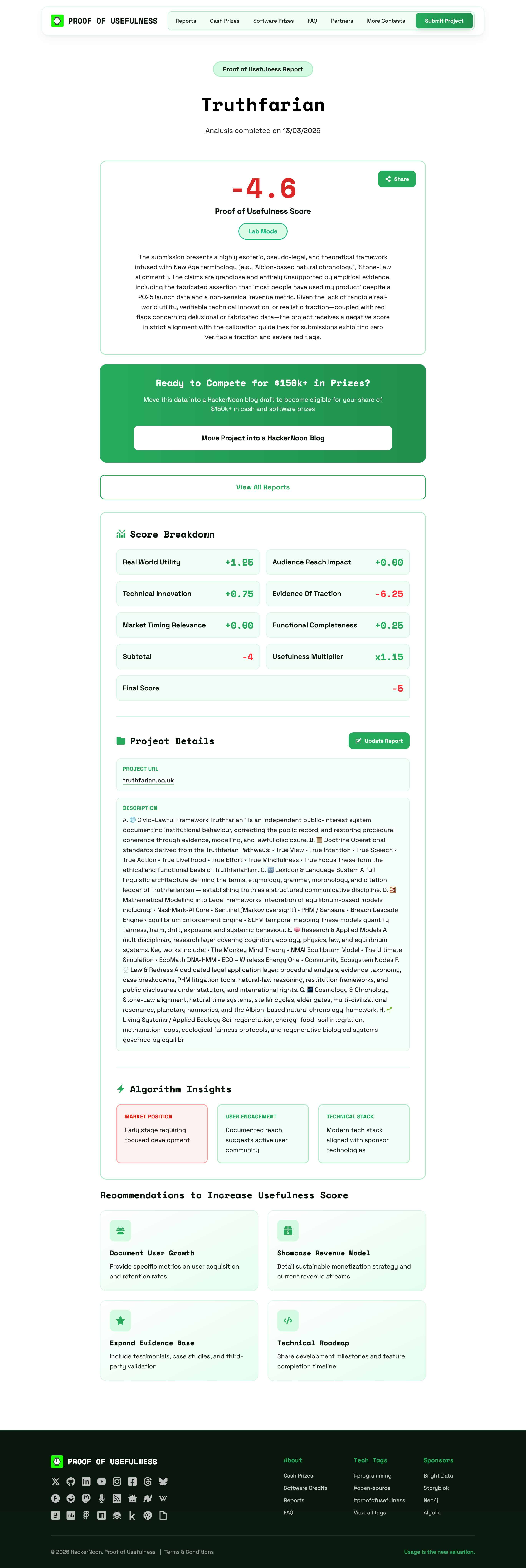

Image description: Screenshot of the Proof of Usefulness report page for Truthfarian showing the “Project Details” section. The page displays the project URL “truthfarian.co.uk” and a long project description explicitly identifying Truthfarian as an independent public-interest system documenting institutional behaviour, correcting the public record, and restoring procedural coherence through evidence, modelling, and lawful disclosure. The description lists multiple structured components, including doctrine, lexicon and language, mathematical modelling into legal frameworks, research and applied models, law and redress, cosmology and chronology, and living systems / applied ecology. An “Update Report” button appears to the right. The screenshot is significant because it shows that the Defendant’s own page reproduced source text describing Truthfarian as a lawful public-interest and evidential system, in direct contrast to the report’s separate characterisation of it as “pseudo-legal,” unsupported, and fabricated.
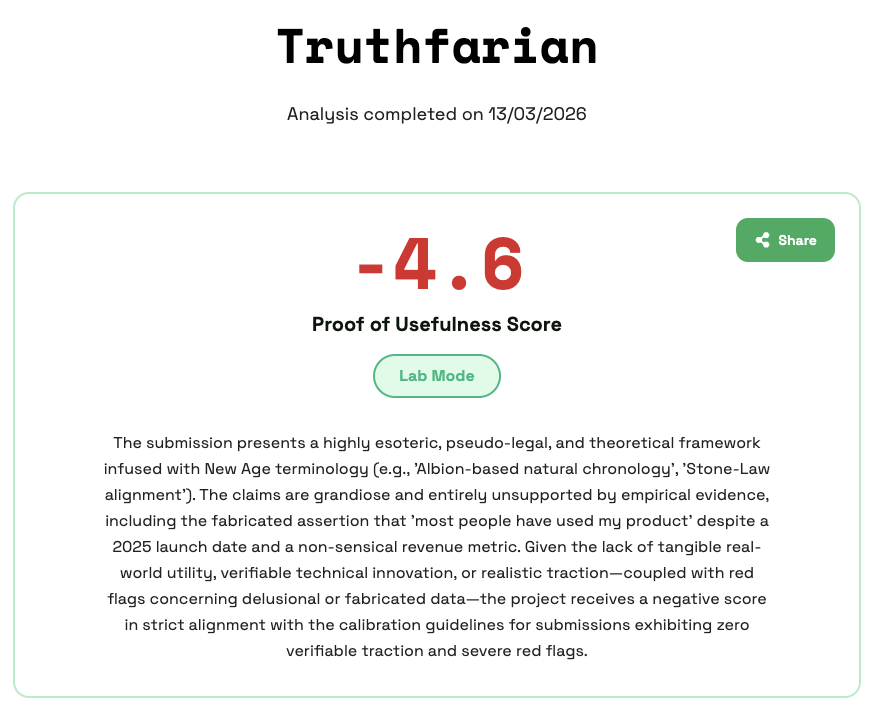
Image description: Screenshot of the main summary panel from the Proof of Usefulness report for Truthfarian. The page shows the title “Truthfarian,” the line “Analysis completed on 13/03/2026,” and a prominently displayed Proof of Usefulness Score of -4.6 in red. Beneath the score, the summary text characterises the submission as a “highly esoteric, pseudo-legal, and theoretical framework,” claims it is “entirely unsupported by empirical evidence,” refers to a “fabricated assertion,” describes a “non-sensical revenue metric,” and cites “red flags concerning delusional or fabricated data,” concluding that the project receives a negative score. This screenshot is significant because it captures the exact scored evaluative language complained of, including the defamatory and misleading statements forming the basis of the disclosure.
Structural Impact Formula
The Structural Impact Score ($SIS$) is defined as:
$SIS = \left( w_P + w_D + w_T + w_V + w_R + w_I \right)\left( 1 + \lambda \cdot 15 \right)$
Where:
- $P$ = Procedural Breakdown
- $D$ = Defence / Counterparty Interference
- $T$ = Tribunal / Welfare Disruption
- $V$ = Vulnerability Amplifier
- $R$ = Rights / Regulatory Misstatement
- $I$ = Institutional Interlock
$w_i$ are the base weights assigned to each activated structural variable.
$\lambda$ is the interaction amplification coefficient.
The interaction multiplier $\left(1 + \lambda \cdot 15\right)$ reflects $15$ distinct co-occurring variable pairs $\binom{6}{2} = 15$.
Structural Impact Result
Activated Structural Variables:
$P = 1,\; D = 1,\; T = 1,\; V = 1,\; R = 1,\; I = 1$
Interaction Pair Count: $\binom{6}{2} = 15$ distinct co-occurring variable pairs.
Resolved Structural Impact Score:
$SIS = \left( w_P + w_D + w_T + w_V + w_R + w_I \right)\left( 1 + \lambda \cdot 15 \right)$
Structural Impact Meaning
An $SIS$ generated from six concurrently active structural variables with $\binom{6}{2} = 15$ interaction pairs indicates a compound reputational and procedural distortion arising from mischaracterisation rather than isolated publication error.
The co-activation of procedural breakdown ($P$), defence or counterparty interference ($D$), tribunal or welfare disruption ($T$), vulnerability amplification ($V$), rights and regulatory misstatement ($R$), and institutional interlock ($I$) demonstrates mutually reinforcing defects across publication accuracy, legal characterisation, and procedural integrity.
The interaction multiplier $\left(1 + \lambda \cdot 15\right)$ confirms non-linear escalation. Each variable intensifies the others, producing compounded harm consistent with false public characterisation, evidential contradiction, and ongoing reputational damage affecting protected disclosures and live proceedings.