
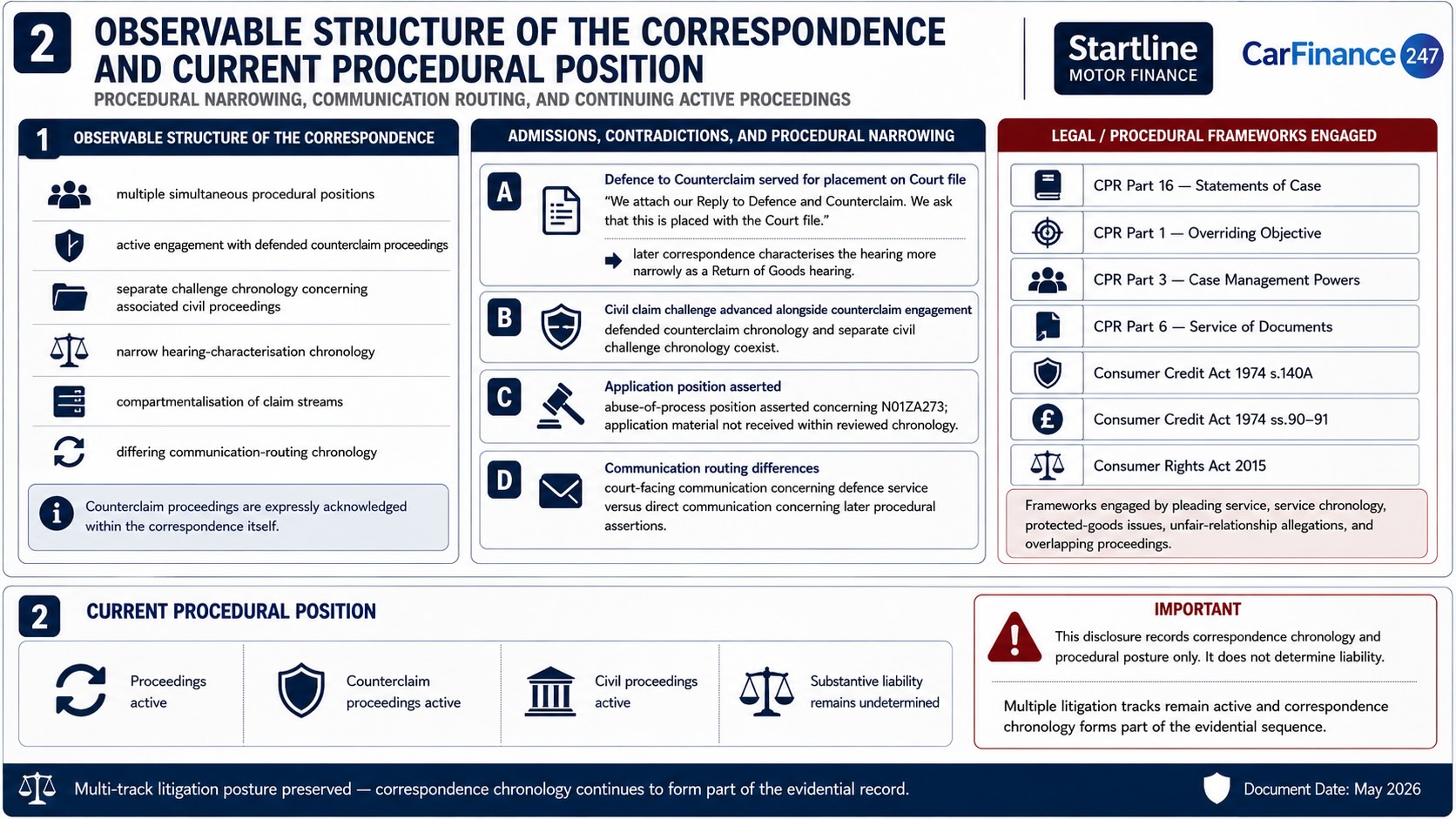
Figure 1. Observable Structure of the Correspondence and Current Procedural Position — illustrating defended counterclaim chronology, hearing-characterisation chronology, civil claim positioning, communication-routing chronology, legal frameworks engaged, and continuing multi-track litigation posture across active proceedings.
HFW Correspondence Chronology, Defence to Counterclaim Service, Civil Claim Positioning, and Hearing Characterisation Following Multi-Track Litigation Escalation
Overview
This disclosure concerns ongoing litigation involving:
- Startline Motor Finance Ltd;
- CarFinance 247;
• HFW acting within the proceedings;
• Claim No. M01RG980;
• Claim No. N01ZA273;
• and associated litigation chronology arising from financed vehicle proceedings, defended counterclaim proceedings, and related civil proceedings.
The proceedings concern:
- vehicle-condition disputes;
- protected-goods chronology;
- vulnerability chronology;
- complaint chronology;
- DSAR chronology;
- residential attendance chronology;
- pleaded unfair relationship allegations under section 140A Consumer Credit Act 1974;
- defended counterclaim proceedings;
- and associated civil proceedings continuing in parallel chronology.
This disclosure records correspondence chronology emerging following service of the Defence to Counterclaim and subsequent procedural communications.
This disclosure does not determine liability.
It records:
• observable procedural positions advanced through correspondence;
• chronology surrounding service of pleadings;
• hearing characterisation chronology;
• communication-routing chronology;
• associated civil claim chronology;
• and the relationship between counterclaim proceedings and associated civil proceedings.
The disclosure further records subsequent correspondence chronology concerning hearing characterisation, asserted procedural positions relating to associated civil proceedings, and correspondence chronology emerging following service of the Defence to Counterclaim.
1. Procedural and Correspondence Chronology
The proceedings had already materially expanded beyond ordinary vehicle-return framing through:
- active counterclaim proceedings;
- vulnerability chronology;
- complaint chronology;
- DSAR chronology;
- protected-goods chronology;
- residential attendance chronology;
- pleaded unfair relationship allegations under section 140A Consumer Credit Act 1974;
- and cumulative litigation chronology extending beyond simple return-of-goods positioning.
A Reply and Defence to Counterclaim was subsequently served by HFW.
The correspondence expressly records:
“We write with reference to the above matter and attach our Reply to Defence and Counterclaim. We ask that this is placed with the Court file.”
Subsequent correspondence chronology records:
- abuse-of-process positioning concerning Claim No. N01ZA273;
- narrower hearing characterisation chronology;
- continuing separation between counterclaim chronology and civil claim chronology;
- and continuing active litigation posture across multiple proceedings.
| Date | Event | Procedural Significance | Evidence |
|---|---|---|---|
| 19 May 2026 | Reply and Defence to Counterclaim served | Formal defended counterclaim posture confirmed | EX01 |
| 19 May 2026 | Request made for Defence to Counterclaim to be placed on Court file | Formal court-facing pleading chronology | EX01 |
| 20 May 2026 | Counterclaim / civil claim distinction formally recorded | Procedural separation chronology preserved | EX02 |
| Subsequent correspondence | Return-of-Goods hearing characterisation advanced | Narrow hearing-position chronology introduced | EX03 |
| Subsequent correspondence | Abuse-of-process position asserted concerning N01ZA273 | Separate civil claim chronology introduced | EX03 |
| Ongoing | Counterclaim chronology and civil claim chronology remain active | Multi-track litigation posture preserved | EX01–EX03 |
2. Observable Structure of the Correspondence
The correspondence appears structured around multiple simultaneous procedural positions.
These include:
- active engagement with defended counterclaim proceedings;
- separate challenge chronology concerning associated civil proceedings;
- narrow hearing characterisation chronology;
- compartmentalisation of claim streams;
- and differing communication-routing chronology.
The disclosure further records:
- counterclaim proceedings are expressly acknowledged within correspondence itself;
- civil proceedings are separately challenged;
- hearing characterisation chronology emerges later within the sequence;
- and procedural chronology remains active across both proceedings.
3. Procedural Context
The proceedings presently remain active.
The disclosure records:
- counterclaim proceedings remain active;
- civil proceedings remain active;
- multiple litigation tracks continue simultaneously;
- substantive liability remains undetermined;
- and correspondence chronology itself forms part of the evidential sequence.
4. Correspondence Admissions, Contradictions, and Procedural Narrowing
I. Defence to Counterclaim Served for Placement on Court File While Later Hearing Characterisation Narrowed
Correspondence Extract
“We attach our Reply to Defence and Counterclaim. We ask that this is placed with the Court file.”
Analysis
The correspondence expressly records:
- service of a full Reply and Defence to Counterclaim;
- intention that the pleading be placed onto the Court file;
- linkage between defence chronology and June hearing chronology.
Subsequent correspondence later characterises the hearing more narrowly as a Return of Goods hearing.
The disclosure records:
- counterclaim proceedings are expressly acknowledged within correspondence itself;
- formal pleading response was considered procedurally necessary;
hearing characterisation chronology narrowed later within the sequence.
II. Civil Claim Challenge Advanced Alongside Counterclaim Engagement
The correspondence chronology records:
- active engagement with the counterclaim;
- separate challenge chronology concerning Claim No. N01ZA273;
- continuing overlap between civil claim chronology and counterclaim chronology.
The disclosure records coexistence of:
- defended counterclaim chronology;
- civil challenge chronology;
- continuing multi-track litigation posture.
III. Application Position Asserted Within Correspondence Chronology
The correspondence records an asserted abuse-of-process position concerning Claim No. N01ZA273.
The disclosure further records:
- application material had not been received within reviewed chronology;
- associated paperwork had not been exhibited within the reviewed correspondence sequence;
- asserted procedural position presently exists within correspondence chronology itself.
IV. Communication Routing Differences Across Procedural Positions
The disclosure records differing communication routing chronology.
This includes:
- court-facing communication concerning defence service;
- direct communication concerning later procedural assertions;
- differing communication pathways across separate procedural positions.
V. Continuing Quantum and Procedural Alignment Chronology
The correspondence chronology further records:
- continuing absence of substantive defence material within Claim No. N01ZA273;
- continuing interaction between civil claim chronology and counterclaim chronology;
- continuing procedural overlap between proceedings.
The disclosure further records that:
- amendment chronology;
- quantum chronology;
- and associated applications arising from the continuing procedural posture remain active considerations.
5. Legal and Procedural Frameworks Engaged
I. CPR Part 16 — Statements of Case
Framework: Civil Procedure Rules Part 16
Verbatim / Principle:
“A statement of case must include a concise statement of the facts on which the party relies.”
Analysis
This disclosure records service of a formal Reply and Defence to Counterclaim together with subsequent hearing-characterisation chronology and associated civil-claim chronology.
The disclosure further records:
• formal pleading response was considered necessary by the Claimant representatives;
• counterclaim chronology remains procedurally active;
• hearing characterisation chronology subsequently narrowed.
(EX01–EX03)
II. CPR Part 1 — Overriding Objective
Framework: Civil Procedure Rules Part 1
Verbatim / Principle:
“These Rules are a new procedural code with the overriding objective of enabling the court to deal with cases justly and at proportionate cost.”
Analysis
This disclosure concerns:
• overlapping proceedings;
• active counterclaim chronology;
• active civil claim chronology;
• hearing-characterisation chronology;
• materially linked litigation streams.
(EX01–EX03)
III. CPR Part 3 — Case Management Powers
Framework: Civil Procedure Rules Part 3
Verbatim / Principle:
“Except where these Rules provide otherwise, the court may … extend or shorten time for compliance…”
Analysis
This disclosure records active procedural management chronology involving:
• defended counterclaim proceedings;
• continuing civil proceedings;
• hearing-position chronology;
• procedural overlap across claims.
(EX01–EX03)
IV. CPR Part 6 — Service of Documents
Framework: Civil Procedure Rules Part 6
Verbatim / Principle:
CPR Part 6 governs service requirements and procedural notification.
Analysis
The disclosure records:
• service of the Defence to Counterclaim;
• asserted application chronology within N01ZA273;
• questions concerning procedural service chronology;
• differing communication-routing chronology.
(EX01–EX03)
V. Consumer Credit Act 1974 — Section 140A (Unfair Relationships)
Framework: Consumer Credit Act 1974, Section 140A
Verbatim / Principle:
“The court may make an order under section 140B … if it determines that the relationship … is unfair to the debtor.”
Analysis
The pleaded proceedings place the wider creditor–debtor relationship directly in issue through:
• vulnerability chronology;
• complaint chronology;
• DSAR chronology;
• residential attendance chronology;
• enforcement chronology;
• cumulative conduct chronology.
(EX04–EX10)
VI. Consumer Credit Act 1974 — Sections 90–91 (Protected Goods)
Framework: Consumer Credit Act 1974, Sections 90–91
Verbatim / Principle:
Protected goods require court process before recovery once statutory thresholds are met.
Analysis
This disclosure records:
• return-of-goods hearing characterisation chronology;
• enforcement chronology;
• protected-goods chronology;
• interaction between recovery framing and wider proceedings.
(EX04–EX10)
VII. Consumer Rights Act 2015
Framework: Consumer Rights Act 2015
Verbatim / Principle:
Consumer contracts and conduct should remain fair and transparent.
Analysis
The wider chronology concerns:
• conduct chronology;
• complaint chronology;
• procedural chronology;
• continuing regulated-credit relationship chronology.
(EX04–EX10)
6. Current Position
At the date of this disclosure:
- proceedings remain active;
- counterclaim proceedings remain active;
- civil proceedings remain active;
- correspondence chronology continues to evolve;
- substantive liability remains undetermined.
7. Conclusion
This disclosure records correspondence chronology emerging following service of the Defence to Counterclaim.
The disclosure identifies:
- active counterclaim engagement;
- separate civil claim chronology;
- hearing characterisation chronology;
- differing communication routing;
- continuing multi-track litigation posture.
Substantive liability remains undetermined.
Exhibits
| Exhibit | Exhibit Title | Description / Purpose |
|---|---|---|
| EX01 | HFW Email — Defence to Counterclaim Service | Records service of Defence to Counterclaim and request for placement on Court file |
| EX02 | Claimant Correspondence — Procedural Clarification Email | Records distinction between counterclaim chronology and civil claim chronology |
| EX03 | HFW Follow-Up Correspondence | Records hearing characterisation chronology and civil claim procedural assertions |
Structural Impact Formula
The Structural Impact Score ($SIS$) is defined as:
$SIS = \left( w_P + w_D + w_T + w_V + w_R + w_I \right)\left( 1 + \lambda \cdot 15 \right)$
Where:
- $P$ = Procedural Breakdown
- $D$ = Defence / Counterparty Interference
- $T$ = Tribunal / Welfare Disruption
- $V$ = Vulnerability Amplifier
- $R$ = Rights / Regulatory Misstatement
- $I$ = Institutional Interlock
The interaction multiplier $\left(1 + \lambda \cdot 15\right)$ reflects $\binom{6}{2} = 15$ co-occurring structural interaction pairs.
Structural Impact Result
Activated Structural Variables:
$P = 1,\; D = 1,\; T = 1,\; V = 1,\; R = 1,\; I = 1$
Interaction Pair Count: $\binom{6}{2} = 15$ distinct co-occurring variable pairs.
Resolved Structural Impact Score:
$SIS = \left( w_P + w_D + w_T + w_V + w_R + w_I \right)\left( 1 + \lambda \cdot 15 \right)$
Structural Impact Meaning
An $SIS$ produced by six concurrently active structural variables with $\binom{6}{2} = 15$ interaction pairs indicates compound multi-track litigation distortion rather than an isolated dispute concerning vehicle finance, hearing classification, or correspondence chronology.
The co-activation of procedural breakdown $P$, defence or counterparty interference $D$, tribunal or welfare disruption $T$, vulnerability amplification $V$, rights and regulatory misstatement $R$, and institutional interlock $I$ demonstrates mutually reinforcing defects across defended counterclaim proceedings, associated civil proceedings, hearing-characterisation chronology, communication-routing chronology, and cumulative litigation management.
The interaction multiplier $\left(1 + \lambda \cdot 15\right)$ confirms non-linear escalation. Each structural condition intensifies the others, producing compounded procedural exposure where defended counterclaim chronology, separate civil proceedings, vulnerability chronology, protected-goods chronology, and correspondence-based procedural narrowing operate simultaneously across overlapping litigation tracks.
This represents a multi-track procedural interaction state in which litigation fragmentation, narrowing behaviour, and overlapping claim structures increase administrative burden, procedural complexity, and cumulative exposure while substantive liability remains undetermined.