
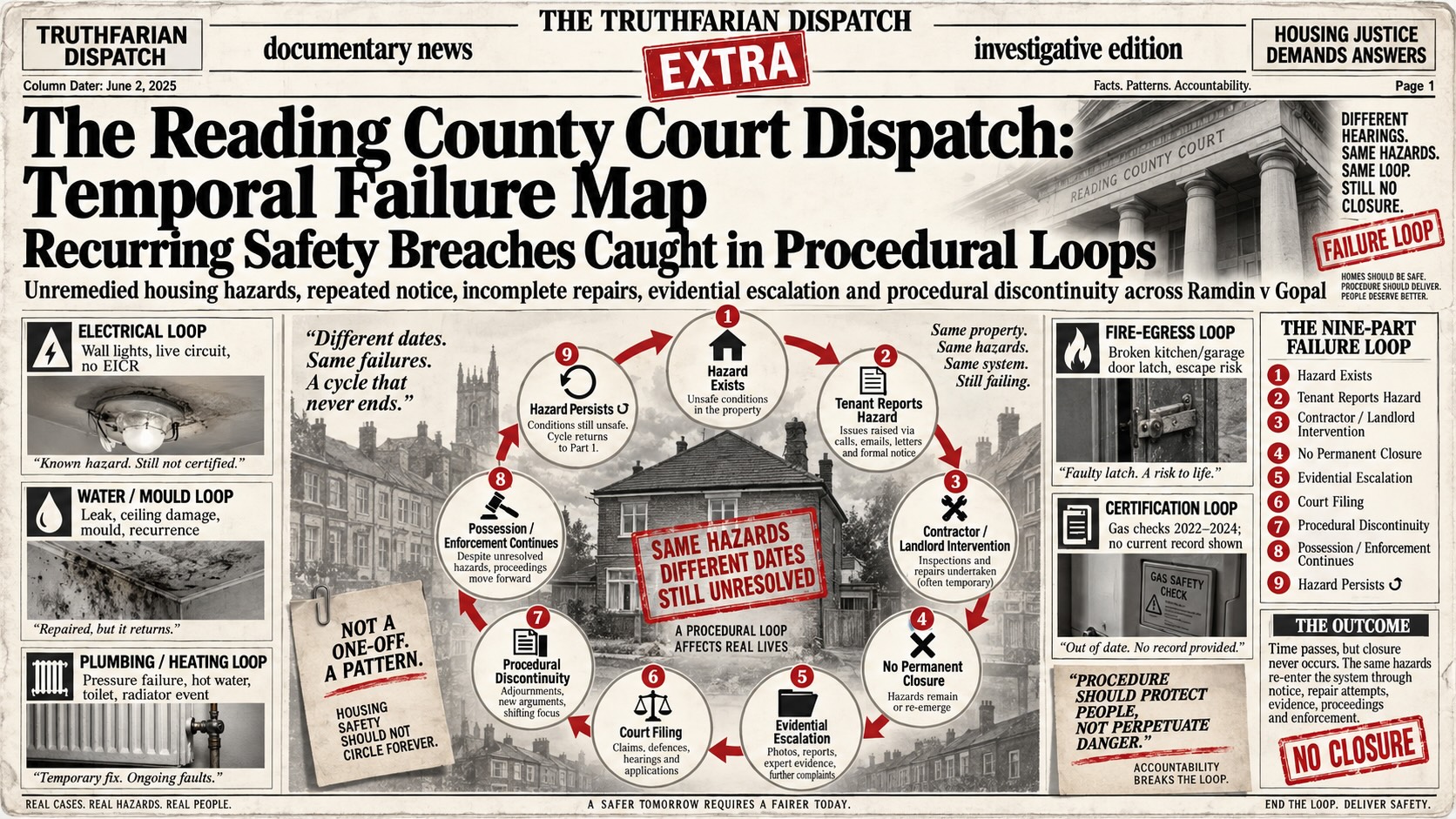
The graphic maps a recurring nine-stage cycle across *Ramdin v Gopal*: housing hazard, tenant notice, landlord or contractor intervention, absence of permanent remediation, evidential escalation, court filing, procedural discontinuity, continuing possession or enforcement activity, and recurrence of the original hazard. Surrounding panels identify the electrical, water and mould, plumbing and heating, fire-egress, and statutory-certification failures forming the underlying safety record. The visual demonstrates the disclosure’s central structural finding: different dates and procedural stages repeatedly return to the same unresolved hazards, producing a temporal failure loop rather than effective closure.
Unremedied Mould, Electrical Hazards, Missing Statutory Safety Records and Procedural Suppression Across Ramdin v Gopal
Proceedings:
M04ZA309 – Endarr Carlton Ramdin v Manohar Gopal
M00RG751 – Manohar Gopal v Endarr Carlton Ramdin
Court: Reading County Court
Disclosure date: 25 August 2026
Executive Summary
This disclosure records a continuing housing-safety and procedural failure extending from the commencement of the tenancy in September 2020 through active possession and civil litigation in August 2026.
The underlying housing record is not confined to historical repair complaints. The filed material documents persistent mould and damp, water ingress, plumbing and heating defects, defective escape arrangements, electrical hazards, absence of an Electrical Installation Condition Report supplied to the tenant, and repeated repair notifications through the landlord's authorised agent and contractors. The Particulars of Claim describe chronic disrepair including mould, damaged ceilings, water ingress and persistent defects; the Rebuttal to Defence records that no EICR had ever been supplied and that exposed/live electrical fittings remained an unresolved issue.
The documentary gas-safety chronology records annual checks arranged for 1 September 2022, 30 August 2023 and 4 September 2024. No later gas-safety record presently forms part of the documentary chain relied upon here, and the current tenant position is that no current gas-safety record has been provided.
The current electrical position is similarly material. The pleaded record states that no EICR was supplied, while the evidence separately identifies a live electrical circuit/wall-light condition and continuing fuse-board/RCD concerns. The September 2025 evidential record then escalated further through a radiator failure, water discharge and associated water/electrical crossover.
The significance is compounded by the procedural history. The safety material did not disappear because possession proceedings advanced. The March 2026 N244 and supporting Witness Statement expressly reconstruct the missing safety and evidential record, while the 26 March 2026 order of Deputy District Judge Passmore recognised the N244 as a live and “very detailed application” and directed an Initial Directions Hearing. The current case-management record identifies unresolved questions concerning the Defence, Counterclaim, M04ZA309 civil claim, historic evidential bundles, September safety evidence and later enforcement.
The disclosure therefore concerns a continuing breach web: physical housing danger, statutory certification failure, prolonged notice, incomplete remediation, possession pressure, and loss of continuity within the court record.
Breach 1. Continuing Mould, Damp and Water-Ingress Failure
The pleaded housing record establishes a continuing pattern of mould, damp, water ingress, ceiling deterioration and associated structural degradation extending across the tenancy.
The Updated Particulars record that the property suffered from damp patches, visible staining, structural cracking to the living-room and kitchen ceilings, water ingress following flooding, worsening mould and damp, bathroom defects and incomplete or cosmetic repairs which failed to remove the underlying causes. These conditions were repeatedly reported and remained part of the substantive disrepair claim.
The contemporaneous communications independently establish repeated water-related failures. Exhibit D records the January 2023 shower leak into the ceiling, subsequent ceiling intervention, attic/floorboard damage and later ceiling cracking. Exhibit E independently records the shower leaking through the ceiling together with later hot-water, toilet, shower-pressure and pump problems.
The Rebuttal disputes that the ceiling and water-damage repairs were satisfactorily completed. It records allegations of defective workmanship, inadequate finishing and continued visible cracking after intervention.
The present position is therefore not merely historical. The mould, damp and associated water-ingress conditions have not been fully remedied and remain ongoing.
Evidence
- Updated Particulars of Claim – 27 May 2025 – chronic disrepair, mould, damp, water ingress, damaged ceilings and structural cracking.
- Exhibit D – Angela Gopal Reported Issues WhatsApp Extract – shower leakage into the ceiling, attic/floor damage, ceiling repairs and subsequent cracking.
- Exhibit E – Simon (Plumber) Reported Issues WhatsApp Extract – shower leakage through the ceiling, hot-water problems, toilet failures and shower/pump defects.
- Rebuttal to Defence – 26 May 2025 – disputed adequacy of ceiling and water-damage repairs and continuing structural deterioration.
- September 2025 Safety / Disrepair Evidential Bundle – later water-discharge and safety escalation incorporated into the March 2026 procedural record.
Legal Frameworks Engaged
- Landlord and Tenant Act 1985 – sections 9A, 10 and 11
- Homes (Fitness for Human Habitation) Act 2018
- Housing Act 2004 – Part 1
- Housing Health and Safety Rating System (HHSRS) – Damp and Mould Growth
- Housing Health and Safety Rating System (HHSRS) – Structural Collapse and Falling Elements
- Housing Health and Safety Rating System (HHSRS) – Excess Cold
- Defective Premises Act 1972 – section 4
- Environmental Protection Act 1990 – section 79
- Common-law negligence
- Human Rights Act 1998 – Article 8 ECHR
- International Covenant on Economic, Social and Cultural Rights – Article 11
Breach 2. Electrical Safety Failure and Non-Provision of the EICR
The electrical-safety breach contains two interconnected components: the physical safety of the electrical installation itself and the absence of an Electrical Installation Condition Report being supplied to the tenant.
The existing Legal Breaches and Evidence record identifies two wall-mounted light fittings containing live wiring but without a functioning switch by which the circuits could ordinarily be turned on and off. The record states that removal of the cover from one fitting caused the light to illuminate unexpectedly, confirming an active circuit without a proper switching or isolation arrangement.
The Rebuttal separately records that no EICR was ever provided to the Claimant, despite repeated requests. It further challenges reliance upon any purported satisfactory electrical certification because the live/exposed wall-light condition remained unresolved.
Exhibit D places the wall-light installation at the very beginning of the tenancy. The September 2020 communication expressly refers to the lounge wall lights and their switching arrangement, demonstrating that the installation was part of the property condition known within the landlord-management structure from commencement.
The later September 2025 evidence adds fuse-board/RCD and water/electrical crossover concerns, thereby extending the electrical-safety architecture beyond the wall-light fittings alone.
The present position is that the electrical-certification failure and the physical electrical hazards have not been demonstrated to have been brought to final compliant remediation.
Evidence
- Legal Breaches and Evidence – Electrical Safety Breaches 24–25 – exposed live wiring, active circuit and unverified installation.
- Legal Breaches and Evidence – Prolonged Housing Disrepair – two live-wired wall fittings with no functioning switch arrangement.
- Rebuttal to Defence – EICR section – no EICR supplied and challenge to any claimed certification while electrical defects remained unresolved.
- Exhibit D – 26 September 2020 WhatsApp communication – contemporaneous evidence concerning the wall-light installation.
- September 2025 Safety / Disrepair material – fuse-board/RCD and water/electrical crossover concerns.
Legal Frameworks Engaged
- Electrical Safety Standards in the Private Rented Sector (England) Regulations 2020
- Landlord and Tenant Act 1985 – sections 9A, 10 and 11
- Homes (Fitness for Human Habitation) Act 2018
- Housing Act 2004 – Part 1
- Housing Health and Safety Rating System (HHSRS) – Electrical Hazards
- Housing Health and Safety Rating System (HHSRS) – Fire
- Defective Premises Act 1972 – section 4
- Common-law negligence
- Human Rights Act 1998 – Article 8 ECHR
- International Covenant on Economic, Social and Cultural Rights – Articles 11 and 12
Breach 3. Current Gas-Safety Record Failure
The gas-safety documentary record establishes a recurring annual compliance sequence.
Exhibit E records:
- 1 September 2022 – annual gas-safety check arranged;
- 30 August 2023 – annual gas-safety check arranged; and
- 4 September 2024 – annual gas-safety check arranged.
The documentary chain presently available therefore demonstrates that gas-safety inspection was historically treated as an annual obligation. The present evidential chain relied upon for this disclosure contains no later gas-safety record after September 2024.
The current August 2026 position is that no current gas-safety record or certificate has been provided to the tenant.
The existence of earlier gas-safety checks does not resolve the current position because the obligation is recurring. The evidential question is therefore whether the required later annual inspection occurred and, separately, whether the resulting statutory record was supplied.
This is a standalone current safety and compliance failure and should not be reduced to a generic repair issue.
Evidence
- Exhibit E – Simon (Plumber) Reported Issues WhatsApp Extract – annual gas-safety chronology through 4 September 2024.
- Rebuttal to Defence – gas-safety compliance expressly identified among the serious safety matters not answered by the Defendant's repair schedule.
- Current August 2026 position – no current gas-safety record/certificate has been provided.
Legal Frameworks Engaged
- Gas Safety (Installation and Use) Regulations 1998 – regulation 36
- Landlord and Tenant Act 1985 – sections 9A, 10 and 11
- Homes (Fitness for Human Habitation) Act 2018
- Housing Act 2004 – Part 1
- Housing Health and Safety Rating System (HHSRS) – Carbon Monoxide and Fuel Combustion Products
- Housing Health and Safety Rating System (HHSRS) – Fire
- Defective Premises Act 1972 – section 4
- Common-law negligence
- Human Rights Act 1998 – Article 8 ECHR
- International Covenant on Economic, Social and Cultural Rights – Articles 11 and 12
Breach 4. September 2025 Radiator Failure, Water Discharge and Electrical Crossover
The September 2025 event represents a distinct escalation from longstanding disrepair into a compound housing-safety event involving heating, water and electricity.
The current Case Management Clarification identifies the September evidential package as containing:
- radiator failure;
- water discharge;
- water/electrical crossover;
- fuse-board/RCD concerns; and
- associated safety and habitability material.
The March 2026 Witness Statement subsequently incorporates that event into the wider procedural case and identifies the September safety evidence as material that was filed but not carried continuously into the later operative court record.
The significance is cumulative. A heating-system failure generated water discharge within premises already subject to pleaded electrical concerns, including live-wired wall-light fittings and unresolved certification issues. The September event therefore cannot properly be isolated from the earlier electrical and water-related history.
The event creates a compound hazard architecture:
heating-system defect → water discharge → electrical interaction → fuse-board/RCD concern → immediate safety exposure → evidential filing → later procedural discontinuity.
Evidence
- September 2025 Safety / Disrepair Evidential Bundle – radiator failure, water discharge, water/electrical crossover and fuse-board/RCD concerns.
- March 2026 Witness Statement – incorporates the September safety evidence into the current procedural and substantive case.
- Case Management Clarification – section 11.9 – seeks confirmation of the September bundle's location, claim allocation, service and operative evidential status.
- Earlier electrical evidence – live circuit and unresolved installation concerns preceding the September water event.
Legal Frameworks Engaged
- Landlord and Tenant Act 1985 – sections 9A, 10 and 11
- Homes (Fitness for Human Habitation) Act 2018
- Housing Act 2004 – Part 1
- Housing Health and Safety Rating System (HHSRS) – Electrical Hazards
- Housing Health and Safety Rating System (HHSRS) – Damp and Mould Growth
- Housing Health and Safety Rating System (HHSRS) – Excess Cold
- Electrical Safety Standards in the Private Rented Sector (England) Regulations 2020
- Defective Premises Act 1972 – section 4
- Common-law negligence
- Human Rights Act 1998 – Article 8 ECHR
- International Covenant on Economic, Social and Cultural Rights – Articles 11 and 12
Breach 5. Fire-Egress and Door-Safety Failure
The kitchen/garage door defect is not merely a defective lock. The pleaded evidence identifies it as a persistent security and emergency-egress hazard.
Exhibit D records the July 2024 complaint that the kitchen-door lock “has always been broken”, that the key was effectively the mechanism keeping it shut, and that the locking arrangement did not function properly.
The Rebuttal records the more serious egress consequence: when closed, the door could not properly be opened from inside, creating a pleaded fire and emergency-escape risk. It records that the matter was raised directly with Angela Gopal and subsequently with Environmental Health.
The Legal Breaches and Evidence schedule further records September 2024 Environmental Health correspondence concerning unresolved fire-safety issues.
The breach architecture is therefore:
longstanding defective latch/lock → repeated notice → inability to use the door normally as an emergency exit → Environmental Health escalation → no demonstrated permanent remediation.
Evidence
- Exhibit D – 19 July 2024 WhatsApp communication – longstanding broken kitchen/garage door lock.
- Rebuttal to Defence – inability to open the door from inside and resulting fire/egress risk.
- Legal Breaches and Evidence – longstanding fire-exit failure and Environmental Health correspondence.
- Environmental Control Officer correspondence – September 2024 – continuing fire-safety concern recorded within the evidential schedule.
Legal Frameworks Engaged
- Landlord and Tenant Act 1985 – sections 9A, 10 and 11
- Homes (Fitness for Human Habitation) Act 2018
- Housing Act 2004 – Part 1
- Housing Health and Safety Rating System (HHSRS) – Fire
- Housing Health and Safety Rating System (HHSRS) – Entry by Intruders
- Defective Premises Act 1972 – section 4
- Regulatory Reform (Fire Safety) Order 2005 – as pleaded within the existing case
- Common-law negligence
- Common Law Right to Quiet Enjoyment
- Human Rights Act 1998 – Article 8 ECHR
- International Covenant on Economic, Social and Cultural Rights – Article 11
Breach 6. Persistent Plumbing, Heating and Essential-Service Failure
The plumbing and essential-service record extends across several years and demonstrates recurring failures rather than a single defect followed by permanent remediation.
The Supplementary Particulars record prolonged low water pressure, unreliable hot-water supply, persistent shower and toilet failures and the eventual involvement of Thames Water. They state that the water-pressure problem persisted for years before the underlying cause was resolved and that the Claimant had to become directly involved in identifying the problem.
Exhibit E independently records:
- shower leakage through the ceiling;
- urgent hot-water problems;
- recurring toilet-valve failures;
- repeated shower-pressure problems;
- shower-cartridge intervention;
- repeated contractor visits after earlier work.
The existing Legal Breaches and Evidence record likewise identifies unreliable shower-pump operation and recurring toilet leakage as examples of failures that were repeatedly attended to without lasting resolution.
The September 2025 radiator failure subsequently extended the same essential-service history into the heating system itself.
The resulting chronology demonstrates continuing interference with water, sanitation, bathing, hot-water and heating systems forming part of ordinary residential occupation.
Evidence
- Supplementary Particulars – March 2025 – prolonged water-pressure, hot-water, shower and toilet failures.
- Exhibit E – Simon (Plumber) WhatsApp Extract – repeated plumbing, shower, hot-water and toilet interventions.
- Legal Breaches and Evidence – shower-pump failure, recurring toilet leakage and incomplete repair history.
- September 2025 Safety / Disrepair Bundle – subsequent radiator/heating failure and water discharge.
Legal Frameworks Engaged
- Landlord and Tenant Act 1985 – sections 9A, 10 and 11
- Homes (Fitness for Human Habitation) Act 2018
- Housing Act 2004 – Part 1
- Housing Health and Safety Rating System (HHSRS) – Water Supply
- Housing Health and Safety Rating System (HHSRS) – Personal Hygiene, Sanitation and Drainage
- Housing Health and Safety Rating System (HHSRS) – Excess Cold
- Defective Premises Act 1972 – section 4
- Common-law negligence
- Common Law Right to Quiet Enjoyment
- Human Rights Act 1998 – Article 8 ECHR
- International Covenant on Economic, Social and Cultural Rights – Article 11
Breach 7. Knowledge, Notice and Agent-Controlled Repair Management
The evidential record establishes sustained notice of the defects through the structure by which the tenancy was actually managed.
Exhibit D records direct communications with Angela Gopal concerning wall lights, smoke alarms, bathtub defects, plumbing, shower leakage, ceiling damage, flooring damage, kitchen-ceiling cracking, the kitchen/garage door and carbon-monoxide alarm issues.
Exhibit E establishes a parallel contractor pathway through Simon, who dealt with plumbing failures, hot water, toilets, shower pressure, pump defects and annual gas-safety visits.
The Rebuttal expressly records that Angela Gopal was repeatedly informed of serious disrepair, both through direct communications and in-person interactions, and that she functioned as the landlord's agent in relation to repair management.
The notice architecture therefore does not depend upon a single message or one particular recipient. It is cumulative:
direct notice → landlord-agent notice → contractor involvement → photographic evidence → Environmental Health escalation → pleaded court record.
The continuing failures therefore arise against a documented history of knowledge rather than absence of notification.
Evidence
- Exhibit D – Angela Gopal WhatsApp Extract – repeated direct notification of multiple defects throughout the tenancy.
- Exhibit E – Simon (Plumber) WhatsApp Extract – contractor knowledge and repeated interventions.
- Rebuttal to Defence – repeated notice to Angela and challenge to the Defendant's denial of knowledge.
- Environmental Health correspondence – external escalation concerning unresolved safety matters.
Legal Frameworks Engaged
- Landlord and Tenant Act 1985 – sections 9A, 10 and 11
- Homes (Fitness for Human Habitation) Act 2018
- Housing Act 2004 – Part 1
- Defective Premises Act 1972 – section 4
- Common-law principles of agency
- Common-law principles of notice
- Common-law negligence
- Common Law Right to Quiet Enjoyment
- Protection from Harassment Act 1997 – insofar as the separately pleaded conduct strand is engaged
- Human Rights Act 1998 – Article 8 ECHR
Breach 8. Incomplete, Cosmetic or Delayed Remediation
The litigation record expressly disputes the proposition that contractor attendance or isolated repair activity establishes satisfactory remediation.
The Rebuttal records that the Defendant relied upon a schedule of repair works between 2020 and 2024, but that those works did not answer the central pleaded hazards and did not account for prolonged delays, poor workmanship or incomplete and superficial repair interventions.
The ceiling evidence is particularly significant. The existing Legal Breaches and Evidence document records a water-damaged ceiling hole being covered using Sellotape and then painted over rather than the damaged section being properly replaced. It separately records weakened floorboards and continuing ceiling bulging and cracking.
The Rebuttal identifies the same distinction in relation to the kitchen/garage door: replacing or dealing with a key did not remedy the central defect that the latch and handle mechanism remained inoperable from inside. It similarly records the absence of evidence establishing completed electrical-safety obligations.
The plumbing chronology demonstrates the same pattern through repeated return visits following earlier interventions.
The breach is therefore not simply failure to attend. It is failure to achieve effective and lasting remediation of the underlying defect and hazard.
Evidence
- Rebuttal to Defence – Paragraphs D and E – delayed, incomplete and superficial repair history.
- Legal Breaches and Evidence – Sellotape/paint ceiling repair, continuing structural deterioration and recurring essential-service failures.
- Exhibit D – repeated repair communications over several years.
- Exhibit E – recurring plumbing failures requiring repeated contractor attendance.
Legal Frameworks Engaged
- Landlord and Tenant Act 1985 – sections 9A, 10 and 11
- Homes (Fitness for Human Habitation) Act 2018
- Housing Act 2004 – Part 1
- Housing Health and Safety Rating System (HHSRS)
- Defective Premises Act 1972 – section 4
- Electrical Safety Standards in the Private Rented Sector (England) Regulations 2020
- Gas Safety (Installation and Use) Regulations 1998 – regulation 36
- Common-law negligence
- Common Law Right to Quiet Enjoyment
- Human Rights Act 1998 – Article 8 ECHR
Breach 9. Possession and Enforcement Progression While the Safety Record Remained Unresolved
The housing-safety failures became inseparable from the procedural record once possession and enforcement continued while the substantive housing evidence, Defence, Counterclaim and linked civil claim remained unresolved.
The March 2026 litigation architecture identifies two competing tracks:
an enforcement track, progressing through possession and enforcement; and
a substantive track, containing the Defence and Counterclaim in M00RG751, the civil claim in M04ZA309, earlier N244 applications, substantial evidential bundles and continuing safety/disrepair evidence.
The March 2026 Witness Statement specifically identifies the failure to preserve separation between the relief track and enforcement track, recording enforcement activity continuing while relief applications, Defence material and evidential filings remained unresolved.
The current Case Management Clarification reconstructs the ≈1,200-page Master Evidential Bundle, August 2025 filings, September safety bundle, October–December filings and March 2026 N244 package precisely because the later operative record did not consistently account for those materials.
The procedural problem is therefore directly connected to the physical housing problem:
continuing safety breach → substantive pleadings and evidence → possession progression → unresolved relief → enforcement progression → fragmented evidential record.
Evidence
- March 2026 Witness Statement – Head 12 / procedural separation breach – enforcement continuing while relief applications, Defence material and evidence remained unresolved.
- Case Management Clarification – reconstruction of the earlier substantive and evidential record.
- September 2025 Safety / Disrepair Evidential Bundle – continuing safety evidence within the possession chronology.
- M00RG751 Counterclaim – substantive housing counterclaim arising within the possession proceedings.
Legal Frameworks Engaged
- Common Law – Natural Justice
- Civil Procedure Rules – CPR 1.1
- Civil Procedure Rules – CPR 3.1
- Civil Procedure Rules – Part 20
- Civil Procedure Rules – Part 23
- Civil Procedure Rules – Part 55
- Civil Procedure Rules – Part 83
- Human Rights Act 1998 – Article 6 ECHR
- Human Rights Act 1998 – Article 8 ECHR
- International Covenant on Civil and Political Rights – Article 14
- International Covenant on Civil and Political Rights – Article 2(3)
- International Covenant on Economic, Social and Cultural Rights – Article 11
- Landlord and Tenant Act 1985 – sections 9A–11
- Housing Act 2004 – Part 1
Breach 10. Continuing Hazard After the March 2026 Application
The March 2026 N244 did not terminate the underlying housing-safety conditions.
The current Case Management Clarification expressly anticipates evidence concerning housing-safety material arising or continuing after the 16/17 March 2026 filing and asks the Court to determine the correct procedural route by which subsequent or continuing evidence should be introduced.
The August 2026 position therefore creates an additional temporal layer rather than replacing the earlier record.
The continuing conditions presently identified include:
- continuing mould and damp;
- unresolved water and disrepair conditions;
- continuing concerns arising from the September radiator/water event;
- live-wired wall lights without a usable on/off switching arrangement;
- fuse-board/RCD concerns;
- no EICR supplied to the tenant;
- no current gas-safety record supplied to the tenant; and
- continuing safety and habitability consequences.
Those conditions sit on top of the earlier evidential chain rather than outside it.
The chronology is therefore:
historic disrepair → repeated repair notice → September 2025 safety escalation → March 2026 evidential reconstruction → continuing unresolved hazard in August 2026.
This is continuing harm and continuing exposure, not merely historical evidence.
Evidence
- Case Management Clarification – section 11.10 – express treatment of post-March or continuing housing-safety material.
- September 2025 Safety / Disrepair material – radiator, water/electrical and fuse-board/RCD concerns.
- Rebuttal to Defence – continuing EICR, electrical, door, ceiling and repair disputes.
- Exhibit E – documentary gas-safety chronology ending with the September 2024 check.
- Current August 2026 condition record – continuing mould, certification and electrical-safety failures.
Legal Frameworks Engaged
- Landlord and Tenant Act 1985 – sections 9A, 10 and 11
- Homes (Fitness for Human Habitation) Act 2018
- Housing Act 2004 – Part 1
- Housing Health and Safety Rating System (HHSRS)
- Electrical Safety Standards in the Private Rented Sector (England) Regulations 2020
- Gas Safety (Installation and Use) Regulations 1998 – regulation 36
- Defective Premises Act 1972 – section 4
- Environmental Protection Act 1990 – section 79
- Common-law negligence
- Human Rights Act 1998 – Article 8 ECHR
- International Covenant on Economic, Social and Cultural Rights – Articles 11 and 12
Breach 11. Procedural Record Suppression and the Safety-Evidence Memory Hole
The final substantive breach arises from the interaction between the physical housing-safety record and the later procedural history.
The current Case Management Clarification records that the March 2026 Witness Statement expressly pleads multiple failures concerning material previously filed within the linked proceedings, including:
- Breach 2 – Suppression of September Safety and Disrepair Evidence Within the Procedural Record;
- Breach 7 – Reliance Within the March 2026 Order on Procedural Reasoning That Does Not Address the Earlier Filings and Evidential Record;
- Breach 9 – Failure of the Court Record to Reflect Delivery and Receipt of the September N244 Application Bundle;
- Breach 10 – Procedural Memory Hole Between the Evidential Chronology and the Later Judicial Record;
- Breach 14 – Failure of the Procedural Record to Acknowledge Material Safety and Habitability Evidence Submitted to the Court;
- Breach 17 – Suppression of Hand-Delivered Court Bundles After Transfer from CNBC to Reading County Court;
- Breach 27 – Failure to Maintain an Accurate and Complete Court Record of Filed Material; and
- Breach 29 – Failure to Address the September 2025 Evidence Bundle Within the Adjudicative Reasoning.
The March 2026 Witness Statement separately records that later determination appears to have proceeded on a reduced procedural record which did not incorporate all material previously delivered into the proceedings.
The Case Management Clarification consequently reconstructs the master evidential bundle, supplementary August filing, earlier N244 package, September safety material, later 2025 filings and current March 2026 N244 package in order to establish one authoritative procedural record.
The resulting breach web is:
safety evidence created → evidence filed → court receipt evidenced → later record continuity breaks → judicial reasoning operates on narrower material → enforcement continues → March 2026 application reconstructs the missing record.
The physical safety breach and procedural breach therefore intersect. The failure to preserve the evidential record compounds the underlying housing-safety failure because the very evidence documenting the hazards becomes part of the unresolved procedural dispute.
Evidence
- March 2026 Witness Statement – Breaches 2, 7, 9, 10, 14, 17, 27 and 29 – pleaded architecture of evidential suppression and record discontinuity.
- March 2026 Witness Statement – Breach 27 analysis – later determination alleged to have proceeded on an incomplete case file.
- Case Management Clarification – reconstruction of filing, service and operative-record continuity.
- September 2025 Safety / Disrepair Evidential Bundle – material whose subsequent court accounting remains directly in issue.
- 17 March 2026 complete N244 re-submission – later procedural reconstruction of the earlier filing history.
Legal Frameworks Engaged
- Common Law – Natural Justice
- Common-law procedural fairness
- Civil Procedure Rules – CPR 1.1
- Civil Procedure Rules – CPR 3.1
- Civil Procedure Rules – CPR 5.4
- Civil Procedure Rules – Part 23
- Civil Procedure Rules – Part 39
- Human Rights Act 1998 – Article 6 ECHR
- Human Rights Act 1998 – section 8
- Human Rights Act 1998 – Article 8 ECHR
- International Covenant on Civil and Political Rights – Article 14
- International Covenant on Civil and Political Rights – Article 2(3)
- International Covenant on Economic, Social and Cultural Rights – Article 11
- Landlord and Tenant Act 1985 – sections 9A–11
- Housing Act 2004 – Part 1
- Electrical Safety Standards in the Private Rented Sector (England) Regulations 2020
- Gas Safety (Installation and Use) Regulations 1998 – regulation 36
Breach 12. Current Litigation Exposure
The present housing-safety disclosure sits within two linked but legally distinct proceedings.
The current Case Management Clarification records:
| Proceeding | Current pleaded value |
| M00RG751 – Counterclaim | £1,128,500 |
| M04ZA309 – Civil Claim | £1,803,800 |
| Combined presently pleaded base | £2,932,300 |
The current document describes that combined exposure as approximately £2.9 million, while preserving the separate identity of the civil claim and the Counterclaim.
The £1,128,500 Counterclaim is independently recorded in the M00RG751 Counterclaim and is advanced under CPR Part 20 for the statutory, contractual and common-law housing breaches pleaded within the possession proceedings.
The March 2026 Witness Statement then carries forward a separate previously quantified consolidated amount of:
£14,354,870.56
as Head 1 of its Schedule of Loss. That document expressly states that the figure is not newly calculated there, but is the consolidated quantum brought forward from the earlier landlord proceedings.
The same Schedule of Loss adds the subsequent procedural and consequential heads and records a final:
Grand Total – £18,105,070.56.
The present disclosure does not recalculate those amounts.
Its purpose is to identify the continuing August 2026 housing-safety layer and preserve its relationship with:
- the £1,128,500 M00RG751 Counterclaim;
- the £1,803,800 M04ZA309 civil claim;
- the £14,354,870.56 consolidated quantum already carried forward;
- the £18,105,070.56 Schedule of Loss total;
- the continuing physical housing hazards;
- the evidential suppression and record-continuity breaches; and
- the further procedural determination now required.
The significance of the continuing safety conditions is therefore not that they automatically generate a new figure within this disclosure. Their significance is that the factual harm did not terminate at the date of the earlier valuation or at the date of the March 2026 N244.
The exposure architecture remains cumulative:
underlying housing breach → pleaded civil and counterclaim values → consolidated harm valuation → procedural amplification → continuing August 2026 safety exposure.
Evidence
- M00RG751 Counterclaim – Grounds and Statement of Case – pleaded Counterclaim value of £1,128,500.
- Case Management Clarification – section 11.11 – M00RG751 Counterclaim £1,128,500; M04ZA309 civil claim £1,803,800; combined evidential exposure approximately £2.9 million.
- March 2026 Witness Statement / Schedule of Loss – Head 1 – consolidated quantum brought forward of £14,354,870.56.
- March 2026 Witness Statement / Schedule of Loss – Summary Table – Grand Total £18,105,070.56 following the additional procedural heads.
- September 2025 Safety / Disrepair Evidential Bundle – continuing hazardous-housing component incorporated into the later procedural valuation architecture.
- Current August 2026 condition record – further continuation of unresolved housing-safety conditions beyond the earlier quantified stages.
Legal Frameworks Engaged
- Civil Procedure Rules – CPR 1.1
- Civil Procedure Rules – CPR 3.1
- Civil Procedure Rules – Part 16
- Civil Procedure Rules – Part 20
- Civil Procedure Rules – Part 23
- Civil Procedure Rules – Part 44
- Civil Procedure Rules – CPR 46.5
- County Courts Act 1984 – section 69
- Landlord and Tenant Act 1985 – sections 9A–11
- Homes (Fitness for Human Habitation) Act 2018
- Housing Act 2004 – Part 1
- Electrical Safety Standards in the Private Rented Sector (England) Regulations 2020
- Gas Safety (Installation and Use) Regulations 1998 – regulation 36
- Defective Premises Act 1972 – section 4
- Protection from Harassment Act 1997
- Common Law Right to Quiet Enjoyment
- Common-law negligence
- Human Rights Act 1998 – section 8
- Human Rights Act 1998 – Articles 6 and 8 ECHR
- International Covenant on Civil and Political Rights – Articles 2(3) and 14
- International Covenant on Economic, Social and Cultural Rights – Articles 11 and 12
Legal Frameworks Engaged
The frameworks below consolidate the domestic housing-safety duties, common-law obligations, possession and civil-procedure rules, remedial provisions, Convention rights and international standards engaged by the twelve breach sections above. The Protection from Eviction Act 1977 is restored here because it is engaged by the possession/interference strand and was omitted from the earlier numerical count. The HHSRS individual hazard classes remain within the Housing Act 2004/HHSRS framework rather than being artificially counted as separate legal frameworks. The underlying disclosure records the continuing mould, electrical, gas-safety, heating, water, fire-egress, evidential and possession architecture to which these frameworks are applied.
I. Common Law – Natural Justice
Authority / Verbatim
In Ridge v Baldwin [1964] AC 40, the House of Lords reaffirmed the audi alteram partem principle and the requirement to give the affected person a “fair opportunity of being heard in his own defence.” (Bailii)
Legal Duty
A court exercising powers capable of affecting substantive civil rights must afford the affected party a proper opportunity to participate, know the procedural basis on which decisions are being taken, place relevant evidence before the decision-maker and have that evidence considered within the adjudicative process.
Natural justice becomes especially material where possession of a home, an extant Defence and Counterclaim, pending applications and substantial evidential material are simultaneously engaged.
Breach Identified
The disclosure records an enforcement trajectory operating while applications, substantive pleadings and safety evidence remained unresolved, followed by the need to reconstruct the operative evidential record through the March 2026 N244 and August 2026 Case Management Clarification. The natural-justice issue therefore concerns whether substantive rights were affected on a procedurally narrowed record rather than through determination of the complete material before the Court.
II. Common Law – Procedural Fairness
Authority
Ridge v Baldwin [1964] AC 40 establishes that the content of procedural fairness depends upon the circumstances and the nature of the decision being made. The underlying requirement is substantive fairness rather than ritual compliance with procedure. (Bailii)
Legal Duty
Where litigation contains linked claims, counterclaims, applications, safety evidence and enforcement consequences, the process must remain sufficiently coherent for the parties to understand what is live, what has been determined, what remains outstanding and which evidential record is being used.
Breach Identified
Sections IX–XI of this disclosure identify precisely that loss of coherence: possession and enforcement continued while the substantive track remained unresolved, earlier safety material ceased to be consistently visible within later reasoning, and a further case-management filing became necessary to reconstruct the procedural state of the two proceedings.
III. Common Law – Negligence
Authority
The modern duty-of-care analysis includes reasonable foreseeability, proximity, and whether the imposition of liability is fair, just and reasonable. (Parliament Q&A)
Legal Duty
Where a duty of care exists, reasonable care must be taken against foreseeable personal injury or property damage. In residential-disrepair litigation, the statutory repairing and premises-safety duties provide a particularly important part of the legal context in which any common-law negligence claim is assessed.
Breach Identified
The underlying evidence identifies repeated notice of water leaks, defective ceilings, plumbing failures, unsafe electrical installations, a defective escape door and later water/electrical crossover. The claim therefore alleges not an unknown latent risk but continued exposure after repeated communication and repair intervention. The earlier pleaded case expressly advanced negligence alongside the statutory housing breaches.
IV. Common Law – Principles of Agency
Authority
At common law, a principal may be bound by acts performed by an agent within actual authority and, where the necessary representation exists, by acts falling within ostensible or apparent authority. The courts distinguish actual authority from circumstances in which the principal has allowed an agent to appear authorised. (Bailii)
Legal Duty
Where a landlord appoints or permits another person to manage repairs, inspections, contractor access or communications concerning the tenancy, notice received and acts performed within that authorised sphere may be legally attributable to the landlord.
Breach Identified
The evidential architecture does not depend solely upon communications personally authored by Manohar Gopal. It records repeated property-management communications through Angela Gopal and contractor communications through Simon. The pleaded position is that Angela acted within the operational landlord/agent structure through which defects, access and repair arrangements were managed.
V. Common Law – Principles of Notice
Authority
O'Brien v Robinson [1973] AC 912 establishes the importance of landlord knowledge or notice in relation to repairing obligations concerning defects within premises. (vLex) Current housing-law guidance similarly records that it is the landlord's knowledge of the defect that matters and that knowledge can arise through authorised employees or other responsible sources. (Shelter England)
Legal Duty
Once a relevant defect has been brought to the landlord's attention, the landlord must have a reasonable opportunity to investigate and perform the repair required by the applicable covenant or statute. What constitutes a reasonable period depends upon the nature and seriousness of the defect.
Breach Identified
The present disclosure records repeated notice over years through WhatsApp communications, contractor involvement, photographs, Environmental Health escalation and formal litigation. The notice question is therefore integral to the cumulative breach web because the defects are pleaded as repeatedly notified rather than newly discovered.
VI. Common Law – Covenant for Quiet Enjoyment
Authority
The Supreme Court has described the covenant as protecting a tenant's possession from substantial interference by the landlord or persons claiming under the landlord and protecting ordinary lawful use of the premises. (Bailii)
Legal Duty
The covenant does not guarantee silence or perfect living conditions. It protects the tenant against substantial interference attributable to the landlord with lawful possession and ordinary enjoyment of the demised premises.
Breach Identified
The underlying pleaded litigation identifies repeated intrusive communications, disputed access conduct, prolonged failures affecting essential residential facilities and alleged harassment within the home. Those matters form the factual basis upon which the quiet-enjoyment strand has historically been pleaded and remain part of the wider housing litigation architecture.
VII. Landlord and Tenant Act 1985 – Sections 9A, 10 and 11
Authority / Verbatim
The statutory scheme requires a landlord to maintain the “structure and exterior” and installations for water, gas, electricity, sanitation, space heating and heating water, while section 9A imposes the fitness-for-human-habitation covenant. (Legislation.gov.uk)
Legal Duty
Section 11 requires relevant structure, exterior and essential-service installations to be kept in repair and proper working order. Sections 9A and 10 add the distinct requirement that the dwelling remain reasonably suitable for occupation, taking account of matters including repair, stability, damp and prescribed hazards.
Breach Identified
The disclosed conditions engage the statutory core directly: mould and damp, ceiling and water damage, plumbing failures, radiator/heating failure, electrical installations, live wiring, fuse-board/RCD concerns and recurring defects affecting essential services. These conditions are alleged to have persisted notwithstanding repeated notice.
VIII. Homes (Fitness for Human Habitation) Act 2018
Authority / Verbatim
The Act created an implied covenant requiring landlords to ensure that rented property is fit for human habitation “at the beginning of the tenancy and throughout.” (Legislation.gov.uk)
Legal Duty
The Act inserted sections 9A–9C into the Landlord and Tenant Act 1985. It gives qualifying tenants a direct contractual remedy where a dwelling is unfit for human habitation and permits the court to order remediation and/or award damages. Fitness is assessed cumulatively by reference to the matters in section 10 and relevant housing hazards. (Legislation.gov.uk)
Breach Identified
The disclosure alleges not one isolated defect but concurrent failures affecting moisture, heating, plumbing, electrical safety, fire egress and essential residential systems. The continuing August 2026 condition is therefore material because fitness is a continuing obligation, not one assessed only at commencement of the tenancy.
IX. Housing Act 2004 – Part 1 / Housing Health and Safety Rating System
Authority / Verbatim
Section 2 defines a hazard as a “risk of harm to the health or safety” of an occupier arising from a deficiency in the dwelling or associated building or land. (Legislation.gov.uk)
The HHSRS Regulations prescribe the relevant categories and methodology for assessing residential hazards. (Legislation.gov.uk)
Legal Duty
Part 1 establishes the statutory housing-hazard regime and local-authority enforcement machinery. The seriousness of a hazard reflects both likelihood and severity of harm. Relevant categories in this disclosure include damp and mould growth, excess cold, electrical hazards, fire, water supply, sanitation, carbon-monoxide/fuel-combustion risks and structural/falling-element risks.
Breach Identified
The disclosure records several hazards operating concurrently rather than independently. Most significantly, the September 2025 radiator event combined water discharge with existing electrical concerns, while mould, heating, plumbing and fire-egress problems were already within the evidential record.
X. Defective Premises Act 1972 – Section 4
Authority / Verbatim
Section 4 requires a landlord within its scope to take reasonable care to see that persons affected by relevant defects are “reasonably safe from personal injury” and property damage. (Legislation.gov.uk)
Legal Duty
The duty arises where the tenancy places maintenance or repair obligations on the landlord and the landlord knows, through notification or otherwise, or ought in the circumstances to know of the relevant defect.
Breach Identified
Repeated reports of water penetration, electrical defects, ceiling deterioration, plumbing failures and the fire-egress defect are material not merely as contractual repair complaints but as notice of conditions alleged to create foreseeable danger to persons or property. The September 2025 water/electrical event further intensifies this premises-safety strand.
XI. Environmental Protection Act 1990 – Section 79
Authority / Verbatim
Section 79 identifies as a statutory nuisance “any premises in such a state as to be prejudicial to health or a nuisance.” (Legislation.gov.uk)
Legal Duty
The statutory-nuisance regime creates a separate environmental-health route where the condition of premises reaches the statutory threshold. It operates alongside rather than replacing the contractual and housing-hazard regimes.
Breach Identified
Persistent mould, damp, water ingress and associated habitability conditions potentially engage section 79 where the evidential condition reaches the statutory threshold of prejudice to health or nuisance. The disclosure records those conditions as continuing rather than merely historical.
XII. Electrical Safety Standards in the Private Rented Sector (England) Regulations 2020
Authority / Verbatim
Current Government guidance states that landlords must have electrical installations inspected and tested by a qualified person “at least every 5 years.” (GOV.UK)
Legal Duty
The landlord must ensure the applicable electrical standards are met, obtain the resulting electrical report–usually an EICR–provide it to an existing tenant within 28 days of inspection, provide it before occupation to a new tenant, retain the report and undertake required remedial or investigative work within the statutory period. The fixed installation includes wiring, light fittings, sockets and the consumer unit/fuse box. (GOV.UK)
Breach Identified
The current pleaded position is that no EICR/electrical safety report has been provided, while the physical evidence independently records live-wired wall lights without normal switch control and later fuse-board/RCD and water/electrical concerns. The reporting and physical-safety strands therefore intersect directly.
XIII. Gas Safety (Installation and Use) Regulations 1998 – Regulation 36
Authority / Verbatim
HSE states that landlords must arrange an annual gas-safety check “every 12 months” and provide an existing tenant with the record within 28 days. (HSE)
Legal Duty
The duty includes maintenance of landlord-provided gas pipework, appliances and flues, annual checking by a Gas Safe registered engineer and provision and retention of the statutory gas-safety record. The 2018 amendments permit limited scheduling flexibility without eliminating the annual obligation. (HSE)
Breach Identified
The evidential chain records annual checks arranged in September 2022, August 2023 and September 2024. The presently available documentary chain contains no later record, and the current factual position advanced in the disclosure is that no current gas-safety record has been provided. That identifies a current record/compliance issue without asserting, absent evidence, that no later inspection ever occurred.
XIV. Regulatory Reform (Fire Safety) Order 2005 – Scope-Dependent Application
Authority
The Fire Safety Order principally governs workplaces and relevant common parts of multi-occupied residential buildings. The Fire Safety Act 2021 clarified its application to the structure, external walls and doors between domestic premises and common parts of buildings containing two or more domestic premises. Individual purely domestic dwellings generally remain outside its ordinary scope. (GOV.UK)
Legal Duty
Where the premises or relevant part of them falls within the Order, the Responsible Person must assess and manage relevant fire risks and maintain appropriate fire precautions.
Breach Identified
The Fire Safety Order was expressly relied upon within the historic pleaded fire-egress case. Its direct statutory application to the particular internal kitchen/garage door must, however, depend upon the legal character of that part of the premises. If it is wholly within a single domestic dwelling, the stronger direct frameworks are the Landlord and Tenant Act 1985, fitness legislation, HHSRS and Defective Premises Act 1972. The historic pleading is preserved without overstating the Order's statutory scope.
XV. Protection from Harassment Act 1997
Authority / Verbatim
Section 1 prohibits a “course of conduct which amounts to harassment” where the person knows or ought to know that it does. Sections 2 and 3 provide criminal and civil consequences respectively. (Legislation.gov.uk)
Legal Duty
For the statutory tort/offence, the evidential threshold requires a course of conduct rather than a single disagreeable incident; section 7 ordinarily requires conduct on at least two occasions and expressly includes speech. The civil remedy can include damages for anxiety and resulting financial loss.
Breach Identified
The historical claim pleads repeated unwanted communications, alleged intimidation, access-related pressure and degrading conduct as a continuing course rather than as a single interaction. Whether the statutory threshold is ultimately established is a matter for evidence and determination; the framework is engaged because that pleaded course-of-conduct allegation remains part of the underlying litigation.
XVI. Protection from Eviction Act 1977
Authority / Verbatim
Section 1 addresses acts calculated to interfere with a residential occupier's peace or comfort where the prescribed statutory intention is present, while section 3 restricts recovery of possession otherwise than through court proceedings in the circumstances covered by the Act. (Legislation.gov.uk)
Legal Duty
The Act separates lawful possession enforcement from unlawful deprivation, harassment and coercive interference. The statutory elements–particularly intention under section 1–must be established before criminal liability can arise. Section 1(5) expressly preserves civil remedies notwithstanding the possibility of an offence. (Legislation.gov.uk)
Breach Identified
This framework is engaged by the disclosure's intersection between occupation, alleged interference/pressure and possession/enforcement activity. It is not treated here as a finding of criminal liability; rather, the recorded conduct must be tested against the statutory elements independently of the civil compensation architecture.
XVII. County Courts Act 1984 – Section 69
Authority / Verbatim
Section 69 permits the judgment sum in qualifying debt or damages proceedings to include “simple interest, at such rate as the court thinks fit.” (Legislation.gov.uk)
Legal Duty
Section 69 is remedial rather than a substantive housing-safety duty. It gives the County Court statutory power, subject to the applicable rules and circumstances, to include pre-judgment interest on recoverable debt or damages.
Breach Identified
Section XII records substantial pleaded monetary claims across M00RG751 and M04ZA309. Section 69 therefore belongs to the quantum and remedy architecture rather than establishing one of the underlying physical breaches.
XVIII. Civil Procedure Rules – CPR 1.1 and CPR 1.4
Authority / Verbatim
CPR 1.1 establishes the overriding objective of enabling the court to deal with cases “justly and at proportionate cost.” CPR 1.4 requires active case management. (GOV.UK Justice)
Legal Duty
The rules expressly include equal footing and full participation, fairness, proportionality, timely handling, compliance with rules and orders, early identification of issues and deciding the order in which issues should be resolved.
Breach Identified
The disclosure identifies linked possession and civil proceedings containing safety evidence, a Defence, Counterclaim, applications and enforcement consequences. The case-management issue is whether those elements were kept procedurally intelligible and determined in a sequence consistent with the overriding objective rather than allowing the enforcement track to eclipse the substantive track.
XIX. Civil Procedure Rules – CPR 3.1
Authority
CPR 3.1 gives the court extensive case-management powers, including the ability to adjourn hearings, stay proceedings, separate parts of proceedings and otherwise control their progression. CPR 3.1A requires the court, when exercising case-management powers, to have regard to the fact that a party is unrepresented. (GOV.UK Justice)
Legal Duty
Those powers permit the Court to coordinate the two proceedings, preserve unresolved applications, stay enforcement where legally appropriate, determine the order of issues and establish an authoritative evidential record.
Breach Identified
The central procedural architecture of Sections IX–XI is precisely a case-management conflict: one enforcement track advanced while the Defence, Counterclaim, linked civil claim, N244 applications and safety evidence remained disputed or unresolved. The current directions exercise seeks to restore that coordination.
XX. CPR Part 5 and Practice Direction 5A – Court Documents and Record Custody
Authority / Verbatim
PD5A paragraph 5.1 provides that “The date on which a document was filed at court must be recorded.” Paragraph 5.2 separately requires delivery particulars to be entered in the court record. (GOV.UK Justice)
Legal Duty
Part 5 governs court documents and court officers' obligations relating to them. PD5A requires recording of filing/delivery and provides for the custody of documents filed, lodged or held at the court office. This is the accurate framework; CPR 5.4 alone is not the record-integrity rule, because rule 5.4 concerns the register of claims. (GOV.UK Justice)
Breach Identified
This directly maps onto the September 2025 and earlier bundle issue. The pleaded problem is that physical delivery is documented yet later procedural reasoning does not consistently account for the materials. Sections IX–XI therefore engage Part 5/PD5A at the point where evidential filing and later court-record visibility diverge.
XXI. Civil Procedure Rules – Part 16
Authority / Verbatim
CPR 16.4 requires particulars of claim to contain a “concise statement of the facts on which the claimant relies.” CPR 16.5 requires a defence to address the allegations advanced. (GOV.UK Justice)
Legal Duty
Part 16 defines the statements of case through which factual allegations, remedies, value, interest and specified categories of damages are formally put in issue. PD16 also requires specific pleading of matters such as knowledge where relied upon. (GOV.UK Justice)
Breach Identified
The continuing safety disclosure does not replace the pleaded causes of action. It preserves the connection between the current condition and the existing Particulars, Defence/Counterclaim, Rebuttal and quantified claim architecture. Section XII therefore remains anchored to the existing statements of case rather than silently creating a new standalone valuation.
XXII. Civil Procedure Rules – Part 20
Authority / Verbatim
CPR 20.1 provides for counterclaims and additional claims to be managed in the “most convenient and effective manner.” CPR 20.13 requires, so far as practicable, original and additional claims to be managed together. (GOV.UK Justice)
Legal Duty
A counterclaim is treated as an additional claim and must retain its substantive procedural identity even when it is managed alongside the original claim.
Breach Identified
This framework applies specifically to the £1,128,500 Counterclaim in M00RG751. It does not convert M04ZA309 into a counterclaim: M04ZA309 remains Endarr Carlton Ramdin's separate £1,803,800 civil claim against Manohar Gopal. The need for coordinated case management arises from their factual and evidential interrelationship, not from conflating their procedural identities.
XXIII. Civil Procedure Rules – Part 23
Authority / Verbatim
CPR 23.4 provides that an application notice must ordinarily “be served on each respondent”, while CPR 23.6 requires the application to identify the order sought and briefly explain why it is sought. (GOV.UK Justice)
Legal Duty
Part 23 governs applications including filing, notice, supporting evidence, service, applications determined without a hearing and mechanisms for setting aside or varying relevant orders made without prior representations.
Breach Identified
The March 2026 N244 is central to this disclosure because it seeks set-aside and restoration across the linked procedural record. DDJ Passmore subsequently recognised a live and very detailed application and created a directions stage. The August clarification then addresses the precise scope, service history and evidence requiring determination.
XXIV. Civil Procedure Rules – Part 39
Authority / Verbatim
CPR 39.8 requires substantive or procedural written communication with the Court to be copied to the other party or parties. (GOV.UK Justice)
Legal Duty
Part 39 governs matters relating to hearings, communications with the Court, hearing records and transcripts. Rule 39.8 protects equality and transparency in substantive court communications; rule 39.9 requires County Court hearings to be officially recorded unless the judge directs otherwise. (GOV.UK Justice)
Breach Identified
The framework is engaged both prospectively and historically. The present August filings were communicated simultaneously to the opposing party, while the underlying disclosure raises questions about earlier hearing visibility, communication pathways and the operative record used for later orders.
XXV. Civil Procedure Rules – Part 44
Authority
CPR 44.2 gives the Court discretion concerning whether costs are payable, their amount and timing, and requires consideration of all the circumstances, including the parties' conduct. (GOV.UK Justice)
Legal Duty
Costs remain a separate procedural consequence of litigation conduct. Relevant matters can include success on individual issues, conduct before and during proceedings, reasonableness and the manner in which issues have been pursued or defended.
Breach Identified
The extensive filing, reconstruction, duplicated bundle work and additional case-management activity alleged to have become necessary because of procedural discontinuity are capable of being relevant to costs even though they do not themselves determine substantive liability for the underlying housing breaches.
XXVI. CPR 46.5 and Practice Direction 46 – Litigant-in-Person Costs
Authority / Verbatim
CPR 46.5 permits recovery of qualifying categories of work and disbursements by a litigant in person. Where actual financial loss cannot be proved, PD46 currently prescribes £24 per hour. (GOV.UK Justice)
Legal Duty
The rule provides the methodology where the Court has ordered that a litigant in person's costs be paid. It does not itself create entitlement to a costs order; the entitlement must arise under the Court's ordinary costs jurisdiction.
Breach Identified
The framework is engaged by the substantial procedural workload recorded across the linked proceedings, including evidential reconstruction, N244 preparation, filing, service and current case-management clarification. It therefore belongs to the remedial/costs architecture rather than the physical disrepair breach itself.
XXVII. Civil Procedure Rules – Part 55
Authority / Verbatim
CPR 55.8 provides that where a possession claim is “genuinely disputed on grounds which appear to be substantial”, the Court gives appropriate case-management directions. (GOV.UK Justice)
Legal Duty
Part 55 governs possession proceedings. It provides a distinct procedural route for determining possession and expressly contemplates contested cases requiring substantive case management rather than automatic progression.
Breach Identified
M00RG751 contains not merely a possession claim but a Defence and substantial Counterclaim intertwined with housing-safety allegations. The disclosure's enforcement-versus-substantive-track analysis therefore engages Part 55 at the point where possession progression is alleged to have overtaken unresolved substantive matters.
XXVIII. Civil Procedure Rules – Part 83
Authority / Verbatim
CPR 83.8A ordinarily requires a notice of eviction to be delivered “not less than 14 days” before execution of a writ or warrant of possession, subject to the rule's exceptions. (GOV.UK Justice)
Legal Duty
Part 83 regulates execution through writs and warrants, including warrants of possession and the associated notice mechanisms. It operates downstream from the underlying possession judgment and therefore must remain procedurally coordinated with any live applications affecting enforceability.
Breach Identified
The wider case alleges irregularity in the enforcement/service chronology and a failure to preserve separation between enforcement and unresolved substantive relief. Part 83 is consequently engaged at the enforcement layer independently of the merits of the original disrepair case.
XXIX. Human Rights Act 1998 – Sections 6–8
Authority / Verbatim
Section 6 states: “It is unlawful for a public authority to act in a way which is incompatible with a Convention right.” Courts and tribunals are expressly included. Section 8 permits appropriate judicial relief where an unlawful public-authority act is established. (Legislation.gov.uk)
Legal Duty
The Human Rights Act therefore directly governs the Court and other public authorities relevant to the litigation. A private landlord is not automatically a public authority merely by being a landlord, so the Convention analysis must distinguish the private housing causes of action from the public-authority handling of possession, evidence, enforcement and remedy.
Breach Identified
The HRA layer is strongest in Sections IX–XI: the interaction between the home, possession enforcement, access to adjudication and the treatment of filed evidence by public institutions. It supplements rather than replaces the direct domestic claims against the landlord.
XXX. European Convention on Human Rights – Article 6
Authority / Verbatim
Article 6 guarantees, in the determination of civil rights and obligations, a “fair and public hearing within a reasonable time” before an independent and impartial tribunal established by law. (HUDOC)
Legal Duty
The protection encompasses practical and effective access to a court, equality within the adjudicative process and a determination conducted through a procedurally fair mechanism.
Breach Identified
The Article 6 issue is not the mere existence of adverse orders. It arises from the alleged divergence between the material actually filed and the narrower record subsequently reflected in procedural reasoning, together with unresolved applications, safety evidence and linked substantive claims.
XXXI. European Convention on Human Rights – Article 8
Authority / Verbatim
Article 8 protects respect for “private and family life, his home and his correspondence.” (HUDOC)
Legal Duty
Article 8 primarily regulates State interference and can also generate positive obligations requiring public authorities to secure effective respect for protected interests. Interference must satisfy the legality, legitimate-aim and necessity requirements of Article 8(2).
Breach Identified
The framework is engaged at the intersection between the continuing condition of the home and public-authority possession/enforcement processes. It should not be presented as though Manohar Gopal, merely as a private landlord, is directly liable under section 6 HRA. His direct liability remains grounded principally in housing statute, contract and tort; Article 8 addresses the Convention/public-authority layer of the same factual architecture.
XXXII. International Covenant on Civil and Political Rights – Article 2(3)
Authority / Verbatim
Article 2(3) requires States Parties to ensure an “effective remedy” for violations of Covenant rights and to ensure that competent authorities determine and enforce such remedies. (Docstore)
Legal Duty
This is an international obligation of the United Kingdom rather than an independently incorporated private cause of action against a landlord. Its relevance is supervisory and systemic: national mechanisms must provide accessible, effective and enforceable remedies where Covenant rights are engaged.
Breach Identified
The Article 2(3) issue arises from the disclosure's alleged sequence of repeated resort to recognised procedural mechanisms followed by evidential discontinuity, unresolved substantive matters and continued enforcement progression. It therefore maps onto the effective-remedy dimension of Sections IX–XI.
XXXIII. International Covenant on Civil and Political Rights – Article 14
Authority
Article 14 provides for equality before courts and tribunals and, in the determination of rights and obligations in a suit at law, adjudication by a competent, independent and impartial tribunal through a fair process.
Legal Duty
At international-law level, Article 14 requires procedural equality and fair adjudication of civil rights. Like Article 2(3), it is principally a State obligation and international supervisory framework rather than a free-standing domestic damages cause of action against the private landlord.
Breach Identified
The procedural memory-hole allegation, the disputed continuity of filed evidence and the need to reconstruct the operative record across two linked proceedings bring Article 14 into the international mapping of the disclosure's procedural layer. The same international framework already forms part of the existing Truthfarian human-rights mapping.
XXXIV. International Covenant on Economic, Social and Cultural Rights – Article 11
Authority / Verbatim
Article 11(1) recognises the right to an adequate standard of living, including “adequate food, clothing and housing”, and continuous improvement of living conditions. (Docstore)
Legal Duty
The Committee on Economic, Social and Cultural Rights has explained that adequate housing encompasses more than shelter alone and includes habitability, security, essential infrastructure and the ability to live in security, peace and dignity. (Docstore)
This is an international State obligation and interpretative standard; it is not substituted for the directly enforceable domestic duties under the Landlord and Tenant Act 1985 and Homes (Fitness for Human Habitation) Act 2018.
Breach Identified
Persistent mould, defective heating and plumbing, electrical risk, missing safety records, fire-egress concerns and possession progression while those conditions remain unresolved engage the adequate-housing dimension cumulatively. The disclosure expressly records that these conditions persisted through active litigation.
XXXV. International Covenant on Economic, Social and Cultural Rights – Article 12
Authority / Verbatim
Article 12 recognises the right to “the highest attainable standard of physical and mental health.” (OHCHR)
Legal Duty
The right to health extends beyond clinical treatment to underlying determinants of health, including safe water, sanitation, adequate housing and healthy environmental conditions. It operates here as an international State-obligation and supervisory framework rather than a standalone private-law cause of action against the landlord.
Breach Identified
The disclosed breach web is inherently environmental and housing-based: mould and damp, water contamination pathways, heating failure, unresolved electrical risks, deficient safety documentation and persistent habitability problems. Their simultaneous operation connects the domestic housing breaches with the broader Article 12 health-protection framework.
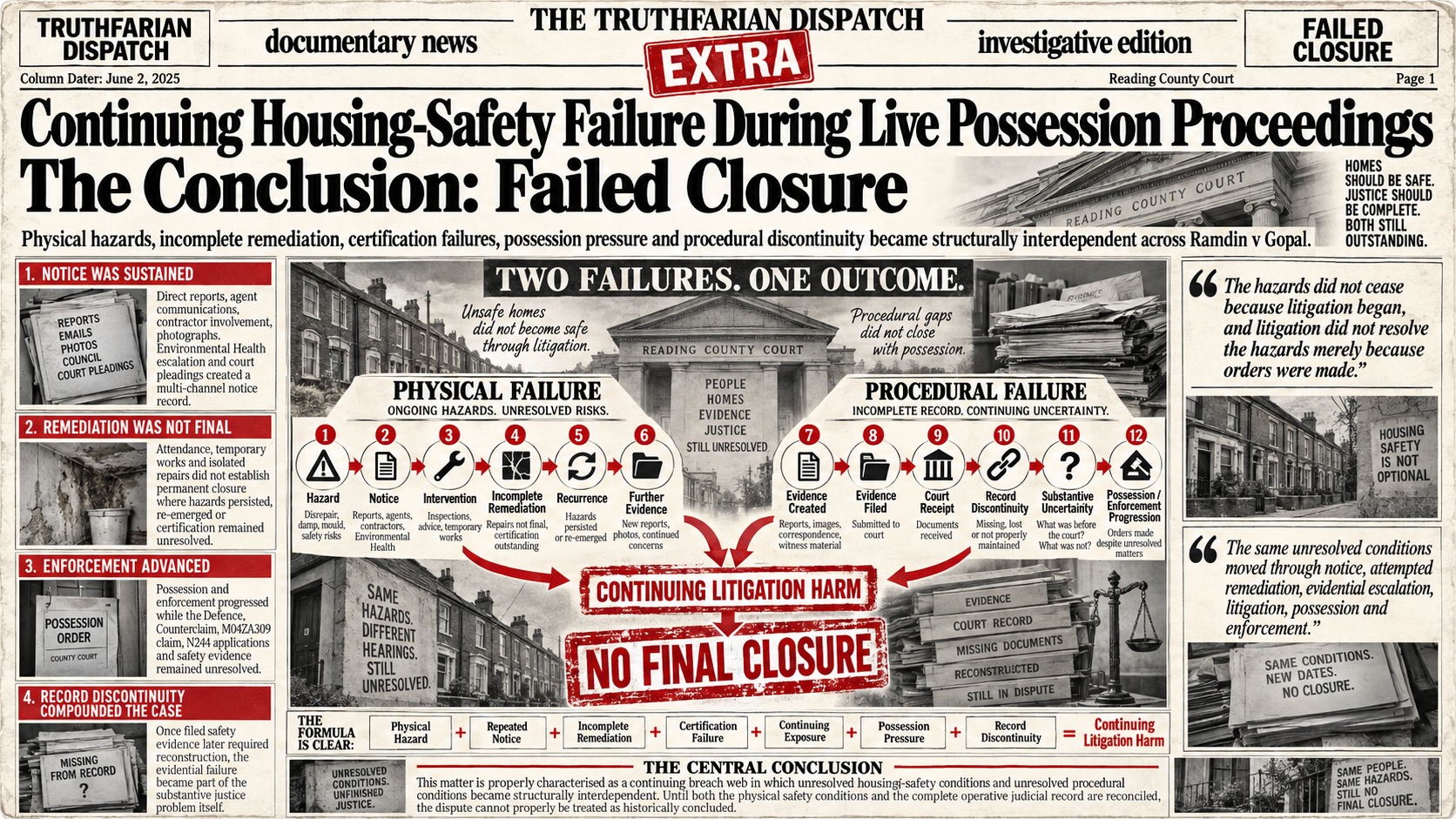
Temporal Failure Architecture and Failed Closure. Visual synthesis of the continuing housing-safety disclosure, showing how physical hazards, repeated notice, incomplete remediation, certification failures, evidential filing, court-record discontinuity, and possession/enforcement progression converged into a continuing breach web without demonstrated final closure.
Conclusion
This disclosure demonstrates a continuing housing-safety and procedural failure extending across the tenancy, the substantive civil proceedings, the possession proceedings, and the later enforcement architecture.
The evidential record does not disclose a sequence of isolated and completed repair events. It discloses recurring and overlapping hazards involving mould, damp, water ingress, plumbing, heating, electrical safety, fire egress, statutory certification and essential residential services. Those conditions were repeatedly reported through the landlord-management structure, repeatedly attended to in part, and repeatedly carried forward without demonstrated permanent closure.
The central factual architecture is therefore one of continuing failure rather than historical defect:
Hazard → Notice → Intervention → Incomplete Remediation → Recurrence → Further Evidence
That physical sequence then intersects with the litigation sequence:
Evidence Created → Evidence Filed → Court Receipt → Record Discontinuity → Substantive Uncertainty → Possession / Enforcement Progression
The significance of that intersection is fundamental. The underlying hazards did not cease because litigation commenced, and the litigation did not resolve the hazards merely because orders were made. Instead, the physical conditions and the procedural record continued to develop simultaneously.
The September 2025 radiator failure, water discharge and water/electrical crossover demonstrate that the risk architecture itself remained dynamic. Existing water, electrical and certification concerns were compounded by a later event capable of engaging several hazard categories at once. The March 2026 N244 and subsequent Case Management Clarification then became necessary because the evidential and procedural history itself required reconstruction.
- First, notice was sustained and multi-channel. The evidential record identifies direct communications, landlord-agent communications, contractor involvement, photographic material, Environmental Health escalation and formal court pleadings. The issue is therefore not absence of notification, but the effectiveness and permanence of the response after notification.
- Second, remediation was incomplete or non-final in material respects. Contractor attendance, isolated repair work or temporary intervention cannot by themselves establish closure where the underlying defect, hazard or certification question remained unresolved or later re-emerged.
- Third, the possession and enforcement track progressed while the substantive safety and evidential track remained unresolved. The Defence, Counterclaim, M04ZA309 civil claim, N244 applications, September 2025 safety evidence and operative evidential record continued to require determination while enforcement consequences advanced.
- Fourth, the loss of continuity within the court record materially compounds the underlying housing-safety case. Where evidence of physical hazards has been created, filed and received, but later requires reconstruction in order to establish its procedural status, the evidential failure becomes part of the substantive justice problem. The safety record cannot be separated from the procedural mechanism through which that safety record must be adjudicated.
The resulting breach web is therefore cumulative. Physical hazard, repeated notice, incomplete remediation, certification failure, continuing exposure, possession pressure and record discontinuity operate together as one continuing litigation harm architecture.
The monetary architecture identified in this disclosure must be read in that same cumulative context. The £1,128,500 Counterclaim in M00RG751 and the £1,803,800 civil claim in M04ZA309 remain distinct pleaded proceedings, while the later consolidated and procedural valuations preserve the wider harm architecture already advanced. This disclosure does not revalue those claims; it establishes that the factual and procedural conditions underlying them continued beyond the earlier valuation dates.
The central conclusion is therefore one of failed closure.
There has been no demonstrated final closure of the physical housing-safety record, no demonstrated final closure of the statutory certification disputes, no demonstrated final closure of the Defence and Counterclaim, no demonstrated final closure of the M04ZA309 civil proceedings, and no demonstrated final closure of the evidential continuity problem.
The same unresolved conditions have instead moved through successive stages of notice, attempted remediation, evidential escalation, litigation, possession and enforcement.
The matter therefore remains properly characterised as a continuing breach web in which unresolved housing-safety conditions and unresolved procedural conditions have become structurally interdependent.
Until both strands are substantively reconciled the physical safety conditions on one side and the complete operative judicial record on the other the dispute cannot properly be treated as historically concluded.
Structural Impact Formula
The Structural Impact Score $SIS$ is defined as:
$SIS = \left( w_P + w_C + w_L + w_D + w_T + w_V + w_R + w_I \right)\left( 1 + \lambda \cdot 28 \right)$
Where:
- $P$ = Procedural Breakdown
- $C$ = Court Administrative Capture
- $L$ = Landlord / Safety Failure
- $D$ = Defence / Counterparty Interference
- $T$ = Tribunal / Welfare Disruption
- $V$ = Vulnerability Amplifier
- $R$ = Rights / Regulatory Misstatement
- $I$ = Institutional Interlock
The interaction multiplier $\left(1 + \lambda \cdot 28\right)$ reflects $\binom{8}{2} = 28$ distinct co-occurring structural interaction pairs generated by the eight concurrently active variables.
Structural Impact Result
Activated Structural Variables:
$P = 1,\; C = 1,\; L = 1,\; D = 1,\; T = 1,\; V = 1,\; R = 1,\; I = 1$
Interaction Pair Count: $\binom{8}{2} = 28$ distinct co-occurring structural interaction pairs.
Resolved Structural Impact Score:
$SIS = \left( w_P + w_C + w_L + w_D + w_T + w_V + w_R + w_I \right)\left( 1 + \lambda \cdot 28 \right)$
The disclosure records concurrent activation across procedural breakdown, court administrative capture, landlord and safety failure, defence or counterparty interference, tribunal or welfare disruption, vulnerability amplification, rights and regulatory misstatement, and institutional interlock. The eight-variable state produces the maximum pairwise interaction structure available within the current eight-variable model.
Structural Impact Meaning
An $SIS$ produced by eight concurrently active structural variables with $\binom{8}{2} = 28$ interaction pairs indicates full-spectrum systemic failure rather than an isolated housing defect, administrative error, or procedural event.
The co-activation of procedural breakdown $P$, court administrative capture $C$, landlord or safety failure $L$, defence or counterparty interference $D$, tribunal or welfare disruption $T$, vulnerability amplification $V$, rights and regulatory misstatement $R$, and institutional interlock $I$ demonstrates mutually reinforcing defects across housing safety, landlord conduct, court processing, evidential continuity, possession proceedings, vulnerability, regulatory compliance, and institutional response.
The interaction multiplier $\left(1 + \lambda \cdot 28\right)$ represents non-linear escalation across the complete pairwise interaction field. Each active condition can amplify the effect of the others, so continuing physical hazards cannot be separated structurally from repeated notice, incomplete remediation, procedural discontinuity, possession or enforcement activity, and the loss of effective evidential continuity.
The resulting state represents a temporal failure loop in which the same underlying safety hazards repeatedly re-enter the system through notice, attempted remediation, evidence, court proceedings and enforcement without achieving permanent closure. The structural significance therefore lies in the interaction of all eight active domains and their twenty-eight pairwise relationships, rather than in any single event viewed independently.