
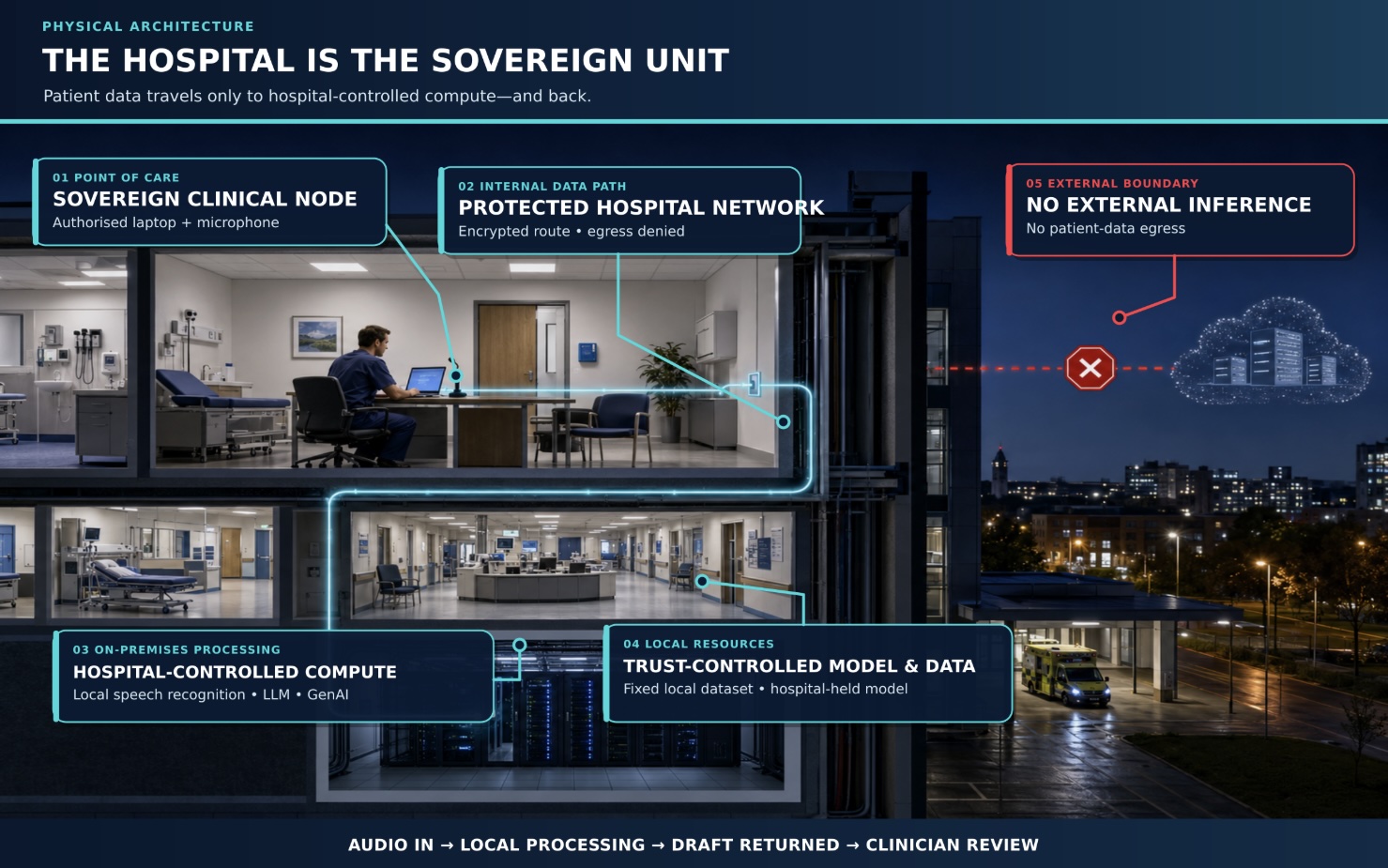
Sovereign hospital architecture: clinical data remains within the protected hospital boundary.
A Sovereign Local-Node Architecture for NHS Clinical AI
Emancipation from vendor lock-in and foreign-jurisdiction exposure using technology available now
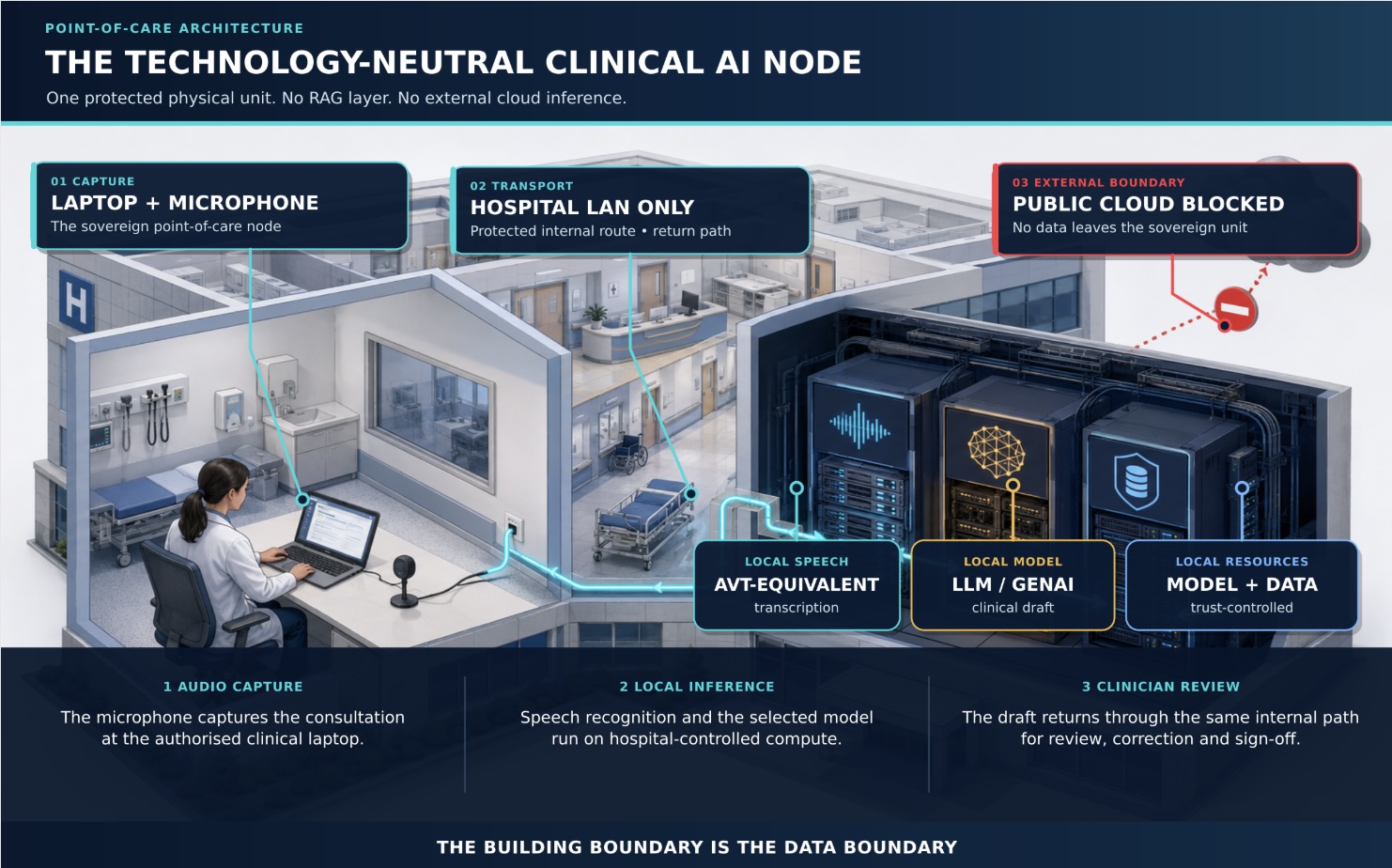
Technology-neutral clinical node: local speech, LLM and GenAI processing without external inference.
Technology-neutral baseline.This reference architecture defines a technology-neutral baseline for a sovereign hospital AI unit. The protected unit comprises an authorised clinical laptop or terminal, its microphone, the hospital’s internal network and hospital-controlled computing infrastructure. Audio and clinical data travel only from the point-of-care node to the hospital’s own server or mainframe, where locally controlled speech-recognition, LLM and generative-AI models perform the required processing. The resulting output returns to the authorised clinical device without using an external inference service or leaving the protected hospital environment. The architecture therefore specifies the physical boundary, data path and operational controls required for sovereignty without prescribing any vendor, model or proprietary platform.
Publication status and scope
This paper is a proposed architecture and public-interest technical analysis. It is not a claim that a particular model, server or assembled system has received medical-device approval, passed NHS clinical-safety assurance or been validated for autonomous diagnosis, triage or treatment. Its purpose is narrower and demonstrable: to show that the components required for trust-controlled clinical transcription, summarisation and draft documentation already exist, can run locally and can be assembled without exporting identifiable patient content to a remote inference provider.
The architecture therefore distinguishes availability from authority. Open software and suitable hardware make local inference technically available. Deployment authority arises only after the intended purpose, evidence, clinical-safety case, data-protection controls, cybersecurity, human workflow and operational resilience have been assessed and accepted by accountable NHS officers.
The NHS is the worked jurisdiction in this paper, not the geographical limit of the architecture. The technical pattern—a microphone and authorised workstation inside the care setting, an institution-controlled internal network, a hospital-operated compute host running locally controlled speech and language models, local clinical data, and an output returned to the authorised user without a public-cloud inference path—is portable across health systems. A deployment outside the United Kingdom must replace the NHS assurance and legal mapping with the applicable national, regional and state or provincial requirements; it cannot obtain compliance merely by changing acronyms.
Central finding. The NHS does not need to wait for a new generation of foundational technology before testing sovereign clinical AI. It needs disciplined assembly, validation, procurement and governance of technology that already exists.
Abstract
The NHS is under simultaneous pressure to reduce administrative burden, adopt artificial intelligence and preserve public control over exceptionally sensitive health information. Predominantly cloud-delivered AI can be useful, but it also concentrates operational dependency, recurring licensing expenditure, supplier-controlled audit evidence and exposure to jurisdictions attached to the provider rather than the physical server location. This paper defines a technology-neutral alternative: a trust-controlled local node that performs speech recognition, retrieval, language-model inference, output validation and evidence logging inside a segmented NHS environment.
The proposal is deliberately limited to functions that can be governed as assistance: transcription, summarisation, correspondence drafting and authorised record navigation. It does not permit autonomous diagnosis, treatment, triage, prescribing or unreviewed write-back. The paper specifies hardware profiles, open software, model and dependency governance, FHIR-based integration, identity controls, cybersecurity, DCB0129 and DCB0160 clinical-safety obligations, medical-device classification, UK data-protection law, confidentiality, international-transfer risk, audit evidence, resilience and whole-life economics. It replaces an unsupported claim of £115,000 savings for 30 clinicians with a transparent break-even model showing that economic advantage depends on user count, actual licence prices, assurance costs and the extent to which a node is reused across clinical services.
The result is a deployable reference architecture rather than a policy promise. It does not assert that local processing is automatically safe, deterministic or compliant. It establishes a controllable boundary within which risks can be measured, evidence can be retained, changes can be frozen and the trust can remain the operator of its clinical intelligence infrastructure.
Although the NHS provides the detailed implementation case, the engineering core is global. Open-weight models, locally deployable speech recognition, standard enterprise compute and HL7 FHIR are not UK-specific technologies. The same protected data path can be implemented by a public hospital, university medical centre, integrated delivery network or regional health authority in another country. What changes is the authority surrounding that path: privacy and confidentiality law, clinical-safety obligations, medical-device classification, records duties, incident reporting and professional accountability must be mapped and revalidated in the adopting jurisdiction.
Keywords
NHS; sovereign AI; local inference; on-premises AI; clinical documentation; ambient voice technology; open-weight models; generative AI; large language models; vendor lock-in; UK GDPR; EU GDPR; HIPAA; HITECH; 42 CFR Part 2; CLOUD Act; DCB0129; DCB0160; clinical safety; FHIR; audit evidence; medical-device software; health-data sovereignty; jurisdictional portability; global health systems.
Contents
1. The Immediate Problem and the Boundary of the Proposal
2. Sovereignty as Operational Control
3. Permitted Clinical Uses and the Safety Boundary
4. Reference Architecture: The Hospital Local Node
5. Hardware, Capacity and Deployment Profiles
6. Open Software Stack and Model Governance
7. Clinical Data Flow, FHIR Integration and Local Retrieval
8. Identity, Access, Network and Cybersecurity Controls
9. Clinical Safety, Human Oversight and Medical-Device Classification
10. Data Protection, Confidentiality and Foreign-Jurisdiction Exposure
11. Audit Evidence, Cryptographic Integrity and Records Management
12. Availability, Resilience, Maintenance and Change Control
13. Whole-Life Economics, Break-Even and Procurement
14. Implementation Roadmap, Public-Interest Finding and Conclusion
15. Global Portability and Jurisdictional Translation
Appendices: Control matrix; starter hazard register; economic variables; references
1. The Immediate Problem and the Boundary of the Proposal
1.1 The issue is not whether AI can assist documentation
Speech recognition, local language models, vector search, structured health-data interfaces and ordinary enterprise servers are mature enough to support controlled clinical-documentation pilots. Faster-Whisper is an openly available implementation of Whisper using CTranslate2, while current Mistral models include locally deployable Apache 2.0 releases. FHIR supplies a standard framework for exchanging health information electronically. None of these components, individually, creates a safe clinical system; together they remove any categorical technical claim that useful clinical AI must be delivered as a foreign-hosted subscription service. [19]-[21]
The practical question is therefore architectural: where does identifiable information travel, who can operate the model, who controls the keys and logs, what evidence is produced, what happens during failure and which organisation can continue the service if a supplier relationship ends? A sovereign local node answers those questions by bringing inference to the authorised data environment rather than exporting the data to a remote inference service.
1.2 The baseline is intentionally narrower than an autonomous clinical agent
This proposal concerns a clinical-assistance system. Its first deployment class is transcription, summarisation and draft document production. It does not treat a generative model as a clinician, a deterministic computation engine or an authorised decision-maker. The distinction matters because the safety, regulatory and evidential burden changes substantially when software moves from recording and organising information to recommending diagnosis, prioritising care or selecting treatment.
| Scope class | Position | Application |
|---|---|---|
| Included | Baseline assistance | Dictated-note transcription, encounter summarisation, draft clinic letters, discharge-document preparation from authorised source records, structured extraction for clinician verification and locally grounded record search. |
| Excluded | Prohibited at baseline | Autonomous diagnosis or triage, dosage calculation, medication selection, treatment planning, referral rejection, risk scoring that changes access to care and any unreviewed update to the legal clinical record. |
| Expansion | New assurance required | An excluded function may enter scope only through a new intended-purpose statement, new validation evidence, renewed DCB0129/DCB0160 work and medical-device classification where applicable. |
1.3 The institutional choice
A trust can rent intelligence as a remote service, own and operate a local inference capability, or use a hybrid arrangement. The paper does not claim that every cloud service is unlawful or that every local deployment is preferable. It establishes a credible local option so that procurement is a genuine comparison rather than a forced choice between named external suppliers. Once a trust can quantify the local alternative, sovereignty, cost, functionality and risk become negotiable procurement variables rather than vendor-defined assumptions.
Boundary rule. Locality is necessary for this architecture, but locality alone is not sufficient. Sovereignty exists only when the trust controls the data plane, inference plane, keys, privileged access, evidence, updates and exit path.
2. Sovereignty as Operational Control
2.1 Physical location is only one control
A server standing in an NHS data centre may still depend on an external control plane, remote administrators, proprietary model licences, supplier-held encryption keys, internet telemetry, mandatory cloud authentication or inaccessible audit systems. Conversely, some cloud services may provide strong contractual and technical controls. The correct analysis is therefore not a slogan about geography. It is a control inventory.
| Control domain | Sovereign requirement | Evidence |
|---|---|---|
| Clinical data | Identifiable inputs, retrieved context and generated drafts remain inside the authorised trust boundary. | Data-flow map; packet capture; egress tests; DPIA. |
| Keys | Encryption and signing keys are generated, held and rotated under trust authority. | Key register; HSM configuration; rotation and recovery records. |
| Identity | The trust defines users, roles, patient-context access and privileged administration. | RBAC matrix; access reviews; break-glass logs. |
| Models | Exact weights, licence, digest, quantisation and runtime are known and can be frozen. | Model register; software bill of materials; hashes. |
| Operation | The trust can start, stop, monitor, recover and decommission the service. | Runbooks; monitoring evidence; recovery tests. |
| Exit | Data, logs and configurations remain usable without supplier permission. | Portability test; documented rebuild; escrow or source access where needed. |
2.2 A measurable sovereignty test
For procurement and audit, the architecture uses a simple control score rather than an absolute label. Let each required control be represented by xᵢ in {0, 0.5, 1}, corresponding to absent, partial or demonstrated. Let wᵢ represent its criticality. The Sovereign Control Index is:
$ \mathrm{SCI} = \frac{\sum_i w_i x_i}{\sum_i w_i} $
The score does not convert illegality into acceptability or allow a critical safety failure to be averaged away. Mandatory controls are gates: if patient-content egress, unauthorised remote administration or loss of trust key control is present, the system cannot be described as fully sovereign regardless of the aggregate score. The index is instead a transparent way to expose partial control and compare competing architectures against the same evidence requirements.
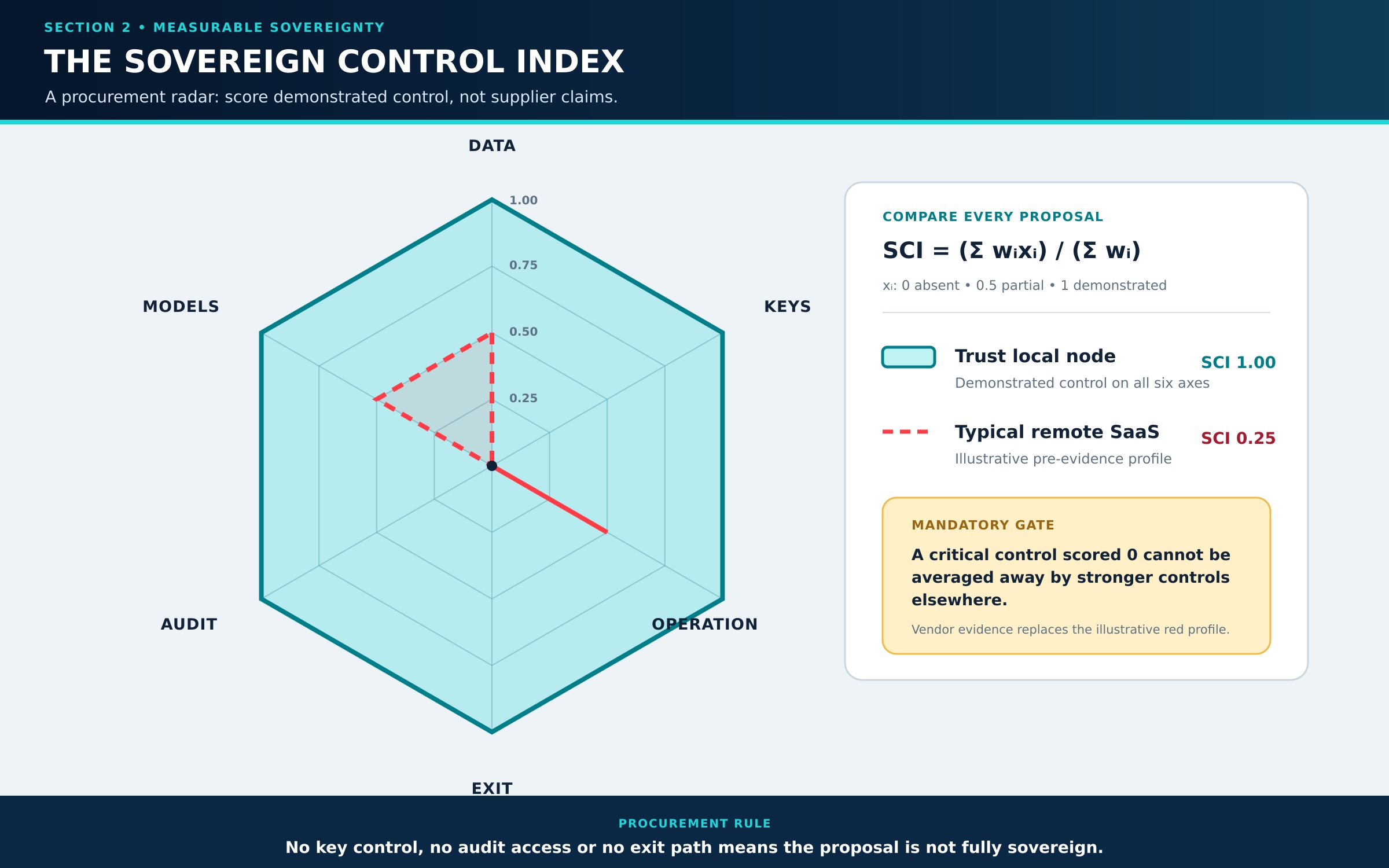
Figure 3. Six-axis Sovereign Control Index comparing a trust-controlled local node with a typical remote SaaS architecture.
2.3 Jurisdiction follows control relationships
The US CLOUD Act confirms that a provider subject to US jurisdiction may be required, under valid legal process, to disclose data within its possession, custody or control regardless of storage location. That does not make every US service automatically unlawful under UK law, and the UK-US data bridge provides a partial adequacy route for eligible certified recipients. It does mean that a claim of UK hosting is not a complete sovereignty analysis. The contracting entity, corporate control, remote access, subprocessors, transfer mechanism and encryption-key position must be examined. [13]-[15]
3. Permitted Clinical Uses and the Safety Boundary
3.1 Start where the clinical value is high and authority is low
The quickest defensible route is to automate preparation, not judgement. Documentation consumes clinical time but the final record already requires professional verification. The local node should therefore enter the workflow as a drafting instrument. It can reduce transcription delay and assemble source-linked material while preserving a clear point at which the clinician accepts, edits or rejects the draft.
| Function | Baseline status | Required human control | Principal hazard |
|---|---|---|---|
| Speech transcription | Permitted pilot | Clinician compares material terms and corrects the draft. | Drug, dose, allergy, negation or speaker error. |
| Encounter summary | Permitted pilot | Source-linked draft; clinician verifies completeness. | Omission or misplaced certainty. |
| Clinic/discharge letter | Permitted pilot | No issue or EPR write-back before sign-off. | Incorrect statement becomes part of the record. |
| Record search | Permitted with controls | Results retain source, date and record version. | Retrieval of wrong patient or stale context. |
| Management recommendation | Outside baseline | New clinical and regulatory work required. | Automation bias and patient harm. |
| Autonomous triage or diagnosis | Prohibited at baseline | Cannot be enabled by configuration alone. | Delay, denial or misdirection of care. |
Figure 4. Permitted baseline uses and the safety boundary preventing expansion into autonomous clinical judgement without renewed assurance.
3.2 Human oversight must be operational, not ceremonial
A button labelled 'approve' does not establish meaningful oversight. The interface must make verification practicable. Material assertions should expose their source; additions and changes should be visually distinguished; critical entities such as medications, allergies, symptoms, dates and negations should receive focused checks; uncertainty should remain visible; and the system must allow rejection without forcing the clinician to repair a fundamentally unsafe draft.
| Control | Operational requirement |
|---|---|
| Draft status | Every generated document remains visibly marked DRAFT until authenticated by an authorised clinician. |
| Authority | The model cannot sign, issue, transmit or write to the EPR using the clinician's identity. |
| Source distinction | Clinical source material and generated language remain visually distinguishable throughout review. |
| Critical data | High-risk fields are checked against structured source data where that data is available. |
| Failure reporting | The interface records edits and rejection reasons without penalising staff for reporting model failure. |
| Continuity | A safe manual workflow remains available during outage, restriction or suspension. |
3.3 Patient transparency and ambient capture
Ambient or dictated audio is itself confidential clinical information. The trust must define when capture starts, how patients are informed, whether consent or another legal basis is relied upon for the particular workflow, how objections are handled, whether raw audio is retained and how multi-party consultations are managed. NHS England's ambient-scribing guidance expressly addresses adoption of generative AI products in care settings and should be used as a minimum reference point. [1]
4. Reference Architecture: The Hospital Local Node
4.1 Architectural pattern
The reference design is centralised on premises and distributed at the point of use. One managed inference service supports authorised workstations over a segmented trust network. The workstation captures or submits content; the node performs transcription, retrieves authorised context, generates a draft and returns the result for human review. The production design should use at least two service instances or an explicitly accepted degraded-mode plan; a single physical server is a pilot configuration, not a resilient clinical service.
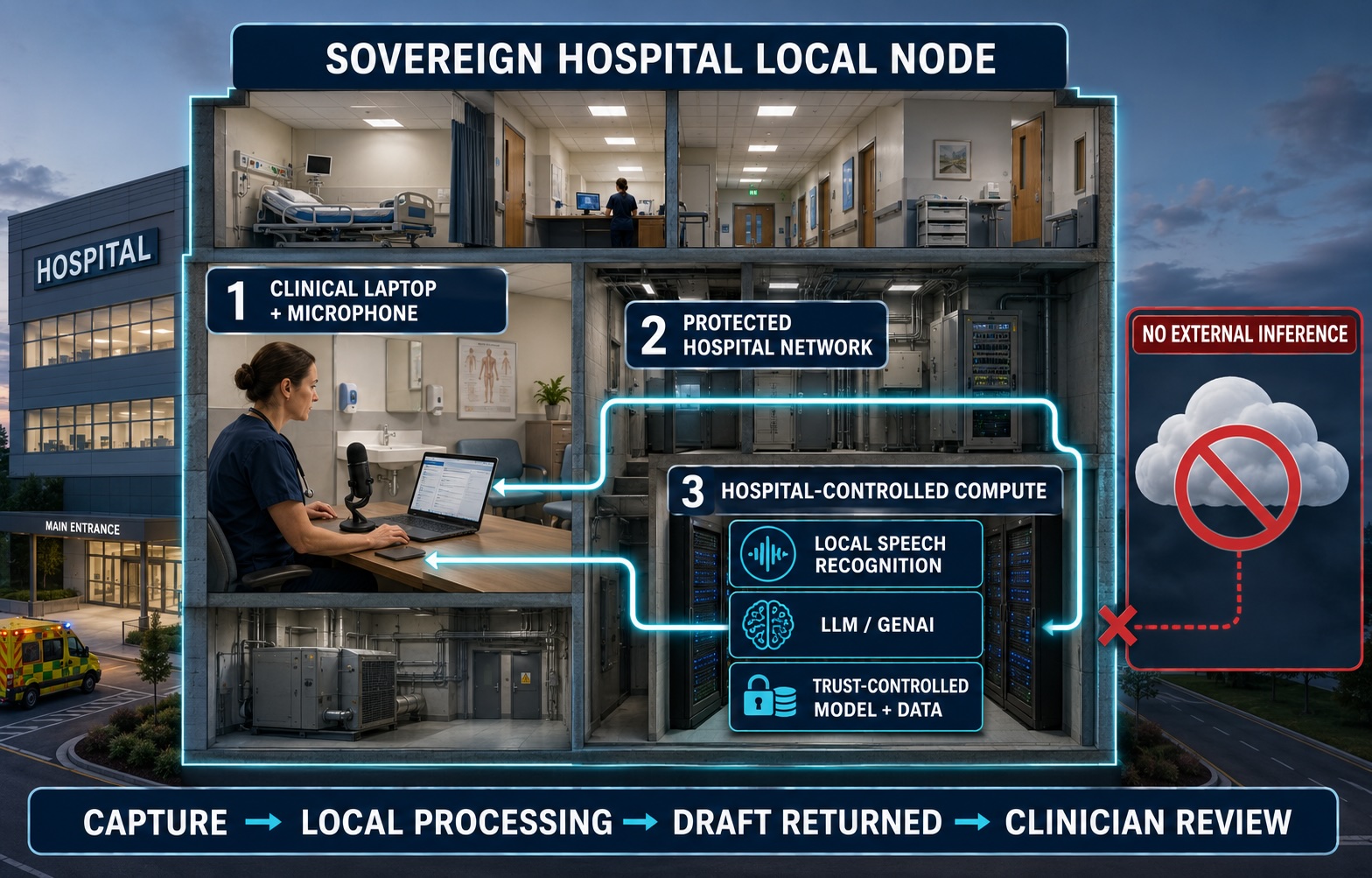
SSovereign hospital local-node architecture. The authorised clinical laptop and microphone connect through the protected hospital network to hospital-controlled compute running local speech recognition, LLM/GenAI and trust-controlled models and data. External inference is blocked, keeping clinical data within the hospital boundary.
4.2 Core services
| Service | Responsibility | Recommended boundary |
|---|---|---|
| API gateway | Authentication, authorisation, request limits, patient-context binding and correlation IDs. | No direct model endpoint exposed to clients. |
| Speech service | Local audio transcription and confidence metadata. | Ephemeral audio unless an approved retention purpose exists. |
| Retrieval service | FHIR queries, document search and authorised context assembly. | Read-only at baseline; minimum necessary fields. |
| Inference service | Frozen model execution under a declared configuration. | No internet tools, shell access or autonomous agents. |
| Output-control service | Schema checks, source linkage, critical-term comparison and prohibited-action enforcement. | Can block or downgrade output; cannot declare clinical truth. |
| Evidence service | Tamper-evident event capture, model provenance and review history. | Separate write authority from ordinary application users. |
| Operations plane | Monitoring, patching, backup, rollback and capacity control. | Privileged access through managed administration path. |
4.3 Network status
The connected clinical node should not be described as air-gapped. It communicates with workstations and authorised clinical systems. The correct terms are segmented, internet-isolated and egress-denied, with a controlled maintenance gateway. A genuinely air-gapped validation laboratory may also be maintained, but production integration requires a defined internal network path.
Non-negotiable design rule.The node may receive signed updates through a controlled maintenance process. It must not acquire model weights, packages, telemetry endpoints or remote support connections dynamically during clinical operation.
5. Hardware, Capacity and Deployment Profiles
5.1 Hardware must be derived from workload
The number of clinicians is not, by itself, a capacity specification. Concurrency, audio duration, turnaround target, model size, context length, quantisation, tokens per second, retention policy and availability objective determine the hardware. A department with 30 named users may have three concurrent requests or 25. The paper therefore replaces a single universal server with benchmarked deployment profiles.
| Profile | Indicative purpose | Compute characteristics | Availability position |
|---|---|---|---|
| Laboratory | Offline model evaluation with synthetic or approved test data. | One professional GPU; isolated storage; reproducible benchmark environment. | No clinical dependency. |
| Pilot | Transcription and draft documentation for a controlled cohort. | One or two 48 GB ECC professional/server GPUs; 256-512 GB RAM; encrypted NVMe; measured request queue. | Time-limited; manual fallback; no single-server claim of resilience. |
| Departmental production | Sustained multi-user clinical documentation. | Two service nodes or an accepted active/passive design; enterprise GPUs; redundant storage, power and network. | Defined RTO/RPO, failover and downtime workflow. |
| Trust platform | Multiple departments and model classes. | Capacity pool with workload isolation, scheduler, separate validation environment and scalable evidence storage. | Formal service management and disaster recovery. |
5.2 Correcting the GPU assumptions
NVIDIA specifies the RTX 6000 Ada at 48 GB ECC and 300 W, while the RTX 4090 has 24 GB memory and 450 W total graphics power. Four cards therefore do not form interchangeable designs. Consumer RTX 4090 cards also present rack fit, support, cooling and production-assurance problems. Aggregate memory across several PCIe GPUs is not automatically available as one unified pool; the selected inference engine must support the intended tensor or pipeline parallelism. [22], [23]
For a clinical production case, professional or server GPUs with ECC, supported thermals and an enterprise warranty are the defensible default. Consumer GPUs may remain useful in a development laboratory where failure has no clinical consequence. A 70-billion-parameter model should not be specified merely because weights can be quantised to fit. Context cache, concurrent users, throughput, latency and output quality must be tested under the exact deployment configuration.
5.3 Acceptance benchmarks
| Benchmark domain | Required measure |
|---|---|
| Throughput and latency | Concurrent transcription streams at the 95th percentile workload and draft-generation latency at defined input and output lengths. |
| Capacity and overload | GPU and system-memory headroom during peak use, together with queue time, timeout rate and behaviour under overload. |
| Resilience | Model-load time, failover time and recovery after node, storage, network and dependency failure. |
| Control overhead | Performance after encryption, logging and safety controls are enabled, rather than before governance is applied. |
| Thermal stability | Power, temperature and throttling under sustained clinical load. |
6. Open Software Stack and Model Governance
6.1 Open does not mean ungoverned
An open licence reduces supplier dependence and permits inspection, modification and local deployment. It does not establish clinical suitability. Every component needs a named version, licence, provenance record, vulnerability status and accountable maintainer. The production system should never call a mutable alias such as latest. It should resolve an exact model artefact and retain a cryptographic digest.
| Layer | Available baseline option | Governance requirement |
|---|---|---|
| Speech recognition | Faster-Whisper / CTranslate2; MIT-licensed implementation. | Validate medical vocabulary, accents, noise, speaker changes, drugs, doses and negation. |
| Language model | Current Apache 2.0 Mistral family or another approved open-weight model. | Freeze exact weights, licence, quantisation, prompt, runtime and digest. |
| Inference runtime | vLLM, llama.cpp, CTranslate2 or equivalent. | Benchmark the exact engine; restrict network and tool capabilities. |
| Retrieval | PostgreSQL/pgvector, OpenSearch or another local indexed store. | Patient and tenant isolation; source-version retention; deletion and rebuild procedure. |
| API and workflow | Open web-service framework and trust-managed client. | Threat modelling, tests, SBOM, signed build and controlled release. |
| Evidence | Append-only database/WORM-backed event store. | Independent write controls, retention, verification and export. |
6.2 Model behaviour remains probabilistic
The orchestration path can be deterministic: the same authorised route, retrieval rules, validators, evidence schema and decision gates can be applied every time. Generative inference may remain stochastic, and even fixed sampling settings may not guarantee bit-identical output across runtimes or hardware. The correct objective is bounded, measured and version-controlled behaviour, not a false claim that an ordinary language model has become deterministic.
6.3 The model register
| Register field | Required record |
|---|---|
| Identity and licence | Model name, publisher, licence, permitted uses and prohibited uses. |
| Artefact integrity | Exact weight files, quantisation method, numerical format and cryptographic digest. |
| Execution environment | Inference runtime, driver, CUDA and dependency versions. |
| Behavioural configuration | Prompt version, output-schema version and approved intended purpose. |
| Validation evidence | Datasets, results, limitations and subgroup findings for the declared use. |
| Lifecycle authority | Approval date, accountable owner, expiry or review date and approved rollback model. |
Mistral's current catalogue includes Apache 2.0 models intended for local and edge deployment. Mistral 7B may remain reproducible as a historical model, but it should not be presented as the current default when the publisher identifies newer replacements. Model selection must be revisited at the point of the pilot while preserving the paper's architecture as model-neutral. [21]
7. Clinical Data Flow, FHIR Integration and Local Retrieval
7.1 Patient-specific context remains identifiable
A patient record retrieved to draft that patient's letter is not anonymised. It remains identifiable special-category data even when obvious identifiers are removed, because the workflow is linked to an individual and the context may permit re-identification. The architecture therefore treats the entire request envelope, retrieval set, embedding, prompt, response and evidence trace as confidential clinical information unless a formal anonymisation assessment proves otherwise.
7.2 FHIR is an interface standard, not an automatic integration
FHIR defines resources and RESTful interactions for exchanging health information, but an actual trust integration depends on the EPR's supported version, profiles, extensions, terminology, authentication and CapabilityStatement. The local node should begin with read-only interfaces and a minimum-necessary resource set. [19]
| Step | Required action |
|---|---|
| 1 | Bind the request to the authenticated user, patient context and declared purpose. |
| 2 | Query only approved resource types and fields through a read-only integration identity. |
| 3 | Retain source identifiers, versions and timestamps for every retrieved fact. |
| 4 | Separate retrieved record text from instructions so that record content cannot silently redefine system behaviour. |
| 5 | Generate the draft with source pointers and uncertainty markers. |
| 6 | Run deterministic schema, critical-term and prohibited-action checks. |
| 7 | Return a draft to the clinician; do not write to the EPR until the human workflow explicitly commits the final record. |
7.3 Retrieval-augmented generation requires its own safety case
Retrieval reduces reliance on unsupported model memory, but it introduces wrong-patient retrieval, stale data, incomplete search, ranking errors, poisoned documents and prompt injection through stored content. OWASP notes that RAG does not eliminate prompt-injection risk. The retriever must therefore apply patient and role filters before semantic ranking, preserve provenance and treat retrieved text as data rather than trusted instruction. [18]
| Risk | Control | Verification |
|---|---|---|
| Wrong patient | Server-side patient-context binding; no patient ID accepted solely from free text. | Cross-patient isolation tests. |
| Stale record | Retain resource version and timestamp; expose age to reviewer. | Known-update and concurrency tests. |
| Omission | Structured critical-field retrieval plus semantic search; source coverage indicator. | Curated missing-fact cases. |
| Prompt injection | Instruction/data separation; sanitisation; no tool authority from retrieved text. | Adversarial document tests. |
| Embedding leakage | Local vector store, encryption, access control and approved deletion. | Access and deletion tests. |
8. Identity, Access, Network and Cybersecurity Controls
8.1 Security is a system property
Moving inference on premises changes the threat model; it does not remove it. The trust becomes responsible for model supply chain, privileged administration, endpoint compromise, insider access, denial of service, ransomware, update integrity and evidence protection. NCSC guidance for secure AI development addresses secure design, supply chain, deployment, monitoring, updates and incident management and should be adopted alongside ordinary NHS security controls. [16], [17]
8.2 Minimum technical controls
| Control area | Minimum technical requirement |
|---|---|
| Identity and privilege | Trust identity federation, multi-factor authentication for privileged access and role- or attribute-based access tied to professional role, patient context and purpose. |
| Service segmentation | Separate client, API, inference, data, evidence and administration zones, with default-deny internet egress from clinical inference services. |
| Cryptographic protection | Mutual service authentication, encryption in transit and encryption at rest using trust-controlled keys with tested recovery. |
| Supply chain | Signed software and model packages, a maintained software bill of materials and active vulnerability tracking. |
| Monitoring and capacity | Central security logging that excludes unnecessary clinical content, together with rate limits, quotas and overload controls. |
| Emergency access | Controlled break-glass access with immediate recording and review. |
8.3 Update pathway
A local node cannot remain safe if it cannot be patched, but unrestricted internet package installation defeats the stated control boundary. Updates should be assembled and scanned outside production, signed, transferred through a controlled gateway, verified inside the environment and deployed first to a representative validation node. Model changes require behavioural revalidation; security patches require regression testing proportionate to their effect. Emergency updates need an expedited but recorded route, not an undocumented exception.
8.4 Threat scenarios
| Threat | Example | Required response |
|---|---|---|
| Model supply-chain compromise | Altered weight or dependency package. | Hash/signature rejection; quarantine; provenance investigation. |
| Prompt injection | Malicious instruction embedded in a retrieved document. | No tool authority; instruction/data separation; block and record. |
| Privilege misuse | Administrator searches or exports patient prompts. | Least privilege; dual control; immutable access evidence; investigation. |
| Ransomware | Inference or evidence storage encrypted by attacker. | Segmentation; offline/immutable backup; rebuild and manual workflow. |
| Exfiltration | Covert egress through telemetry or support tunnel. | Default-deny egress; allow-list; packet monitoring; key control. |
9. Clinical Safety, Human Oversight and Medical-Device Classification
9.1 Clinical safety is mandatory work
NHS England states that DCB0129 applies to organisations responsible for developing and maintaining health IT systems, while DCB0160 applies to health organisations deploying, using, maintaining or decommissioning them. NHS clinical-safety guidance describes the hazard log and Clinical Safety Case Report as formal safety artefacts. Compliance with the standards is mandatory within their scope. [2], [3], [28], [29]
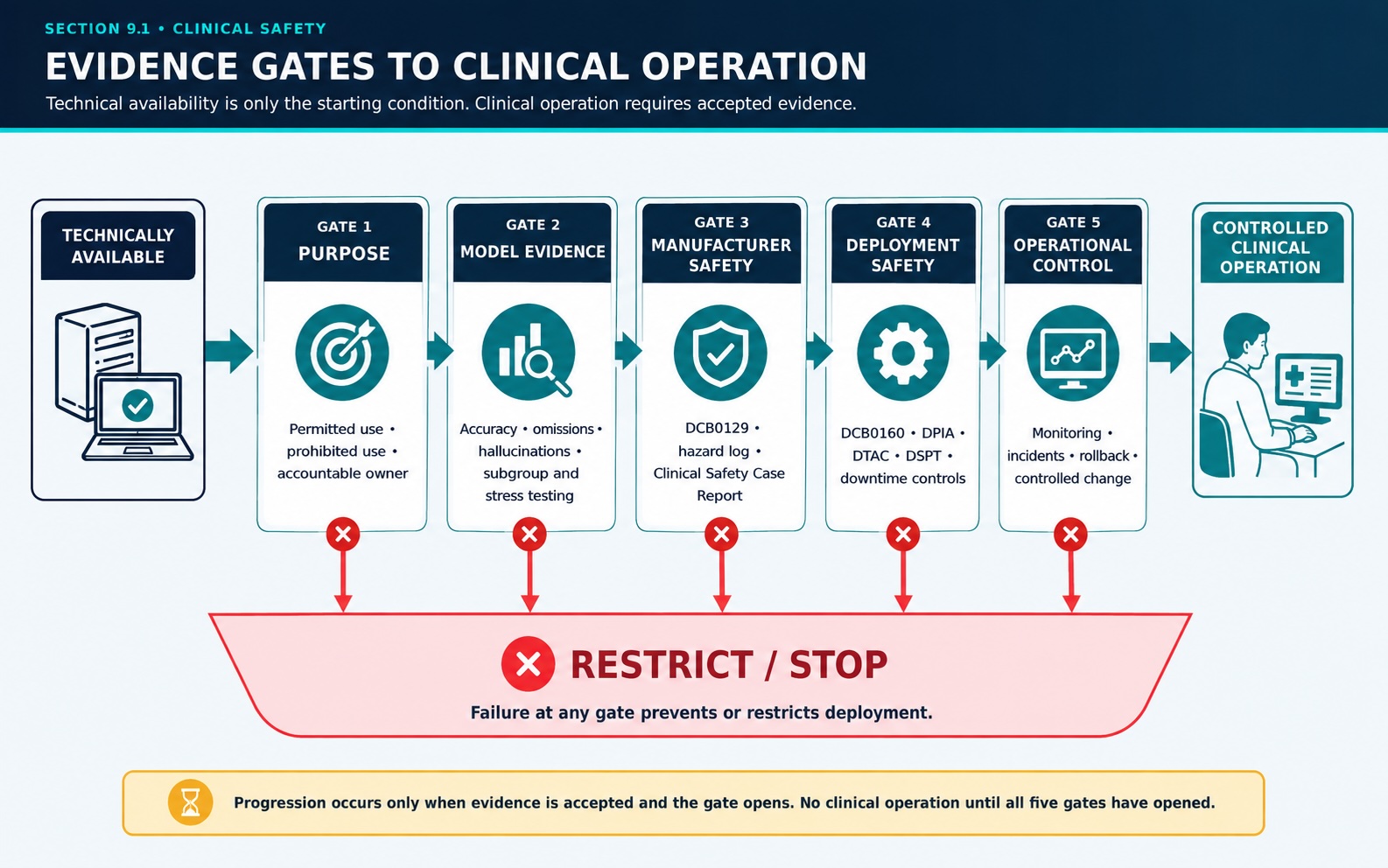
Evidence gates between technical availability and clinical operation.
9.2 Manufacturer and deployment responsibilities
An NHS trust assembling the software may become the health IT manufacturer for DCB0129 purposes even when every component is open source. It must establish a clinical-risk management system, appoint appropriate clinical-safety competence, identify hazards, estimate and control risk, maintain evidence and issue a Clinical Safety Case Report. The deploying organisation must then conduct its DCB0160 work in the actual clinical environment, where staffing, configuration, integration, training and local workflow create additional hazards.
9.3 Medical-device boundary
Whether software is a medical device depends on its intended purpose and function, not whether it is open source, free or operated locally. Documentation assistance may fall outside medical-device regulation when it does not perform a medical purpose, but patient-specific recommendations, diagnosis, prediction, monitoring or treatment functionality may bring it within the UK Medical Devices Regulations. The intended-purpose statement must therefore be precise and reviewed against current MHRA guidance before deployment. [6], [33]
9.4 Human review does not cure every hazard
Clinicians may accept fluent but wrong text, especially under workload pressure. Safety controls must address automation bias, alert fatigue and the possibility that reviewing a generated note takes longer than writing a short accurate one. Acceptance criteria should include corrected-error rates, material omission rates, time-to-review and the frequency with which staff reject the draft entirely. The benefit case fails if the system transfers hidden verification labour to clinicians while representing that labour as saved time.
10. Data Protection, Confidentiality and Foreign-Jurisdiction Exposure
10.1 Applicable governance
The principal framework includes the UK GDPR as amended, the Data Protection Act 2018, the Data (Use and Access) Act 2025, common-law confidentiality, the Caldicott Principles, NHS information-governance guidance and the Records Management Code of Practice. Health information is special-category data. A local deployment still requires a lawful basis, Article 9 condition, transparency, minimisation, security, retention control and accountability. [7]-[12]
10.2 DPIA and data-flow evidence
Clinical AI processing using new technology and large volumes of sensitive health information is likely to require a Data Protection Impact Assessment. The DPIA should not be a generic statement that the server is local. It must follow audio, transcript, retrieved record, embedding, prompt, draft, user edits, audit evidence, backups and support access through their complete lifecycle.
| Assessment domain | Required examination |
|---|---|
| Purpose and proportionality | Purpose, necessity and proportionality for every data element used by the workflow. |
| Legal roles | Controller, processor and joint-controller roles where applicable. |
| Access | Authorised access groups, patient-context binding and privileged-access controls. |
| Retention | Separate periods for raw audio, transcripts, drafts, final records and audit evidence. |
| Transparency and rights | Patient information, objection handling and applicable rights processes. |
| Jurisdiction | International-transfer position and foreign-jurisdiction exposure. |
| Residual risk | Recorded residual risks, accountable acceptance and scheduled review date. |
10.3 CLOUD Act and transfer analysis
The CLOUD Act is relevant where a provider subject to US jurisdiction has possession, custody or control of data. It does not prove an automatic UK GDPR breach in every case. The UK-US data bridge may support transfers to eligible certified organisations, and other safeguards may be available. The public-interest concern is more specific: a trust should not describe patient data as sovereign merely because a supplier stores it in Britain while a foreign-controlled provider can access or produce it. [13]-[15]
| Question | Remote SaaS | Trust local node |
|---|---|---|
| Who receives identifiable inference content? | Provider and declared subprocessors, subject to actual architecture. | Trust-controlled services only, if egress tests confirm. |
| Who holds operational keys? | Depends on service and contract. | Trust, by design. |
| Foreign compulsory-access exposure? | Requires entity, jurisdiction and control analysis. | Reduced where no foreign entity possesses or controls content. |
| Transfer mechanism? | May require adequacy, IDTA/Addendum or another lawful route. | No inference transfer if processing remains internal; other support flows still assessed. |
| Exit dependency? | Contractual export and deletion rights. | Trust retains model-independent records, evidence and configuration. |
10.4 Confidentiality and minimum necessary access
Local processing does not permit broad internal use. The Caldicott Principles require justified purpose, necessity, minimum use and responsibility. Model prompts and outputs should not become a secondary clinical-data warehouse. Each service should receive only the information required for the authorised task, and training or model improvement must not reuse clinical content without a separately justified and governed pathway. [11]
11. Audit Evidence, Cryptographic Integrity and Records Management
11.1 Evidence before interpretation
The system must preserve what occurred before producing management reports or retrospective explanations. For every transaction it should record the authorised user, patient context, declared purpose, source resource identifiers and versions, model and runtime digests, effective settings, generated draft, deterministic check results, user edits, sign-off and final disposition. Evidence must be proportionate: logging complete clinical content everywhere creates a new confidentiality risk.
11.2 Tamper evidence
A hash chain can reveal alteration when each canonical event includes the previous event hash. Digital signatures can bind batches or events to an authorised system identity. NIST FIPS 204 standardises ML-DSA, while SHA-3 functions are standardised under FIPS 202. Algorithm names alone do not create an audit ledger. The design also needs canonical serialisation, sequence control, trusted time, key protection, rotation, revocation, independent verification, replicated storage and long-term cryptographic migration. [26], [27]
hₙ = SHA3-512(canonical(eventₙ) || hₙ₋₁)
The event hash is an integrity primitive, not proof that the event was clinically correct. Clinical correctness remains dependent on source evidence, validation and human review. The ledger supports reconstruction and accountability; it does not transform a wrong model output into truth.
11.3 Records-management classification
The trust must decide which artefacts form part of the health record, which are transient working material, which are safety or security evidence and which are operational logs. Retention should follow the current Records Management Code of Practice and the documented purpose of each class. Raw audio and rejected drafts should not be retained indefinitely merely because storage is available. Conversely, deletion must not remove evidence required for patient safety, complaints, litigation, audit or an active inquiry. [12]
11.4 Offline verification package
| Package component | Required content |
|---|---|
| Event records | Exported events in a documented, non-proprietary format. |
| Version manifest | Model, application and evaluator identities and versions. |
| Integrity material | Hash-chain root and signature-verification material. |
| Verification procedure | A documented procedure that can be performed without contacting a vendor. |
| Key history | Key-status, rotation, revocation and certificate history. |
| Chain of custody | A complete custody record for the exported package. |
12. Availability, Resilience, Maintenance and Change Control
12.1 A clinical service cannot depend on one server
A single local server is an acceptable research or pilot node only where a manual fallback is immediate and the clinical workflow does not depend on continuous availability. A production service needs a documented service level, component redundancy proportionate to risk, monitored capacity, tested restore, downtime procedures and an accountable decision about whether inference continues in degraded mode.
| Failure | Safe behaviour | Evidence test |
|---|---|---|
| GPU failure | Queue stops or shifts to approved node; no silent model substitution. | Pull GPU or disable device during test. |
| Node failure | Client reports unavailable; manual documentation remains usable. | Failover and manual-workflow exercise. |
| FHIR/EPR unavailable | No generation from incomplete context unless task explicitly permits it and warning is prominent. | Dependency outage simulation. |
| Evidence store unavailable | Clinical inference stops if required evidence cannot be committed. | Fail-closed test. |
| Model anomaly | Version suspended; rollback to approved model or manual workflow. | Kill-switch and rollback exercise. |
| Cyber incident | Isolate node, preserve evidence, invoke incident and continuity plans. | Tabletop and technical recovery test. |
12.2 Model and configuration change
A model update is not an ordinary patch. New weights, quantisation, prompts, retrieval rules, output schemas or inference engines can alter clinical behaviour. Each change must create a new configuration identity and pass a defined regression suite. Results from an earlier model cannot be silently attributed to its successor. Emergency rollback must be faster than emergency revalidation.
12.3 Monitoring after deployment
| Monitoring domain | Measures | Required response |
|---|---|---|
| Clinical content | Material transcription and critical-term errors; omissions; unsupported assertions; contradictions. | Investigate and restrict or suspend when the approved threshold is exceeded. |
| Human review | Clinician edit distance, rejection rate and review time. | Reassess workflow benefit, interface design and permitted use. |
| Safety experience | Incidents, near misses and patient complaints linked to the service. | Open the clinical-safety investigation and consider immediate suspension. |
| Service operation | Latency, queueing, timeouts, resource saturation and failover events. | Apply capacity, failover or degraded-mode controls. |
| Security | Access anomalies, denied requests and attempted egress. | Contain, preserve evidence and invoke the incident plan. |
| Equity | Performance by relevant patient, language, accent and clinical subgroups. | Restrict affected use until disparity is understood and controlled. |
Monitoring thresholds must have actions: investigate, restrict, suspend or roll back. A dashboard without an intervention rule is observation, not governance. NCSC guidance specifically identifies behavioural monitoring, input monitoring and secure updates as operational requirements for AI systems. [16]
13. Whole-Life Economics, Break-Even and Procurement
13.1 Replace marketing arithmetic with a reproducible model
The earlier comparison subtracted a one-off server price from three years of licence charges and labelled the difference a saving. That omits resilience, integration, assurance, power, support, staffing and replacement. A defensible comparison uses whole-life cost on both sides and declares every input.
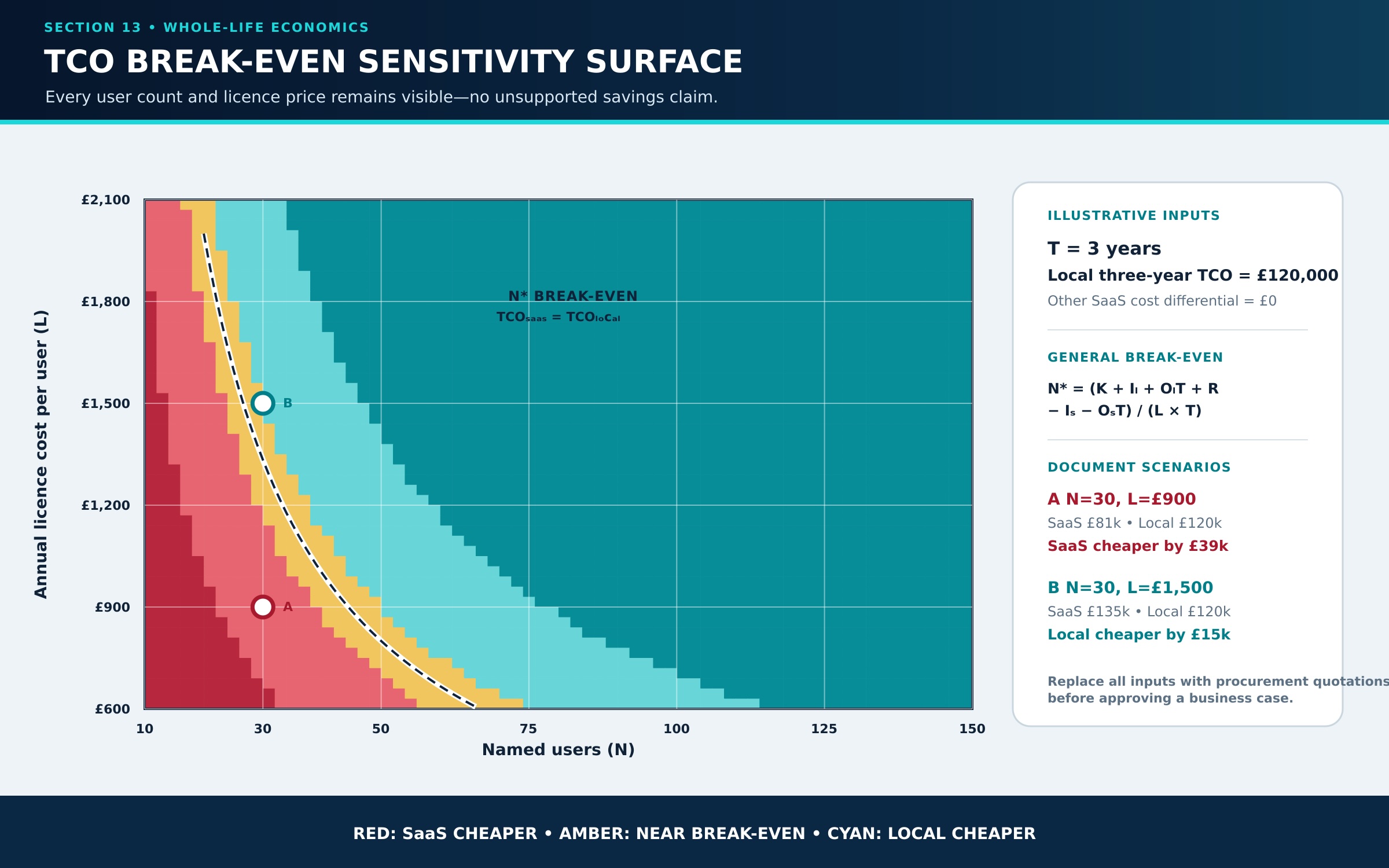
Figure 5. Three-year break-even sensitivity across the number of licensed users and annual per-user SaaS licence cost.
$ \mathrm{TCO}_{\mathrm{SaaS}} = N \times L \times T + I_s + O_sT $
$ \mathrm{TCO}_{\mathrm{local}} = K + I_l + O_lT + R $
$ N^{*} = \frac{K + I_l + O_lT + R - I_s - O_sT}{L \times T} $
Here N is licensed users, L annual SaaS licence cost per user, T years, K local capital expenditure, I integration and assurance cost, O annual operating cost and R refresh or residual transition cost. Actual trust procurement quotations must replace illustrative assumptions before a business case is approved.
13.2 Illustrative three-year scenarios
| Scenario | Assumptions | Three-year SaaS | Three-year local | Result |
|---|---|---|---|---|
| 30 users / lower licence | L=£900; local fixed+3yr operating=£120k | £81k | £120k | Local costs £39k more. |
| 30 users / higher licence | L=£1,500; local fixed+3yr operating=£120k | £135k | £120k | Local saves £15k. |
| 100 users / lower licence | L=£900; local platform=£150k | £270k | £150k | Local saves £120k. |
| 100 users / higher licence | L=£1,500; local platform=£150k | £450k | £150k | Local saves £300k. |
These are not procurement prices or guaranteed savings. They demonstrate the scale effect: a local platform has substantial fixed cost but low marginal software cost, so its economic case is normally stronger when infrastructure is reused across departments and use cases. Public listings show that licence prices vary materially, while professional multi-GPU hardware can exceed the original £20,000 assumption. [24], [25], [35]
13.3 Benefits beyond licence substitution
| Benefit | Operational consequence |
|---|---|
| Reusable capacity | The same governed compute platform can support several separately approved clinical workloads. |
| Controlled change | The trust controls model timing and validation rather than accepting mandatory vendor updates. |
| Lower switching cost | Data, configuration and evidence remain portable if a component or supplier changes. |
| Model comparison | Candidate models can be evaluated without rebuilding the entire clinical workflow. |
| Capability retention | Technical knowledge and operational competence remain inside the trust. |
| Commercial resilience | Exposure to per-seat price increases and discontinued services is reduced. |
13.4 Procurement evaluation
Procurement should compare outcomes and control, not product labels. Bidders and internal teams should complete the same matrix covering data location and control, jurisdiction, model identity, clinical evidence, DCB0129 deliverables, DCB0160 support, DTAC, DSPT, interoperability, audit export, incident access, pricing, energy, resilience, deletion and exit. An on-premises supplier appliance should not receive automatic sovereignty credit if the supplier retains remote control or keys.
14. Implementation Roadmap, Public-Interest Finding and Conclusion
14.1 A staged route from evidence to operation
| Phase | Scope | Exit evidence |
|---|---|---|
| 0. Authority and purpose | Executive sponsor; clinical owner; CSO, DPO, Caldicott Guardian, security and architecture representation; intended-purpose statement. | Approved scope and prohibited-use register. |
| 1. Laboratory | Offline node; synthetic/de-identified test material where appropriate; candidate model comparison; threat model. | Reproducible benchmark pack and initial hazard log. |
| 2. Silent validation | Process approved real workflow without returning output for care, where lawful and ethically approved. | Local accuracy, omission, subgroup and latency evidence. |
| 3. Controlled pilot | Small cohort; documentation drafts only; prominent human review; manual fallback. | DCB0129/0160 artefacts, DPIA, DTAC/DSPT evidence and pilot report. |
| 4. Departmental service | Resilient node; monitored service; incident and rollback operations. | Accepted safety case, service readiness and benefits evidence. |
| 5. Trust platform | Multiple approved workflows using shared control plane and isolated model profiles. | Whole-life business case, capacity model and continuous assurance. |
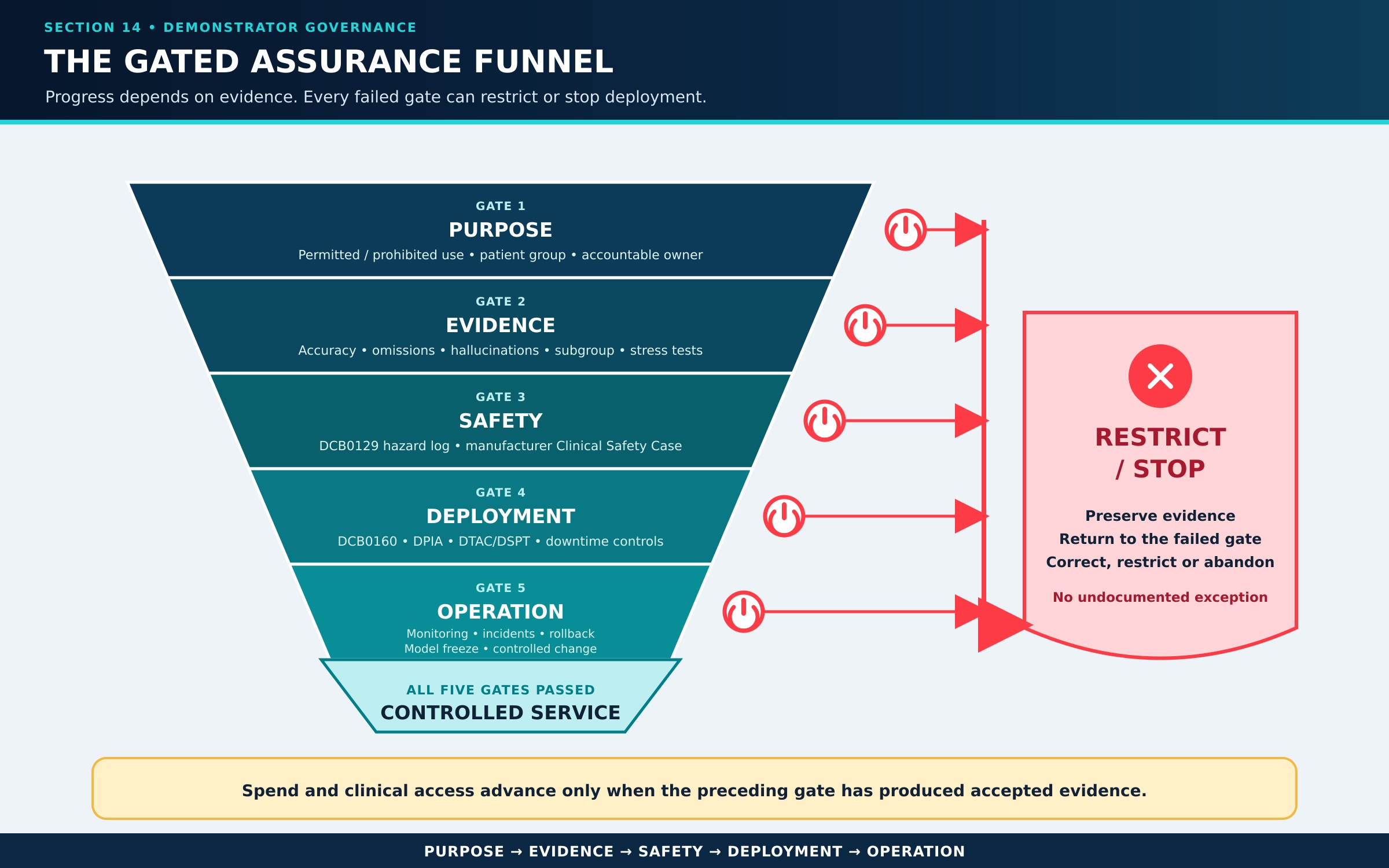
Figure 6. Five assurance gates directing insufficient evidence to restriction or termination before controlled clinical operation.
14.2 Ninety-day demonstrator
| Period | Programme work | Required output |
|---|---|---|
| Days 1-15 | Establish governance, intended purpose, data-flow map, initial hazard log and measurable acceptance criteria. | Approved scope, owners and baseline evidence plan. |
| Days 16-30 | Procure or allocate a laboratory node; assemble signed open-source components; create model and dependency registers. | Reproducible build and controlled component inventory. |
| Days 31-50 | Integrate a read-only test interface; build local speech, retrieval, inference, output-control and evidence services. | Working end-to-end demonstrator inside the test boundary. |
| Days 51-65 | Run clinical, cybersecurity, privacy, usability and failure testing; document every material limitation. | Test results, defect register and revised hazard controls. |
| Days 66-75 | Complete pilot safety and information-governance artefacts; train the clinical cohort and rehearse downtime and rollback. | Pilot readiness decision supported by completed evidence. |
| Days 76-90 | Conduct a tightly controlled pilot, monitor results daily and publish an evidence-based decision on continuation, restriction or stop. | Pilot report and accountable go, restrict or stop decision. |
14.3 Public-interest finding
The components required for a sovereign NHS clinical-documentation node are available now. Open speech recognition, open-weight language models, local inference runtimes, standard databases, FHIR interfaces, enterprise hardware and established NHS assurance mechanisms already exist. The absence of a local option is therefore not adequately explained as an absence of technology. It is a decision about architecture, capability, procurement, validation and institutional responsibility.
That finding does not justify reckless deployment. It creates the opposite obligation. Once a controllable alternative exists, an NHS body choosing remote dependency should be able to explain why the chosen arrangement provides superior clinical value, proportionate cost and acceptable sovereignty, jurisdiction, exit and audit controls. Conversely, a trust choosing local inference must accept the operational responsibility it has deliberately reclaimed.
14.4 Conclusion
Sovereign clinical AI does not begin with a claim that open models are infallible, deterministic or automatically compliant. It begins with a boundary. Identifiable clinical content, model execution, keys, evidence and operational authority are placed under trust control. The probabilistic component is constrained by deterministic routing and validation rules, linked to authorised source records, prevented from acting autonomously and exposed to human review. Every change is versioned; every material action is reconstructable; failure returns the workflow to a safe manual state.
The economic case must be proven with whole-life figures, but the architecture changes the shape of that case. Instead of paying indefinitely for one vendor-defined function, a trust acquires reusable capability. Instead of accepting a supplier's audit representation, it preserves its own evidence. Instead of treating domestic server location as sovereignty, it tests control directly. Instead of waiting for a future technology, it can begin a governed demonstrator with the technology already available.
Final proposition. The immediate NHS choice is not between AI and no AI. It is between intelligence infrastructure controlled by the health service and intelligence rented on terms controlled elsewhere.
15. Global Portability and Jurisdictional Translation
15.1 The NHS is the worked implementation, not the architectural boundary
The architecture is defined by control relationships rather than British terminology. At the point of care, an authorised laptop or clinical terminal and its microphone form the capture node. Audio and associated request data travel only across the healthcare institution's protected internal network to its local compute host or mainframe. The institution-controlled speech model and large language model—or another approved generative-AI model—execute there against locally governed clinical data. The resulting draft returns to the authorised workstation for human review. The ordinary clinical path does not require a public-cloud inference service, an external model API or supplier-held patient-content store.
That pattern can be reproduced in any country able to procure suitable enterprise hardware and operate a protected clinical network. Open-weight models, local speech-recognition software, Linux-based inference runtimes, standard databases and HL7 FHIR interfaces are globally available building blocks. FHIR itself is an international standard for electronic exchange of healthcare information. The portable proposition is therefore not that every hospital must buy the same server or choose the same model. It is that computation can be brought inside the authorised health-data boundary while the institution retains control of model artefacts, data, identities, keys, evidence, operation and exit. [19]
15.2 The pressure for sovereignty is global
Hospitals across public, private and mixed health systems face the same structural tension. They need to reduce clinical-documentation burden and use modern AI, yet patient records, consultations and voice recordings are among the most sensitive information they hold. Remote SaaS can create recurring per-user cost, operational dependence on a supplier's control plane, restricted access to audit evidence and exposure to legal process attached to the provider or its corporate group. The relevant foreign jurisdiction will differ by country, but the architectural question is universal: can an institution continue to provide the service, verify its operation and protect its records without the permission or infrastructure of an external inference provider?
A sovereign local node answers that question by reducing the number of organisations and jurisdictions in the clinical data path. It does not make the hospital exempt from law, professional confidentiality, safety duties or regulatory oversight. Local processing changes the risk surface; it does not erase it. The institution becomes directly responsible for secure operation, model validation, access control, lifecycle management, continuity, incident response and evidence preservation. That responsibility is the operational substance of sovereignty rather than a side effect of owning hardware.
15.3 What remains invariant and what must be translated
International adoption should preserve the technical control boundary while rebuilding the assurance wrapper for the destination jurisdiction. Calling the exercise an acronym swap would materially understate the work. The legal basis for clinical processing, the scope of protected health information, patient rights, professional duties, breach thresholds, medical-device rules and clinical-safety evidence can differ substantially even where the same hardware and model are used.
| Portable architectural invariant | Jurisdiction-specific translation and evidence |
|---|---|
| Point-of-care capture node | Confirm rules for notice, consent or other authority for microphone use, multi-party consultations, workplace monitoring and any retention of raw audio. |
| Protected internal data path | Map privacy, confidentiality, cybersecurity, cross-border-transfer, compelled-access and breach-notification requirements. |
| Institution-controlled compute, model and data | Classify each operator, supplier and support party; allocate controller, processor, covered-entity, business-associate or equivalent roles. |
| Declared intended purpose and human review | Apply local clinical-safety, professional-practice, human-factors and medical-device rules to each software function. |
| Institution-controlled identities, keys and logs | Meet local authentication, audit, records-retention, patient-access, correction, discovery and evidential requirements. |
| Export, rebuild and safe exit | Preserve lawful patient access and interoperability; test any national portability, information-sharing or information-blocking obligations. |
15.4 Illustrative jurisdictional mapping
The following matrix is a starting point, not a substitute for local legal and regulatory advice. It demonstrates that the architecture can remain stable while the governing evidence changes. In particular, the European Medicines Agency is not the approval body for ordinary medical-device software. An EU deployment must assess Regulation (EU) 2017/745, the applicable conformity-assessment and CE-marking route, notified-body involvement where required, and the relevant national competent authority. [36]-[38]
| Jurisdiction | Health-data and confidentiality layer | Clinical, AI and device layer | Translation consequence |
|---|---|---|---|
| United Kingdom | UK GDPR; Data Protection Act 2018; common-law confidentiality; Caldicott; sector records duties. | DCB0129 and DCB0160; DTAC/DSPT; UK MDR and MHRA assessment where applicable. | The detailed chapters in this paper provide the worked NHS implementation. |
| EU / EEA | EU GDPR plus Member-State health, secrecy, employment and records law. | EU MDR 2017/745; CE marking and notified body where required; national competent authority; EU AI Act where applicable. | Member-State law and local care governance remain necessary despite EU-wide regulations. |
| United States | HIPAA/HITECH where the entity and information fall within scope; 42 CFR Part 2 where applicable; federal and state privacy, recording, breach and medical-record law. | FDA software-function and clinical-decision-support analysis; state professional and facility governance; local quality and patient-safety controls. | A federal baseline is insufficient: entity, data, function and state-by-state analysis are required. |
| Canada | PIPEDA where applicable, provincial health-information statutes and professional confidentiality requirements. | Health Canada SaMD definition and classification; provincial clinical and facility governance. | Federal and provincial responsibilities must be allocated before the data flow is approved. |
| Australia | Privacy Act 1988, Australian Privacy Principles, My Health Records Act where relevant, and state or territory health-privacy law. | TGA software-based medical-device rules and local clinical-governance requirements. | Commonwealth, state or territory and institutional rules must be combined for the deployment site. |
The presence of a rule in the table does not mean that it applies automatically. Applicability turns on the deploying organisation, patient population, intended purpose, software functions, data categories, contractual roles and location of operation. A health system should record that analysis as a jurisdictional assurance schedule linked to the same versioned architecture and model register used for technical validation. [36]-[38], [48]-[52]
15.5 United States legal and regulatory implementation
A United States deployment requires more than replacing 'UK GDPR' with 'HIPAA'. HIPAA is an entity- and relationship-based federal regime. The Privacy Rule applies to covered health plans, clearinghouses and healthcare providers conducting specified electronic transactions, and to protected health information handled within that regulated relationship. The Security Rule protects electronic PHI and requires reasonable and appropriate administrative, physical and technical safeguards. HITECH extended direct Security Rule obligations and enforcement exposure to business associates. Health information outside that perimeter may instead fall under other federal or state law. [39]-[41]
The sovereign design can simplify this map if the capture node, internal network, compute host, models, storage and operational workforce are genuinely owned and controlled by the hospital. It does not eliminate business-associate analysis. A supplier that remotely administers the server, receives diagnostic bundles containing PHI, maintains an external backup, hosts a support portal containing patient content, monitors identifiable prompts or otherwise creates, receives, maintains or transmits PHI on behalf of the hospital may be a business associate even if the principal inference server is on site. The hospital must identify every such relationship and execute a compliant business associate agreement where required. [41]
| US legal layer | Application to the sovereign node | Required implementation evidence |
|---|---|---|
| HIPAA Privacy Rule | Determine whether the operator is a covered entity, which data are PHI and which uses or disclosures are permitted. Patient-specific audio, transcripts, prompts, outputs and logs may be PHI when held in the regulated care relationship. [39] | Data inventory; role analysis; notice and authorisation analysis; access/use policy; patient-rights workflow; minimum-necessary assessment where applicable. |
| HIPAA Security Rule and HITECH | All ePHI created, received, maintained or transmitted by covered entities and business associates requires risk analysis, risk management and appropriate administrative, physical and technical safeguards. Locality is an architectural control, not a safe harbour. [40] | Documented risk analysis; asset and data-flow inventory; access control; audit controls; integrity, transmission security, contingency and workforce evidence. |
| Business associates and BAAs | Any external party with the relevant PHI function or access must be classified. Remote support and maintenance pathways are included in the analysis; a claim of on-premises hosting does not decide the question. [41] | Supplier-role register; BAAs where required; subcontractor flow-down; permitted-use limits; incident notice; return or destruction and termination controls. |
| HIPAA Breach Notification Rule | A breach of unsecured PHI triggers assessment and, where required, notice to affected individuals, HHS and sometimes the media; a business associate must notify the covered entity. [42] | Incident playbook; breach-risk assessment; contact and escalation matrix; evidence preservation; tested notification timetable. |
| State privacy, confidentiality and recording law | HIPAA is a federal floor and more stringent state privacy protections may remain operative. The microphone workflow also requires state analysis of recording consent, medical-record law and, if voiceprints are used, biometric rules. [43] | State-law addendum for every deployment location; patient-notice script; audio-retention rule; state breach matrix; records and minors/sensitive-data controls. |
| 42 CFR Part 2 | Where the system handles records identifying a patient as having or having had a substance-use disorder within Part 2 scope, additional use, disclosure, consent, segregation and breach requirements apply. [44] | Part 2 applicability decision; tagged data and access rules; consent and redisclosure controls; Part 2 incident pathway. |
| FTC health-privacy jurisdiction | Consumer health apps and personal-health-record services outside HIPAA may fall within the FTC Act and Health Breach Notification Rule. A hospital-facing deployment and a public companion app may therefore occupy different federal regimes. [45] | Product-by-product scope analysis; consumer disclosures; privacy and security substantiation; FTC breach-notification route where applicable. |
| 21st Century Cures Act information blocking | Sovereign control must not be used to prevent lawful access, exchange or use of electronic health information by patients or other authorised actors, subject to the regulatory exceptions. [46] | Standards-based export; patient access; documented exception handling; no supplier lock on data or audit export. |
| FDA device-software boundary | Each software function must be assessed by intended use and risk. Transcription or administrative drafting may fall outside active FDA device oversight, while patient-specific analysis or recommendations can change the position. Labels such as 'AI assistant' do not decide classification. [47] | Function-level intended-purpose statement; CDS/device analysis; human-review rationale; validation and change-control evidence; regulatory submission or clearance pathway if required. |
| State clinical and institutional duties | Medical-practice, hospital-licensing, professional discipline, malpractice, record authentication, retention and discoverability rules continue to apply to clinician use of generated drafts. | State and facility governance schedule; credential and sign-off controls; retention/legal-hold procedure; professional training and incident escalation. |
The resulting US control boundary is therefore precise. Patient content remains on the point-of-care node only long enough to transmit it through the protected hospital network; processing and storage occur on the hospital-controlled compute host; outputs return internally; and no external inference provider receives the content. Any maintenance, telemetry, backup or support route that would contradict that description must be blocked, de-identified under an approved method, or brought expressly within the legal, contractual and security control set. HHS guidance confirms that use of a cloud provider is not prohibited by HIPAA, but it requires a BAA where the provider is a business associate and an appropriate risk analysis. The sovereign node is valuable because it permits a hospital to remove that remote dependency from the ordinary clinical path, not because HIPAA requires every workload to be local. [41], [53]
15.6 A repeatable portability method
A health system adapting the blueprint should translate it through one controlled programme. First, freeze the physical and logical data-flow diagram, including the microphone, workstation, internal network, compute host, model artefacts, clinical data, evidence store and every maintenance path. Second, declare the intended purpose and prohibit autonomous clinical functions at baseline. Third, classify the institution, suppliers, users, data and software functions under the destination law. Fourth, map privacy, confidentiality, recording, security, records, patient-rights, clinical-safety, professional and medical-device obligations to named evidence owners. Fifth, validate the exact model and workflow on local language, accent, specialty, patient-group and infrastructure conditions. Sixth, test egress denial, key control, audit reconstruction, failover, manual fallback, export and supplier exit. Only then should a time-limited clinical pilot begin.
This method preserves the architecture's global value without pretending that national law is interchangeable. The technology layer can be common; the assurance case must be local. That combination is the basis of a genuinely open blueprint: any healthcare institution may reproduce the protected data path, but each institution remains accountable for proving that the path is safe, lawful, clinically useful and sovereign in its own jurisdiction.
Global proposition. The NHS paper is a worked sovereign-health architecture for one jurisdiction. Its larger public-interest value is a reusable pattern: local capture, institution-controlled inference and data, human clinical authority, verifiable evidence, and no compulsory external AI data path.
Appendix A. Minimum Control Matrix
| Domain | Minimum evidence before pilot | Owner |
|---|---|---|
| Purpose | Approved intended purpose, prohibited uses and patient cohort. | Clinical owner / CSO |
| Data protection | DPIA, data-flow map, lawful basis/condition, transparency and retention. | DPO / IG |
| Confidentiality | Caldicott review, minimum-necessary design and objection route. | Caldicott Guardian |
| Clinical safety | Clinical-risk management plan, hazard log and DCB0129/0160 evidence. | CSO / manufacturer / trust |
| Medical device | Documented classification and intended-purpose analysis. | Regulatory lead |
| Cybersecurity | Threat model, SBOM, hardening, egress test, pen test and incident plan. | CISO / security |
| Models | Version, licence, hash, validation, limitations and rollback. | Model owner |
| Interoperability | FHIR profile, read-only scope, source version and wrong-patient tests. | Integration lead |
| Human factors | Draft marking, source display, edit/reject workflow and usability evidence. | Clinical UX / safety |
| Operations | Monitoring, capacity, backup, restore, failover and downtime test. | Service owner |
| Economics | Like-for-like three/five-year TCO with sensitivity analysis. | Finance / procurement |
| Exit | Rebuild, export, deletion and supplier-removal test. | Architecture / procurement |
Appendix B. Starter Hazard Register
This table is illustrative and cannot replace the hazard analysis required by DCB0129 and DCB0160.
| Hazard | Possible cause | Potential harm | Example control |
|---|---|---|---|
| Incorrect medication or dose in draft | Speech error; model substitution; stale record. | Medication error or misleading record. | |
| Negation lost | Speech recognition or summarisation failure. | Condition recorded as present rather than absent, or vice versa. | Negation-focused test set; source-linked sentence; block high-risk discrepancy. |
| Material omission | Context truncation; retrieval failure; summarisation bias. | Incomplete discharge or follow-up information. | |
| Wrong-patient context | Client parameter tampering; cache or index isolation failure. | Cross-patient disclosure and unsafe documentation. | Server-bound patient context; isolation tests; no shared semantic cache. |
| Unsupported diagnosis | Generative completion exceeds scope. | Automation bias or inappropriate treatment. | |
| Draft issued without review | Workflow/API design error or credential misuse. | Unverified content reaches patient or record. | Separate commit authority; draft watermark; no model write credential. |
| Service unavailable | Node, GPU, EPR, storage or cyber failure. | Documentation delay and workflow disruption. | |
| Audit evidence incomplete | Evidence-store outage or asynchronous logging loss. | Incident cannot be reconstructed. | Fail closed for clinical generation; transactional evidence commit. |
| Performance inequity | Accent, language or subgroup under-representation. | Unequal documentation burden or error risk. |
Appendix C. Economic Variables and Sensitivity Requirements
| Variable | Definition | Required source |
|---|---|---|
| N | Named and concurrent users by workflow. | Workforce and telemetry evidence. |
| L | Annual per-user SaaS licence, including mandatory base licences. | Procurement quotation or framework price. |
| K | Server, GPU, storage, network, installation and redundancy CapEx. | Itemised supplier quotations. |
| I | Integration, clinical safety, DPIA, testing, training and deployment cost. | Internal work estimate and external quotations. |
| O | Power, cooling, support, staff, monitoring, backup and annual assurance. | Facilities and service-management estimates. |
| R | Refresh, decommissioning, residual transition and disposal. | Lifecycle and asset policy. |
| B | Measured time, quality and patient-service benefit. | Pilot evidence, not vendor projection. |
The approved business case should present low, central and high scenarios; separate sunk from incremental cost; identify VAT treatment; disclose shared infrastructure assumptions; and show the result if adoption is half the forecast level. Productivity benefits should not be booked as cash savings unless the trust has an executable plan for converting released time into reduced expenditure or additional capacity.
References
[1] NHS England. Guidance on the use of AI-enabled ambient scribing products in health and care settings. https://www.england.nhs.uk/long-read/guidance-on-the-use-of-ai-enabled-ambient-scribing-products-in-health-and-care-settings/ (accessed 22 August 2026).
[2] NHS England Digital. DCB0129: Clinical Risk Management: its Application in the Manufacture of Health IT Systems. https://digital.nhs.uk/data-and-information/information-standards/information-standards-and-data-collections-including-extractions/publications-and-notifications/standards-and-collections/dcb0129-clinical-risk-management-its-application-in-the-manufacture-of-health-it-systems (accessed 22 August 2026).
[3] NHS England Digital. DCB0160: Clinical Risk Management: its Application in the Deployment and Use of Health IT Systems. https://digital.nhs.uk/data-and-information/information-standards/information-standards-and-data-collections-including-extractions/publications-and-notifications/standards-and-collections/dcb0160-clinical-risk-management-its-application-in-the-deployment-and-use-of-health-it-systems (accessed 22 August 2026).
[4] NHS England Transformation Directorate. Digital Technology Assessment Criteria guidance for buyers and suppliers. https://transform.england.nhs.uk/information-governance/information-governance-templates/ (accessed 22 August 2026).
[5] NHS England. Data Security and Protection Toolkit. https://www.dsptoolkit.nhs.uk/ (accessed 22 August 2026).
[6] MHRA. Software and artificial intelligence as a medical device. https://www.gov.uk/government/publications/software-and-artificial-intelligence-ai-as-a-medical-device/software-and-artificial-intelligence-ai-as-a-medical-device (accessed 22 August 2026).
[7] NHS England. Artificial intelligence: information-governance guidance. https://transform.england.nhs.uk/information-governance/guidance/artificial-intelligence/ (accessed 22 August 2026).
[8] Information Commissioner's Office. Guidance on AI and data protection. https://ico.org.uk/for-organisations/uk-gdpr-guidance-and-resources/artificial-intelligence/guidance-on-ai-and-data-protection/ (accessed 22 August 2026).
[9] UK Parliament. Data Protection Act 2018. https://www.legislation.gov.uk/ukpga/2018/12/contents (accessed 22 August 2026).
[10] Department for Science, Innovation and Technology. Data (Use and Access) Act 2025: data protection and privacy changes. https://www.gov.uk/guidance/data-use-and-access-act-2025-data-protection-and-privacy-changes (accessed 22 August 2026).
[11] National Data Guardian. The Caldicott Principles. https://www.gov.uk/government/publications/the-caldicott-principles (accessed 22 August 2026).
[12] NHS England. Records Management Code of Practice. https://www.gov.uk/government/publications/records-management-code-of-practice-for-health-and-social-care (accessed 22 August 2026).
[13] Information Commissioner's Office. A brief guide to international transfers. https://ico.org.uk/for-organisations/uk-gdpr-guidance-and-resources/international-transfers/a-brief-guide-to-international-transfers/ (accessed 22 August 2026).
[14] UK Government. UK-US data bridge: factsheet for UK organisations. https://www.gov.uk/government/publications/uk-us-data-bridge-supporting-documents/uk-us-data-bridge-factsheet-for-uk-organisations (accessed 22 August 2026).
[15] US Department of Justice. The Purpose and Impact of the CLOUD Act. https://www.justice.gov/criminal/media/999601/dl?inline= (accessed 22 August 2026).
[16] National Cyber Security Centre. Guidelines for secure AI system development. https://www.ncsc.gov.uk/collection/guidelines-secure-ai-system-development (accessed 22 August 2026).
[17] National Cyber Security Centre. The cloud security principles. https://www.ncsc.gov.uk/collection/cloud/the-cloud-security-principles (accessed 22 August 2026).
[18] OWASP GenAI Security Project. LLM01:2025 Prompt Injection. https://genai.owasp.org/llmrisk/llm01-prompt-injection/ (accessed 22 August 2026).
[19] HL7. FHIR specification. https://hl7.org/fhir/ (accessed 22 August 2026).
[20] SYSTRAN. Faster-Whisper: transcription with CTranslate2. https://github.com/SYSTRAN/faster-whisper (accessed 22 August 2026).
[21] Mistral AI. Models overview. https://docs.mistral.ai/models (accessed 22 August 2026).
[22] NVIDIA. RTX 6000 Ada Generation specifications. https://www.nvidia.com/en-gb/products/workstations/rtx-6000/ (accessed 22 August 2026).
[23] NVIDIA. GeForce RTX 4090 specifications. https://www.nvidia.com/en-us/geforce/graphics-cards/40-series/rtx-4090/ (accessed 22 August 2026).
[24] UK Government Digital Marketplace. Dragon Medical One G-Cloud service listing. https://www.applytosupply.digitalmarketplace.service.gov.uk/g-cloud/services/831119084612871 (accessed 22 August 2026).
[25] Microsoft. Microsoft 365 Copilot plans and pricing. https://www.microsoft.com/en-us/microsoft-365-copilot/pricing (accessed 22 August 2026).
[26] NIST. FIPS 204: Module-Lattice-Based Digital Signature Standard. https://csrc.nist.gov/pubs/fips/204/final (accessed 22 August 2026).
[27] NIST. FIPS 202: SHA-3 Standard. https://csrc.nist.gov/pubs/fips/202/final (accessed 22 August 2026).
[28] NHS England. Digital clinical safety assurance. https://www.england.nhs.uk/long-read/digital-clinical-safety-assurance/ (accessed 22 August 2026).
[29] NHS England Digital. Clinical risk management standards. https://digital.nhs.uk/services/clinical-safety/clinical-risk-management-standards (accessed 22 August 2026).
[30] Information Commissioner's Office. A guide to data security. https://ico.org.uk/for-organisations/uk-gdpr-guidance-and-resources/security/a-guide-to-data-security/ (accessed 22 August 2026).
[31] NHS England Digital. AI in practice: post-deployment monitoring and safety reporting. https://digital.nhs.uk/services/ai-knowledge-repository/ai-in-practice (accessed 22 August 2026).
[32] Department of Health and Social Care. A guide to good practice for digital and data-driven health technologies. https://www.gov.uk/government/publications/code-of-conduct-for-data-driven-health-and-care-technology/initial-code-of-conduct-for-data-driven-health-and-care-technology (accessed 22 August 2026).
[33] NHS England Digital. Applicability of DCB0129 and DCB0160: step-by-step guidance. https://digital.nhs.uk/services/clinical-safety/applicability-of-dcb-0129-and-dcb-0160/step-by-step-guidance (accessed 22 August 2026).
[34] Information Commissioner's Office. How the UK Extension to the EU-US Data Privacy Framework works. https://ico.org.uk/for-organisations/uk-gdpr-guidance-and-resources/international-transfers/adequacy-regulations/how-does-the-uk-extension-to-the-eu-us-data-privacy-framework-work/ (accessed 22 August 2026).
[35] CTO Servers. UK GPU server catalogue (illustrative market pricing only). https://www.ctoservers.com/rtx-6000-204-c.asp (accessed 22 August 2026).
[36] European Union. Regulation (EU) 2016/679: General Data Protection Regulation. https://eur-lex.europa.eu/eli/reg/2016/679/oj/eng (accessed 22 August 2026).
[37] European Union. Regulation (EU) 2017/745 on medical devices. https://eur-lex.europa.eu/eli/reg/2017/745/oj/eng (accessed 22 August 2026).
[38] European Commission. Notified bodies for medical devices. https://health.ec.europa.eu/medical-devices-topics-interest/notified-bodies-medical-devices_en (accessed 22 August 2026).
[39] US Department of Health and Human Services. The HIPAA Privacy Rule. https://www.hhs.gov/hipaa/for-professionals/privacy/index.html (accessed 22 August 2026).
[40] US Department of Health and Human Services. Summary of the HIPAA Security Rule. https://www.hhs.gov/hipaa/for-professionals/security/laws-regulations/index.html (accessed 22 August 2026).
[41] US Department of Health and Human Services. Business associates and business-associate arrangements. https://www.hhs.gov/hipaa/for-professionals/privacy/guidance/business-associates/index.html (accessed 22 August 2026).
[42] US Department of Health and Human Services. HIPAA Breach Notification Rule. https://www.hhs.gov/hipaa/for-professionals/breach-notification/index.html (accessed 22 August 2026).
[43] US Department of Health and Human Services. Preemption of state law under the HIPAA Privacy Rule. https://www.hhs.gov/hipaa/for-professionals/faq/preemption-of-state-law/index.html (accessed 22 August 2026).
[44] Electronic Code of Federal Regulations. 42 CFR Part 2: Confidentiality of Substance Use Disorder Patient Records. https://www.ecfr.gov/current/title-42/chapter-I/subchapter-A/part-2 (accessed 22 August 2026).
[45] US Federal Trade Commission. Health Breach Notification Rule. https://www.ftc.gov/legal-library/browse/rules/health-breach-notification-rule (accessed 22 August 2026).
[46] Office of the National Coordinator for Health Information Technology. Information Blocking. https://healthit.gov/information-blocking/ (accessed 22 August 2026).
[47] US Food and Drug Administration. Clinical Decision Support Software: Guidance for Industry and Food and Drug Administration Staff. https://www.fda.gov/regulatory-information/search-fda-guidance-documents/clinical-decision-support-software (accessed 22 August 2026).
[48] Health Canada. Software as a Medical Device: Definition and Classification. https://www.canada.ca/en/health-canada/services/drugs-health-products/medical-devices/application-information/guidance-documents/software-medical-device-guidance-document.html (accessed 22 August 2026).
[49] Government of Canada. Personal Information Protection and Electronic Documents Act. https://laws-lois.justice.gc.ca/eng/acts/p-8.6/ (accessed 22 August 2026).
[50] Australian Government. Privacy Act 1988. https://www.legislation.gov.au/C2004A03712/latest (accessed 22 August 2026).
[51] Australian Government. My Health Records Act 2012. https://www.legislation.gov.au/Details/C2017C00313 (accessed 22 August 2026).
[52] Therapeutic Goods Administration. Regulation of software and artificial intelligence as medical devices. https://www.tga.gov.au/products/medical-devices/software-and-artificial-intelligence-ai/overview (accessed 22 August 2026).
[53] US Department of Health and Human Services. Guidance on HIPAA and cloud computing. https://www.hhs.gov/hipaa/for-professionals/special-topics/health-information-technology/cloud-computing/index.html (accessed 22 August 2026).