
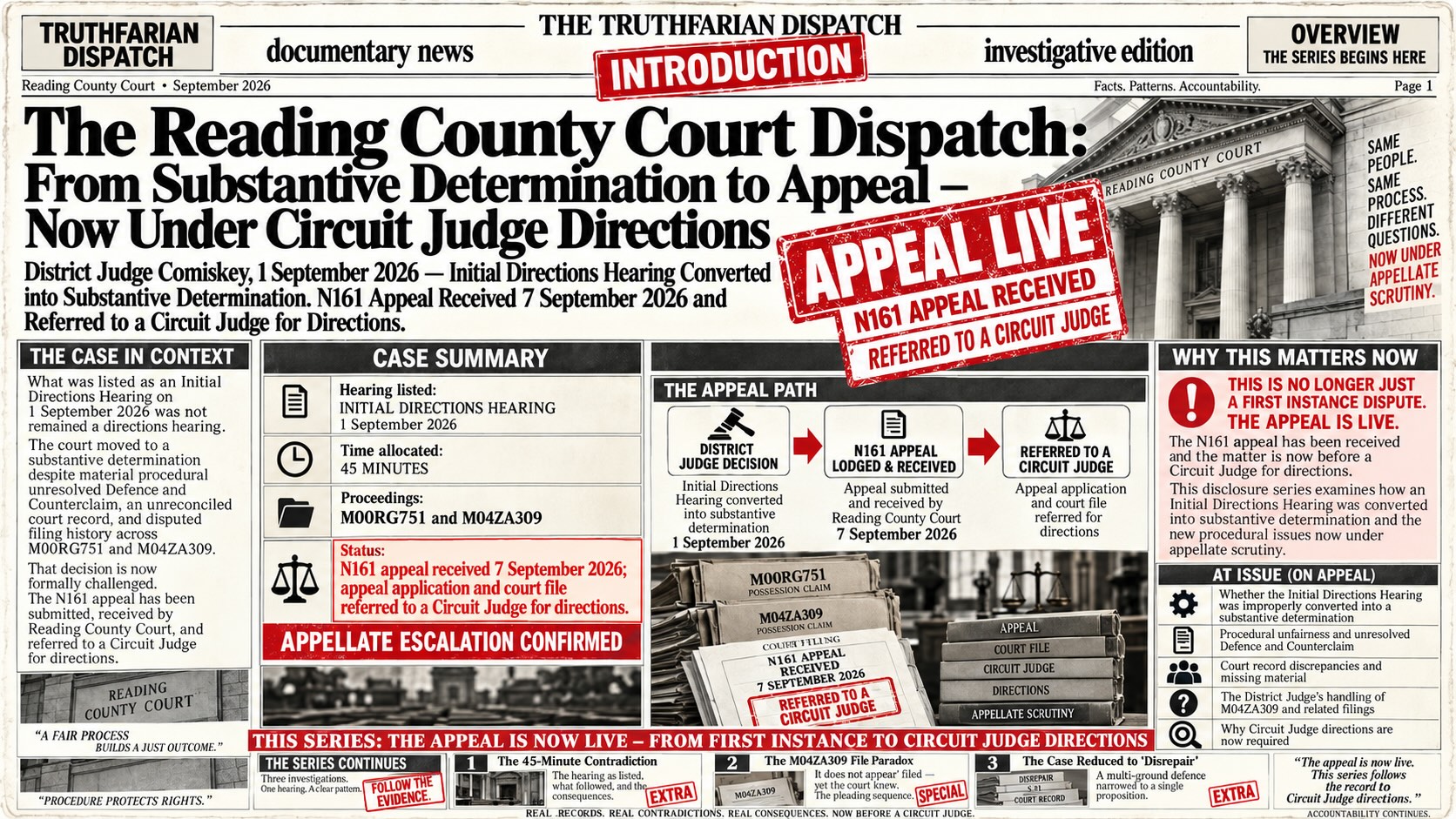
Introduction — Appeal Escalation and Procedural Conversion. Introductory overview of the disclosure showing how the 1 September 2026 hearing at Reading County Court, formally listed as an Initial Directions Hearing, was converted into substantive determination, and how that challenged procedural sequence has now moved into the appellate stage, with the N161 appeal received on 7 September 2026 and the appeal application and court file referred to a Circuit Judge for directions.
District Judge Comiskey, 1 September 2026 – Evidential Asymmetry, Unresolved Defence and Counterclaim, and Procedural Collapse Across M00RG751 / M04ZA309
Public Interest Disclosure
Author: Endarr Carlton Ramdin
Court: Reading County Court
Claims: M00RG751 / M04ZA309
Hearing: 1 September 2026
Judge: District Judge C. Comiskey
Status: N161 appeal received by Reading County Court on 7 September 2026; appeal application and court file referred to a Circuit Judge for directions
Disclosure Date: 7 September 2026
I. Introduction and Disclosure Basis
This disclosure concerns what occurred at Reading County Court on 1 September 2026, when a hearing formally listed as an “INITIAL DIRECTIONS Hearing” became the vehicle for substantive determination of possession and, on the Appellant’s understanding, the wider treatment of the Defence, Counterclaim and linked civil proceedings.
The hearing did not arise from a simple possession dispute. By that date, the record contained a filed Defence and Counterclaim in M00RG751, a separate civil claim in M04ZA309, multiple N244 applications, substantial evidential bundles, unresolved questions concerning the operative court record, and a housing case extending beyond ordinary disrepair into property representation, certification, statutory safety, consumer-law issues, repair-completion representations and consequential loss.
Deputy District Judge Passmore’s order of 26 March 2026 had expressly recognised the March 2026 N244 as a “very detailed application” and directed that it be listed for an initial directions hearing so that the Court could determine, on both parties’ submissions, how best to handle it. The subsequent Notice of Hearing again stated that 45 minutes had been allowed for the INITIAL DIRECTIONS Hearing.
The 20 August 2026 Case Management Clarification was then filed precisely because the operative litigation record had become fragmented. It asked the Court to identify what files and bundles were live, what earlier applications remained unresolved, the status of the Defence and Counterclaim, the status of M04ZA309, the September 2025 safety material, and how the two proceedings should be case-managed going forward.
The central disclosure is therefore not merely that the Court reached an adverse possession conclusion. It is that the hearing proceeded from a defined case-management purpose into substantive disposal while the Court itself recognised, in substance, that the volume of material could not properly be engaged with within the available 45 minutes. The appeal material records that the Court questioned the whereabouts of relevant files and that the Appellant had personally to draw attention to material already contained within the filed evidential architecture.
That sequence creates the central procedural contradiction:
| Procedural position before hearing | What the hearing was for | What occurred |
| N244 recognised as a “very detailed application” | Determine how the application and record should be handled | Substantive determinations followed |
| Defence and Counterclaim remained unresolved | Clarify their status and give directions | Possession proceeded without full substantive determination |
| M04ZA309 remained a distinct linked civil claim | Clarify its status and relationship with M00RG751 | Appellant understood it to be treated as closed/dismissed |
| Extensive bundles and missing-record issues remained unresolved | Reconcile the operative court record | Court questioned whereabouts of files/material |
| 45 minutes allocated | Initial directions only | Final substantive consequences arose |
That is the event now challenged through the N161 appeal.
II. Breaches
Breach 1 – Conversion of an Initial Directions Hearing into Substantive Determination
The hearing was expressly listed for initial directions, not final disposal. Deputy District Judge Passmore’s order of 26 March 2026 identified the purpose as determining, on both parties’ submissions, how best to handle the Claimant’s very detailed N244 application. The subsequent Notice of Hearing again stated that 45 minutes had been allowed for the INITIAL DIRECTIONS Hearing.
Nevertheless, the hearing resulted in substantive determinations concerning possession, the N244, the Defence and Counterclaim and, on the Appellant’s understanding, the linked M04ZA309 civil proceedings.
The procedural breach therefore arises from the divergence between the formally notified purpose of the hearing and the substantive consequences ultimately imposed.
Evidence
- Order of Deputy District Judge Passmore – 26 March 2026 – records the March N244 as a “very detailed application” and directs an Initial Directions Hearing so the Court can determine how best to handle it.
- Notice of Hearing – 1 September 2026 – expressly states that 45 minutes has been allowed for the INITIAL DIRECTIONS Hearing.
- Case Management Clarification – 20 August 2026 – identifies the unresolved matters requiring directions before substantive determination.
- Appellant’s Skeleton Argument / N161 appeal material – records the substantive determinations made at the 1 September hearing and challenges the procedural conversion of the hearing.
Legal Frameworks Engaged
- Magna Carta 1297 – Chapter 29
- Common Law – Natural Justice
- Common Law – Procedural Fairness
- Civil Procedure Rules – CPR 1.1
- Civil Procedure Rules – CPR 1.4
- Civil Procedure Rules – CPR 3.1
- Civil Procedure Rules – Part 23
- Civil Procedure Rules – CPR 52.21(3)(b)
- Human Rights Act 1998 – section 6
- European Convention on Human Rights – Article 6
- International Covenant on Civil and Political Rights – Article 14
Breach 2 – Substantive Disposal Despite Express Recognition That the Record Could Not Be Properly Traversed in Time
The 1 September 2026 hearing had been allocated 45 minutes and was expressly listed as an Initial Directions Hearing. By that stage, the Court was dealing with two linked proceedings, a Defence and Counterclaim, a separate civil claim in M04ZA309, multiple N244 applications, substantial evidential bundles, September 2025 safety material, later filings, disputed service and notice issues, and unresolved questions concerning which documents formed the operative court record.
The purpose of the hearing was therefore procedural: to determine how that record should be organised, what remained live, what evidence required consideration, and how the linked proceedings should be managed.
During the hearing, the Court recognised in substance that the volume of material could not properly be traversed within the time available.
That recognition was incompatible with proceeding in the same 45-minute hearing to substantive determination.
Once the Court had acknowledged that the evidential and procedural record could not properly be examined within the available time, the proper case-management function was to identify the operative record, determine what remained unresolved, sequence the issues, and give further directions.
Instead, substantive consequences followed.
The General Form of Judgment or Order dated 2 September 2026 and received on 7 September 2026 confirms that the hearing resulted in:
- dismissal of the application to set aside the possession order;
- permission for the Claimant to apply for a warrant forthwith;
- treatment of M04ZA309 as having stood struck out from 12 February 2026;
- a direction requiring a further restoration application if the Appellant maintained that he had complied with the earlier filing order; and
- substantive treatment of the Appellant’s case through the reduced description of “disrepair as a Defence to the possession claim.”
The same sealed order records that, in relation to M04ZA309, “it does not appear” that the Appellant complied with the earlier order while simultaneously recording that the Appellant asserted that he had complied.
That is itself evidence that material factual and procedural questions remained unresolved at the point substantive consequences were imposed.
The breach therefore arises from a direct contradiction:
the Court recognised that the record could not properly be traversed within the available hearing time, yet proceeded to determine substantive matters whose proper resolution depended upon that very record.
Evidence
- Order of Deputy District Judge Passmore – 26 March 2026 – records the March 2026 N244 as a “very detailed application” and directs an Initial Directions Hearing so that the Court can determine, on both parties’ submissions, how best to handle it.
- Notice of Hearing – 1 September 2026 – expressly confirms that 45 minutes had been allocated for the INITIAL DIRECTIONS Hearing.
- Case Management Clarification – 20 August 2026 – identifies the unresolved procedural and evidential matters requiring directions, including the operative court record, earlier applications, Defence and Counterclaim, M04ZA309, service history, September 2025 safety evidence and subsequent filings.
- Master Evidential Bundle and supplementary filings – demonstrate the scale and complexity of the material requiring reconciliation before substantive determination.
- Appellant’s Skeleton Argument / N161 appeal material – records that the Court recognised in substance that the volume of material could not properly be engaged with within the allotted hearing time.
- General Form of Judgment or Order – dated 2 September 2026, received 7 September 2026 – confirms the substantive consequences imposed notwithstanding continuing uncertainty concerning the M04ZA309 filing position and the wider evidential record.
Legal Frameworks Engaged
- Magna Carta 1297 – Chapter 29
- Common Law – Natural Justice
- Common Law – Procedural Fairness
- Common Law – Access to Justice
- Civil Procedure Rules – CPR 1.1
- Civil Procedure Rules – CPR 1.4
- Civil Procedure Rules – CPR 3.1
- Civil Procedure Rules – Part 5 / Practice Direction 5A
- Civil Procedure Rules – Part 23
- Civil Procedure Rules – Part 32
- Civil Procedure Rules – CPR 52.21(3)(b)
- Human Rights Act 1998 – section 6
- European Convention on Human Rights – Article 6
- International Covenant on Civil and Political Rights – Articles 2(3) and 14
Breach 3 – Failure to Reconcile the Operative Court Record Before Substantive Determination
The 20 August 2026 Case Management Clarification identified a central procedural problem: the Court had not yet established a single, authoritative operative record across M00RG751 and M04ZA309.
By that stage, the litigation record included the approximately 1,200-page Master Evidential Bundle, August 2025 supplementary material, the September 2025 Safety / Disrepair Evidential Bundle, earlier N244 applications, the March 2026 application package and Witness Statement, later filings, service material, the Defence and Counterclaim, and the separate M04ZA309 civil proceedings.
The Initial Directions Hearing was therefore the procedural stage at which the Court was expected to identify:
- which files and bundles were operative;
- which applications remained live;
- which evidence had been received and retained;
- what material belonged to M00RG751 and what belonged to M04ZA309;
- the status of the Defence and Counterclaim;
- and what further directions were required before substantive determination.
That reconciliation did not occur before substantive consequences followed.
At the 1 September 2026 hearing, the Court questioned the whereabouts of relevant files and material. The Appellant was required to identify evidence already contained within the filed record, including material relating to Environmental Health and Universal Credit / DWP.
The Court also recognised in substance that the volume of material could not properly be traversed within the 45 minutes allocated to the hearing. That fact does not contradict the Court’s difficulty in locating individual documents; rather, the two matters reinforce one another.
The significance is cumulative:
the record was extensive → specific material could not readily be located → the Court recognised that the material could not properly be traversed in the time available → the operative record had not been reconciled → substantive determinations nevertheless followed.
The issue is therefore not simply that the bundle was large or that individual documents were difficult to find.
The breach arises because the Court proceeded to substantive determination before first establishing which evidential and procedural record it was actually determining the case upon.
The later General Form of Judgment or Order dated 2 September 2026 further reinforces the record-continuity problem. That order proceeds on disputed assumptions concerning the status of M04ZA309 and the filing of the Amended Particulars of Claim while separately directing the Appellant to reconstruct and prove the same filing history through a further application.
The procedural architecture therefore moved in the reverse order from that contemplated by the Initial Directions Hearing:
record reconciliation should have preceded substantive determination; substantive determination instead preceded full record reconciliation.
Evidence
- Case Management Clarification – 20 August 2026 – expressly identifies the operative court record, earlier applications, evidential bundles, Defence and Counterclaim, M04ZA309, service history and September 2025 safety material as matters requiring directions.
- Master Evidential Bundle – approximately 1,200 pages – principal evidential record identified within the Case Management Clarification.
- August 2025 supplementary filings – additional evidential material requiring integration into the operative record.
- September 2025 Safety / Disrepair Evidential Bundle – later safety material whose procedural location and status required clarification.
- March 2026 N244 application package and Witness Statement – reconstruct the filing and evidential history across the linked proceedings.
- Appellant’s Skeleton Argument / N161 appeal material – records the Court questioning the whereabouts of relevant files/material and the Appellant identifying evidence already filed.
- General Form of Judgment or Order – dated 2 September 2026, received 7 September 2026 – proceeds upon disputed filing assumptions concerning M04ZA309 while requiring a further application to reconstruct the filing position.
Legal Frameworks Engaged
- Magna Carta 1297 – Chapter 29
- Common Law – Natural Justice
- Common Law – Procedural Fairness
- Common Law – Access to Justice
- Civil Procedure Rules – CPR 1.1
- Civil Procedure Rules – CPR 1.4
- Civil Procedure Rules – CPR 3.1
- Civil Procedure Rules – Part 5
- Practice Direction 5A
- Civil Procedure Rules – Part 23
- Civil Procedure Rules – Part 32
- Civil Procedure Rules – CPR 52.21(3)(b)
- Human Rights Act 1998 – section 6
- European Convention on Human Rights – Article 6
- International Covenant on Civil and Political Rights – Articles 2(3) and 14
Breach 4 – Failure to Engage with Material Already Filed by the Appellant
The Appellant had personally to direct the Court to material already contained within the filed evidential record, including Environmental Health correspondence and Universal Credit / DWP evidence.
The significance is not merely that documents had to be mentioned orally. It is that material already filed and directly relevant to the substantive housing case required re-identification during a 45-minute directions hearing while substantive determinations were being made.
That supports the wider concern that the operative evidential record had not been fully reconciled before adjudication.
Evidence
- Master Evidential Bundle – Environmental Health correspondence and council material.
- Universal Credit / DWP evidence – including the rent-payment / property-condition material already within the filed record.
- Appellant’s Skeleton Argument – records the need to identify those documents orally at the 1 September hearing.
- Case Management Clarification – 20 August 2026 – identifies unresolved evidential-record continuity.
Legal Frameworks Engaged
- Common Law – Natural Justice
- Common Law – Procedural Fairness
- Civil Procedure Rules – CPR 1.1
- Civil Procedure Rules – CPR 1.4
- Civil Procedure Rules – CPR 3.1
- Civil Procedure Rules – Part 32
- Human Rights Act 1998 – section 6
- European Convention on Human Rights – Article 6
- International Covenant on Civil and Political Rights – Article 14
Breach 5 – Evidential Asymmetry Between the Gopal Case and the Appellant’s Filed Record
Earlier proceedings already demonstrated a materially asymmetrical evidential and participation history.
The January 2026 order recorded Manohar Gopal appearing with Angela Gopal assisting him, while the Appellant’s absence was treated against a notice/service history that remained disputed. At the later 1 September hearing, the Appellant’s challenge concerning formal notice remained unresolved, while landlord-side communication concerning hearing information had previously been treated as materially relevant.
At the same time, substantial Appellant-side evidential material remained uncertain within the operative court record.
The asymmetry therefore lies in the difference between landlord-side participation and communication being visible within the judicial record while the Appellant’s own notice objection and filed evidential architecture remained unresolved.
Evidence
- January 2026 Order – records Manohar Gopal appearing with Angela Gopal assisting him.
- Appellant’s N161 / Skeleton Argument – records the disputed notice history and the significance attributed to Angela Gopal’s communication of hearing details.
- Case Management Clarification – 20 August 2026 – expressly identifies earlier hearing notice/service as requiring determination.
- Master Evidential Bundle and supplementary filings – substantial Appellant-side evidential record.
- 1 September 2026 hearing account in the appeal material – Court questioned whereabouts of files and Appellant identified evidence already filed.
Legal Frameworks Engaged
- Magna Carta 1297 – Chapter 29
- Common Law – Natural Justice
- Common Law – Procedural Fairness
- Civil Procedure Rules – CPR 1.1
- Civil Procedure Rules – Part 39
- Human Rights Act 1998 – section 6
- European Convention on Human Rights – Article 6
- International Covenant on Civil and Political Rights – Article 14
Breach 6 – Failure to Determine the Defence, Counterclaim and Monetary Claims Previously Recognised by the Court
The procedural record had already established that the possession proceedings were not uncontested and that the Defendant’s substantive case required proper consideration.
The Court had previously recorded:
“A Defence has been raised which needs to be properly considered.”
That Defence was accompanied by a substantial Counterclaim in M00RG751. The 20 August 2026 Case Management Clarification therefore expressly asked the Court to determine the status of the Defence and Counterclaim, identify what remained live, establish which pleadings and evidential materials were operative, and give directions for their substantive determination.
The 1 September 2026 hearing did not result in that exercise.
Instead, the General Form of Judgment or Order dated 2 September 2026 and received on 7 September 2026 records the Defendant’s position principally as:
“the Defendant seeking to rely on disrepair as a Defence to the possession claim”
and then records that the Court was not satisfied that disrepair could constitute a substantive Defence to the Section 21 possession claim.
That description does not determine the Defence and Counterclaim already before the Court.
The pleaded case extended materially beyond ordinary disrepair and included property representation, false or misleading advertising, certification, gas/CO documentation, electrical safety, statutory compliance, repair-completion representations, consequential loss and the relationship between those matters and the possession proceedings.
The Defendant also expressly raised fraud / false representation and certification during the 1 September hearing. Those matters do not appear in the sealed order.
The omission is substantive. It reduces the recorded case from a multi-ground Defence and Counterclaim to a single proposition concerning disrepair and then rejects that narrowed proposition without determining the wider pleaded case.
The sealed order also does not record any substantive merits determination of the monetary claims.
The presently pleaded value of the M00RG751 Counterclaim was £1,128,500. That figure had not been judicially assessed or approved, but it remained the pleaded value of a live substantive claim requiring determination.
The order does not:
- determine liability on the Counterclaim;
- assess or reject the pleaded monetary heads;
- determine the wider consequential-loss case;
- make findings on the representation / certification causes of action;
- determine damages;
- or give a reasoned merits judgment disposing of the monetary claim.
Instead, the order is overwhelmingly directed toward the possession and enforcement route.
The result is therefore a procedural split:
possession and enforcement advanced
while
the substantive Defence, Counterclaim and monetary claims remained unresolved on their merits.
That is material because the earlier judicial record had already recognised that the Defence required proper consideration. The 1 September hearing did not provide that substantive determination and the sealed order does not purport to resolve the pleaded compensation architecture.
The breach therefore arises from the failure to determine the actual substantive vehicle already recognised by the Court as requiring proper consideration, while advancing the eviction route and leaving the monetary claims unresolved.
Evidence
- Court record / Notice of Hearing dated 13 June 2025 – records that the Court was “NOT being satisfied that the Claimant is entitled to use the accelerated procedure” and that “A Defence has been raised which needs to be properly considered.”
- Defence and Counterclaim – M00RG751 – contains the substantive Defence and pleaded Counterclaim.
- Current pleaded Counterclaim value – £1,128,500.
- March 2026 N244 and supporting Witness Statement – seeks restoration and substantive determination of the Defence and Counterclaim.
- Case Management Clarification – 20 August 2026 – expressly identifies the Defence and Counterclaim as unresolved matters requiring directions at the Initial Directions Hearing.
- Master Evidential Bundle and subsequent evidential filings – contain the representation, certification, safety, disrepair, consequential-loss and associated evidence underlying the Defence and Counterclaim.
- Appellant’s Skeleton Argument / N161 appeal material – records the wider substantive case and challenges the failure to determine it.
- General Form of Judgment or Order – dated 2 September 2026, received 7 September 2026 – characterises the Defendant’s position as relying on “disrepair as a Defence to the possession claim”, advances the possession/enforcement route, and does not record any substantive determination of the Counterclaim or pleaded monetary heads.
Legal Frameworks Engaged
- Magna Carta 1297 – Chapter 29
- Common Law – Natural Justice
- Common Law – Procedural Fairness
- Common Law – Access to Justice
- Civil Procedure Rules – CPR 1.1
- Civil Procedure Rules – CPR 1.4
- Civil Procedure Rules – CPR 3.1
- Civil Procedure Rules – Part 16
- Civil Procedure Rules – Part 20
- Civil Procedure Rules – Part 23
- Civil Procedure Rules – Part 32
- Civil Procedure Rules – Part 55
- Civil Procedure Rules – CPR 52.21(3)(b)
- Human Rights Act 1998 – section 6
- European Convention on Human Rights – Article 6
- International Covenant on Civil and Political Rights – Articles 2(3) and 14
Breach 7 – Procedural Treatment of M04ZA309 Without Determining the Disputed Filing Position or the Monetary Claim on Its Merits
M04ZA309 was a separate civil proceeding from the possession claim in M00RG751.
The 20 August 2026 Case Management Clarification expressly identified M04ZA309 as requiring directions concerning its current status, operative pleadings, evidential record, outstanding applications and relationship with the possession proceedings.
The General Form of Judgment or Order dated 2 September 2026 and received on 7 September 2026 now records that:
“it does not appear that the Defendant complied with paragraph 1 (or 2) of the Order of 14 January 2026, such that claim M04ZA309 stands struck out from 12 February 2026”
The same order simultaneously records:
“the Defendant asserting that he had complied”
The sealed order therefore identifies a live factual dispute concerning compliance with the January 2026 filing requirement but does not determine that dispute before attaching the consequence that M04ZA309 stood struck out.
Instead, the Defendant is directed to make a further application to restore the civil claim, accompanied by the Amended Particulars of Claim and a witness statement of no more than five pages explaining when and how those Particulars were filed.
The procedural consequence is circular.
The Defendant’s position is that the Amended Particulars were already filed. The wider March 2026 N244 and August 2026 Case Management Clarification were themselves directed toward reconstruction of the filing and operative-record history. Yet the 1 September Initial Directions Hearing did not resolve that disputed filing record. The sealed order instead requires a further application asking the Defendant to prove again the filing whose status was already one of the matters requiring clarification.
The order also does not determine the substance of M04ZA309 on its merits.
The presently pleaded value of M04ZA309 was £1,803,800. That figure had not been judicially assessed or approved, but it remained the pleaded value of a distinct civil claim.
The sealed order does not:
- determine the pleaded causes of action in M04ZA309;
- make findings on liability;
- determine the representation / certification / housing-safety case;
- assess or reject the pleaded monetary heads;
- determine damages;
- or give a substantive merits judgment disposing of the £1,803,800 civil claim.
Instead, it treats the claim as procedurally struck out while expressly leaving open a restoration route.
That distinction is critical.
The effect of the order is not:
M04ZA309 determined and dismissed on its merits.
It is:
M04ZA309 treated as procedurally struck out on a disputed filing basis → Defendant asserts compliance → Court leaves restoration open → monetary claim remains undetermined on its merits.
The breach therefore arises from the Court proceeding on an “it does not appear” basis, notwithstanding an express assertion of compliance and an existing evidential dispute concerning court-record continuity, while advancing the possession route without determining the separate civil monetary claim.
Evidence
- Order dated 14 January 2026 – identifies the filing requirement relied upon in the later strike-out position.
- Amended Particulars of Claim – M04ZA309 – document the Defendant maintains was filed in compliance with the January order.
- Evidence of filing / delivery of the Amended Particulars of Claim – relevant to the disputed compliance position.
- Current pleaded value of M04ZA309 – £1,803,800.
- March 2026 N244 and supporting Witness Statement – reconstruct the filing and procedural history across the linked proceedings.
- Case Management Clarification – 20 August 2026 – expressly identifies the status of M04ZA309, operative pleadings and court-record continuity as matters requiring directions.
- Appellant’s Skeleton Argument / N161 appeal material – records the Appellant’s challenge to the procedural treatment of M04ZA309.
- General Form of Judgment or Order – dated 2 September 2026, received 7 September 2026 – records both that compliance “does not appear” to have occurred and that the Defendant asserted that he had complied, before directing a further restoration application and without determining the monetary claim on its merits.
Legal Frameworks Engaged
- Magna Carta 1297 – Chapter 29
- Common Law – Natural Justice
- Common Law – Procedural Fairness
- Common Law – Access to Justice
- Civil Procedure Rules – CPR 1.1
- Civil Procedure Rules – CPR 1.4
- Civil Procedure Rules – CPR 3.1
- Civil Procedure Rules – Part 5 / Practice Direction 5A
- Civil Procedure Rules – Part 16
- Civil Procedure Rules – Part 23
- Civil Procedure Rules – Part 32
- Civil Procedure Rules – CPR 52.21(3)(b)
- Human Rights Act 1998 – section 6
- European Convention on Human Rights – Article 6
- International Covenant on Civil and Political Rights – Articles 2(3) and 14
Breach 8 – Narrowing the Section 21 Issue to “Disrepair Does Not Prevent Section 21” and Omission of the Wider False-Representation / Certification Case
The Appellant’s challenge to the possession claim was not confined to the proposition that disrepair, by itself, invalidated Section 21.
The filed case extended materially beyond ordinary disrepair and included:
- false or misleading property representation at tenancy formation;
- EPC and energy-performance representation;
- gas / carbon-monoxide certification issues;
- electrical-safety and EICR issues;
- prescribed-document and service questions;
- later repair-completion representations;
- the Defence and Counterclaim in M00RG751; and
- the linked civil claim in M04ZA309.
At the 1 September 2026 hearing, the Appellant expressly raised fraud, false advertising, certification and wider documentary issues.
The General Form of Judgment or Order dated 2 September 2026 and received on 7 September 2026 does not record those matters.
Instead, it characterises the Appellant’s position as:
“the Defendant seeking to rely on disrepair as a Defence to the possession claim”
and then records:
“the Court not being satisfied that disrepair could be a substantive Defence to a claim under s.21”
That is not a determination of the case actually advanced.
The sealed order therefore narrows a multi-layered substantive challenge into a single disrepair proposition and then rejects that reduced proposition.
The omission is particularly significant because the false-representation and certification strands operate on a different legal basis from later disrepair. They concern the legitimacy and factual integrity of the tenancy transaction, statutory and safety documentation, and the documentary basis upon which possession was subsequently pursued.
The order also does not identify:
- which prescribed documents were relied upon;
- when they were supplied;
- by whom they were supplied;
- by what method they were served;
- what evidence established service;
- how the EPC and certification evidence was treated;
- or how the false-representation / fraud allegations were determined.
The result is a written order that does not record the full substantive case placed before the Court.
The breach therefore arises not merely from an adverse Section 21 conclusion, but from the Court determining a narrower case than the one actually advanced, while omitting from the written order the wider false-representation, certification and documentary issues expressly raised at the hearing.
Evidence
- Master Evidential Bundle – contains the property-advertising, EPC, gas/CO, electrical, Section 21 and wider certification evidence.
- Property advertisement / tenancy-formation material – relied upon in the false-representation strand.
- EPC documentation – relied upon in the certification / representation strand.
- Gas Safety Records dated 11 September 2020 and 28 August 2021 – relied upon in the gas/CO certification strand.
- Carbon-monoxide communication evidence – relied upon in the documentary contradiction strand.
- Electrical-safety / EICR evidence – relied upon in the statutory-compliance strand.
- Form 6A / prescribed-document evidence – relied upon in the Section 21 documentary/service challenge.
- Defence and Counterclaim – M00RG751 – contains the wider substantive case.
- M04ZA309 pleadings – contain the linked civil causes of action.
- Case Management Clarification – 20 August 2026 – identifies the wider substantive and procedural issues requiring directions.
- Appellant’s Skeleton Argument / N161 appeal material – records that the Appellant’s challenge extended beyond disrepair.
- General Form of Judgment or Order – dated 2 September 2026, received 7 September 2026 – records the Appellant’s case only as “disrepair as a Defence” and does not record the fraud / false-representation / certification strands raised at the hearing.
Legal Frameworks Engaged
- Magna Carta 1297 – Chapter 29
- Common Law – Natural Justice
- Common Law – Procedural Fairness
- Common Law – Access to Justice
- Common Law – Misrepresentation
- Misrepresentation Act 1967 – section 2(1)
- Consumer Protection from Unfair Trading Regulations 2008
- Consumer Protection (Amendment) Regulations 2014
- Energy Performance of Buildings (England and Wales) Regulations 2012
- Gas Safety (Installation and Use) Regulations 1998 – regulation 36
- Electrical Safety Standards in the Private Rented Sector (England) Regulations 2020
- Landlord and Tenant Act 1985 – sections 9A, 10 and 11
- Homes (Fitness for Human Habitation) Act 2018
- Housing Act 2004 – Part 1 / HHSRS
- Housing Act 1988 – sections 21, 21A and 21B
- Assured Shorthold Tenancy Notices and Prescribed Requirements (England) Regulations 2015
- Civil Procedure Rules – CPR 1.1
- Civil Procedure Rules – CPR 1.4
- Civil Procedure Rules – Part 32
- Civil Procedure Rules – Part 55
- Civil Procedure Rules – CPR 52.21(3)(b)
- Human Rights Act 1998 – sections 6 and 8
- European Convention on Human Rights – Articles 6 and 8
- International Covenant on Civil and Political Rights – Articles 2(3), 14 and 17
- International Covenant on Economic, Social and Cultural Rights – Articles 11 and 12
Breach 9 – Failure to Distinguish Tenancy-Formation Representation from Later Disrepair
The substantive case does not begin with later repair complaints.
It begins with the 2020 tenancy transaction itself: property advertising, EPC representation, gas/CO documentation, electrical and safety representation and the wider compliance position upon which the tenancy was entered.
Later defects then arose on their own chronology, including the January 2023 ceiling leak and the 2024 kitchen/garage door failure.
Reducing the substantive dispute to “disrepair” therefore erased two legally distinct layers:
representation, certification and statutory condition at tenancy formation
and
later repair, safety and habitability obligations during occupation.
Evidence
- Property advertisement / August 2020 letting material.
- EPC documentation.
- Gas Safety Records – 2020 and 2021.
- CO-alarm contradiction within the documentary record.
- September 2020 wall-light / electrical communications.
- January 2023 ceiling-leak evidence.
- July 2024 kitchen/garage door evidence.
- Updated Particulars of Claim and Rebuttal to Defence.
Legal Frameworks Engaged
- Misrepresentation Act 1967 – section 2(1)
- Common Law – Misrepresentation
- Consumer Protection from Unfair Trading Regulations 2008
- Consumer Protection (Amendment) Regulations 2014
- Landlord and Tenant Act 1985 – sections 9A and 10
- Homes (Fitness for Human Habitation) Act 2018
- Energy Performance of Buildings (England and Wales) Regulations 2012
- Gas Safety (Installation and Use) Regulations 1998 – regulation 36
- Electrical Safety Standards in the Private Rented Sector (England) Regulations 2020
- Fraud Act 2006 – sections 2 and/or 3 where the statutory elements are established
- International Covenant on Economic, Social and Cultural Rights – Articles 11 and 12
Breach 10 – Failure to Give Directions for Technical and Life-Safety Evidence
The record contained disputed electrical, gas, fire, water and housing-safety evidence that could not realistically be resolved through assertion alone.
The appeal material identifies fuse-board configuration, RCD protection, live wiring, absence of a current EICR and water/electrical crossover. The existing housing record separately contains fire-egress, CO, gas-safety, damp, water and essential-service evidence.
The Initial Directions Hearing was the obvious procedural stage at which the Court could have directed inspection, expert evidence, testing, disclosure of certification or other technical evidence necessary to determine those disputes.
Instead, substantive consequences followed without those technical matters being resolved.
Evidence
- Electrical / wall-light evidence.
- Consumer-unit / fuse-board photographs and configuration evidence.
- September 2025 Safety / Disrepair Evidential Bundle – radiator failure, water discharge, water/electrical crossover and RCD/fuse-board concerns.
- EICR dispute contained within the Rebuttal to Defence and Legal Breaches material.
- Gas Safety Records and CO-alarm evidence.
- Environmental Health correspondence.
- Appellant’s Skeleton Argument – identifies the technical matters requiring proper inspection and determination.
Legal Frameworks Engaged
- Landlord and Tenant Act 1985 – sections 9A, 10 and 11
- Homes (Fitness for Human Habitation) Act 2018
- Housing Act 2004 – Part 1 / HHSRS
- Defective Premises Act 1972 – section 4
- Electrical Safety Standards in the Private Rented Sector (England) Regulations 2020
- BS 7671 – including Regulations 314.1 and 433.1.204 where technically applicable
- Gas Safety (Installation and Use) Regulations 1998 – regulation 36
- Smoke and Carbon Monoxide Alarm (England) Regulations 2015, as amended
- Environmental Protection Act 1990 – section 79 where the statutory threshold is met
- Civil Procedure Rules – CPR 1.1
- Civil Procedure Rules – CPR 3.1
- Civil Procedure Rules – Part 32
- Human Rights Act 1998 – Article 8 ECHR
- International Covenant on Economic, Social and Cultural Rights – Articles 11 and 12
Breach 11 – Internal Contradiction Concerning Receipt and Knowledge of the Amended Particulars of Claim
The sealed order proceeds on the basis that compliance with the 14 January 2026 filing requirement “does not appear” to have occurred, with M04ZA309 therefore treated as struck out from 12 February 2026.
The same order nevertheless demonstrates detailed knowledge of the very pleading said not to have been properly received, expressly identifying the Amended Particulars of Claim, requiring their reproduction, and directing a witness statement explaining when and how they were filed.
The two positions are materially inconsistent.
If the Court did not receive or have access to the Amended Particulars, the basis upon which their existence, procedural character and filing history were known requires explanation.
If the Court did receive or have access to them, the basis upon which M04ZA309 was treated as struck out for apparent non-compliance likewise requires explanation.
This is therefore a direct court-record integrity and procedural continuity breach, not merely a disagreement about case management.
The subsequent appellate record materially reinforces the significance of this contradiction. On 7 September 2026, Reading County Court confirmed in writing that the N161 appeal application had been received and that both the appeal application and the court file had been referred to a Circuit Judge for directions. The referral therefore places the disputed M04ZA309 filing history, the treatment of the Amended Particulars of Claim, and the wider court-record continuity issue within the appellate record now before a higher judicial level.
The timing is material. The HMCTS letter is dated the same day the appeal was recorded as received. The documentary chronology therefore shows same-day referral of the appeal application and underlying court file to a Circuit Judge. That referral does not itself determine the contradiction identified above, but it means that the contradiction is no longer confined to the 1 September decision or the sealed order: it now forms part of the operative record subject to appellate directions.
Accordingly, the record now contains the following sequence:
Amended Particulars said by the Appellant to have been filed → Court treats compliance as apparently absent → same Court demonstrates knowledge of the pleading and directs its reproduction → M04ZA309 treated as struck out while restoration remains open → N161 appeal lodged → appeal application and court file referred to a Circuit Judge on 7 September 2026.
This sequence strengthens the court-record integrity issue because the disputed filing history and the judicial treatment of that history are now preserved within the appellate file itself.
Evidence
- Order dated 14 January 2026.
- Amended Particulars of Claim – M04ZA309.
- Filing/delivery evidence concerning the Amended Particulars.
- Case Management Clarification – 20 August 2026.
- General Form of Judgment or Order – dated 2 September 2026, received 7 September 2026.
- Continuation page directing reproduction of the Amended Particulars and a five-page witness statement on filing history.
- HM Courts & Tribunals Service / Reading County Court letter dated 7 September 2026 – confirms that the appeal application and the court file were referred to a Circuit Judge for directions on the same date the appeal was received.
Legal Frameworks Engaged
- Magna Carta 1297 – Chapter 29
- Common Law – Natural Justice
- Common Law – Procedural Fairness
- Common Law – Access to Justice
- Civil Procedure Rules – CPR 1.1
- Civil Procedure Rules – CPR 1.4
- Civil Procedure Rules – CPR 3.1
- Civil Procedure Rules – Part 5 / Practice Direction 5A
- Civil Procedure Rules – Part 23
- Civil Procedure Rules – Part 32
- Civil Procedure Rules – CPR 52.21(3)(b)
- Human Rights Act 1998 – section 6
- European Convention on Human Rights – Article 6
- International Covenant on Civil and Political Rights – Articles 2(3) and 14
Legal Frameworks Engaged
I. Magna Carta 1297 – Chapter 29
Citation: Magna Carta 1297, Chapter 29.
Verbatim:
“We will sell to no man, we will not deny or defer to any man either Justice or Right.” (House of Commons Library)
Analysis:
Chapter 29 forms the foundational constitutional layer of the disclosure. Its modern direct legal operation is narrower than later procedural statutes, but the principle remains central: justice must not be denied or deferred, and substantive deprivation must occur through lawful process. The 1 September 2026 hearing engages that lineage because the Court had already recognised that a Defence required proper consideration, yet a hearing formally listed for initial directions proceeded to substantive possession consequences while the Defence, Counterclaim, linked proceedings and operative evidential record remained unresolved.
II. Petition of Right 1628
Citation: Petition of Right 1628.
Verbatim:
“that no freeman, in any such manner as is before mentioned, be imprisoned or detained” (Teaching American History)
Analysis:
The Petition of Right is part of the constitutional progression from Magna Carta toward government constrained by law rather than arbitrary authority. Its immediate subject matter was unlawful detention and prerogative power, not residential possession. Its relevance here is therefore foundational rather than a standalone housing cause of action: judicial and executive authority must operate according to law and through the procedure Parliament has established. Parliament itself describes the Petition as a major step in protecting the “rights and liberties of the subject” against arbitrary power. (Parliament News)
III. Habeas Corpus Act 1679
Citation: Habeas Corpus Act 1679.
Verbatim:
“for the prevention whereof, and the more speedy relief of all persons imprisoned” (Wikisource)
Analysis:
The Habeas Corpus Act likewise concerns liberty from unlawful detention rather than tenancy law. It belongs in the constitutional lineage because it developed the principle that legal rights cannot be rendered meaningless through procedural delay or administrative obstruction. The relevance to this disclosure is structural: where legal protection exists, the procedure must provide an effective route by which the right can actually be tested and determined.
IV. Bill of Rights 1689
Citation: Bill of Rights 1689.
Verbatim:
“That it is the right of the subjects to petition the King” (JAOC Investigations)
Analysis:
The Bill of Rights forms part of the constitutional settlement limiting arbitrary authority and preserving lawful avenues of redress. UK Parliament identifies it as part of the uncodified constitutional structure and notes its continuing importance to civil liberties and just treatment by courts. (Parliament News)
For this disclosure, the significance is not that a modern N244 or N161 is literally a petition to the Crown. The constitutional continuity is that access to redress must be real, lawful and capable of producing determination. The repeated filing of applications, evidence and a Counterclaim is therefore relevant to whether the judicial process provided an effective route to adjudication rather than merely receiving documents into a file.
V. Act of Settlement 1701 – Judicial Independence
Citation: Act of Settlement 1701.
Verbatim:
“Judges Commissions be made Quam diu se bene Gesserint” (Wikisource)
Analysis:
The Act of Settlement established the constitutional foundation of judicial independence. The Courts and Tribunals Judiciary describes the 1701 settlement as the point at which security of judicial tenure became a fundamental feature of judicial independence. (Courts and Tribunals Judiciary)
Its relevance here is structural: judicial independence exists to secure lawful and impartial adjudication. The issue disclosed is not personal disagreement with a judge; it is whether the judicial process operated consistently with the independent, lawful and procedurally fair determination of the actual issues placed before the Court.
COMMON-LAW AND CONSTITUTIONAL PRINCIPLES
VI. Common Law – Natural Justice: Audi Alteram Partem
Citation: Common-law principle of natural justice.
Verbatim:
“Hear the other side.”
Analysis:
This is directly engaged by the difference between the hearing notified and the hearing conducted. An Initial Directions Hearing gives notice of case-management activity. A substantive possession determination is materially different. If final consequences were imposed without a proper opportunity to prepare for the actual scope of determination, the foundational requirement to hear both sides is engaged.
The earlier evidential asymmetry is also relevant: the landlord side had been heard with Angela Gopal assisting, while the Claimant’s notice objection, evidence and wider case remained disputed or incompletely reflected in the adjudicative record.
VII. Common Law – Procedural Fairness
Citation: Common-law duty of procedural fairness.
Verbatim:
The governing principle is that a person affected by a decision must have a fair opportunity to know and answer the case being determined.
Analysis:
The procedural fairness issue is cumulative. It includes the hearing-purpose divergence, unresolved notice history, questions concerning what files were actually available to the judge, evidence already filed but requiring oral re-identification, the unresolved Defence and Counterclaim, and the treatment of M04ZA309.
The disclosure therefore concerns the fairness of the adjudicative process as a whole, not simply whether the final possession conclusion was favourable or unfavourable.
VIII. Common Law – Access to Justice
Citation: Constitutional common-law right of access to the courts.
Verbatim:
Access to justice requires more than physical access to a courthouse; legal rights must be capable of effective judicial determination.
Analysis:
The Defence, Counterclaim, N244 applications and evidential bundles were repeatedly placed before the Court. The disclosed issue is whether that formal access translated into substantive adjudication. A Counterclaim cannot fulfil its legal function merely by existing in the procedural record if the issues carried within it are never actually determined.
HUMAN RIGHTS ACT – DOMESTIC INCORPORATION
IX. Human Rights Act 1998 – Section 6
Citation: Human Rights Act 1998, s.6(1).
Verbatim:
“It is unlawful for a public authority to act in a way which is incompatible with a Convention right.”
Analysis:
The courts exercise public functions and must act compatibly with Convention rights. The procedural handling of the 1 September hearing therefore engages the domestic statutory duty to conduct proceedings consistently with Article 6 and, where possession of the home is concerned, the relevant Article 8 framework.
CIVIL PROCEDURE
X. Civil Procedure Rules – CPR 1.1
Citation: CPR 1.1(1).
Verbatim:
“enabling the court to deal with cases justly and at proportionate cost.” (GOV.UK Justice)
Analysis:
The case involved two linked proceedings, a Defence, Counterclaim, multiple applications and extensive evidence. CPR 1.1 is engaged because the Court had to ensure equal footing, full participation, fairness and proportionality before converting a directions hearing into substantive determination. The present CPR expressly includes ensuring that parties can participate fully and give their best evidence. (GOV.UK Justice)
XI. Civil Procedure Rules – CPR 1.4
Citation: CPR 1.4(1).
Verbatim:
“The court must further the overriding objective by actively managing cases.” (GOV.UK Justice)
Analysis:
The March N244 and August clarification were directed precisely at active case management: identify the live applications, operative evidence, Defence, Counterclaim and relationship between M00RG751 and M04ZA309. The central question is whether those matters were reconciled before substantive disposal.
XII. Civil Procedure Rules – CPR 3.1
Citation: CPR 3.1 – Court’s general powers of management.
Verbatim:
“consolidate proceedings” (GOV.UK Justice)
Analysis:
CPR Part 3 gave the Court ample procedural tools to coordinate the two proceedings, determine the order of issues, separate questions requiring trial and control the evidential process. The 1 September hearing had been listed precisely because case-management decisions were still required. Substantive disposal before those structural matters were resolved engages Part 3 directly.
XIII. Civil Procedure Rules – CPR 23.6
Citation: CPR 23.6.
Verbatim:
“what order the applicant is seeking” (GOV.UK Justice)
Analysis:
The March 2026 N244 identified substantive and procedural relief considerably wider than Section 21. It sought restoration, reopening, consideration of the Defence and Counterclaim, linked-case treatment and enforcement relief. The procedural treatment of that application must therefore be assessed against the relief actually sought, not a narrower reconstructed version of it.
XIV. Civil Procedure Rules – CPR 23.7
Citation: CPR 23.7.
Verbatim:
“at least 3 days before the court is to deal with the application” (GOV.UK Justice)
Analysis:
The rule reflects the wider requirement of notice before an application is determined. In this disclosure, notice is especially relevant because the hearing had been formally identified as an Initial Directions Hearing rather than a final substantive disposal hearing.
XV. Civil Procedure Rules – CPR 32.1
Citation: CPR 32.1(1).
Verbatim:
“The court may control the evidence by giving directions” (GOV.UK Justice)
Analysis:
Where the operative record contained substantial disputed housing, technical, certification and procedural evidence, the Court could direct what evidence was required and how it should be placed before the Court. The significance of the judge asking where relevant files were located is therefore amplified: evidential control should precede substantive determination.
XVI. Civil Procedure Rules – CPR 32.6
Citation: CPR 32.6(1).
Verbatim:
“evidence at hearings other than the trial is to be by witness statement” (GOV.UK Justice)
Analysis:
The 1 September hearing was not listed as a trial. The substantive use or non-use of the written evidence, applications and statements already lodged therefore matters directly to whether the wider factual case was actually before the Court when substantive conclusions were reached.
XVII. Civil Procedure Rules – CPR 32.14
Citation: CPR 32.14 – False statements.
Verbatim:
CPR 32.14 provides the contempt route where a false statement is made in a document verified by a statement of truth without honest belief.
Analysis:
This is engaged only where the relevant signed statement-of-truth document and the required evidential threshold are established. It is relevant to any landlord-side factual assertion relied upon in formally verified litigation documents that is contradicted by objective contemporaneous evidence.
It should not be used loosely against ordinary correspondence or unsigned material.
XVIII. Civil Procedure Rules – CPR 52.21(3)
Citation: CPR 52.21(3).
Verbatim:
“unjust because of a serious procedural or other irregularity” (GOV.UK Justice)
Analysis:
This is one of the central appellate provisions engaged by the N161. The appeal is not confined to saying the result was substantively wrong. It challenges the procedural route: a directions hearing becoming substantive; unresolved files; Defence and Counterclaim; linked civil proceedings; and evidence that had not been properly reconciled.
XIX. Civil Procedure Rules – CPR 83.3
Citation: CPR 83.3(3).
Verbatim:
“valid for the period of 12 months beginning with the date of its issue.” (GOV.UK Justice)
Analysis:
This provision is directly relevant to the warrant chronology. The existing warrant must be assessed by reference to its date of issue, any extension and the current appellate/stay position. It is a separate enforcement question from the underlying validity of the possession determination.
XX. Civil Procedure Rules – CPR 83.26
Citation: CPR 83.26(1).
Verbatim:
“A judgment or order for the recovery of land will be enforceable by warrant of possession.” (GOV.UK Justice)
Analysis:
This is the enforcement layer now sitting downstream of the appealed possession decision. The N161 stay request is therefore directed at preventing enforcement from overtaking the appellate determination.
TENANCY FORMATION, MISREPRESENTATION AND CONSUMER LAW
XXI. Misrepresentation Act 1967 – Section 2(1)
Citation: Misrepresentation Act 1967, s.2(1).
Verbatim:
“Where a person has entered into a contract after a misrepresentation has been made to him” (Legislation.gov.uk)
Analysis:
This is one of the central substantive frameworks because the case begins with the tenancy transaction itself. The question is whether materially inaccurate representations concerning property condition, energy performance, safety or compliance induced entry into the tenancy.
That issue exists independently of later disrepair.
XXII. Common-Law Misrepresentation
Citation: Common-law doctrine of misrepresentation.
Verbatim:
A materially false statement of existing fact which induces entry into a contract may give rise to rescission and/or damages depending on its classification.
Analysis:
The advert, EPC, gas/CO documentation and other letting representations must be compared against the physical and contemporaneous record. Classification as fraudulent, negligent or innocent depends on what was represented, what the representor knew or believed, and whether the statement materially induced the tenancy.
XXIII. Consumer Protection from Unfair Trading Regulations 2008
Citation: Consumer Protection from Unfair Trading Regulations 2008, Regulations 5 and 6, as applicable to the 2020 transaction.
Verbatim:
Regulation 5 prohibited misleading actions; Regulation 6 prohibited misleading omissions affecting transactional decisions.
Analysis:
This was the consumer-protection regime operating when the tenancy was entered. It is engaged by property advertising, information about safety and energy performance, omissions concerning material condition, and later representations concerning satisfactory repair.
The regime has since been replaced prospectively by the Digital Markets, Competition and Consumers Act 2024, but the 2020 transaction remains analysed under the law applicable when the conduct occurred. (Legislation.gov.uk)
XXIV. Consumer Protection (Amendment) Regulations 2014
Citation: Consumer Protection (Amendment) Regulations 2014.
Verbatim:
The Regulations introduced private rights of redress for consumers entering contracts following misleading or aggressive practices. (Legislation.gov.uk)
Analysis:
This is relevant because it connects the public consumer-protection regime to private civil remedies, including unwinding, discount and damages in qualifying circumstances. It reinforces the distinction between the original tenancy transaction and later ordinary disrepair.
HOUSING AND HABITABILITY
XXV. Landlord and Tenant Act 1985 – Section 9A
Citation: Landlord and Tenant Act 1985, s.9A.
Verbatim:
“is fit for human habitation at the time the lease is granted” (Legislation.gov.uk)
Analysis:
This provision is fundamental because it expressly recognises an obligation at the time of grant, not only a later repairing obligation. That maps directly onto the case architecture: tenancy formation and statutory fitness first; later disrepair second.
XXVI. Landlord and Tenant Act 1985 – Section 11
Citation: Landlord and Tenant Act 1985, s.11.
Verbatim:
Section 11 imposes an implied obligation to keep the structure, exterior and essential installations in repair and proper working order.
Analysis:
This is the later-disrepair framework governing the water, sanitation, electrical, heating and hot-water issues once defects arose or persisted during occupation. It does not displace the earlier representation or certification case.
XXVII. Housing Act 2004 – Part 1 / HHSRS
Citation: Housing Act 2004, s.2.
Verbatim:
“hazard means any risk of harm to the health or safety of an actual or potential occupier” (Legislation.gov.uk)
Analysis:
The documented electrical, fire, damp/mould, excess-cold, gas/CO and building-fabric conditions engage the HHSRS framework. The statutory concept is important because hazards can arise from construction, lack of maintenance or repair, or otherwise; they do not have to fit into one narrow “disrepair” label.
XXVIII. Housing Health and Safety Rating System (England) Regulations 2005
Citation: Housing Health and Safety Rating System (England) Regulations 2005.
Verbatim:
The Regulations prescribe the method by which housing hazards under Part 1 of the Housing Act 2004 are assessed.
Analysis:
They provide the technical statutory framework for evaluating the cumulative physical risks evidenced at the property, including fire, electrical hazards, excess cold, damp and mould and related occupier safety risks. (Legislation.gov.uk)
SECTION 21 / POSSESSION
XXIX. Housing Act 1988 – Sections 21, 21A and 21B
Citation: Housing Act 1988, ss.21, 21A and 21B.
Verbatim:
These provisions formed the statutory Section 21 possession framework applicable to the proceedings.
Analysis:
The key point is that Section 21 was only the possession layer. It did not determine the earlier tenancy-formation representation case, certification disputes, Counterclaim, later repair liability or linked M04ZA309 civil proceedings.
Because the possession proceedings began under the former statutory regime, transitional provisions under the Renters’ Rights Act 2025 preserve specified existing proceedings until concluded or time-barred. (Legislation.gov.uk)
XXX. Assured Shorthold Tenancy Notices and Prescribed Requirements (England) Regulations 2015
Citation: Assured Shorthold Tenancy Notices and Prescribed Requirements (England) Regulations 2015.
Verbatim:
The Regulations prescribe requirements relevant to lawful reliance upon the Section 21 route.
Analysis:
The actual issue is documentary and evidential: which prescribed documents were served, when, how and by whom. A statement that “disrepair does not invalidate Section 21” does not determine those separate service and prescribed-document questions.
XXXI. Deregulation Act 2015 – Section 33
Citation: Deregulation Act 2015, s.33.
Verbatim:
Section 33 establishes restrictions on Section 21 notices in specified circumstances following qualifying complaints about the condition of a dwelling.
Analysis:
This is the correct statutory framework for the retaliatory-eviction strand. It should replace any mistaken reference to “Housing Act 1988 s.33” in older evidence schedules. The council / Environmental Health chronology and timing of possession activity are relevant to whether the statutory conditions were engaged.
SAFETY AND CERTIFICATION
XXXII. Energy Performance of Buildings (England and Wales) Regulations 2012 – Regulation 6
Citation: Regulation 6(2).
Verbatim:
“make available free of charge a valid energy performance certificate to any prospective buyer or tenant” (Legislation.gov.uk)
Analysis:
This directly engages the EPC position at tenancy formation. The issue is both provision and integrity: what EPC was supplied and whether the documented C-rating and underlying assessment corresponded with the property condition actually represented and let.
XXXIII. Gas Safety (Installation and Use) Regulations 1998 – Regulation 36
Citation: Regulation 36.
Verbatim:
“each appliance and flue … is checked for safety … at intervals of not more than 12 months” (Legislation.gov.uk)
Analysis:
The gas-safety regime is directly engaged by the 2020 and 2021 certification and the alleged contradiction concerning whether a CO alarm was recorded as present/tested when contemporaneous evidence indicates that none was present.
That creates a certification-integrity issue distinct from ordinary building disrepair.
XXXIV. Smoke and Carbon Monoxide Alarm (England) Regulations 2015, as amended in 2022
Citation: Smoke and Carbon Monoxide Alarm (England) Regulations 2015; Smoke and Carbon Monoxide Alarm (Amendment) Regulations 2022.
Verbatim:
The 2015 regime required smoke alarms on relevant storeys and prescribed CO-alarm duties; the 2022 amendments expanded and strengthened those duties. (Legislation.gov.uk)
Analysis:
The early smoke-alarm chronology and absence of a CO alarm engage this safety framework. The law applicable at each point must be mapped chronologically because the 2022 amendments expanded the CO-alarm duty during the tenancy.
XXXV. Electrical Safety Standards in the Private Rented Sector (England) Regulations 2020
Citation: Electrical Safety Standards in the Private Rented Sector (England) Regulations 2020.
Verbatim:
The Regulations require private landlords to ensure electrical installations meet safety standards and undergo prescribed inspection and testing.
Analysis:
The live wall-light evidence, disputed EICR position, consumer-unit configuration and installation history engage the statutory inspection and safety regime. The central question is whether the installation actually inspected and certified corresponded with the installation evidenced at the property. (Legislation.gov.uk)
XXXVI. BS 7671 – Regulations 314.1 and 433.1.204
Citation: BS 7671 Requirements for Electrical Installations, Regs 314.1 and 433.1.204.
Verbatim:
BS 7671 provides the technical benchmark for electrical installation design, circuit division, protection, inspection and testing.
Analysis:
The single B32 general socket circuit serving both storeys and utility demand, together with the consumer-unit configuration and fixed-wiring evidence, require technical evaluation against these requirements. These provisions should be presented as technical standards underlying the statutory electrical-safety regime, not as standalone criminal statutes.
REPAIR REPRESENTATION / FRAUD / HARASSMENT
XXXVII. Fraud Act 2006 – Section 2
Citation: Fraud Act 2006, s.2.
Verbatim:
“A representation is false if … it is untrue or misleading” (Legislation.gov.uk)
Analysis:
This is potentially engaged only where all criminal elements are evidenced: dishonesty, a false or misleading representation, knowledge that it is or may be false, and intent to gain or cause/expose another to loss.
It may therefore be relevant to any knowingly false property, certification or repair representation, but must remain expressly distinguished from the lower civil threshold for misrepresentation.
XXXVIII. Fraud Act 2006 – Section 3
Citation: Fraud Act 2006, s.3.
Verbatim:
“dishonestly fails to disclose to another person information which he is under a legal duty to disclose” (Legislation.gov.uk)
Analysis:
This may be engaged if a legally required disclosure concerning property condition, certification or another material matter was deliberately withheld with the statutory intent. Again, it is a criminal threshold and must be framed as potentially engaged where the evidence satisfies every element.
XXXIX. Protection from Harassment Act 1997
Citation: Protection from Harassment Act 1997, ss.1, 3 and 7.
Verbatim:
“References to harassing a person include alarming the person or causing the person distress.” (Legislation.gov.uk)
Analysis:
This is engaged by the pleaded course-of-conduct / retaliatory strand where repeated conduct is relied upon rather than isolated contact. It formed part of the wider Counterclaim and therefore helps demonstrate why that Counterclaim could not properly be reduced to a simple repair dispute.
INTERNATIONAL AND REGIONAL HUMAN-RIGHTS LAYER
XL. European Convention on Human Rights – Article 6(1)
Citation: ECHR, Article 6(1).
Verbatim:
“Everyone is entitled to a fair and public hearing within a reasonable time by an independent and impartial tribunal”
Analysis:
Article 6 is the principal international fair-hearing framework engaged by the 1 September event. The issues include hearing notice, scope of hearing, equality of participation, evidential asymmetry, unresolved court files, substantive determination of matters not properly case-managed and the unresolved Defence and Counterclaim.
Through the Human Rights Act 1998, this Convention right also operates within domestic law.
XLI. European Convention on Human Rights – Article 8
Citation: ECHR, Article 8(1).
Verbatim:
“Everyone has the right to respect for his private and family life, his home and his correspondence.”
Analysis:
The possession and enforcement process directly engages the home. Article 8 does not automatically defeat a lawful possession claim, but it reinforces the requirement that interference with the home occur through lawful and procedurally fair means.
XLII. International Covenant on Civil and Political Rights – Article 14(1)
Citation: ICCPR, Article 14(1).
Verbatim:
Article 14 requires equality before courts and tribunals and a fair and public hearing by a competent, independent and impartial tribunal.
Analysis:
This directly mirrors the central procedural issue disclosed: whether both sides of the litigation were placed on equal footing and whether the actual Defence, Counterclaim and evidence were capable of proper determination before possession consequences followed.
XLIII. International Covenant on Civil and Political Rights – Article 17
Citation: ICCPR, Article 17.
Verbatim:
Article 17 prohibits arbitrary or unlawful interference with privacy, family and home.
Analysis:
The home is directly engaged by possession and eviction. The relevance is not that Article 17 independently determines English possession law, but that the international framework rejects arbitrary interference with the home and reinforces legality and procedural protection.
XLIV. International Covenant on Economic, Social and Cultural Rights – Article 11(1)
Citation: ICESCR, Article 11(1).
Verbatim:
“the right of everyone to an adequate standard of living … including adequate food, clothing and housing” (Human Rights Covenants 50th Anniversary)
Analysis:
The physical-condition case – fire, electrical, thermal, water, damp, sanitation and certification – sits within the international concept of adequate housing. The provision gives the housing dispute a wider public-interest dimension beyond private repair liability.
XLV. Universal Declaration of Human Rights – Article 8
Citation: UDHR, Article 8.
Verbatim:
“Everyone has the right to an effective remedy by the competent national tribunals” (United Nations)
Analysis:
This maps directly onto the unresolved Counterclaim and repeated applications. A legal remedy is effective only if the underlying rights and evidence can actually receive determination.
XLVI. Universal Declaration of Human Rights – Article 10
Citation: UDHR, Article 10.
Verbatim:
“Everyone is entitled in full equality to a fair and public hearing by an independent and impartial tribunal” (United Nations)
Analysis:
This reinforces the central public-interest issue surrounding the 1 September hearing: equality of participation, proper notice, availability of the evidence and impartial substantive determination.
XLVII. Universal Declaration of Human Rights – Article 12
Citation: UDHR, Article 12.
Verbatim:
“No one shall be subjected to arbitrary interference with his privacy, family, home or correspondence” (United Nations)
Analysis:
This provides the foundational international home/privacy layer corresponding with ECHR Article 8 and ICCPR Article 17.
XLVIII. Universal Declaration of Human Rights – Article 25
Citation: UDHR, Article 25(1).
Verbatim:
“the right to a standard of living adequate for the health and well-being of himself and of his family” (United Nations)
Analysis:
Housing condition, safety and habitability form part of the broader international conception of adequate living conditions. This supports the public-interest significance of the physical-condition evidence without replacing the domestic statutory causes of action.
XLIX. UN Committee on Economic, Social and Cultural Rights – General Comment No. 4
Citation: CESCR General Comment No. 4 – Right to Adequate Housing.
Verbatim:
The Committee interprets adequate housing as extending beyond mere shelter to security, services, affordability, habitability and other conditions.
Analysis:
The present record engages several of those dimensions simultaneously: habitability, essential services, safety, energy performance and security of occupation. This is therefore an international interpretive framework, not a standalone domestic cause of action.
L. UN Committee on Economic, Social and Cultural Rights – General Comment No. 7
Citation: CESCR General Comment No. 7 – Forced Evictions.
Verbatim:
The Committee treats forced eviction as subject to strict requirements of legality, procedural protection and effective remedy.
Analysis:
The relevance arises at the enforcement stage, particularly where possession would take practical effect while an appeal challenging the underlying procedural validity remains live.
Conclusion
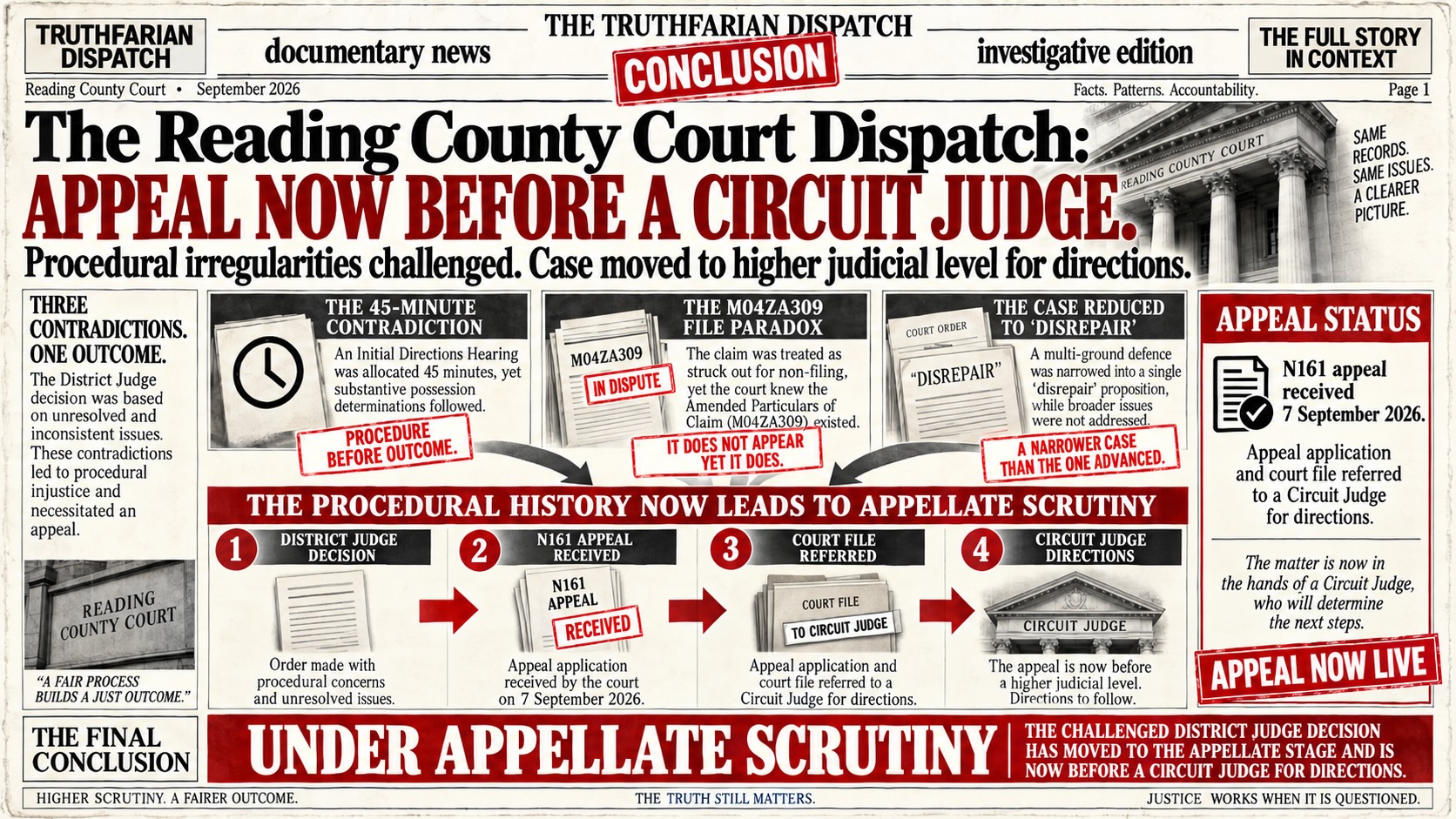
Conclusion — Appeal Now Before a Circuit Judge. Concluding synthesis of the disclosure showing that the procedural contradictions identified in the 1 September 2026 hearing including the 45-minute contradiction, the M04ZA309 filing paradox, and the narrowing of the wider case to “disrepair” have now resulted in appellate scrutiny, with the challenged District Judge decision progressing to Circuit Judge level following receipt of the N161 appeal and referral of the court file for directions.
This disclosure establishes a procedural failure arising from the conversion of a hearing formally listed for initial directions into a hearing producing substantive possession consequences, while the operative evidential record, Defence and Counterclaim, linked civil proceedings and filing disputes remained unresolved.
The significance lies not in one adverse ruling viewed in isolation, but in the sequence by which the ruling was reached. The March 2026 N244 had been recognised as a “very detailed application”, the 1 September 2026 hearing had been allocated 45 minutes for initial directions, and the August 2026 Case Management Clarification had expressly identified the need to reconcile the live applications, evidential bundles, Defence, Counterclaim and M04ZA309 before substantive determination. Yet substantive consequences followed before that reconciliation was completed.
The first contradiction is therefore one of hearing purpose. A directions hearing exists to organise, sequence and clarify what is to be determined. In this instance, the procedural stage itself became the vehicle for substantive disposal. That divergence is especially material because the Court recognised in substance that the volume of material could not properly be traversed within the time available. The difficulty was not merely that the bundle was large; it was that substantive determinations were made while the record needed to support those determinations remained incompletely reconciled.
The second contradiction concerns M04ZA309 and court-record continuity. The sealed order records that compliance with the earlier filing requirement “does not appear” to have occurred, while simultaneously recording that the Appellant asserted compliance, identifying the Amended Particulars of Claim, directing their reproduction and requiring a witness statement explaining when and how they had been filed. The filing dispute was therefore not resolved before procedural consequences were attached to it. Instead, the disputed filing history was pushed forward into a further restoration application.
The third contradiction concerns substantive narrowing. The case advanced by the Appellant was not confined to the proposition that ordinary disrepair defeated a Section 21 claim. The filed case extended across representation, advertising, EPC, gas and carbon-monoxide certification, electrical safety, EICR compliance, prescribed-document questions, repair-completion representations, consequential loss, the Defence and Counterclaim, and the linked M04ZA309 claim. Yet the sealed order records the position principally as “disrepair as a Defence to the possession claim”. The result is that a broader pleaded case was reduced to a narrower proposition and that narrower proposition was then rejected without the wider case being substantively determined on its merits.
These contradictions converge into one procedural architecture:
Directions were required, but substantive disposal followed.
Record reconciliation was required, but determination came first.
A filing dispute required resolution, but procedural consequences were attached before resolution.
A multi-ground case required determination, but the written order recorded a narrower case.
The consequence was asymmetrical progression. Possession and enforcement advanced, while the substantive Defence, Counterclaim, monetary claims, technical safety issues, certification disputes and linked civil proceedings remained unresolved or were pushed into further procedural applications.
The disclosure therefore concerns more than case-management error. It concerns whether the judicial process preserved the distinction between directions and determination, between record uncertainty and adjudicated fact, and between the case actually advanced and the narrower case recorded in the order.
That distinction is now preserved within the appellate architecture. On 7 September 2026, Reading County Court confirmed that the N161 appeal application had been received and that the appeal application and court file had been referred to a Circuit Judge for directions. The disputed hearing conversion, the M04ZA309 filing history, the unresolved Defence and Counterclaim, and the narrowing of the substantive case therefore now form part of the operative appellate record.
The central conclusion is accordingly one of procedural inversion.
The sequence should have been:
clarify the record → identify the live issues → determine the scope of the claims → give directions → hear the substantive case → determine the merits.
Instead, the disclosure records the reverse:
substantive consequences first → unresolved record questions afterward → further reconstruction and restoration applications later.
Until the operative court record, the status of the Defence and Counterclaim, the M04ZA309 filing position, the wider representation and certification case, and the technical safety evidence are substantively reconciled, the 1 September 2026 outcome cannot be treated as having resolved the full case actually placed before the Court.
Structural Impact Formula
The Structural Impact Score $SIS$ is defined as:
$SIS = \left( w_P + w_C + w_L + w_D + w_T + w_V + w_R + w_I \right)\left( 1 + \lambda \cdot 28 \right)$
Where:
- $P$ = Procedural Breakdown
- $C$ = Court Administrative Capture
- $L$ = Landlord / Safety Failure
- $D$ = Defence / Counterparty Interference
- $T$ = Tribunal / Welfare Disruption
- $V$ = Vulnerability Amplifier
- $R$ = Rights / Regulatory Misstatement
- $I$ = Institutional Interlock
The interaction multiplier $\left(1 + \lambda \cdot 28\right)$ reflects $\binom{8}{2} = 28$ distinct co-occurring structural interaction pairs generated by the eight concurrently active variables.
Structural Impact Result
Activated Structural Variables:
$P = 1,\; C = 1,\; L = 1,\; D = 1,\; T = 1,\; V = 1,\; R = 1,\; I = 1$
Interaction Pair Count: $\binom{8}{2} = 28$ distinct co-occurring structural interaction pairs.
Resolved Structural Impact Score:
$SIS = \left( w_P + w_C + w_L + w_D + w_T + w_V + w_R + w_I \right)\left( 1 + \lambda \cdot 28 \right)$
The disclosure records concurrent activation across hearing conversion, unresolved court-file and filing-status contradictions, unresolved landlord and property-safety evidence, counterparty positioning, welfare and participation consequences, vulnerability chronology, disputed statutory and regulatory compliance, and institutional interaction across the possession, civil, administrative, and appellate pathways.
Structural Impact Meaning
An $SIS$ produced by eight concurrently active structural variables with $\binom{8}{2} = 28$ interaction pairs indicates full-spectrum systemic procedural distortion rather than an isolated hearing-management error or housing dispute.
The co-activation of procedural breakdown $P$, court administrative capture $C$, landlord or safety failure $L$, defence or counterparty interference $D$, tribunal or welfare disruption $T$, vulnerability amplification $V$, rights and regulatory misstatement $R$, and institutional interlock $I$ demonstrates mutually reinforcing effects across hearing purpose, court administration, evidential treatment, housing safety, possession, welfare, vulnerability, regulatory compliance, and access to substantive adjudication.
The interaction multiplier $\left(1 + \lambda \cdot 28\right)$ represents non-linear escalation across the complete pairwise interaction field. The conversion of a listed directions hearing into substantive possession determination cannot therefore be structurally isolated from the unresolved Defence and Counterclaim, disputed filing history, safety evidence, vulnerability evidence, monetary claims, and wider procedural record.
The resulting state represents maximum interaction within the current eight-variable SIF architecture: all eight domains are simultaneously active, generating twenty-eight pairwise relationships and a compounded procedural state subsequently carried into the N161 appellate pathway and referral of the appeal application and court file to a Circuit Judge for directions.