
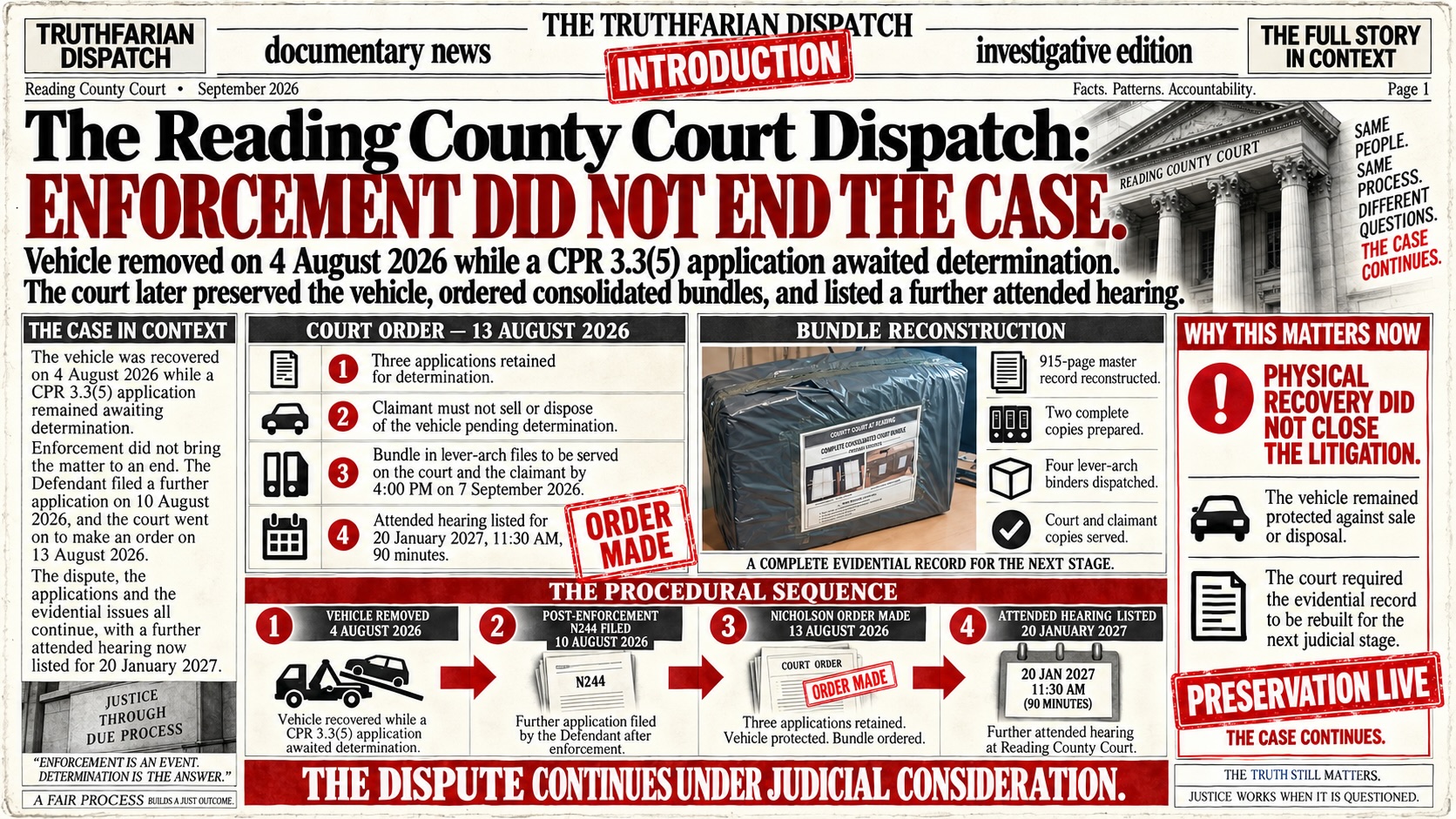
Post-enforcement procedural position following vehicle recovery. The figure shows that removal of the Mazda on 4 August 2026 did not conclude the litigation: the vehicle was subsequently protected against sale or disposal, the outstanding applications remained within the court’s determination framework, a 915-page consolidated evidential record was prepared and served, and a further 90-minute attended hearing was listed for 20 January 2027.
Post-Enforcement Judicial Preservation, Consolidated Bundle Direction and Continued Determination
Startline Motor Finance Limited, CarFinance247 Limited, Reading County Court and Claim Nos. M01RG980 and N01ZA273
Public Interest Disclosure
Author: Endarr Carlton Ramdin
Court: Reading County Court
Primary Claim: M01RG980
Associated Claim: N01ZA273
Order: District Judge Nicholson (SiR), 13 August 2026
Further Hearing: 20 January 2027 at 11:30 AM
Hearing Duration: 90 minutes
Bundle Deadline: 4:00 PM, 7 September 2026
Disclosure Date: 7 September 2026
Introduction
This disclosure continues the documented Startline Motor Finance Limited / CarFinance247 litigation chronology from the point reached in Procedural Failure, Unresolved Counterclaim and Enforcement Before Effective Determination.
That preceding disclosure examined the period ending on 4 August 2026, when the disputed Mazda CX-5 was removed while the Defendant’s renewed CPR 3.3(5) application remained awaiting determination. It recorded the unresolved Defence and Counterclaim, the separately issued N01ZA273 proceeding, the earlier N32 Judgment, the 29 June N244, District Judge Watt’s 15 July order, the renewed 24 July application, the requested stay and vehicle-preservation measures, and the practical loss of those pre-enforcement protections when recovery occurred before oral determination.
That disclosure itself formed the fourth stage of an existing Startline / CarFinance247 public record. Earlier disclosures had already examined the Defence structure and substantive breach chronology, DWF’s correspondence and hearing-characterisation chronology, and the contradiction between the case-management/directions history and the subsequent N32 delivery-of-goods judgment. The present disclosure does not repeat those earlier substantive allegations. They remain the evidential substrate upon which the new post-enforcement events operate. (Truthfarian)
The present disclosure concerns what happened after enforcement had already changed physical possession of the disputed vehicle.
On 10 August 2026, a further N244 application was filed addressing the consequences of the completed removal and seeking consequential procedural protection.
On 13 August 2026, District Judge Nicholson (SiR) made a further order without notice. That order materially changed the post-enforcement position.
It recorded that the Defendant’s applications dated 24 July 2026 and 10 August 2026 were to be heard and expressly noted that the Defendant also sought to set aside or vary District Judge Watt’s 15 July 2026 order striking out the earlier application dated 29 June 2026.
The Court further ordered:
“The Defendant must prepare a bundle (in a Lever Arch file) containing copies of the three applications and supporting evidence and a copy of the bundle must be sent to the court and to the Claimant by 4:00 PM on 7 September 2026.”
Most significantly, paragraph 3 imposed an express preservation restriction:
“The Claimant must not sell or dispose of the vehicle which is the subject of the Return of Goods order pending determination of the applications.”
The applications were subsequently listed for an in-person hearing on 20 January 2027 at 11:30 AM, with 90 minutes allowed.
The post-enforcement chronology therefore contains a new and materially different sequence:
Vehicle Removed → Further N244 Filed → Judicial Preservation Imposed → Application Records Consolidated → 915-Page Master Record Produced → Court and Claimant Copies Served → 90-Minute Attended Hearing Fixed
The central issue is no longer whether preservation was requested before enforcement. That has already been disclosed.
The new question is what the Court’s subsequent conduct demonstrates about the procedural state of the litigation after enforcement had already occurred.
The term “alleged breach” is used throughout in the same manner as the preceding disclosures. The analysis identifies apparent procedural and evidential failures arising from the documentary chronology. It does not represent that the substantive allegations have already been finally adjudicated by an appellate court or other competent tribunal.
Executive Summary
The documentary record identifies eight connected post-enforcement developments and alleged procedural breaches.
I. Judicial preservation was imposed only after the identified preservation risk had crystallised
Before removal, preservation of the Mazda had been expressly requested because its physical condition formed part of the live litigation.
After removal, District Judge Nicholson prohibited its sale or disposal.
The significance is not retrospective illegality. The significance is that the Court itself subsequently imposed protection against further irreversible disposition of the same disputed physical evidence.
II. The CPR 3.3(5) remedy remained alive but could no longer operate in its original pre-enforcement form
The 24 July application had sought preservation of the existing position.
Following removal, that position no longer existed.
The later hearing therefore became a mechanism for determining the legal and procedural consequences of an enforcement event which had already occurred rather than a mechanism capable of preventing that event.
III. Enforcement did not terminate judicial determination
The Nicholson order did not treat physical recovery as the end of the litigation.
It listed the 24 July and 10 August applications for attended determination, expressly recorded the continuing challenge concerning the 29 June application, required the three applications and supporting evidence to be assembled, and imposed continuing control over the vehicle.
Physical enforcement and final judicial determination therefore remained separate events.
IV. The Court required the three applications and supporting evidence to be assembled for determination
The 13 August order required a physical lever-arch bundle containing copies of the three applications and supporting evidence.
Compliance with that direction led the Defendant to reconstruct the interdependent applications, pleadings, statements, exhibits, orders and enforcement materials into a coherent working record.
V. Compliance produced a 915-page consolidated master record
The complete record was divided into Bundles A–D and continuously master-paginated from page 1 to page 915.
Two complete copies were produced: one for the Court and one for the Claimant.
The resulting filing comprised 1,830 printed pages across four lever-arch files.
VI. The reconstruction burden fell upon an unrepresented Defendant
The Defendant personally undertook the reconciliation, indexing, pagination, duplication, physical assembly, packaging and service required to make the fragmented procedural history usable for the later hearing.
The scale of that task is relevant to proportionality and effective participation.
VII. Evidential control remained asymmetrical after the preservation order
The Nicholson order prevented sale or disposal but did not restore physical possession to the Defendant.
Startline or its recovery chain retained control of the disputed vehicle while its physical condition remained relevant to the litigation.
The order therefore preserved the evidence against disposal without fully reversing the evidential-control shift caused by removal.
VIII. The proceedings remained materially unresolved after enforcement
The later order did not determine the merits of the Defence and Counterclaim, the disputed monetary architecture, the substantive consumer allegations, the relationship with N01ZA273 or the ultimate consequences of the three applications.
The post-enforcement stage therefore demonstrates continued litigation rather than procedural closure.
Breaches
Breach 1. Preservation Protection Became Judicially Operative Only After the Evidential Position Had Already Changed
The preceding disclosure established that preservation of the Mazda had been expressly requested before its removal. The vehicle was not merely property claimed under the N32. Its physical condition formed part of the pleaded dispute and was potentially capable of independent technical examination.
The requested protection therefore had an evidential purpose. Before removal, the objective was to keep the vehicle in a known location and condition while the Court determined the outstanding procedural and substantive issues.
That position changed on 4 August 2026 when recovery transferred possession and practical control away from the Defendant.
The subsequent Nicholson order is significant because it demonstrates that the preservation issue did not disappear when Startline recovered the vehicle. Instead, the Court imposed an express prohibition against the next irreversible stage: sale or disposal.
The preservation position before and after removal
The two positions are therefore materially different.
The later order did not restore the original position. It preserved what remained capable of preservation after enforcement had already changed control.
That produces the central temporal sequence:
Preservation Requested → No Effective Pre-Enforcement Protection → Vehicle Removed → Court Subsequently Prohibits Sale or Disposal
The alleged breach arises from that timing. A judicial preservation boundary ultimately existed, but only after the earlier evidential status quo had ceased to exist.
Evidence
29 June 2026 N244 and Proposed Draft Order — sought preservation, inspection and enforcement restraint before recovery.
District Judge Watt order dated 15 July 2026 — struck out the earlier application.
24 July 2026 CPR 3.3(5) N244 — renewed the request for a stay, preservation and oral determination.
4 August 2026 urgent court update — records completed removal while the renewed application remained awaiting determination.
10 August 2026 N244 — places the post-removal position and consequential relief before the Court.
District Judge Nicholson order dated 13 August 2026 — expressly prohibits the Claimant from selling or disposing of the vehicle pending determination.
Legal Frameworks Engaged
- Common-law procedural fairness.
- Common-law evidential-integrity principle.
- Common-law access-to-justice principle.
- Court’s inherent jurisdiction to protect the integrity of proceedings.
- CPR 1.1.
- CPR 1.2.
- CPR 1.4.
- CPR 3.1(2)(g).
- CPR 3.1(2)(p).
- CPR 3.3(5)–(7).
- CPR 25.1(1)(c)(i)–(ii).
- CPR 25.1(2).
- CPR 25.2.
- CPR 32.1.
- CPR 35.1.
- Consumer Credit Act 1974, sections 90–92.
- Human Rights Act 1998, section 6.
- Article 6 ECHR.
- Article 1 of Protocol No. 1 ECHR.
Procedural consequence: preservation existed first as requested relief and later as a court-imposed prohibition, but physical control had already changed before the judicial protection became operative.
Breach 2. Loss of the Original Practical Effect of the CPR 3.3(5) Remedy Despite Its Subsequent Judicial Continuation
District Judge Watt’s order expressly provided a mechanism under CPR 3.3(5) by which the Defendant could seek to have the own-initiative order set aside, varied or stayed.
The Defendant used that mechanism.
The 24 July 2026 application was not merely an abstract request for reconsideration. It sought an oral hearing and immediate protective relief capable of preserving the existing factual position while the Court considered whether District Judge Watt’s order should remain operative.
The practical relationship between the relief was straightforward:
Stay of N32 Enforcement + Vehicle Preservation + Oral Determination
The vehicle could only remain within the original preservation regime if enforcement itself did not overtake that regime.
Recovery on 4 August therefore changed the nature of the remedy before it had been determined.
Before removal
The application could potentially have preserved:
- possession;
- direct access;
- location;
- custody;
- condition;
- inspection opportunity;
- and the effectiveness of any later preservation order.
After removal
The later application necessarily concerned:
- the consequences of completed recovery;
- continued custody;
- location;
- preservation in another party’s control;
- inspection after transfer;
- restriction on sale or disposal;
- and any consequential relief considered appropriate.
District Judge Nicholson subsequently directed an attended hearing. The CPR 3.3(5) pathway therefore remained procedurally alive.
But its function had changed.
The later hearing could determine what should follow from the removal. It could no longer make the removal itself a future event.
The distinction is therefore between formal survival of the remedy and loss of part of its original practical utility.
The previous disclosure identified that risk prospectively and then documented its crystallisation on 4 August. The Nicholson order now confirms that the underlying application remained sufficiently live to require later judicial determination. (Truthfarian)
Chronology
| Date | Event | Effect |
| 15 July 2026 | Watt order | CPR 3.3(5) route expressly available |
| 24 July 2026 | N244 filed | Stay, variation/restoration and preservation sought |
| 4 August 2026 | Vehicle removed | Original status quo lost |
| 10 August 2026 | Further N244 | Post-enforcement consequences placed before Court |
| 13 August 2026 | Nicholson order | Non-disposal protection imposed; applications listed |
| 20 January 2027 | Attended hearing | Substantive procedural determination to follow |
Evidence
District Judge Watt order dated 15 July 2026.
N244 dated 24 July 2026.
Supporting Witness Statement dated 24 July 2026.
Proposed Draft Order dated 24 July 2026.
Signed urgent update dated 4 August 2026.
N244 dated 10 August 2026.
District Judge Nicholson order dated 13 August 2026.
Notice of Hearing fixing 20 January 2027.
Legal Frameworks Engaged
- Common-law access to justice.
- Common-law procedural fairness.
- Common-law effective-remedy principle.
- CPR 1.1.
- CPR 1.2.
- CPR 1.4.
- CPR 3.1(2)(g).
- CPR 3.1(7).
- CPR 3.3(5).
- CPR 3.3(7).
- CPR Part 23.
- CPR 25.1.
- CPR 25.2.
- CPR 40.8A.
- CPR 52.16.
- Human Rights Act 1998, section 6.
- Article 6 ECHR.
- ICCPR Article 2(3).
- ICCPR Article 14.
Procedural consequence: the reconsideration route survived in law, but the pre-enforcement function of the requested stay and preservation relief had already been partially overtaken.
Breach 3. Enforcement Took Effect While the Applications Remained Capable of Further Judicial Determination
The 4 August recovery produced an immediate physical consequence: the Defendant ceased to possess the Mazda.
It did not produce an equivalent determination of the remaining procedural controversy.
This distinction is demonstrated by the Court’s own subsequent actions.
District Judge Nicholson did not treat recovery as rendering the later applications academic. The 13 August order instead:
a. identified the applications dated 24 July and 10 August 2026 for hearing;
b. recorded that the Defendant also sought to challenge District Judge Watt’s 15 July treatment of the 29 June application;
c. prohibited sale or disposal of the vehicle; and
d. ordered production of a physical bundle containing the three application records and supporting evidence.
The applications were then allocated 90 minutes for an attended hearing.
The procedural sequence therefore differs materially from a conventional finality model.
Conventional finality model
Final Determination → Enforcement → Closure
Documented chronology
Enforcement → Further Judicial Preservation → Evidential Reconstruction → Attended Determination Still Required
The distinction matters because physical recovery cannot itself answer questions concerning the correctness of the earlier procedural handling, the appropriate treatment of the 29 June application, the CPR 3.3(5) challenge, the post-enforcement application or any consequential orders.
The same distinction applies to the wider pleaded litigation. Recovery of the goods under the N32 did not, by itself, amount to adjudication of every cause of action contained within the Defence and Counterclaim.
The later order therefore provides a significant evidential marker: enforcement had happened, but adjudicative work remained to be done.
Evidence
N32 Judgment.
N244 dated 29 June 2026.
District Judge Watt order dated 15 July 2026.
N244 dated 24 July 2026.
4 August 2026 removal evidence.
N244 dated 10 August 2026.
District Judge Nicholson order dated 13 August 2026.
Notice of Hearing for 20 January 2027.
Legal Frameworks Engaged
- Common-law natural justice.
- Common-law procedural fairness.
- Common-law access to justice.
- CPR 1.1.
- CPR 1.4.
- CPR 3.1.
- CPR 3.3.
- CPR Part 20.
- CPR Part 23.
- CPR Part 25.
- CPR 40.8A.
- Human Rights Act 1998, section 6.
- Article 6 ECHR.
- ICCPR Article 14.
Procedural consequence: enforcement achieved a physical outcome before the procedural questions capable of affecting that outcome had reached final attended determination.
Breach 4. Court-Directed Assembly and Reconstruction of the Three-Application Evidential Record
The 13 August 2026 order did more than list a further hearing. It imposed a specific documentary requirement upon the Defendant:
“The Defendant must prepare a bundle (in a Lever Arch file) containing copies of the three applications and supporting evidence…”
The distinction is important. The Court did not direct the Defendant to create a 915-page consolidated record or prescribe the later A–D architecture. What the Court required was a bundle containing the three applications and the evidence supporting them. The 915-page consolidated structure was the method by which the Defendant complied with that direction while preserving the chronology and documentary dependencies necessary to understand the applications properly.
The three applications could not realistically be treated as isolated N244 forms because each arose from, and depended upon, an earlier procedural stage. The 29 June 2026 application challenged the consequences of the N32 and sought substantive and interim relief including a stay, preservation, inspection and case-management directions. The 24 July 2026 application followed District Judge Watt’s 15 July own-initiative order striking out the earlier application and invoked CPR 3.3(5) to seek that order’s reconsideration together with renewed interim protection. The 10 August 2026 application was filed after the vehicle had been removed on 4 August and therefore addressed a materially changed factual position.
Accordingly, compliance with the Nicholson order required more than reproducing three application forms. The applications had to be accompanied by the supporting material necessary to demonstrate their procedural origin, the relief sought, the orders to which they related and the events occurring between them. The Defendant therefore reconstructed that material into a single navigable evidential record.
Reconstruction architecture
The consolidated record was organised as follows:
| Bundle | Content | Master Pages |
| A | Defence and Counterclaim Bundle | 1–272 |
| B | 29 June 2026 N244 / N32 Response Bundle | 273–480 |
| C | 24 July 2026 CPR 3.3(5) N244 Bundle | 481–686 |
| D | 10 August 2026 N244 / Proposed Amended Counterclaim Bundle | 687–915 |
The completed master record therefore contained 915 continuously paginated pages. This structure was not itself ordered by the Court; it was the Defendant’s method of satisfying the Court’s direction while making the three applications and their supporting evidence intelligible as one procedural sequence.
The architecture preserved both chronology and provenance. Material could be located by master page while still remaining identifiable by the procedural stage from which it originated. That was particularly important because the later applications depended upon the earlier ones. The 24 July application cannot properly be understood without the 15 July Watt order and the 29 June application to which that order related. Likewise, the 10 August application cannot properly be understood without the outstanding preservation history and the intervening removal of the vehicle on 4 August.
The resulting bundle was therefore more than a collection of accumulated documents. It became a reconstructed procedural record capable of showing how the original Defence and Counterclaim, the N32 response, the 29 June application, the CPR 3.3(5) challenge, the enforcement event and the subsequent 10 August application related to one another. The Nicholson order required the applications and supporting evidence to be placed before the Court; the consolidated A–D structure was the practical means by which that requirement was fulfilled.
Evidence
District Judge Nicholson order dated 13 August 2026.
Master Index.
Bundle A internal index.
Bundle B internal index.
Bundle C internal index.
Bundle D internal index.
N244 application dated 29 June 2026.
N244 application dated 24 July 2026 and supporting material.
N244 application dated 10 August 2026 and supporting material.
Relevant court orders, N32 and post-enforcement evidence.
Legal Frameworks Engaged
- Common-law procedural fairness.
- CPR 1.1 — Overriding Objective.
- CPR 1.2 — application of the Overriding Objective.
- CPR 1.4 — active case management.
- CPR 3.1 — general powers of case management.
- CPR 3.1A — case management where at least one party is unrepresented.
- CPR Part 20 — counterclaims and additional claims.
- CPR Part 23 — applications.
- CPR Part 32 — evidence.
- Human Rights Act 1998, section 6.
- Article 6 ECHR — fair hearing and effective participation.
Procedural consequence: the Court required the three applications and their supporting evidence to be assembled for attended determination. Compliance with that direction required the Defendant to reconstruct the interdependent procedural material into a coherent 915-page consolidated record capable of showing how each application arose from, and related to, the preceding stages of the litigation.
Breach 5. Evidential Reconstruction Burden, Proportionality and Effective Participation
The Nicholson order required the Defendant to prepare a lever-arch bundle containing the three applications and their supporting evidence and to provide a copy to both the Court and the Claimant. It did not prescribe a 915-page bundle, four physical files or the internal A–D structure subsequently adopted. Those features arose from the volume of material required to place the three interdependent applications and their supporting chronology before the Court in a coherent form.
One complete evidential set comprised 915 master pages. Two complete copies were prepared:
- Court Copy; and
- Claimant Copy.
The resulting physical production therefore amounted to:
915 pages × 2 complete sets = 1,830 printed pages
distributed across four lever-arch files.
The use of four files was a practical consequence of the volume and physical capacity of the completed record, rather than an express requirement imposed by the Nicholson order. The Defendant was nevertheless required personally to undertake the work necessary to convert the underlying material into the usable evidential record directed by the Court.
That exercise included:
identifying and reconciling the correct documents across the three application histories;
preserving the pagination and provenance of the earlier component bundles;
creating continuous master pagination across Bundles A–D;
constructing and checking the Master Index and internal indexes;
dividing each complete set into physically manageable Parts 1 and 2;
producing duplicate Court and Claimant copies;
labelling and assembling the four lever-arch files;
checking that the physical contents corresponded with the indexes and master pagination;
packaging the completed sets for delivery; and
arranging dispatch and retaining the associated service and delivery evidence.
The significance of this work is not that the existence of 915 pages, or the use of four lever-arch files, establishes procedural unfairness by itself. Nor does the volume alone establish that the Court’s direction was disproportionate. The relevant issue is the interaction between the scale of the evidential reconstruction, the Defendant’s status as a litigant in person, the existing vulnerability evidence, and the procedural history that made such reconstruction necessary before the applications could receive attended determination.
The Defendant was not compiling an independent archive unrelated to the proceedings. The reconstruction was undertaken in direct response to the Court’s requirement that the three applications and their supporting evidence be brought together for the later hearing. Because those applications arose at different procedural stages and depended upon earlier orders, pleadings, witness evidence and enforcement events, meaningful compliance required those dependencies to be made intelligible within a single working record.
The resulting 915-page master bundle therefore provides an objective measure of the complexity that had accumulated by the post-enforcement stage. It demonstrates the volume of documentary material considered necessary to place the outstanding application history before the Court in a form capable of effective use at the January hearing.
That scale is relevant to proportionality under the overriding objective, but the proportionality question is broader than page count or the value of the physical vehicle alone. It includes the importance and complexity of the issues, the procedural resources required to determine them fairly, the position of the parties, effective participation and the continuing need for judicial determination after physical enforcement had already taken place.
The procedural progression is therefore significant:
Three Interdependent Applications → Court-Directed Bundle → Reconstruction of Supporting Evidence → 915-Page Master Record → Two Complete Sets → Four Lever-Arch Files → Further 90-Minute Attended Hearing
The record shows that enforcement did not simplify or conclude the proceedings. It was followed by a substantial evidential reconstruction exercise necessary to enable the unresolved applications to proceed to the next judicial stage.
Evidence
District Judge Nicholson order dated 13 August 2026.
Master Index.
Bundles A–D and their internal indexes.
One 915-page consolidated master record.
Two complete evidential sets totalling 1,830 printed pages.
Four lever-arch files used to contain the two complete sets.
Photographic record of reconciliation, assembly and packaging.
Dispatch, service and delivery evidence.
Legal Frameworks Engaged
- CPR 1.1 — Overriding Objective: justice and proportionality.
- CPR 1.2 — application of the Overriding Objective.
- CPR 1.4 — active case management.
- CPR 1.6 — participation of vulnerable parties and witnesses.
- Practice Direction 1A — Participation of Vulnerable Parties or Witnesses.
- CPR 3.1 — general case-management powers.
- CPR 3.1A — case management where at least one party is unrepresented.
- CPR Part 23 — applications.
- CPR Part 32 — evidence.
- CPR Part 44 — costs and procedural conduct.
- CPR 46.5 — litigant-in-person costs, subject to an underlying costs entitlement.
- Common-law procedural fairness.
- Article 6 ECHR — fair hearing and equality of arms.
- Human Rights Act 1998, section 6.
- Convention on the Rights of Persons with Disabilities, Article 13 — effective access to justice.
Procedural consequence: compliance with the Nicholson order required the unrepresented Defendant to reconstruct the supporting material for three interdependent applications into a coherent 915-page master record, duplicate it for the Court and Claimant, and prepare the resulting four-file physical production before the applications had received attended determination. The scale of that task is relevant to proportionality and effective participation without, by itself, establishing that the Court’s bundle direction was disproportionate.
Breach 6. Continuing Evidential-Control Asymmetry After the Non-Disposal Order
The Nicholson order materially strengthened the preservation position by expressly prohibiting the Claimant from selling or disposing of the Mazda pending determination of the applications. That protection was significant because it prevented a further irreversible change to the status of the disputed vehicle after recovery had already transferred physical possession away from the Defendant.
The order did not, however, restore possession or direct immediate inspection. Following removal on 4 August 2026, practical control of the vehicle had passed from the Defendant into Startline’s recovery chain. The Defendant therefore no longer exercised direct control over its location, storage, movement or physical accessibility.
That distinction remains material because the Mazda is not merely the property subject to the Return of Goods order. Its physical condition also forms part of the pleaded dispute and is capable of having evidential significance to the Defence and Counterclaim. Preservation against sale or disposal therefore protects the continued existence of the vehicle, but it does not by itself resolve all questions concerning custody, access or inspection.
The evidential position changed as follows:
| Evidential factor | Before removal | After removal |
| Possession | Defendant | Startline / recovery chain |
| Direct access | Immediate | No longer controlled by Defendant |
| Location | Known directly to Defendant | Dependent upon information from the current custodian |
| Storage | Defendant-controlled | Outside Defendant’s control |
| Movement | Observable by Defendant | Outside Defendant’s direct observation |
| Sale / disposal | Prospective risk | Expressly prohibited by Court |
| Independent inspection | Directly achievable in principle | Dependent upon access, agreement or further direction |
The Nicholson order therefore addressed the most serious immediate preservation risk permanent disposal of the vehicle without itself determining the wider evidential arrangements surrounding the vehicle after recovery.
Those unresolved matters potentially include the vehicle’s current location and custodian, the conditions in which it is stored, any movements since recovery, its recorded mileage, photographs or condition reports created during collection or storage, and the arrangements through which independent examination could occur if required.
This does not amount to an allegation that the vehicle has been altered, repaired, damaged or otherwise interfered with since recovery. No such proposition is necessary to establish the evidential issue. The concern is prospective and procedural: once control of disputed physical evidence moves exclusively into the hands of one side or its agents, preservation, traceability and access become relevant to maintaining confidence in the condition of that evidence pending determination.
The distinction between preservation and access is therefore important. The Nicholson order ensured that the vehicle could not be sold or disposed of pending determination of the applications. It did not, by that provision alone, determine whether the Defendant was entitled to inspect the vehicle, require disclosure of custody records, or establish the procedure by which any future technical examination should take place.
The post-enforcement position can therefore be expressed as:
Possession Transferred → Evidential Control Shifted → Sale / Disposal Prohibited → Vehicle Preserved → Access and Inspection Remain Separate Questions
The order materially reduced the risk of the vehicle disappearing from the litigation altogether. It did not reverse the evidential-control asymmetry created by recovery.
Evidence
Particulars of Counterclaim — pleaded vehicle-condition allegations.
29 June 2026 Proposed Draft Order — preservation and inspection relief.
24 July 2026 N244 and Proposed Draft Order — renewed preservation and protective relief.
4 August 2026 recovery evidence — transfer of physical possession.
10 August 2026 N244 — post-enforcement position.
District Judge Nicholson order dated 13 August 2026 — express prohibition on sale or disposal pending determination.
Consolidated Bundles A–D — underlying procedural and evidential record.
Legal Frameworks Engaged
- Common-law procedural fairness.
- Court’s inherent jurisdiction to protect the integrity of proceedings.
- CPR 1.1 — Overriding Objective.
- CPR 1.4 — active case management.
- CPR 3.1 — general case-management powers.
- CPR 3.1(2)(p) — wider power to make orders furthering the overriding objective.
- CPR 25.1(1)(c)(i) — detention, custody or preservation of relevant property.
- CPR 25.1(1)(c)(ii) — inspection of relevant property.
- CPR 25.1(2) — meaning of relevant property.
- CPR 25.2 — timing of interim remedies, including after judgment.
- CPR 31.12 — specific disclosure or inspection of relevant documents, where applicable.
- CPR 32.1 — Court control of evidence.
- CPR 35.1 — expert evidence where reasonably required.
- Consumer Rights Act 2015, sections 9–11, 19, 23 and 24 — underlying vehicle-condition and consumer-remedy issues.
- Human Rights Act 1998, section 6.
- Article 6 ECHR — fair hearing and equality of arms.
- Article 1 of Protocol No. 1 ECHR — protection of possessions.
Evidential consequence: the Nicholson order protected the disputed vehicle against sale or disposal pending determination, but recovery had already transferred physical custody and direct access away from the Defendant. The vehicle was therefore preserved from permanent disposal while questions of custody, access, inspection and evidential control remained distinct matters capable of requiring further agreement or judicial direction.
Breach 7. Continued Absence of Final Merits Determination of the Defence and Counterclaim After Physical Enforcement
The preceding Startline disclosures had already established that the Defence and Counterclaim were not merely objections to repossession.
They constituted a formally pleaded additional claim concerning the same regulated transaction, vehicle condition, complaint chronology, enforcement conduct and alleged unfair relationship.
Startline had responded through a Reply and Defence to Counterclaim.
The procedural existence of the Counterclaim was therefore established before enforcement.
The N32 produced an operative vehicle-recovery outcome.
It did not record a substantive merits judgment disposing of the wider Counterclaim.
The Nicholson order did not do so either.
Its function was instead preservatory and procedural.
This produces a continuing two-track position:
| Enforcement track | Additional-claim track |
| N32 produced delivery-of-goods relief | Defence and Counterclaim remained pleaded |
| Vehicle removed 4 August | Wider liability questions remained unresolved |
| Physical possession transferred | Monetary case not finally assessed |
| Nicholson order preserved vehicle | Applications remained for hearing |
| Recovery achieved practical result | Substantive merits remained outstanding |
The distinction must be stated carefully.
The later procedural activity does not amount to judicial approval of the Counterclaim or its monetary methodology.
Equally, physical recovery does not amount to a merits dismissal of that Counterclaim.
The correct description is that the physical remedy progressed while the wider additional claim remained without equivalent final merits adjudication.
The same principle applies to N01ZA273. Earlier disclosures documented its separate issue, service and filing chain and DWF’s own procedural challenge concerning its relationship with M01RG980. No later material relied upon in this disclosure establishes that the Nicholson order finally determined the substantive merits of that separate proceeding. (Truthfarian)
Evidence
Defence and Counterclaim.
Particulars of Counterclaim.
Reply and Defence to Counterclaim.
N510 and N215 documentation concerning N01ZA273.
DWF application material concerning alleged overlap.
N32 Judgment.
29 June N244.
24 July N244.
10 August N244.
Nicholson order.
Notice of Hearing.
Legal Frameworks Engaged
- CPR 1.1.
- CPR 1.2.
- CPR 1.4.
- CPR 3.1(2)(f), (g), (h), (i), (j), (k) and (p).
- CPR Part 15.
- CPR Part 16.
- CPR Part 20.
- CPR Part 23.
- Consumer Credit Act 1974, sections 90–92.
- Consumer Credit Act 1974, sections 140A–140B.
- Consumer Rights Act 2015, sections 9–11, 19, 23 and 24.
- Human Rights Act 1998, section 6.
- Article 6 ECHR.
- ICCPR Article 14.
Procedural consequence: physical recovery became effective while the wider substantive claims arising from the same transaction remained distinct from that enforcement outcome.
Breach 8. Failure of Enforcement to Produce Procedural Closure and the Resulting Proportionality Escalation
The complete post-enforcement record demonstrates that 4 August did not represent the end of the case.
Instead, the enforcement event generated another procedural layer.
The sequence after removal was:
a further application was filed;
the Court imposed a non-disposal order;
an attended hearing was required;
the three applications and supporting evidence had to be assembled for determination;
a 915-page master evidential record was created;
two complete physical copies were produced;
four lever-arch files were required;
further service and compliance evidence was generated; and
a 90-minute hearing was fixed for January 2027.
That sequence materially changes how the litigation can be characterised.
It is no longer accurate to describe the procedural architecture simply as a finance company recovering a motor vehicle following an N32.
The post-enforcement record now contains:
Recovery + Preservation + Three Applications + 915 Pages of Consolidated Evidence + Continued Hearing
The bundle volume is not itself a legal breach and does not create damages merely through page count.
Its significance is evidential and proportional.
It demonstrates objectively the amount of procedural material now required to reconstruct the issues still awaiting judicial determination.
The same record must also be considered by the represented opposing parties if they are to respond properly at the January hearing.
That creates a substantial continuing cost environment on both sides which is structurally disproportionate to the simple physical-asset description of the original dispute.
The litigation has therefore become self-amplifying:
Underlying Dispute → Procedural Challenge → Enforcement → Further Application → Preservation → Evidential Reconstruction → Further Hearing → Further Cost
This is not an assertion that any specific amount of opposing-party legal expenditure has been judicially established.
It is a documentary observation that the procedural architecture now requires substantial additional professional and judicial resources after the physical enforcement remedy has already been exercised.
Evidence
Nicholson order dated 13 August 2026.
Notice of Hearing for 20 January 2027.
Master Index.
Bundles A–D.
915-page master pagination.
two complete sets / 1,830 printed pages.
four lever-arch files.
photographic bundle-production record.
service and dispatch evidence.
Legal Frameworks Engaged
- CPR 1.1.
- CPR 1.4.
- CPR 3.1.
- CPR 3.1A.
- CPR Part 20.
- CPR Part 23.
- CPR Part 32.
- CPR Part 44.
- CPR 46.5.
- Common-law procedural fairness.
- Common-law access to justice.
- Article 6 ECHR.
Procedural consequence: enforcement did not reduce the proceedings to closure; it generated an additional preservation, reconstruction and hearing stage carrying its own evidential and cost consequences.
Overall Evidential Finding
The eight post-enforcement breaches are not independent administrative events.
They represent the continuation of the procedural sequence disclosed before 4 August.
Before removal, the Defendant sought protection capable of preserving the vehicle, the evidential position and the practical effectiveness of the outstanding applications.
Removal occurred before that protection operated.
What happened afterwards is now equally important.
The Court subsequently:
- prohibited sale or disposal of the vehicle;
- listed the 24 July and 10 August applications for attended determination and expressly recorded the continuing challenge concerning the 29 June application;
- required the three application records and supporting evidence to be assembled;
- and fixed a 90-minute hearing.
The Defendant then reconstructed the procedural record into a 915-page consolidated master bundle, duplicated into two complete sets totalling 1,830 printed pages across four lever-arch files.
The central chronology is therefore:
Requested Preservation → Enforcement → Changed Evidential Control → Post-Enforcement Application → Judicial Preservation → Evidential Reconstruction → Continued Determination
This is not procedural closure.
It is procedural continuation after enforcement.
Legal Frameworks Engaged
FOUNDATIONAL CONSTITUTIONAL PRINCIPLES
I. Magna Carta 1297 — Chapter 29
Citation: Magna Carta 1297, Chapter 29.
Verbatim:
“We will sell to no man, we will not deny or defer to any man either Justice or Right.”
Analysis: Chapter 29 remains in force and provides the historic constitutional foundation for due legal process and access to justice, although its direct modern operation is supplemented by later statutes, the Civil Procedure Rules and Convention rights. (House of Commons Library)
Its relevance here is foundational rather than a standalone cause of action. The Defendant had invoked procedures seeking a stay, preservation and reconsideration before enforcement; the vehicle was removed before those protections received effective determination, after which the Court imposed a prohibition on sale or disposal and listed the applications for attended determination. The chronology therefore engages the enduring constitutional concern with justice being available in a form capable of practical operation, rather than existing only after the event requiring protection has occurred.
COMMON-LAW PRINCIPLES
II. Natural Justice — Right to Be Heard
Citation: Ridge v Baldwin [1963] UKHL 2; [1964] AC 40.
Verbatim:
“a fair opportunity of being heard in his own defence.”
Analysis: Ridge v Baldwin is a foundational authority for the requirement that a person affected by a decision be afforded a fair opportunity to be heard. (BAILII)
The present disclosure does not contend that the Defendant was entitled automatically to obtain the relief sought. The material issue is that the 24 July 2026 application invoked the express CPR 3.3(5) reconsideration mechanism, requested oral determination and sought immediate protection before enforcement. Recovery occurred before that oral determination; the Nicholson order subsequently placed the unresolved application issues into an attended-hearing framework. The right-to-be-heard principle is therefore engaged by the timing and practical effectiveness of that opportunity.
III. Common-Law Procedural Fairness
Citation: R v Secretary of State for the Home Department, ex parte Doody [1993] UKHL 8; [1994] 1 AC 531.
Verbatim:
“What fairness demands is dependent on the context of the decision”.
Analysis: Doody establishes that procedural fairness is contextual rather than mechanically identical in every case. (BAILII)
Here, the context included relief whose usefulness was inherently time-sensitive. A stay sought before recovery serves a materially different function from relief considered after recovery; preservation while the vehicle remains in the Defendant’s possession is materially different from preservation after custody has transferred. The 13 August order could protect against subsequent sale or disposal, but it could not recreate the precise pre-removal position. That temporal distinction is therefore part of the fairness analysis rather than a merely administrative delay.
IV. Constitutional Right of Access to Justice
Citation: R (UNISON) v Lord Chancellor [2017] UKSC 51, [66].
Verbatim:
“The constitutional right of access to the courts is inherent in the rule of law.”
Analysis: The Supreme Court identifies access to the courts as a constitutional right rather than simply access to an administrative service. (Supreme Court)
The present chronology distinguishes between access to a procedural mechanism and its ability to operate effectively in time. The Defendant was able to lodge the 24 July application, but the enforcement event occurred while the requested stay and preservation protection remained awaiting determination. The subsequent Nicholson order confirms that judicial determination remained available; the issue exposed by the chronology is that part of the original preventive purpose of that process had already been overtaken.
CIVIL PROCEDURE RULES
V. CPR 1.1 — Overriding Objective
Citation: Civil Procedure Rules 1998, CPR 1.1.
Verbatim:
“deal with cases justly and at proportionate cost”.
Analysis: CPR 1.1 expressly requires justice and proportionality and additionally addresses equal footing, full participation, expense, complexity, expedition and fairness. (GOV.UK Justice)
Those considerations are directly engaged by the post-enforcement record. After recovery, the Court required the application evidence to be assembled for further determination. Compliance ultimately produced a 915-page consolidated master record, duplicated into two complete sets comprising 1,830 printed pages across four lever-arch files. The significance is not that page count itself constitutes a breach, but that it objectively records the scale, complexity and resource burden to which the proceedings had developed while substantive application issues remained unresolved.
VI. CPR 1.2 — Application of the Overriding Objective
Citation: CPR 1.2.
Verbatim:
“seek to give effect to the overriding objective”.
Analysis: CPR 1.2 requires the Court to give effect to the overriding objective when exercising powers under the Rules and when interpreting them. (GOV.UK Justice)
That obligation is engaged across the sequence of reconsideration, stay, preservation, case management and evidential directions. The Nicholson order itself represents a later exercise of those powers: the vehicle was protected against sale or disposal, the applications were brought into an attended-hearing framework, and supporting evidence was required to be assembled for determination.
VII. CPR 1.4 — Active Case Management
Citation: CPR 1.4.
Verbatim:
“actively managing cases.”
Analysis: CPR 1.4 requires active case management, which includes identifying issues, determining their sequence, controlling progress, considering cost-benefit proportionality and dealing with multiple aspects together where appropriate. (GOV.UK Justice)
The Nicholson order is directly relevant. After enforcement, the Court did not treat the dispute as exhausted. It imposed continuing control over the vehicle, directed the preparation of the evidence necessary to determine the applications and fixed a further attended hearing. The later order therefore demonstrates continuing case-management necessity after the physical recovery remedy had already been executed.
VIII. CPR 1.6 and Practice Direction 1A — Participation of Vulnerable Parties
Citation: CPR 1.6; Practice Direction 1A, paragraphs 2–6.
Verbatim:
“Vulnerability of a party or witness may impede participation and also diminish the quality of evidence.”
Analysis: Practice Direction 1A requires vulnerability to be considered where personal or situational factors may adversely affect participation or the giving of evidence, and requires proportionate measures where necessary. Physical disability, impairment or health condition is expressly included among the potentially relevant factors. (GOV.UK Justice)
The Defendant’s vulnerability and litigant-in-person status had already formed part of the procedural record before the post-enforcement stage. The later requirement to reconcile, paginate, duplicate, physically assemble and serve a 915-page record materially increased the participation burden. The framework does not predetermine what adjustment should have been made; it requires vulnerability and effective participation to remain relevant considerations within the management of that burden.
IX. CPR 3.1 — General Powers of Case Management
Citation: CPR 3.1(2)(f)–(k), CPR 3.1(2)(p) and CPR 3.1(7).
Verbatim:
“stay … proceedings or judgment”.
Analysis: CPR 3.1 gives the Court extensive powers to manage connected proceedings and issues. Those powers include separate treatment of a counterclaim, staying proceedings or judgment, consolidation, trying claims together, directing separate trials, determining the order of issues and making other orders required to further the overriding objective. CPR 3.1(7) additionally confirms the Court’s power to vary or revoke an order. (GOV.UK Justice)
Those powers map directly onto the procedural questions repeatedly raised by the Defendant: the status of the Counterclaim, the relationship between connected proceedings, the requested stay, preservation and sequencing of substantive and enforcement issues. The Nicholson order demonstrates the continuing availability of case-management intervention after recovery rather than treating enforcement as procedural closure.
X. CPR 3.1A — Unrepresented Parties
Citation: CPR 3.1A(2).
Verbatim:
“at least one party is unrepresented.”
Analysis: CPR 3.1A requires the Court, when exercising case-management powers, to have regard to the fact that at least one party is unrepresented. It also requires the procedure adopted at a hearing to further the overriding objective. (GOV.UK Justice)
That framework is directly relevant to the Court-directed reconstruction exercise. The Defendant personally produced the record required for continued determination while the corporate Claimant remained professionally represented. The rule does not remove an unrepresented party’s obligation to comply with directions, but it makes that status an express case-management consideration.
XI. CPR 3.3(5) — Application to Set Aside, Vary or Stay an Own-Initiative Order
Citation: CPR 3.3(5)(a).
Verbatim:
“set aside, varied or stayed”.
Analysis: CPR 3.3(5) expressly permits a party affected by an own-initiative order made without prior representations to apply to have that order set aside, varied or stayed. (GOV.UK Justice)
That is the procedural mechanism invoked by the Defendant on 24 July 2026 following District Judge Watt’s 15 July order. The significance to this disclosure is therefore precise: the application was made through a procedure expressly contemplated by the Rules and sought interim protection before recovery. The vehicle was removed while that application remained awaiting determination; the later Nicholson order then placed the relevant issues into a further hearing framework.
XII. CPR 3.3(7) — Oral Hearing of the CPR 3.3(5) Application
Citation: CPR 3.3(7).
Verbatim:
“considered at an oral hearing”.
Analysis: CPR 3.3(7) provides that an application under CPR 3.3(5)(a) is to be considered at an oral hearing unless the Court decides and records that it is totally without merit. (GOV.UK Justice)
The later listing of an attended hearing therefore has particular significance. It confirms that oral judicial consideration remained part of the procedural pathway after enforcement. The issue identified by this disclosure is that the vehicle had already been removed before that oral determination could address the stay and preservation relief in its original preventive form.
XIII. CPR Part 15 — Defence to Counterclaim
Citation: CPR 15.8.
Verbatim:
“the reply should form one document with any defence to counterclaim”.
Analysis: Part 15 expressly recognises a defence to counterclaim as part of the statements-of-case architecture. (GOV.UK Justice)
Startline had already served a Reply and Defence to Counterclaim. The Counterclaim was therefore not merely correspondence or an objection to possession: it was a formally pleaded additional claim to which a formal responsive pleading existed. That matters to the post-enforcement chronology because physical recovery did not, by itself, constitute a merits judgment disposing of that pleaded additional claim. The preceding disclosure records the same procedural distinction.
XIV. CPR Part 16 — Content of Defence
Citation: CPR 16.5.
Verbatim:
“the defendant must deal with every allegation in the particulars of claim”.
Analysis: CPR 16.5 regulates how a defence responds to pleaded allegations, including admissions, denials and matters requiring proof. (GOV.UK Justice)
Its relevance is evidential and procedural. Once substantive allegations have been pleaded and answered, they form issues requiring appropriate disposal or case management. The existence of an operative recovery order does not automatically convert every separately pleaded and defended issue into a determined issue.
XV. CPR Part 20 — Counterclaims and Additional Claims
Citation: CPR 20.1 and CPR 20.3(1).
Verbatim:
“managed in the most convenient and effective manner”.
“treated as if it were a claim”.
Analysis: CPR Part 20 gives a counterclaim an identifiable procedural status and requires additional claims to be managed effectively. (GOV.UK Justice)
This is central to the distinction between Startline’s recovery route and the Defendant’s wider Counterclaim. The N32 produced a practical outcome concerning delivery of the vehicle. It did not automatically operate as a merits disposition of every cause of action contained within the additional claim. The Nicholson order likewise did not adjudicate those wider merits; it dealt with preservation, evidence and the applications awaiting determination.
XVI. CPR 23.6 — Content of an Application Notice
Citation: CPR 23.6.
Verbatim:
“what order the applicant is seeking”.
Analysis: CPR 23.6 requires an application notice to identify the order sought and briefly explain why it is sought. (GOV.UK Justice)
The three applications must therefore be understood by reference to their actual relief rather than treated as interchangeable documents. The 29 June application included substantive, interim, preservatory and case-management relief; the 24 July application invoked reconsideration and renewed protection; and the 10 August application addressed the position after removal. Nicholson’s direction requiring the three applications and supporting evidence to be placed into a common bundle reflects that connected but distinct procedural architecture.
INTERIM REMEDIES, PRESERVATION AND EVIDENCE
XVII. CPR 25.1(1)(c)(i) — Preservation of Relevant Property
Citation: CPR 25.1(1)(c)(i).
Verbatim:
“detention, custody or preservation of relevant property”.
Analysis: This is the principal CPR provision supporting the preservation analysis. (GOV.UK Justice)
The Mazda was both the subject of the Return of Goods proceedings and physical evidence relevant to disputed vehicle-condition allegations. The earlier applications sought preservation before recovery; the Nicholson order subsequently prohibited sale or disposal after recovery. The rule therefore maps directly onto the continuing need to preserve the physical subject matter while related questions remained awaiting judicial determination.
XVIII. CPR 25.1(1)(c)(ii) — Inspection of Relevant Property
Citation: CPR 25.1(1)(c)(ii).
Verbatim:
“inspection of relevant property”.
Analysis: CPR 25 expressly recognises inspection of relevant property as an interim remedy. (GOV.UK Justice)
Before 4 August, the Defendant retained direct access to the Mazda. After recovery, physical access and any independent examination depended upon the vehicle’s custodian, agreement between the parties or further Court direction. The later non-disposal order preserved the vehicle from one form of irreversible loss but did not itself resolve access or inspection.
XIX. CPR 25.1(2) — Meaning of Relevant Property
Citation: CPR 25.1(2).
Verbatim:
“subject of a claim”.
Analysis: For CPR 25 purposes, relevant property includes property which is the subject of a claim or about which a question may arise on a claim. (GOV.UK Justice)
The Mazda meets that relationship on the disclosed record: Startline sought delivery of it and the Defendant’s pleaded case placed aspects of its physical condition in issue. Preservation and inspection were therefore directed toward the central physical subject matter of the proceedings, rather than collateral property.
XX. CPR 25.2 — Timing of Interim Remedies
Citation: CPR 25.2(1).
Verbatim:
“after judgment has been given”.
Analysis: CPR 25.2 expressly permits an interim remedy to be ordered after judgment, subject to contrary rules, practice directions or enactments. (GOV.UK Justice)
This is particularly important to the 13 August order. The existence of the N32 and the completion of physical recovery did not necessarily exhaust the Court’s ability to protect relevant property afterwards. Nicholson subsequently prohibited sale or disposal pending determination of the applications. The post-enforcement preservation order is therefore consistent with the Rules expressly contemplating interim protection after judgment.
XXI. CPR 25.3 — Supporting Evidence for Interim Relief
Citation: CPR 25.3(1).
Verbatim:
“must be supported by evidence”.
Analysis: An application for an interim remedy ordinarily requires evidential support unless the Court directs otherwise. (GOV.UK Justice)
The 24 July application was supported by a witness statement, draft order and the preceding procedural material, and the later Nicholson order specifically required the three applications together with their supporting evidence to be assembled for the attended determination. The rule therefore reinforces why the supporting material was substantive to the applications rather than merely administrative attachment material.
XXII. CPR 31.12 — Specific Disclosure or Inspection of Documents
Citation: CPR 31.12.
Verbatim:
“specific disclosure or specific inspection”.
Analysis: CPR 31.12 concerns documents, not physical inspection of the Mazda. Where Part 31 applies, the Court may order specific disclosure or inspection of documents falling within the rule. (GOV.UK Justice)
Its potential relevance after recovery concerns documentary material such as recovery records, custody information, condition photographs, storage records, movement records, repair instructions or other documents material to the applications or Counterclaim. Physical inspection of the vehicle itself is governed more directly by CPR 25.1(1)(c)(ii).
XXIII. CPR 32.1 — Court Control of Evidence
Citation: CPR 32.1(1).
Verbatim:
“control the evidence by giving directions”.
Analysis: CPR 32.1 permits the Court to control the issues on which evidence is required, the nature of that evidence and how it is placed before the Court. (GOV.UK Justice)
The Nicholson bundle direction falls squarely within the wider evidential-management context. The Court required the three application records and supporting evidence to be assembled into a usable hearing record. That direction ultimately resulted in the consolidated 915-page bundle architecture now documented in the disclosure.
XXIV. CPR 35.1 — Expert Evidence
Citation: CPR 35.1.
Verbatim:
“reasonably required to resolve the proceedings.”
Analysis: CPR 35.1 restricts expert evidence to that which is reasonably required. No expert evidence has been ordered merely because the vehicle was preserved. (GOV.UK Justice)
The provision is nevertheless relevant because the pleaded dispute includes physical-condition issues potentially capable of technical examination. Preservation of the Mazda protects the possibility of meaningful expert inspection if the Court later concludes that expert evidence is reasonably required.
JUDGMENTS, STAYS AND APPEAL
XXV. CPR 40.8A — Stay of Execution and Other Post-Judgment Relief
Citation: CPR 40.8A.
Verbatim:
“on the ground of matters which have occurred since the date of the judgment or order”.
Analysis: CPR 40.8A is narrower than a general free-standing power to suspend any judgment for any reason. It permits a party against whom judgment or an order has been made to seek a stay of execution or other relief on the basis of matters occurring since that judgment or order. (GOV.UK Justice)
That distinction is important here. The Defendant’s application history included later procedural events and, ultimately, the completed 4 August recovery itself. The Nicholson order then imposed prospective non-disposal protection. CPR 40.8A therefore belongs within the post-judgment framework, but it should not be described as though it independently determines whether the original N32 should have been made.
XXVI. CPR 52.16 — Appeal Does Not Automatically Stay Enforcement
Citation: CPR 52.16.
Verbatim:
“an appeal shall not operate as a stay of any order or decision of the lower court.”
Analysis: CPR 52.16 explains why directing a substantive challenge toward appeal did not itself preserve the vehicle. Unless the lower court or appeal court orders otherwise, the appeal route leaves the underlying order operative. (GOV.UK Justice)
That rule is central to the earlier procedural sequence. Once District Judge Watt directed the substantive N32 challenge toward appeal, separate stay relief remained practically important if enforcement was to be restrained pending that challenge. The 24 July application sought that protection; recovery occurred before it received effective determination.
COSTS AND LITIGANT-IN-PERSON WORK
XXVII. CPR 44.2 — Court’s Discretion as to Costs
Citation: CPR 44.2.
Verbatim:
“The court has discretion as to”.
Analysis: CPR 44.2 gives the Court discretion over whether costs are payable, their amount and when they are payable. In exercising that discretion, the Court may consider the circumstances and conduct of the proceedings. (GOV.UK Justice)
The 915-page reconstruction, duplicate physical production, further applications and January hearing therefore form part of the procedural history potentially relevant to a later costs decision. They do not, by themselves, establish that any party is presently entitled to recover a particular sum.
XXVIII. CPR 46.5 — Litigant-in-Person Costs
Citation: CPR 46.5.
Verbatim:
“costs of a litigant in person are to be paid by any other person.”
Analysis: CPR 46.5 applies where the Court has first made an order that another person is to pay the costs of a litigant in person. It then regulates the categories and amount of qualifying recoverable costs. (GOV.UK Justice)
The Defendant personally undertook extensive document reconciliation, pagination, indexing, duplication, physical assembly and service work in response to the Nicholson direction. That work is relevant to CPR 46.5 only if an underlying entitlement to costs is subsequently established; the Rule does not itself create that entitlement.
CONSUMER CREDIT ACT 1974
XXIX. Consumer Credit Act 1974 — Section 90: Protected Goods
Citation: Consumer Credit Act 1974, s.90(1).
Verbatim:
“except on an order of the court.”
Analysis: Section 90 applies where the statutory conditions are satisfied, including the debtor having paid one-third or more of the total price and property in the goods remaining with the creditor. In those circumstances the creditor is not entitled to recover possession from the debtor except pursuant to a court order. Goods falling within the section are defined as protected goods.
The existence of the N32 is therefore legally important: Startline did possess a court order through which recovery was pursued. The present disclosure should not state that section 90 was automatically breached simply because a later application was outstanding. Its relevance is that the N32 was the statutory gateway upon which recovery depended, making the requested stay and the subsequent procedural challenges materially consequential. The Counterclaim records the protected-goods issue as part of the pleaded case.
XXX. Consumer Credit Act 1974 — Section 91: Consequences of Contravention of Section 90
Citation: Consumer Credit Act 1974, s.91.
Verbatim:
“recovered by the creditor in contravention of section 90”.
Analysis: Section 91 prescribes significant consequences where goods are recovered in contravention of section 90, including termination of the regulated agreement where not already terminated, release of the debtor from liability and recovery of sums paid. (Legislation.gov.uk)
Its relevance must therefore remain conditional. The present disclosure does not establish that the 4 August recovery contravened section 90 merely because the N244 remained outstanding; an operative N32 existed. Section 91 matters because it demonstrates why the legal validity and procedural treatment of recovery of protected goods can have substantive consequences if a section 90 contravention is ultimately established.
XXXI. Consumer Credit Act 1974 — Section 92: Entry to Premises
Citation: Consumer Credit Act 1974, s.92(1).
Verbatim:
“Except under an order of the court”.
Analysis: Section 92 restricts entry to premises for the purpose of taking possession of goods subject to the regulated agreements identified in the provision. Subsection (3) expressly makes entry contrary to the statutory restriction actionable as a breach of statutory duty.
The provision was directly relevant to the N32’s premises-entry consequences and to the earlier applications seeking protection against enforcement and entry. In the present post-enforcement disclosure its role is contextual: it demonstrates that residential entry associated with recovery of regulated goods is itself subject to statutory control, rather than being an incidental collection activity.
XXXII. Consumer Credit Act 1974 — Section 140A: Unfair Relationships
Citation: Consumer Credit Act 1974, s.140A(1)(b) and s.140A(4).
Verbatim:
“the way in which the creditor has exercised or enforced any of his rights”.
Analysis: Section 140A permits the Court, where the statutory test is met, to consider whether the creditor-debtor relationship is unfair because of the agreement’s terms, the way the creditor exercised or enforced its rights, or other acts or omissions by or on behalf of the creditor. Importantly, the jurisdiction can apply notwithstanding that the underlying relationship may have ended. (Legislation.gov.uk)
That is directly relevant to the distinction between vehicle recovery and the unresolved Counterclaim. Recovery of the Mazda did not necessarily exhaust an unfair-relationship allegation concerning the wider course of conduct. The existing Counterclaim expressly pleads section 140A as part of the substantive case.
XXXIII. Consumer Credit Act 1974 — Section 140B: Remedial Powers
Citation: Consumer Credit Act 1974, s.140B(1).
Verbatim:
“to do or not to do … anything specified in the order”.
Analysis: Section 140B gives the Court a broad range of remedies where an unfair relationship under section 140A has been established, including repayment, directions concerning conduct, reduction or discharge of sums and alteration of the agreement. (Legislation.gov.uk)
That remedial jurisdiction reinforces why the wider Counterclaim cannot be equated with the possession question alone. The Nicholson order did not determine whether an unfair relationship existed or whether section 140B relief should be granted. Those substantive questions remain analytically separate from the fact that recovery occurred.
CONSUMER RIGHTS ACT 2015
XXXIV. Consumer Rights Act 2015 — Section 9: Satisfactory Quality
Citation: Consumer Rights Act 2015, s.9(1).
Verbatim:
“the quality of the goods is satisfactory.”
Analysis: Section 9 implies a term that supplied goods must be of satisfactory quality. The statutory conception of quality includes condition, fitness for normal purposes, appearance and finish, freedom from minor defects, safety and durability. (Legislation.gov.uk)
The Counterclaim pleads defects in the Mazda and relies upon its condition as part of the substantive case. Section 9 therefore contributes directly to the evidential significance of preservation. The Nicholson non-disposal order does not decide whether the vehicle breached section 9; it preserves the physical subject matter while that underlying controversy remains unresolved.
XXXV. Consumer Rights Act 2015 — Section 10: Fitness for Particular Purpose
Citation: Consumer Rights Act 2015, s.10(3).
Verbatim:
“the goods are reasonably fit for that purpose”.
Analysis: Section 10 applies where the statutory conditions concerning a purpose made known to the trader or, in the circumstances specified by the section, a credit-broker are satisfied.
The pleaded vehicle-condition case includes allegations concerning reliability and use of the Mazda. Section 10 is therefore part of the underlying substantive dispute. As with section 9, the post-enforcement relevance is evidential: preservation protects the possibility of assessing physical condition if fitness remains an issue requiring determination.
XXXVI. Consumer Rights Act 2015 — Section 11: Goods to Be as Described
Citation: Consumer Rights Act 2015, s.11(1).
Verbatim:
“the goods will match the description.”
Analysis: Section 11 requires goods supplied by description to correspond with that description. (Remedy Legal)
The Counterclaim pleads discrepancies between the vehicle represented or supplied and its alleged condition. Section 11 therefore remains part of the underlying merits. The Nicholson order does not determine those allegations; its relevance lies in protecting the vehicle from disposal while questions concerning its condition remain capable of adjudication.
XXXVII. Consumer Rights Act 2015 — Section 19: Remedies for Non-Conforming Goods
Citation: Consumer Rights Act 2015, s.19(3).
Verbatim:
“the right to repair or replacement”.
Analysis: Section 19 connects breaches of the statutory terms in sections 9–11 and related provisions with the remedies provided by the Act, including rejection, repair or replacement, and price reduction or final rejection where the statutory conditions are satisfied. (Scottish Courts and Tribunals Service)
That architecture is important because an enforcement outcome concerning possession does not itself answer whether the underlying goods conformed to the contract or what consumer remedies were available. The Counterclaim’s consumer-rights case therefore remains conceptually separate from the Return of Goods remedy.
XXXVIII. Consumer Rights Act 2015 — Section 23: Repair or Replacement
Citation: Consumer Rights Act 2015, s.23(2).
Verbatim:
“within a reasonable time and without significant inconvenience to the consumer”.
Analysis: Where the statutory right to repair or replacement is available and invoked, section 23 regulates performance of that remedy. (Legislation.gov.uk)
The earlier complaint and diagnostic chronology relied upon by the Counterclaim includes alleged efforts to obtain investigation and remediation of vehicle defects. The section remains relevant to the substantive case but is not itself determined by the later Nicholson preservation order.
XXXIX. Consumer Rights Act 2015 — Section 24: Price Reduction or Final Right to Reject
Citation: Consumer Rights Act 2015, s.24.
Verbatim:
“The right to a price reduction is the right”.
Analysis: Section 24 provides the price-reduction and final-rejection remedies in the circumstances prescribed by the Act. (Better Regulation)
Its relevance is again to the unresolved substantive consumer case. Recovery of the vehicle under the N32 did not itself amount to a reasoned determination of whether the statutory conditions for section 24 relief were met. The post-enforcement chronology must therefore distinguish the executed possession remedy from the unresolved consumer-rights merits.
HUMAN RIGHTS ACT AND EUROPEAN CONVENTION
XL. Human Rights Act 1998 — Section 6
Citation: Human Rights Act 1998, s.6(1) and s.6(3)(a).
Verbatim:
“It is unlawful for a public authority to act in a way which is incompatible with a Convention right.”
Analysis: Section 6 expressly includes a court or tribunal within the meaning of public authority. (Legislation.gov.uk)
The section therefore applies to the judicial and court-process dimensions of this disclosure. It should not be used to describe Startline itself as a public authority merely because it is a regulated finance company. Its relevance is to the Court’s handling of civil rights, participation, preservation and procedural fairness through the Convention rights incorporated by the Human Rights Act.
XLI. European Convention on Human Rights — Article 6(1): Fair Hearing
Citation: ECHR, Article 6(1).
Verbatim:
“everyone is entitled to a fair and public hearing within a reasonable time”.
Analysis: Article 6 applies to determination of civil rights and obligations and requires an independent and impartial tribunal established by law. (ECHR)
The Article 6 question raised by the chronology is not simply whether a hearing eventually exists. The 24 July application sought time-sensitive interim protection; the vehicle was removed before attended determination; and the Court subsequently imposed preservation and fixed a further hearing. The fairness analysis therefore encompasses the proceedings as a whole, including whether procedural opportunities were practically capable of protecting the interests they were invoked to protect.
Equality of Arms
Citation: Article 6(1), as interpreted by the European Court of Human Rights.
Verbatim:
“a reasonable opportunity to present his case … without … a substantial disadvantage vis-à-vis his opponent”.
Analysis: Equality of arms is properly located within the Article 6 fair-hearing guarantee, rather than described as a freestanding English common-law rule.
The post-enforcement position potentially engages that principle because the represented corporate party or recovery chain controlled the disputed vehicle while the unrepresented Defendant bore the practical burden of reconstructing the application record into a 915-page consolidated bundle. That does not itself establish an Article 6 violation; it identifies a procedural asymmetry relevant to the overall fairness assessment.
XLII. European Convention on Human Rights — Article 8
Citation: ECHR, Article 8(1).
Verbatim:
“Everyone has the right to respect for his private and family life, his home and his correspondence.”
Analysis: Article 8 protects interests relating to private and family life, the home and correspondence. (HUDOC)
Its strongest connection arises from the earlier premises-entry and residential-enforcement architecture rather than the later bundle-production exercise. Article 8 does not prohibit lawful enforcement or lawful court-authorised entry. Its relevance is that interference with the protected sphere of the home by a public authority must satisfy the Convention framework, and the N32 premises-entry consequences formed part of the procedural relief challenged before enforcement.
XLIII. Article 1 of Protocol No. 1 ECHR — Protection of Property
Citation: ECHR, Protocol No. 1, Article 1.
Verbatim:
“Every natural or legal person is entitled to the peaceful enjoyment of his possessions.”
Analysis: Article 1 of Protocol No. 1 protects qualifying possessions while recognising lawful State control of property in the general interest.
The provision does not determine title to the Mazda or establish that the Defendant had an absolute right to continued possession under the finance agreement. Its relevance is narrower: the Return of Goods order, statutory protected-goods regime, completed recovery and subsequent preservation order all concern competing legally recognised interests in property whose treatment was subject to judicial process.
INTERNATIONAL FAIR-HEARING AND ACCESS-TO-JUSTICE STANDARDS
XLIV. International Covenant on Civil and Political Rights — Article 2(3)
Citation: ICCPR, Article 2(3)(a).
Verbatim:
“shall have an effective remedy”.
Analysis: Article 2(3) requires effective remedies for violations of rights recognised by the Covenant. It is an international-law standard and not a freestanding domestic damages cause of action merely because an English civil-procedure dispute exists.
Its relevance is interpretive and structural. The chronology exposes the distinction between a procedural remedy being formally available and its ability to operate effectively before the factual position it seeks to preserve changes. The CPR 3.3(5) route continued after removal, but part of the original preventive function of the requested relief had already been overtaken.
XLV. International Covenant on Civil and Political Rights — Article 14(1)
Citation: ICCPR, Article 14(1).
Verbatim:
“All persons shall be equal before the courts and tribunals.”
Analysis: Article 14 further provides for a fair and public hearing by a competent, independent and impartial tribunal in determination of rights and obligations in a suit at law. (OHCHR)
As an international standard, it reinforces the domestic CPR and Article 6 analysis concerning effective participation, equality within proceedings and meaningful opportunity to present a civil case. It does not independently determine that the procedural asymmetries described in this disclosure constitute a Covenant violation.
XLVI. Convention on the Rights of Persons with Disabilities — Article 13
Citation: Convention on the Rights of Persons with Disabilities, Article 13(1).
Verbatim:
“effective access to justice for persons with disabilities on an equal basis with others”.
Analysis: Article 13 expressly links access to justice with procedural accommodation and effective participation in legal proceedings. (OHCHR)
Within this disclosure it operates as an international standard alongside CPR 1.6 and Practice Direction 1A. It does not create an automatic domestic damages remedy or predetermine disability status. Its relevance is that where vulnerability materially affects participation, the procedural system must consider whether its operation permits effective participation. The scale of the Court-directed evidential reconstruction and the continuing hearing burden therefore remain relevant to that analysis.
Current Procedural Position
As at the date of this disclosure, the documentary chronology establishes the following position:
| Issue | Current documented position |
| Mazda recovery | Completed on 4 August 2026 |
| Sale or disposal | Expressly prohibited pending determination |
| 24 July N244 | Listed for attended determination |
| 10 August N244 | Listed for attended determination |
| 29 June N244 | Its strike-out is expressly challenged within the later procedural framework |
| Evidence | Court-directed bundle containing the three applications and supporting evidence required |
| Master record | 915 pages |
| Copies | Court Copy + Claimant Copy |
| Physical production | 1,830 printed pages across four lever-arch files |
| Further hearing | 20 January 2027, 11:30 AM |
| Hearing duration | 90 minutes |
| Defence / Counterclaim merits | Not finally determined by Nicholson order |
| N01ZA273 merits | Not finally determined by Nicholson order |
| Vehicle condition | Preserved against sale/disposal; substantive issues remain disputed |
| Monetary quantum | Not determined by Nicholson order |
The correct post-enforcement description is therefore:
The Court imposed preservation and renewed case-management measures while leaving substantive applications and wider disputed issues for later determination.
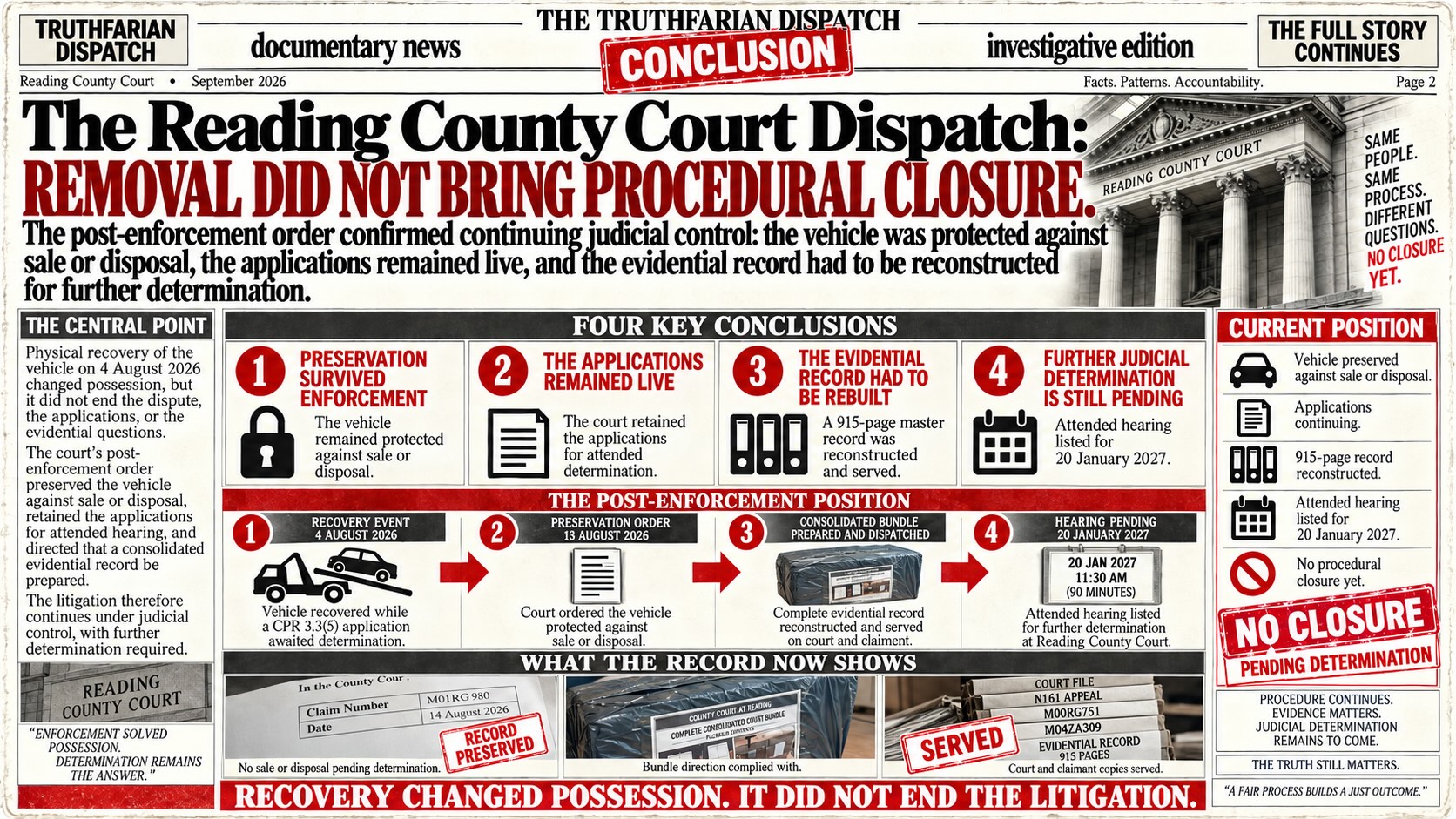
Post-enforcement judicial preservation and continuation of proceedings. The figure summarises the position following recovery of the Mazda on 4 August 2026: a further N244 was filed, District Judge Nicholson subsequently prohibited sale or disposal of the vehicle, directed assembly of the three applications and supporting evidence, and listed a 90-minute attended hearing for 20 January 2027. The sequence shows that physical recovery altered possession but did not bring the litigation to procedural closure.
Conclusion
This disclosure establishes that the removal of the Mazda CX-5 on 4 August 2026 did not bring the Startline Motor Finance / CarFinance247 litigation to procedural or substantive closure. The enforcement event changed physical possession of the vehicle, but the applications, evidential questions and wider litigation architecture continued afterwards. The subsequent order of District Judge Nicholson dated 13 August 2026 is therefore significant not because it retrospectively determines the legality of the earlier recovery, but because it demonstrates that the Court itself considered further judicial control necessary after recovery had already occurred. The vehicle was expressly protected against sale or disposal, the 24 July and 10 August applications were listed for attended determination, the continuing challenge concerning the 29 June application was expressly recorded, and the Defendant was required to assemble the three applications and supporting evidence into a physical bundle for the next judicial stage.
The chronology must therefore be read as one continuous procedural sequence rather than as separate administrative events. Before removal, the Defendant had sought a stay, preservation and oral determination. The vehicle was then removed while the renewed CPR 3.3(5) application remained awaiting determination. After removal, a further N244 was filed addressing the changed position. District Judge Nicholson subsequently imposed a non-disposal restriction and required the applications and supporting evidence to be brought together for an attended hearing. The practical effect was that the litigation moved from an unresolved pre-enforcement preservation dispute into a post-enforcement preservation and reconstruction stage without the underlying controversy having been finally adjudicated.
Four conclusions follow from that sequence.
The preservation issue survived enforcement. The fact that physical recovery had already taken place did not eliminate the evidential importance of the Mazda. The later prohibition on sale or disposal preserved the vehicle against a further irreversible step while the applications remained outstanding. That distinction is material because recovery transferred possession, whereas sale or disposal could have removed the vehicle from the litigation environment altogether and materially affected inspection, condition comparison, technical examination and any later remedial order.
The applications remained capable of substantive judicial determination after recovery. The Nicholson order did not treat the 4 August enforcement event as having rendered the applications academic or exhausted. Instead, the Court expressly identified the 24 July and 10 August applications for hearing and recorded the continuing challenge to District Judge Watt’s treatment of the 29 June application. The subsequent listing of a 90-minute attended hearing on 20 January 2027 confirms that further judicial determination remained necessary despite the fact that the physical enforcement remedy had already taken effect.
The procedural record itself required reconstruction before that determination could take place. Compliance with the 13 August order required the Defendant to assemble the three application histories and their supporting evidence into a coherent evidential structure. That exercise ultimately produced a continuously paginated 915-page master record divided across Bundles A–D. Two complete sets were prepared, creating 1,830 printed pages across four lever-arch files. The significance of that volume is not the page count in isolation. It demonstrates the extent to which the litigation had accumulated across the Defence and Counterclaim, the N32 response, the 29 June application, the 24 July CPR 3.3(5) application, the 10 August post-enforcement application and the evidence generated by the enforcement event itself.
Physical recovery did not determine the wider merits of the dispute. The Nicholson order did not adjudicate the substantive Counterclaim, approve or reject the pleaded monetary methodology, finally determine the consumer-rights and unfair-relationship allegations, resolve the wider enforcement and vulnerability issues, or dispose of the procedural questions associated with N01ZA273. Those matters remained distinct from the immediate question of possession of the vehicle. The post-enforcement procedure therefore continued against a background in which one practical remedy had been executed while the broader civil and evidential dispute remained unresolved.
The resulting position is materially different from an ordinary enforcement chronology in which a final substantive determination is followed by execution and closure. Here, the record shows enforcement followed by further application, judicial preservation, reconstruction of the evidential record and a later attended hearing. The Court’s own subsequent directions therefore demonstrate that additional procedural work remained necessary after recovery and that the vehicle itself continued to require protection while that work was undertaken.
The 915-page consolidated bundle is important within that context because it converts the fragmented procedural history into one continuous documentary record. It permits the Court and the represented parties to trace the relationship between the original Defence and Counterclaim, the N32, the three applications, the enforcement event and the later preservation order without treating any one of those stages as though it existed in isolation. The photographic record appended to this disclosure further documents the physical reconstruction, assembly and preparation of the Court and Claimant copies and provides contemporaneous evidence of what was actually produced in response to the Court’s direction.
The central conclusion is therefore that 4 August 2026 was not the end of the litigation but a procedural turning point within it. The vehicle had been removed before the requested interim protection operated, yet the Court subsequently preserved it against sale or disposal, listed the 24 July and 10 August applications for attended determination, expressly recorded the continuing challenge concerning the 29 June application, required the three applications and supporting evidence to be assembled, and fixed a further attended hearing. The enforcement event changed the factual position, but it did not extinguish the legal, evidential or procedural questions that had already been placed before the Court.
Accordingly, the post-enforcement record now demonstrates a continuing dispute in which physical recovery, evidential preservation, application determination and the wider Defence and Counterclaim remain separate but interconnected stages. Until the outstanding applications and related substantive issues receive determination, the 4 August recovery cannot properly be treated as having brought the Startline / CarFinance247 proceedings to complete procedural closure.
Evidential Appendix – Physical Reconstruction and Service of the Court-Directed Bundle
Exhibit – Photographic Record of Consolidated Bundle Reconstruction
The photographic record appended below documents the physical reconstruction and preparation of the consolidated application and evidence bundle required following the order of District Judge Nicholson dated 13 August 2026.
The photographs evidence the production process across the Court and Claimant copies, including physical collation, reconciliation, indexing, divider structure, master pagination, lever-arch assembly, packaging and preparation for service.
They provide contemporaneous physical corroboration of the following bundle architecture:
| Physical Set | Contents | Pages |
|---|---|---|
| Court Copy – Part 1 | Bundles A + B | 1–480 |
| Court Copy – Part 2 | Bundles C + D | 481–915 |
| Claimant Copy – Part 1 | Bundles A + B | 1–480 |
| Claimant Copy – Part 2 | Bundles C + D | 481–915 |
| Total | Two complete evidential sets | 1,830 printed pages |
The photographic evidence should therefore be read as part of the compliance record rather than as illustrative material alone.
It records the physical manifestation of the Court-directed reconstruction: two complete 915-page evidential sets across four lever-arch files, prepared for service upon the Court and Claimant within the ordered procedural framework.

Reconstruction and indexing of the consolidated evidential record. Photographic record showing the physical reconciliation of the application materials, internal indexes, master pagination and tabbed sections used to assemble Bundles A–D into a continuous 915-page evidential record.
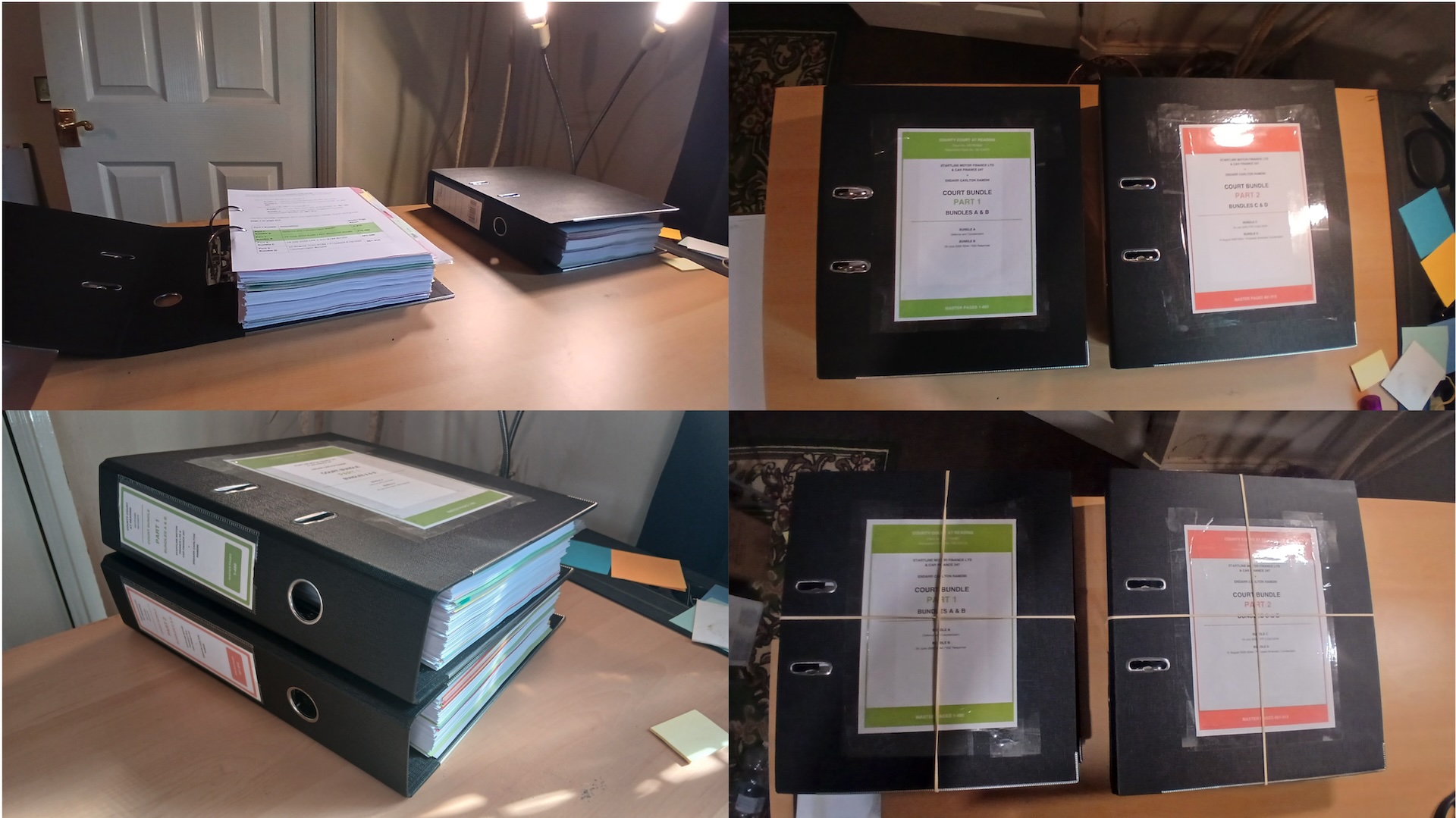
Completed two-part consolidated Court bundle. The finished lever-arch files show Part 1 — Bundles A and B and Part 2 — Bundles C and D, together forming one complete continuously paginated record from pages 1–915, before final packaging and dispatch.

Physical protection and packaging of the completed Court copy. The two lever-arch files comprising Parts 1 and 2 are shown secured, reinforced with cardboard protection and progressively enclosed for transport, evidencing the physical preparation of the 915-page Court bundle for dispatch.
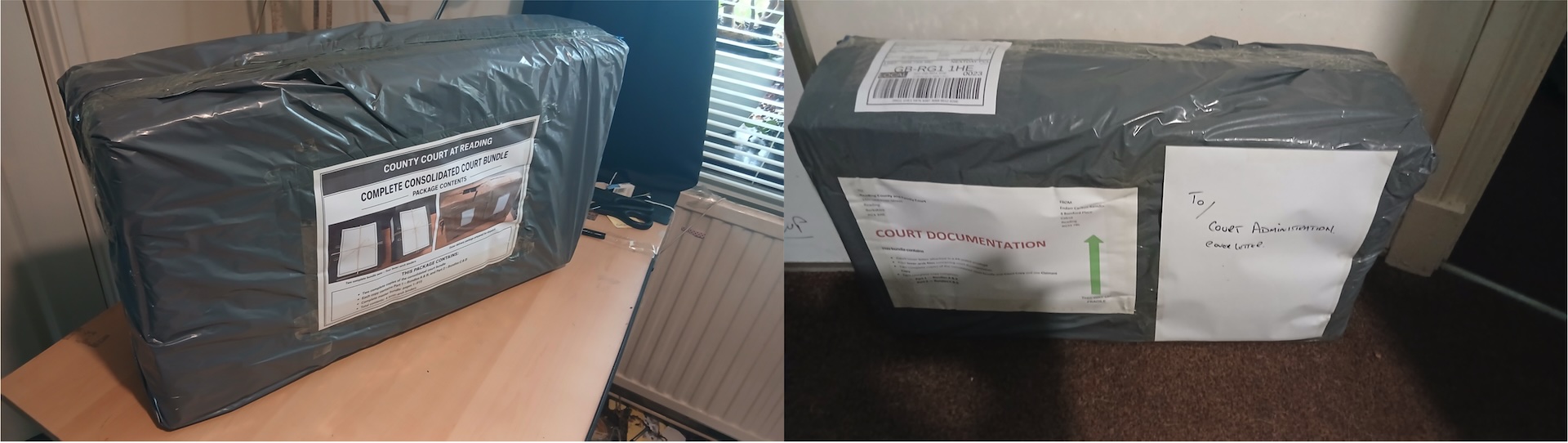
Completed court bundle packaged for dispatch. The consolidated lever-arch bundle is shown sealed within its outer protective wrapping and marked for Court Administration, documenting the final packaging stage before delivery of the Court copy.
Structural Impact Formula
The Structural Impact Score $SIS$ is defined as:
$SIS = \left( w_P + w_C + w_D + w_T + w_V + w_R + w_I \right)\left( 1 + \lambda \cdot 21 \right)$
Where:
- $P$ = Procedural Breakdown
- $C$ = Court Administrative Capture
- $D$ = Defence / Counterparty Interference
- $T$ = Tribunal / Welfare Disruption
- $V$ = Vulnerability Amplifier
- $R$ = Rights / Regulatory Misstatement
- $I$ = Institutional Interlock
Seven structural variables are engaged. With seven active variables, the model contains $\binom{7}{2}=21$ pairwise interactions. The amplification term $\lambda$ represents the cumulative structural effect produced by those interacting failures.
In this disclosure, the model captures the progression from unresolved pre-enforcement protection through physical recovery, post-enforcement judicial preservation, continuing evidential-control asymmetry, reconstruction of the three-application record, and further attended determination.
Structural Impact Result
Activated Structural Variables:
$P = 1,\; C = 1,\; D = 1,\; T = 1,\; V = 1,\; R = 1,\; I = 1$
Interaction Pair Count: $\binom{7}{2} = 21$ distinct co-occurring structural interaction pairs.
Resolved Structural Impact Score:
$SIS = \left( w_P + w_C + w_D + w_T + w_V + w_R + w_I \right)\left( 1 + \lambda \cdot 21 \right)$
The disclosure records concurrent activation across unresolved pre-enforcement protection, physical enforcement, post-enforcement judicial preservation, continuing evidential-control asymmetry, reconstruction of the three-application record, substantial participation and vulnerability burden, unresolved Defence and Counterclaim issues, and continued judicial determination after enforcement.
Structural Impact Meaning
An $SIS$ produced by seven concurrently active structural variables with $\binom{7}{2} = 21$ interaction pairs indicates systemic continuation rather than procedural closure following enforcement.
The co-activation of procedural breakdown $P$, court administrative capture $C$, defence / counterparty interference $D$, tribunal / welfare disruption $T$, vulnerability amplification $V$, rights / regulatory misstatement $R$, and institutional interlock $I$ records a structure in which enforcement altered physical and evidential control without resolving the underlying Defence, Counterclaim, applications, or disputed chronology.
The interaction multiplier $\left(1 + \lambda \cdot 21\right)$ represents the compounded effect of those conditions: unresolved preservation protection preceded enforcement, enforcement changed the evidential position, judicial preservation followed, and the Court subsequently required the three applications and supporting evidence to be assembled for continued attended determination.
The resulting structural state is therefore not enforcement followed by closure, but enforcement followed by preservation, evidential reconstruction, continuing participation burden, and further judicial determination. The model records the non-linear impact created when those processes remain simultaneously active after the underlying asset has already passed out of the Defendant's physical control.