

Reconstructed scene of the Linear Park incident illustrating the wider public setting, the complainant’s continued verbal confrontation after the resident had apologised, and the intervention of two independent men telling her to move away. Akira is shown harnessed and physically controlled beside the resident, while other dog walkers remain present nearby. The reconstruction highlights the contrast between the intensity of the confrontation and the absence of any identified photographic, video, veterinary or independent eyewitness evidence substantiating the later allegation of injury.
Authority: Public Protection Partnership / West Berkshire Council
Reference: 140258
Incident alleged: 3 September 2026
Authority correspondence: 18 September 2026
Received correspondence: Sat 26th
Formal challenge / SAR / rectification / restriction request: 28 September 2026
Status: Formal evidential challenge submitted; Article 15 Subject Access Request, Article 16 accuracy/rectification challenge and Article 18 restriction request formally acknowledged by West Berkshire District Council’s Data Protection Team; identity verification completed; Data Protection reference DP/C/2026/67 assigned; request routed to the relevant operational team for action; substantive response from the Animal Warden team remains outstanding.
Executive Summary
This disclosure concerns the transformation of a disputed third-party allegation into a retained local-authority record carrying prospective enforcement significance.
On 18 September 2026, the Public Protection Partnership wrote to “The Occupier” at 4 Bamford Place concerning an alleged incident at Linear Park on 3 September 2026.
The correspondence did not state that the allegation had been proved.
It expressly stated that:
- “a complaint has been received”;
- the officer “believe[d]” the occupier to be responsible for an alleged Akita;
- “It is alleged” that the dog was not under control; and
- the other dog “is reported to have sustained injuries.”
Those words identify an unresolved evidential state.
Nevertheless, the same correspondence then stated:
“A record of the complaint will be kept on file for future reference”
and expressly connected future allegations with possible:
“enforcement action”.
The letter then invoked the Dogs Act 1871 and described consequences including destruction of a dog, restrictions on where it may be taken, lead and muzzle requirements, fines and disqualification from dog ownership.
It subsequently requested cooperation in ensuring:
“that no offence is committed”
and strongly advised that the dog be kept on a short lead, muzzled around other dogs, taken to a training group and referred to a behaviourist.
The central disclosure is therefore not merely that a resident received a warning following a dog complaint.
It is that an expressly unproven allegation was converted into a retained administrative record capable of acquiring future enforcement significance, despite unresolved questions concerning:
- identification of the dog;
- attribution of that dog to the resident;
- provenance of the residential address;
- whether the dog was actually uncontrolled;
- whether an injury occurred;
- the mechanism of any injury;
- causation;
- whether any offence occurred;
- and what evidential threshold justified the restrictions being recommended.
The identification issue is fundamental.
The authority's correspondence refers only to:
“an Akita”
yet the resident does not own an Akita.
His dog is a Husky mix.
The authority's letter gives no colouring, markings, sex, age, approximate size or other individualising description capable of distinguishing the alleged animal from another dog.
The resident's formal response dated 26 September 2026 consequently challenges the allegation, the evidential foundation of the correspondence, the accuracy and provenance of the retained information, the use of offence and enforcement language, and the prospective use of the complaint in future decision-making. It also constitutes a formal Subject Access Request and seeks rectification and restriction of disputed personal data. FORMAL RESPONSE TO ALLEGATION
The disclosed sequence is therefore:
third-party allegation → disputed breed identification → unexplained residential-address association → adverse administrative record → future enforcement significance → offence language → behavioural restrictions → formal evidential and data-protection challenge
The question now is whether the Public Protection Partnership can establish the evidential and lawful basis for each transition in that chain.
Post-Submission Development: Data Protection Engagement and Continuing Animal Warden Silence
Following submission of the formal response, Subject Access Request, rectification challenge and restriction request, West Berkshire District Council’s Data Protection Team formally engaged with the matter.
The Data Protection Team first requested photographic identification under Article 12(6) UK GDPR for the purpose of identity verification.
The resident subsequently supplied a copy of his driving licence.
The Data Protection Team then confirmed safe receipt of the identification and request, assigned reference DP/C/2026/67, and stated:
“We have sent your request to the relevant team to action, and they will contact you in due course.”
That confirmation is significant because the data-protection process has now moved beyond initial receipt and identity verification into substantive operational handling.
The request has been formally routed to the team holding or controlling the underlying records.
At the time of this update, however, the Animal Warden team has provided no substantive response to the resident’s evidential challenge.
The following matters therefore remain unanswered by the operational team:
who identified the dog as an Akita;
what evidence supported that identification;
how 4 Bamford Place became associated with the complaint;
whether the complainant supplied the address;
what evidence establishes that the dog was not under control;
what evidence establishes injury;
what evidence establishes causation;
whether any offence is actually alleged to have occurred;
what investigation took place before the letter was issued;
and why the complaint was retained for future enforcement reference before those matters were resolved.
The present institutional position is therefore:
formal evidential challenge submitted → Data Protection engaged → identity verified → SAR formally routed to relevant team → Animal Warden substantive response outstanding

The Story So Far. Chronological reconstruction of the documentary sequence from the alleged incident on 3 September 2026, through the Public Protection Partnership letter of 18 September 2026 and the formal response of 26 September 2026, to Data Protection engagement, identity verification, assignment of reference DP/C/2026/67 and the continuing absence of a substantive Animal Warden response
Breaches

Cast of Characters. Reconstructed visual identifying the principal participants in the originating Linear Park incident: the complainant, two independent gentlemen present during the confrontation, and the resident with Akira. The figure distinguishes the complainant’s conduct and dog from the resident’s position and the independent third parties capable of giving direct evidence.
Breach 1 — Material Failure of Identification Before Adverse Administrative Attribution
The originating correspondence identifies the alleged dog only as:
“an Akita”
and states that the officer believes the occupier of 4 Bamford Place to be responsible for it.
That identification is materially disputed.
The resident does not own an Akita.
His dog is a Husky mix.
The problem is not simply semantic disagreement over breed terminology.
Breed is the only identifying characteristic contained within the authority's letter.
No colouring is given.
No markings are given.
No sex is given.
No approximate age is given.
No approximate size is given.
No name is given.
No individual physical characteristic is given.
Yet the alleged animal is connected to a specific residential address and its occupier.
The evidential chain therefore begins:
unidentified complainant description → “Akita” → 4 Bamford Place → “The Occupier” → retained complaint record
Where the only visible identification criterion is itself materially disputed, the integrity of every later administrative consequence depends upon establishing how that identification was made.
The formal response therefore requires disclosure of the original description supplied by the complainant and expressly asks whether any description beyond breed exists. FORMAL RESPONSE TO ALLEGATION
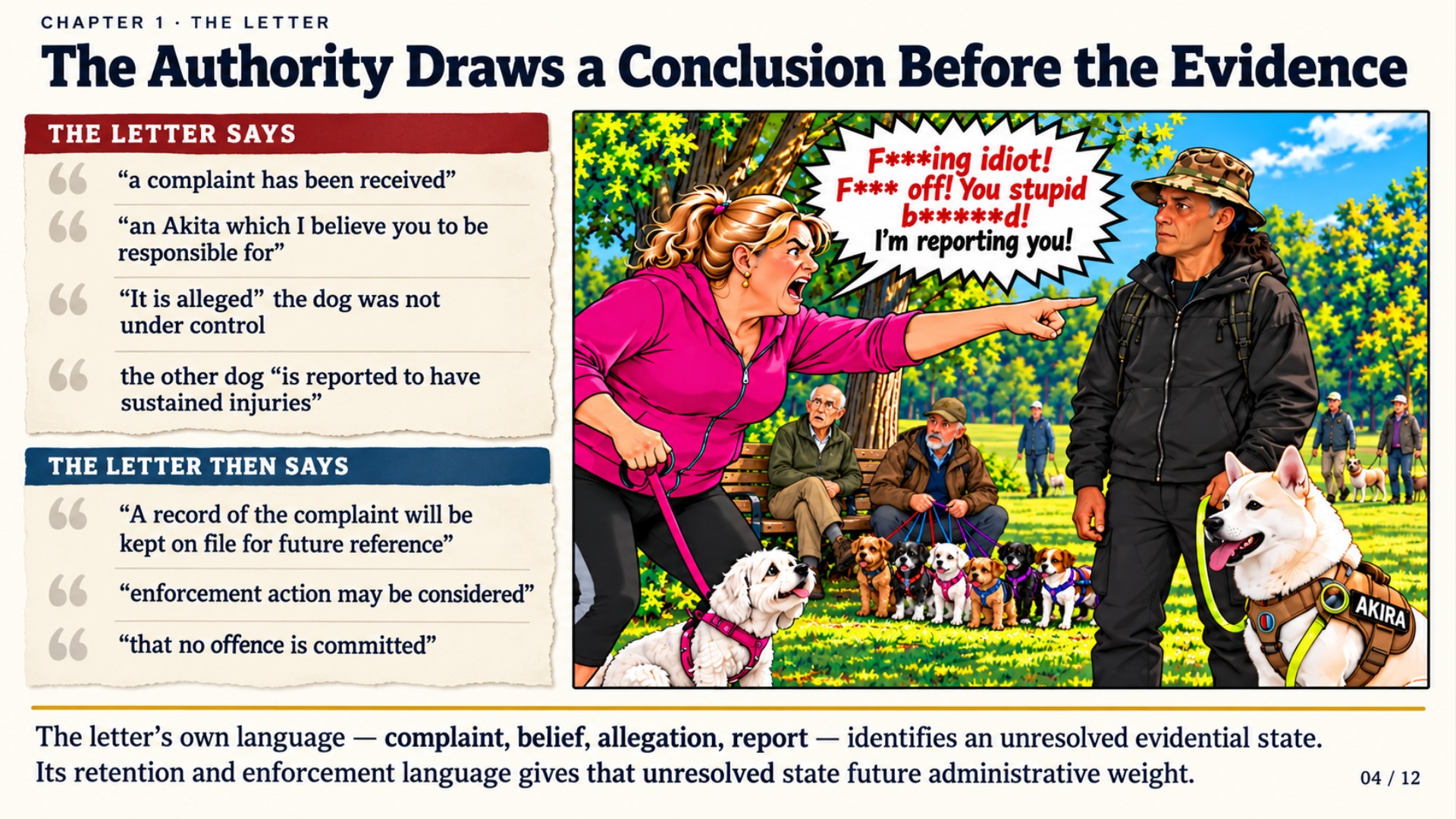
The Authority Draws a Conclusion Before the Evidence. Comparative visual showing the authority’s own uncertain language complaint, belief, allegation and reported injury against the later retention, enforcement and offence language contained in the same correspondence. The figure illustrates the central evidential tension between unresolved factual status and increasing administrative consequence.
Evidence
- Public Protection Partnership letter dated 18 September 2026, reference 140258.
- Description in the authority correspondence: “an Akita which I believe you to be responsible for.”
- Formal response dated 26 September 2026.
- Resident's categorical statement that he does not own an Akita.
- Resident's identification of his dog as a Husky mix.
- Photographic evidence appended to the formal response showing the dog concerned.
- Request for disclosure of the complainant's original full description of the alleged dog.

‘An Akita’ — But No Akita Exists. Identification comparison showing that the authority’s letter describes only “an Akita”, while the resident identifies his dog as a Husky mix. The figure highlights that no colouring, markings, sex, age, size or name are given in the letter, leaving the only stated identifying characteristic materially disputed.
Legal Frameworks Engaged
- UK GDPR Article 5(1)(d) — accuracy.
- UK GDPR Article 5(1)(a) — lawfulness, fairness and transparency.
- UK GDPR Article 14 — indirectly obtained personal data.
- UK GDPR Article 15 — access and available source information.
- UK GDPR Article 16 — rectification.
- UK GDPR Article 18 — restriction while accuracy is contested.
- Data Protection Act 2018.
- Common-law procedural fairness.
- Public and administrative law.
- Human Rights Act 1998 — section 6.
- Article 8 ECHR.

How Did 4 Bamford Place Become Associated? Visual reconstruction of the unresolved address-provenance issue arising from correspondence addressed to “The Occupier” at 4 Bamford Place. The figure identifies the principal unanswered questions concerning who supplied the address, when it became linked to the complaint, what searches or enquiries were undertaken and what lawful basis supported the processing.
Breach 2 — Unexplained Association of the Allegation With 4 Bamford Place
The authority's correspondence was not addressed to Endarr Carlton Ramdin by name.
It was addressed simply to:
“The Occupier”
at 4 Bamford Place.
That feature is evidentially significant.
The correspondence itself therefore indicates that the authority possessed sufficient information to associate the alleged dog incident with a specific private residential address, while apparently lacking or not using the identity of the person it alleged was responsible.
The resident did not supply that address to the Public Protection Partnership in connection with the alleged incident.
The resulting provenance question is direct:
How did 4 Bamford Place become associated with an alleged Akita and the Linear Park incident?
The formal response requires disclosure of:
- who supplied the address;
- when the address was first associated with the complaint;
- what information enabled the association;
- whether the complainant supplied it;
- whether another council database was searched;
- whether another public authority supplied information;
- whether another person supplied information;
- what enquiry connected the alleged dog with the property;
- and what lawful basis was relied upon for the resulting processing.
The correspondence was issued fifteen days after the alleged incident.
The resident has therefore also required disclosure of when the complaint was actually received and what investigative or administrative steps occurred between the alleged incident and the letter. Ramdin_Formal_Response_SAR_Ref_…
The breach is not an assertion that obtaining the address was necessarily unlawful.
The breach disclosed is the existence of an unexplained data-association process carrying adverse administrative consequences.
Evidence
- PPP letter addressed to “The Occupier.”
- Address: 4 Bamford Place.
- Alleged incident date: 3 September 2026.
- Letter date: 18 September 2026.
- Formal provenance challenge dated 26 September 2026.
- Article 15 Subject Access Request.
- Requests concerning database searches, third-party disclosure and inter-authority information sharing.
Legal Frameworks Engaged
- UK GDPR Article 5(1)(a).
- UK GDPR Article 5(1)(d).
- UK GDPR Article 14.
- UK GDPR Article 15.
- Data Protection Act 2018.
- Article 8 ECHR.
- Human Rights Act 1998 — section 6.
- Common-law procedural fairness.
- Public and administrative law.

The Letter Says / The Same Record Shows. Documentary comparison placing the authority’s allegations and recommendations alongside the contrary factual material identified by the resident. The figure contrasts the disputed Akita identification, alleged lack of control, reported injury, offence language and short-lead recommendation with the resident’s evidence concerning Akira’s breed, harness, physical restraint and the absence of identified independent injury evidence.
Breach 3 — Conversion of an Unverified Allegation Into a Retained Adverse Record
The most consequential sentence in the authority's correspondence states:
“A record of the complaint will be kept on file for future reference and if we receive similar allegations in the future regarding this dog, they will be investigated and enforcement action may be considered.”
This changes the character of the communication.
The authority is not merely notifying a resident that a complaint exists.
It is creating institutional memory.
That retained record is expressly intended to be capable of influencing future enforcement assessment.
Yet the same letter does not establish:
- that the dog was correctly identified;
- that the dog was uncontrolled;
- that the dog attacked another dog;
- that the dog bit another dog;
- that the alleged injury occurred in the manner alleged;
- that the resident was legally responsible;
- or that an offence was committed.
The administrative risk is therefore temporal.
An allegation may begin as uncertain information but acquire increased institutional weight merely through continued retention.
The sequence becomes:
allegation → record → historical entry → later allegation → apparent pattern → enforcement consideration
The evidential status of the first event may not have improved at all.
Its administrative significance nevertheless increases.
The resident's formal response therefore requires that, if the complaint remains retained, the same record must prominently state that:
- the allegation is disputed;
- lack of control is denied;
- the dog was physically secured;
- injury and causation are disputed;
- independent witnesses exist;
- the breed identification is disputed;
- and the evidential basis has been formally requested. FORMAL RESPONSE TO ALLEGATION
The disclosed failure is therefore:
institutional persistence without evidential closure.
Evidence
- PPP statement that the complaint will be “kept on file for future reference.”
- Express reference to possible future “enforcement action.”
- No finding of fact contained within the correspondence.
- Formal accuracy challenge dated 26 September 2026.
- Article 16 rectification request.
- Article 18 restriction request.
- Request that the disputed status of the allegation remain attached to the record.
Legal Frameworks Engaged
- UK GDPR Article 5(1)(a).
- UK GDPR Article 5(1)(d).
- UK GDPR Article 16.
- UK GDPR Article 18.
- Data Protection Act 2018.
- Common-law fairness.
- Public and administrative law.
- Human Rights Act 1998 — section 6.
- Article 8 ECHR.
Breach 4 — Enforcement Escalation Without Evidential Determination
The authority's own language establishes that the underlying event remained an allegation.
Nevertheless, the correspondence then introduces the statutory enforcement consequences available under the Dogs Act 1871.
Those consequences include:
- destruction of a dog;
- exclusion from particular land;
- lead requirements;
- muzzle requirements;
- fines;
- and disqualification from owning a dog.
The issue is not that an authority may never explain the legislation potentially applicable to an allegation.
The disclosed issue is the relationship between the unresolved evidential state and the seriousness of the consequences immediately introduced into the communication.
The letter moves through the following sequence:
complaint received
↓
officer belief
↓
“it is alleged”
↓
injury “reported”
↓
record retained
↓
future enforcement
↓
destruction / muzzle / restriction / fines / disqualification
The evidential state remains qualified throughout the first half of that sequence.
The potential legal consequences become progressively more severe.
The authority therefore created a substantial asymmetry:
evidential certainty remained low while administrative and enforcement consequence increased.
Evidence
- PPP letter dated 18 September 2026.
- Express allegation/report/belief language.
- Express reference to future enforcement.
- Express description of destruction, restrictions, fines and disqualification.
- No identified factual adjudication within the letter.
Legal Frameworks Engaged
- Dogs Act 1871 — section 2.
- Common-law natural justice.
- Common-law procedural fairness.
- Public and administrative law.
- Human Rights Act 1998 — section 6.
- Article 8 ECHR.
- UK GDPR Article 5(1)(a).
- UK GDPR Article 5(1)(d).
Breach 5 — Unexplained Use of “Offence” Language Where No Offence Is Identified as Established
The authority subsequently requests cooperation in ensuring:
“that the dog is kept under control, that no offence is committed and that no further action is necessary.”
That language introduces a distinct legal problem.
No offence is identified earlier in the correspondence as having been established.
The letter instead describes:
- an allegation;
- a report;
- a belief;
- and a complaint.
The formal response therefore requires the Public Protection Partnership to identify:
what specific “offence” the sentence refers to;
whether the authority contends that an offence has already occurred;
if so, what statutory offence is alleged;
against whom the allegation is made; and
what evidence supports it. FORMAL RESPONSE TO ALLEGATION
The significance is not confined to vocabulary.
Within a communication already invoking destruction, fines, disqualification and future enforcement, the word “offence” carries obvious legal weight.
An authority must therefore distinguish clearly between:
conduct which might constitute an offence if proved
and
an offence which has actually been established.
The authority's own correspondence does not identify the latter.
Evidence
- PPP letter: “that no offence is committed.”
- Absence of any identified established offence within the preceding factual narrative.
- Formal request dated 26 September 2026 for clarification of the statutory offence, alleged offender and supporting evidence.
Legal Frameworks Engaged
- Common-law procedural fairness.
- Natural justice.
- Public and administrative law.
- Dogs Act 1871 — section 2.
- Human Rights Act 1998 — section 6.
- UK GDPR Article 5(1)(a).
- UK GDPR Article 5(1)(d).
Breach 6 — Restrictive Behavioural Recommendations Without a Recorded Finding of Dangerousness or Lack of Control
The authority “strongly advise[d]” that the dog should:
- be kept on a short lead;
- remain in view;
- be muzzled when encountering other dogs;
- attend a dog-training group;
- and be assessed by a dog behaviourist.
Those recommendations are significant because they imply a behavioural risk requiring corrective intervention.
Yet the correspondence identifies no established finding that:
- the dog is dangerous;
- the dog was uncontrolled;
- the dog has a behavioural disorder;
- the dog requires retraining;
- the dog requires behavioural assessment;
- or the dog requires a muzzle.
The short-lead recommendation is particularly notable because the resident's evidence is that his dog was already harnessed and its lead was physically attached to his belt.
The resident could therefore not simply release or lose physical control of the dog in the manner implied by a generic off-lead allegation.
The disclosure does not contend that advice itself necessarily constitutes a formal Dog Control Order.
It records the evidential disconnect between the recommendations and the absence of an identified factual finding supporting them.
Evidence
- PPP recommendation for a short lead.
- PPP recommendation for a muzzle.
- PPP recommendation for dog training.
- PPP recommendation for behavioural intervention.
- Resident's evidence that the dog was harnessed.
- Resident's evidence that the lead was physically attached to his belt.
- Photographic evidence showing the dog with harness and lead.
- Formal response challenging the basis of the proposed restrictions. FORMAL RESPONSE TO ALLEGATION
Legal Frameworks Engaged
- Dogs Act 1871 — section 2.
- Common-law procedural fairness.
- Public and administrative law.
- UK GDPR Article 5(1)(d).
- Human Rights Act 1998 — section 6.
- Article 8 ECHR.
Breach 7 — Failure to Establish Injury and Causation Before Adverse Administrative Consequence
The authority does not state that the resident's dog injured another dog as an established fact.
It states only that the other dog:
“is reported to have sustained injuries.”
That wording leaves at least three separate factual questions unresolved:
Was there an injury?
How was any injury caused?
Did the resident's dog cause it?
Those propositions cannot be collapsed into one another.
A veterinary record may establish injury.
It does not necessarily establish causation.
A photograph may establish visible damage.
It does not necessarily identify what caused it.
A complainant's statement may establish that an allegation was made.
It does not establish that the allegation is true.
The formal response therefore requires confirmation whether the authority possesses:
photographs of the alleged injuries;
photographs of the alleged incident;
CCTV or video;
an independent witness statement from somebody who witnessed a bite;
veterinary records;
a veterinary report or statement;
contemporaneous evidence establishing timing;
evidence establishing mechanism of injury; and
evidence establishing that the resident's dog caused the injury. FORMAL RESPONSE TO ALLEGATION
The breach is therefore evidential:
reported injury was allowed to contribute to an adverse administrative record before the disclosed correspondence established either injury or causation.
Evidence
- PPP wording: “is reported to have sustained injuries.”
- Absence of disclosed injury evidence within the letter.
- Formal nine-part evidential request dated 26 September 2026.
- Resident's categorical denial that his dog bit or attacked the complainant's dog.
- Presence of other people at the location capable of giving evidence concerning what occurred.
Legal Frameworks Engaged
- Common-law natural justice.
- Common-law procedural fairness.
- UK GDPR Article 5(1)(d).
- UK GDPR Article 15.
- UK GDPR Article 16.
- UK GDPR Article 18.
- Public and administrative law.
- Human Rights Act 1998 — section 6.
Breach 8 – Failure to Record and Assess the Discriminatory and Targeted Conduct Forming Part of the Originating Incident
The originating incident did not consist solely of an alleged interaction between two dogs. The resident’s account identifies a materially wider sequence of conduct by the complainant which forms part of the factual context from which the later Public Protection Partnership complaint arose. Following the interaction, the resident apologised. The complainant did not disengage. Instead, she continued shouting and swearing directly at him, remained confrontational and threatened to report him.
Two independent gentlemen were present during the relevant period. The complainant’s conduct continued to the point that those men intervened and told her to move away with her dog. That intervention is evidentially significant because it provides independent support for the resident’s account that the confrontation continued after the immediate interaction had ended and that the complainant’s conduct had become sufficiently persistent and abusive for third parties to intervene. The resident’s formal response already records that the complainant remained at the location shouting and swearing and that the gentlemen present told her to move away. Ramdin_Formal_Response_SAR_Ref_…
The resident experienced the complainant’s conduct as racially discriminatory. That allegation does not depend upon the use of an explicit racial epithet. It arises from the nature, persistence, intensity and targeting of the conduct as a whole. The resident further states that, during the incident itself, he told other persons present in the park that he believed the complainant’s behaviour towards him was racist. The significance of that contemporaneous statement is that the discrimination concern arose during the event itself and was communicated to others at the time; it was not an interpretation first formulated after the Public Protection Partnership subsequently wrote to him.
The subsequent provenance of the resident’s residential address creates an additional evidential issue. The Public Protection Partnership correspondence was addressed only to “The Occupier” at 4 Bamford Place and did not identify the resident by name. The resident’s position is that the complainant did not previously know his home address. If that position is correct, the means by which the address became associated with the complaint requires direct explanation from the underlying records.
One live factual possibility is that the complainant followed the resident sufficiently far from the park to identify where he lived after threatening to report him. That proposition is not presently advanced as an established fact because the original complaint and address-provenance records have not yet been disclosed. It is, however, an evidential question directly engaged by the chronology and by the subsequent use of the resident’s address within the Council’s administrative process.
The resident’s formal response therefore requires disclosure of who supplied the address, when it was first associated with the complaint, whether it came from the complainant, what searches or enquiries were undertaken, what information connected the alleged dog with 4 Bamford Place and what investigation occurred before the letter was issued. Ramdin_Formal_Response_SAR_Ref_…
The discrimination strand and the data-provenance strand consequently intersect. The documented sequence is not simply an alleged dog incident followed by routine correspondence. It is an incident involving an apology, continuing verbal abuse, a threat to report, intervention by independent witnesses, a contemporaneous allegation of racial discrimination and the later unexplained appearance of the resident’s home address within an official complaint record.
The Public Protection Partnership was subsequently placed expressly on notice that the resident experienced the complainant’s conduct and remarks as racist and discriminatory. The formal response requires that this part of his account not be excluded while the complainant’s allegations are retained and also requires confirmation that the discrimination allegation has itself been recorded. Ramdin_Formal_Response_SAR_Ref_…
The breach therefore concerns the integrity of the administrative account ultimately retained by the authority. If one party’s accusation is preserved for future enforcement purposes while the other party’s account of persistent abusive conduct, independent witnesses, contemporaneous discrimination concerns and disputed address provenance is omitted or marginalised, the resulting record ceases to reflect the full contested circumstances from which the complaint arose.
Evidence
Formal Response to Allegation dated 26 September 2026 – records that the resident was stationary with his dog in the company of other people and dogs, that the complainant approached their position and that the resident’s dog remained harnessed and physically connected to him. Ramdin_Formal_Response_SAR_Ref_…
Formal Response to Allegation – records that following the interaction the complainant remained at the location shouting and swearing and that the gentlemen present told her to move away with her dog. Ramdin_Formal_Response_SAR_Ref_…
Two independent gentlemen present during the incident – capable of giving direct evidence concerning the complainant’s continuing conduct, the intervention, the respective dogs and leads, and the circumstances immediately following the interaction.
Resident’s contemporaneous statement to other persons present in the park that he experienced the complainant’s conduct towards him as racist.
Formal Response, section 12 – records that the resident experienced the complainant’s conduct and remarks as racist and discriminatory and requires that this account not be excluded while the complainant’s allegations are retained. Ramdin_Formal_Response_SAR_Ref_…
Public Protection Partnership correspondence – addressed to “The Occupier” at 4 Bamford Place while identifying responsibility for the alleged dog only through stated belief.
Formal Response / Subject Access Request – requires disclosure of who supplied the address, what information connected 4 Bamford Place with the allegation and what investigation occurred before the correspondence was issued. Ramdin_Formal_Response_SAR_Ref_…
Legal Frameworks Engaged
- Equality Act 2010 – section 29.
- Equality Act 2010 – section 149.
- Human Rights Act 1998 – section 6.
- European Convention on Human Rights – Article 8.
- UK GDPR – Article 5(1)(a).
- UK GDPR – Article 5(1)(d).
- UK GDPR – Article 14.
- UK GDPR – Article 15.
- UK GDPR – Article 16.
- UK GDPR – Article 18.
- Data Protection Act 2018.
- Common-law procedural fairness.
- Public and administrative law.
- Dogs Act 1871 – section 2.
Breach 9 — Administrative Reliance Upon a One-Sided Account Without Evidential Closure
The correspondence demonstrates that a complaint was received.
It does not demonstrate that competing evidence was obtained before the adverse record was created.
The resident's account is materially different.
His position is that:
- his dog was harnessed;
- the lead was physically attached to his belt;
- he was stationary;
- other people and dogs were present;
- the complainant approached that position;
- the complainant's dog was on a substantially longer lead;
- others present asked the complainant to move away;
- and, to the resident's knowledge, none of those persons witnessed his dog bite the complainant's dog.
That evidence does not automatically prove the resident's account.
Its significance is procedural.
Once supplied, it prevents the original complaint from legitimately functioning as though it were an uncontested factual record.
The authority must now deal with:
complainant account + resident account + available witnesses + documentary material + any veterinary or photographic evidence
rather than:
complaint = incident.
This distinction is central to the continuing accuracy, fairness and future use of the record.
Evidence
- Formal response dated 26 September 2026.
- Resident's account of physical control.
- Resident's account of the complainant approaching.
- Identification of independent persons present.
- Photographs appended to the response.
- Request that contrary evidence be associated with the retained complaint record.
Legal Frameworks Engaged
- Common-law natural justice.
- Common-law procedural fairness.
- Public and administrative law.
- UK GDPR Article 5(1)(a).
- UK GDPR Article 5(1)(d).
- UK GDPR Article 16.
- UK GDPR Article 18.
- Human Rights Act 1998 — section 6.
Breach 10 — Data Accuracy Risk Created by Future Reliance Upon a Contested Record
The data-protection issue is not merely whether the authority may record that somebody complained.
A true statement that:
“Person X alleged Y”
is conceptually different from an administrative record that later functions as:
“Y happened before.”
That distinction becomes critical where the authority itself states that the record will be retained for future reference and may contribute to later enforcement.
The resident has therefore formally disputed any record representing as established fact that:
- he owns an Akita;
- his dog was off lead;
- his dog was not under control;
- his dog attacked another dog;
- his dog bit another dog;
- his dog caused injury;
- or an offence was committed by him. Ramdin_Formal_Response_SAR_Ref_…
The potential harm lies in status drift.
Information can begin life as an allegation but later be read by another officer as a historical event.
The greater the enforcement significance of the data, the greater the importance of maintaining the distinction between:
allegation
and
established fact.
Evidence
- Express retention statement.
- Express future-enforcement statement.
- Formal Article 16 rectification request.
- Formal Article 18 restriction request.
- Formal dispute of seven material factual propositions.
- Request for the resident's denial and evidence to remain attached to the complaint record.
Legal Frameworks Engaged
- UK GDPR Article 5(1)(a).
- UK GDPR Article 5(1)(d).
- UK GDPR Article 16.
- UK GDPR Article 18.
- Data Protection Act 2018.
- Article 8 ECHR.
- Human Rights Act 1998 — section 6.
Breach 11 — Escalation From Allegation to Institutional Consequence Without Transparent Decision Architecture
Taken as a whole, the letter discloses an identifiable administrative transformation.
Input
A third-party allegation.
Evidential status
Complaint, belief, allegation and reported injury.
Identification
An alleged “Akita”, without further individual description in the correspondence.
Attribution
4 Bamford Place and “The Occupier.”
Administrative consequence
Record retained for future reference.
Prospective consequence
Future allegations capable of leading to enforcement consideration.
Statutory consequence introduced
Destruction, exclusion, muzzle, lead requirements, fines and ownership disqualification.
Behavioural consequence proposed
Short lead, muzzle, training and behaviourist.
Criminal/regulatory language
“that no offence is committed.”
The disclosure therefore identifies a sequence in which institutional consequence increased at every stage without any corresponding factual determination being identified within the communication.
That is the central structural failure.
It can be expressed as:
uncertain allegation → institutional attribution → retained record → future enforcement value
while:
identification + injury + causation + responsibility + offence remain unresolved.
Evidence
- Complete PPP correspondence dated 18 September 2026.
- Formal response dated 26 September 2026.
- Article 15 SAR.
- Article 16 rectification challenge.
- Article 18 restriction request.
- Preservation request.
- Twenty-four substantive questions requiring institutional response.
Legal Frameworks Engaged
- Common-law natural justice.
- Common-law procedural fairness.
- Public and administrative law.
- Human Rights Act 1998 — section 6.
- Article 8 ECHR.
- UK GDPR Articles 5, 14, 15, 16 and 18.
- Data Protection Act 2018.
- Equality Act 2010 — sections 29 and 149, following notification of the resident's account of discriminatory conduct.
- Dogs Act 1871 — section 2.
Overall Evidential Finding
The ten breaches above are not independent drafting defects.
They describe a single administrative progression.
The originating information was expressly uncertain:
complaint
belief
allegation
reported injury
Yet the institutional consequence was not neutral.
The allegation was:
linked to a private address → attributed to its occupier → retained → designated for future reference → connected to enforcement → accompanied by offence language → accompanied by restrictive behavioural recommendations
The fundamental divergence is therefore:
Evidential certainty did not increase.
Institutional consequence did.
The resulting structure is:
Allegation → Identification Failure → Address Attribution → Administrative Retention → Prospective Enforcement → Restrictive Consequence
The authority's response of 18 September 2026 therefore created more than correspondence.
It created an institutional state capable of persisting beyond the alleged incident itself.
The formal response of 26 September 2026 creates the counter-state:
categorical denial → contrary evidence → identification challenge → causation challenge → provenance challenge → SAR → rectification → restriction → preservation → institutional notice
The Public Protection Partnership is now expressly on notice that the foundational information is disputed. FORMAL RESPONSE TO ALLEGATION
Future reliance upon the complaint must therefore take account of that dispute and whatever evidential position emerges from the authority's own records.
The authority cannot allow the existence of a complaint to become administratively equivalent to the existence of a finding.
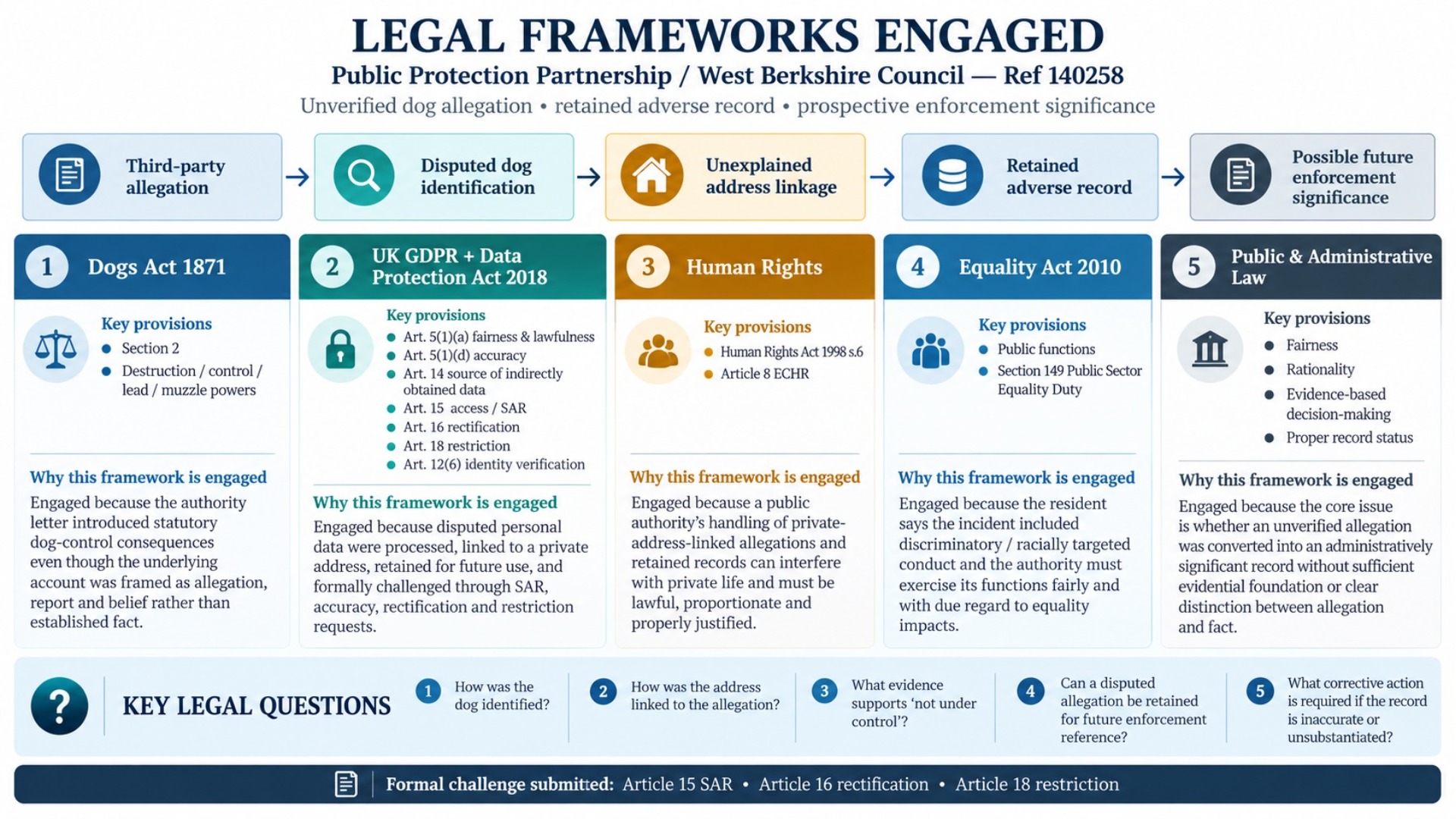
Legal Frameworks Engaged. Consolidated legal-framework map showing the relationship between the third-party allegation, disputed identification, unexplained address linkage, retained adverse record and prospective enforcement significance. The figure links those stages to the Dogs Act 1871, UK GDPR and Data Protection Act 2018, Human Rights Act 1998 and Article 8 ECHR, Equality Act 2010 and public and administrative law.
Legal Frameworks Engaged
I. Common Law — Natural Justice
Authority / Citation
Ridge v Baldwin [1963] UKHL 2; [1964] AC 40. BAILII
Verbatim
“a fair opportunity of being heard in his own defence.”
Legal Duty / Interpretation
The common-law requirement of natural justice requires a person materially affected by an adverse decision or administrative process to be given a fair opportunity to know the case being advanced against them and to place their own account before the decision-maker.
The principle is not satisfied merely because an individual may challenge the matter at some later stage. Its practical significance lies in whether the person has a fair opportunity to answer material adverse information before that information acquires operative administrative consequences.
Breach Identified
The Public Protection Partnership created and retained an adverse complaint record before the resident had been invited to provide his account.
The correspondence itself confirms that the underlying matters remained allegations. It refers to a complaint having been received, states that the dog was one which the authority “believe[d]” the occupier to be responsible for, describes the alleged lack of control as an allegation and describes the alleged injury as something “reported” to have occurred.
Despite that unresolved evidential position, the complaint was retained “for future reference” and expressly connected with possible future enforcement.
The resident has now supplied a detailed rebuttal, challenged the identification of the dog, disputed lack of control, disputed causation and requested the evidence underlying the accusation.
Any future administrative reliance upon the original complaint without equivalent recognition of the resident’s contrary account would deepen the original evidential asymmetry.
II. Common Law — Procedural Fairness
Authority / Citation
Lloyd v McMahon [1987] UKHL 5; [1987] AC 625. BAILII
Verbatim
“what the requirements of fairness demand ... depends on the character of the decision-making body, the kind of decision it has to make”
Legal Duty / Interpretation
Procedural fairness is contextual. The degree of fairness required depends upon the nature of the public function being exercised, the character of the decision and the consequences capable of flowing from it.
The more serious the potential consequence, the greater the significance of ensuring that adverse information is properly identified, tested and distinguished from established fact.
Breach Identified
The PPP correspondence did not merely notify the resident that somebody had made a complaint.
It expressly stated that the complaint would be retained for future reference, linked similar future allegations to possible enforcement action, referred to Magistrates’ Court proceedings and identified consequences including destruction, muzzling, restrictions, fines and disqualification from dog ownership.
That prospective enforcement architecture materially increases the significance of the accuracy and evidential status of the retained record.
The procedural problem arises because identification, control, injury and causation remained unresolved while the complaint was nevertheless given an express future administrative function.
III. Human Rights Act 1998 — Section 6
Authority / Citation
Human Rights Act 1998, section 6(1). Legislation.gov.uk
Verbatim
“It is unlawful for a public authority to act in a way which is incompatible with a Convention right.”
Legal Duty / Interpretation
Section 6 applies Convention obligations directly to public authorities exercising public functions.
The relevant question is therefore not simply whether the Public Protection Partnership possesses statutory powers, but whether those powers are exercised compatibly with Convention rights when information is obtained, attributed, retained and subsequently used against an identifiable individual.
Breach Identified
The authority associated adverse information with the resident’s home address and expressly contemplated retaining that information for possible future enforcement use.
The factual and informational basis by which 4 Bamford Place became associated with the alleged incident remains disputed and has now been made the subject of formal access, accuracy and provenance requests.
The continuing handling of that information therefore engages the authority’s section 6 obligations insofar as Convention rights are engaged.
IV. Article 8 ECHR — Private Life, Home and Correspondence
Authority / Citation
European Convention on Human Rights, Article 8, incorporated through the Human Rights Act 1998. Legislation.gov.uk
Verbatim
“Everyone has the right to respect for his private and family life, his home and his correspondence.”
Article 8(2) further provides:
“There shall be no interference by a public authority with the exercise of this right except such as is in accordance with the law”
Legal Duty / Interpretation
Article 8 protects interests extending to private life and the home and requires public-authority interference falling within its scope to possess a lawful and justified basis.
Where official information is connected to a private residential address and retained for possible adverse future use, the source, accuracy, purpose and continuing treatment of that information become materially relevant to the Article 8 assessment.
Breach Identified
The PPP associated the alleged animal-control event with 4 Bamford Place, addressed its correspondence to “The Occupier” and created a record expressly intended to remain available for future reference.
The correspondence does not explain how the address was obtained or what evidence connected the alleged animal, the alleged incident and that residence.
That unresolved connection between the individual, his home and a retained adverse administrative record gives the Article 8 issue its factual basis.
V. UK GDPR Article 5(1)(a) — Lawfulness, Fairness and Transparency
Authority / Citation
UK GDPR, Article 5(1)(a). Legislation.gov.uk
Verbatim
“processed lawfully, fairly and in a transparent manner in relation to the data subject”
Legal Duty / Interpretation
Article 5(1)(a) establishes lawfulness, fairness and transparency as governing principles of personal-data processing.
Transparency requires that the individual is not left without intelligible information concerning material processing which affects them, particularly where information has been obtained from another source and is intended to be retained or reused.
Fairness requires examination not merely of whether data can technically be stored, but whether the manner in which they are collected, characterised and used produces an unfair adverse effect upon the data subject.
Breach Identified
The originating correspondence did not explain how 4 Bamford Place became associated with the allegation, who supplied the relevant information, what evidence supported the attribution or what processing occurred before the correspondence was issued.
The authority nevertheless created an adverse record and stated that it would be retained for future reference.
The resident has therefore required disclosure of the information source, administrative pathway, evidential basis and intended continuing use.
VI. UK GDPR Article 5(1)(d) — Accuracy
Authority / Citation
UK GDPR, Article 5(1)(d). Legislation.gov.uk
Verbatim
“accurate and, where necessary, kept up to date”
and:
“every reasonable step must be taken to ensure that personal data that are inaccurate ... are erased or rectified without delay”
Legal Duty / Interpretation
Accuracy concerns both the correctness of factual information and the manner in which information is represented.
Where information consists of an allegation or disputed account, its status as allegation, dispute or established fact is itself material to accurate processing.
The importance of accuracy becomes greater where the data are retained specifically for future administrative or enforcement use.
Breach Identified
The PPP record concerns an alleged “Akita”.
The resident does not own an Akita and identifies his dog as a Husky mix.
He further disputes any representation that his dog was off lead, uncontrolled, attacked another dog, bit another dog, caused injury or that an offence was committed by him.
The authority has nevertheless stated that the complaint will remain available for future reference.
The accuracy principle is therefore directly engaged because the disputed information is not merely historical: it has been assigned prospective administrative significance.
VII. UK GDPR Article 14 — Personal Data Not Obtained From the Data Subject
Authority / Citation
UK GDPR, Article 14(1). Legislation.gov.uk
Verbatim
“Where personal data have not been obtained from the data subject, the controller shall provide the data subject with the following information”
including:
“the purposes of the processing for which the personal data are intended as well as the legal basis for the processing”
and:
“the categories of personal data concerned”
Legal Duty / Interpretation
Article 14 governs specified transparency obligations where personal data have been obtained from sources other than the data subject, subject to the statutory qualifications and exemptions applicable to the particular processing.
Its relevance here is direct because the resident did not supply the authority with the information which connected his residential address with the alleged incident.
Breach Identified
The originating correspondence does not identify the source through which 4 Bamford Place became associated with the complaint or explain the informational steps leading to that attribution.
The resident has therefore required the authority to identify the source, categories, purpose and lawful basis of the processing insofar as Article 14 applies.
VIII. UK GDPR Article 15 — Right of Access
Authority / Citation
UK GDPR, Article 15(1). Legislation.gov.uk
Verbatim
“The data subject shall have the right to obtain from the controller confirmation as to whether or not personal data concerning him or her are being processed”
and, where the data were not collected directly from the data subject:
“any available information as to their source”
Legal Duty / Interpretation
Article 15 permits the data subject to obtain access to qualifying personal data together with prescribed supplementary information concerning the processing.
The source provision is particularly important where the administrative origin of adverse personal information is disputed.
Breach Identified
The resident has invoked Article 15 specifically to reconstruct the information chain underlying the PPP correspondence:
complaint → source → identification → address → searches → officer notes → evidence → correspondence → retention → future use
The Subject Access Request therefore forms part of the evidential architecture of this disclosure because it is capable of establishing how the disputed private allegation entered and moved through the public-authority system.
IX. UK GDPR Article 16 — Right to Rectification
Authority / Citation
UK GDPR, Article 16. Legislation.gov.uk
Verbatim
“The data subject shall have the right to obtain from the controller without undue delay the rectification of inaccurate personal data concerning him or her.”
The Article further provides:
“the data subject shall have the right to have incomplete personal data completed”
Legal Duty / Interpretation
Article 16 creates a statutory mechanism for correcting inaccurate personal data and addressing incomplete information where the statutory conditions are satisfied.
In a contested administrative record, completeness can also require proper association of the data subject’s correction or supplementary account with the original information.
Breach Identified
The resident has expressly challenged the accuracy of the breed identification and the material factual allegations concerning control, attack, biting, injury and offence.
The authority has therefore been placed on notice that the continuing record contains information whose accuracy is disputed and which may require rectification or completion through the resident’s contrary account.
X. UK GDPR Article 18 — Restriction of Processing
Authority / Citation
UK GDPR, Article 18(1)(a). Legislation.gov.uk
Verbatim
“the accuracy of the personal data is contested by the data subject, for a period enabling the controller to verify the accuracy of the personal data”
Legal Duty / Interpretation
Article 18 provides a restriction mechanism where the accuracy of personal data is contested and the conditions of the Article are satisfied.
Its function is particularly significant where disputed information would otherwise remain available for active use while its accuracy is still being verified.
Breach Identified
The PPP has expressly stated that the complaint will be retained for future reference and may become relevant if similar allegations are subsequently received.
The resident has now formally contested the accuracy of the underlying information.
Restriction has therefore been requested to prevent unresolved information from acquiring additional adverse significance before verification has taken place.
XI. Data Protection Act 2018 — Section 2
Authority / Citation
Data Protection Act 2018, section 2(1). Legislation.gov.uk
Verbatim
The Act states that the UK GDPR and the Act protect individuals in particular by:
“requiring personal data to be processed lawfully and fairly”
and by:
“conferring rights on the data subject to obtain information about the processing of personal data and to require inaccurate personal data to be rectified”
Legal Duty / Interpretation
Section 2 identifies the domestic statutory architecture within which the UK GDPR operates.
It expressly connects lawful and fair processing, access to processing information and rectification of inaccurate personal data.
The Act must therefore be read alongside the specific UK GDPR rights and obligations engaged by the retained complaint record.
Breach Identified
The disputed information has been collected, recorded and retained by a public authority and is intended to remain available for potential future use.
The resident has challenged its accuracy, requested access to the underlying processing information and invoked rectification and restriction.
The statutory data-protection framework is therefore engaged across the complete lifecycle of the record: collection, attribution, recording, retention, access, correction and prospective reuse.
XII. Equality Act 2010 — Section 29
Authority / Citation
Equality Act 2010, section 29. Legislation.gov.uk
Verbatim
Section 29(2) provides that a service-provider must not discriminate against a person:
“by subjecting B to any other detriment.”
Section 29(3) further provides:
“A service-provider must not, in relation to the provision of the service, harass”
a person requiring or receiving that service.
Legal Duty / Interpretation
Section 29 regulates discrimination, harassment and victimisation within the statutory field of services and public functions.
The allegation that the complainant herself acted in a racially discriminatory manner does not, without more, establish unlawful discrimination by the authority.
It does, however, form part of the factual circumstances which the authority has now been expressly required to consider while exercising its own functions.
Breach Identified
The resident has formally stated that he experienced the complainant’s conduct and remarks as racist and discriminatory.
His account includes continued shouting and swearing after he had apologised, a threat to report him and conduct which continued until two gentlemen present told the complainant to move away.
The resident further states that he expressed his concern about racism to others present at the time.
That account must not be erased from the administrative history while the complainant’s adverse allegations are retained and capable of future enforcement use.
XIII. Equality Act 2010 — Section 149: Public Sector Equality Duty
Authority / Citation
Equality Act 2010, section 149(1). Legislation.gov.uk
Verbatim
“A public authority must, in the exercise of its functions, have due regard to the need to—”
including:
“eliminate discrimination, harassment, victimisation and any other conduct that is prohibited by or under this Act”
and:
“foster good relations between persons who share a relevant protected characteristic and persons who do not share it.”
Legal Duty / Interpretation
Section 149 concerns the manner in which public authorities exercise their functions.
Once information concerning alleged racial discrimination forms part of the factual circumstances before the authority, it becomes relevant to the authority’s own discharge of the statutory equality duty.
The duty does not predetermine whose account is factually correct. It requires the authority to exercise its functions with proper regard to the statutory equality considerations.
Breach Identified
The Public Protection Partnership has now been expressly informed that racial discrimination forms part of the resident’s account of the originating incident.
The resident’s allegation is not peripheral to the factual dispute. It concerns the complainant’s behaviour immediately before the complaint became an official administrative matter.
A record which preserves the complainant’s allegations for future enforcement purposes while excluding or marginalising the contemporaneous discrimination account would present an incomplete account of the circumstances now before the authority.
XIV. Public and Administrative Law — Illegality, Irrationality and Procedural Impropriety
Authority / Citation
Council of Civil Service Unions v Minister for the Civil Service [1984] UKHL 9; [1985] AC 374, as subsequently summarised in Wheeler v Leicester City Council [1985] UKHL 6. BAILII
Verbatim
The recognised grounds were described as:
“First, illegality, second, irrationality and third, procedural impropriety.”
Legal Duty / Interpretation
Public bodies must exercise statutory and administrative powers lawfully, rationally and through procedurally proper decision-making.
Relevant information must be considered, factual assumptions must have a rational evidential basis and public powers must not be exercised upon materially mistaken or unexplained premises.
Breach Identified
The administrative sequence disclosed by the PPP correspondence requires evidential explanation:
complaint received → residential address identified → alleged breed recorded → responsibility attributed through belief → complaint retained → future enforcement contemplated → offence language used → behavioural restrictions recommended
Several of those transitions remain unexplained.
The authority has not yet disclosed who identified the animal as an Akita, what evidence supported that identification, how the residential address was obtained, what evidence established lack of control, what evidence established injury or causation, or what investigation occurred before the letter was issued.
The public-law problem therefore arises from the relationship between serious prospective administrative consequences and an evidential pathway which remains materially unresolved.
XV. Dogs Act 1871 — Section 2 and Dangerous Dogs Act 1991 — Section 3(5)
Authority / Citation
Dogs Act 1871, section 2, as preserved and supplemented in England and Wales; Dangerous Dogs Act 1991, section 3(5). Legislation.gov.uk
Verbatim
The Dangerous Dogs Act 1991 expressly describes section 2 of the 1871 Act as an:
“order on complaint that dog is dangerous and not kept under proper control”
and provides that such an order:
“may be made whether or not the dog is shown to have injured any person”
and may specify measures:
“whether by muzzling, keeping on a lead, excluding it from specified places or otherwise.”
Legal Duty / Interpretation
The statutory architecture distinguishes between the existence of a complaint and the making of an order by a court.
The statutory question concerns whether the dog is dangerous and not kept under proper control. Measures such as muzzling, lead requirements or exclusion from places arise within that legal framework and are not themselves proof that the statutory threshold has already been established.
Breach Identified
The PPP correspondence does not record any judicial finding that the resident’s dog is dangerous or was not kept under proper control.
Instead, the correspondence expressly uses unresolved language: a complaint “has been received”; it is “alleged” that the dog was not under control; the other dog “is reported” to have sustained injuries; and the authority “believe[s]” the occupier to be responsible for the alleged Akita.
The same correspondence nevertheless introduces the possibility of destruction, muzzling, restrictions, fines and disqualification and strongly recommends immediate behavioural restrictions.
The statutory distinction must therefore remain explicit:
complaint ≠ finding
allegation ≠ determination
reported injury ≠ established causation
administrative retention ≠ judicial conclusion
The existence of the complaint cannot lawfully be transformed through repetition or retention into an established finding that the statutory section 2 threshold has been met.
Public-Interest Significance
This disclosure extends beyond one allegation concerning one dog.
It exposes a general governance problem arising wherever an authority receives an unverified complaint and converts it into a retained administrative record capable of influencing later enforcement.
The danger lies in institutional memory without evidential status control.
If the database remembers only that:
“there was a previous dog incident”
while forgetting that:
the breed was disputed; control was disputed; causation was disputed; the alleged offence was never established; and the resident formally rebutted the allegation
then administrative persistence itself creates distortion.
The original allegation acquires authority not because it was proved, but because it survived.
That is the systemic issue.
The present disclosure therefore records a testable institutional sequence:
Allegation → Recording → Persistence → Apparent History → Enforcement Amplification
The Article 15 response is now capable of establishing whether this sequence resulted from:
- an individual officer decision;
- a standard template;
- an internal operational policy;
- a case-management system;
- an information-sharing process;
- or a wider repeatable administrative practice.
That question remains open.
It does not need to be assumed.
It can now be evidenced.
Conclusion
The Public Protection Partnership's letter of 18 September 2026 begins from express uncertainty.
It records a complaint, a belief, an allegation, and an injury that is merely reported.
It nevertheless creates a retained adverse record, connects that record with future enforcement, invokes potentially severe statutory consequences, introduces offence language and recommends behavioural restrictions.
The authority's correspondence therefore reveals a measurable divergence:
Evidential certainty remained unresolved while institutional consequence increased.
The resident's formal response of 26 September 2026 interrupts that progression.
It places the authority on explicit notice that:
- the breed identification is disputed;
- the dog was physically controlled;
- the alleged attack and bite are denied;
- injury and causation are disputed;
- address provenance is unexplained;
- witnesses exist;
- the meaning of the alleged “offence” requires clarification;
- the retained record is formally challenged;
- rectification is sought;
- restriction is sought;
- and the complete administrative and evidential chain is now subject to an Article 15 Subject Access Request. Ramdin_Formal_Response_SAR_Ref_…
The present institutional state is therefore no longer:
complaint received → allegation retained.
It is:
complaint received → allegation retained → allegation formally disputed → evidential basis challenged → data provenance challenged → accuracy challenged → future processing challenged → institutional response required.
The disclosure remains open pending that response.
Exhibit Letter from Animal Warden
Structural Impact Formula
The Structural Impact Score $SIS$ is defined as:
$SIS = \left( w_P + w_C + w_D + w_V + w_R + w_I \right)\left( 1 + \lambda \cdot 15 \right)$
Where:
- $P$ = Procedural Breakdown
- $C$ = Court Administrative Capture
- $D$ = Defence / Counterparty Interference
- $V$ = Vulnerability Amplifier
- $R$ = Rights / Regulatory Misstatement
- $I$ = Institutional Interlock
The interaction multiplier $\left(1 + \lambda \cdot 15\right)$ reflects $\binom{6}{2} = 15$ distinct co-occurring structural interaction pairs generated by the six concurrently active variables.
In this disclosure, the model captures the interaction between procedural breakdown in the handling of an unverified allegation, administrative capture through its conversion into a retained official record, counterparty interference through the originating private accusation, vulnerability amplification arising from the resident’s protected and support-related circumstances, rights and regulatory misstatement through the use of offence, enforcement and control language before evidential determination, and institutional interlock across the complainant, Animal Warden function, Public Protection Partnership, West Berkshire Council and the Data Protection Team.
Structural Impact Result
Activated Structural Variables:
$P = 1,\; C = 1,\; D = 1,\; V = 1,\; R = 1,\; I = 1$
Interaction Pair Count: $\binom{6}{2} = 15$ distinct co-occurring structural interaction pairs.
Resolved Structural Impact Score:
$SIS = \left( w_P + w_C + w_D + w_V + w_R + w_I \right)\left( 1 + \lambda \cdot 15 \right)$
The disclosure records concurrent activation across procedural breakdown in the handling of the allegation, administrative capture through conversion of disputed information into a retained official record, counterparty interference through the originating private accusation, vulnerability amplification arising from the resident’s protected and support-related circumstances, rights and regulatory misstatement through offence, enforcement and control language used before evidential determination, and institutional interlock across the complainant, Animal Warden function, Public Protection Partnership, West Berkshire Council and the Data Protection Team.
Structural Impact Meaning
The result signifies a compound administrative and regulatory failure in which procedural breakdown, administrative capture, counterparty interference, vulnerability amplification, rights and regulatory misstatement, and institutional interlock reinforce one another across the complaint-handling process.
Within the disclosure, the structural impact arises because the originating private allegation did not remain confined to a single interpersonal dispute. It moved through an institutional chain involving complaint intake, animal-control administration, retained record creation, prospective enforcement, data-protection processing and formal regulatory challenge. The interaction between these layers amplifies the consequences of the original allegation because disputed information can acquire increasing administrative weight as it passes between connected actors and systems without any corresponding increase in evidential certainty.